How Mold Remediation Works in Whitewood Framing and Properties
Mold remediation in whitewood structural framing and indoor environments involves a systemic, multi-stage restoration process designed to eradicate fungal growth while preserving building integrity. Certified technicians establish nega...
Mold remediation in whitewood structural framing and indoor environments involves a systemic, multi-stage restoration process designed to eradicate fungal growth while preserving building integrity. Certified technicians establish negative-pressure containment, physically remove fungal hyphae through HEPA sanding or media blasting, apply EPA-registered antimicrobials, dry timber below 15% wood moisture content, and apply fungicidal encapsulants.
Contents
Understanding Whitewood Framing and Mold Susceptibility
In residential and commercial construction, the term whitewood refers primarily to structural softwood lumber derived from spruce, pine, or fir species (commonly stamped as SPF). Whitewood is the standard material for framing studs, floor joists, subfloors, ceiling rafters, and roof trusses. While valued for its strength-to-weight ratio and workability, whitewood possesses high cellular porosity and sapwood composition, making it particularly vulnerable to fungal colonization when exposed to moisture.
Mold development on structural whitewood occurs when three microclimatic factors converge:
- Elevated Moisture Levels: A Wood Moisture Content (WMC) exceeding 19% or relative humidity (RH) surrounding the timber consistently above 60%.
- Organic Nutrient Substrate: The cellulose and hemicellulose sugars inherent in softwood fibers.
- Stagnant Air Circulation & Ambient Temperature: Environments between 40°F and 100°F (4°C to 38°C) with limited ventilation, such as crawlspaces, attics, and unvented wall cavities.
Unlike non-porous materials like glass or metal where mold remains entirely superficial, whitewood permits fungal root systems—known as hyphae—to penetrate deeply into the outer sapwood layers. Consequently, simply wiping the surface or applying topical liquids fails to achieve full remediation. Effective abatement requires physical extraction of deep-seated fungal structures paired with rigorous environmental drying.
The IICRC S520 Standard for Structural Remediation
Professional restoration contractors execute mold abatement under the IICRC S520 Standard for Professional Mold Remediation, an ANSI-accredited consensus standard. The framework categorizes indoor mold contamination into three distinct condition levels:
- Condition 1 (Normal Fungal Ecology): An indoor environment that reflects normal background spore counts and types, free from settled spores or active growth.
- Condition 2 (Settled Spores): Areas contaminated with settled mold spores or fungal fragments that were dispersed from an active growth source, but where active growth is not currently occurring on surfaces.
- Condition 3 (Actual Mold Growth): Surfaces experiencing active fungal growth, hyphal invasion, and visible colony development on substrates like structural whitewood framing or gypsum board.
Remediation targets Condition 3 contamination, systematically restoring affected framing and indoor airspace back to Condition 1 standards.
The Step-by-Step Whitewood Mold Remediation Workflow
Successfully remediating mold within structural whitewood requires a precise sequence of containment, extraction, treatment, and moisture control. Skipping or reordering steps risks cross-contaminating unaffected building zones or encapsulating latent fungal spores within moist wood.
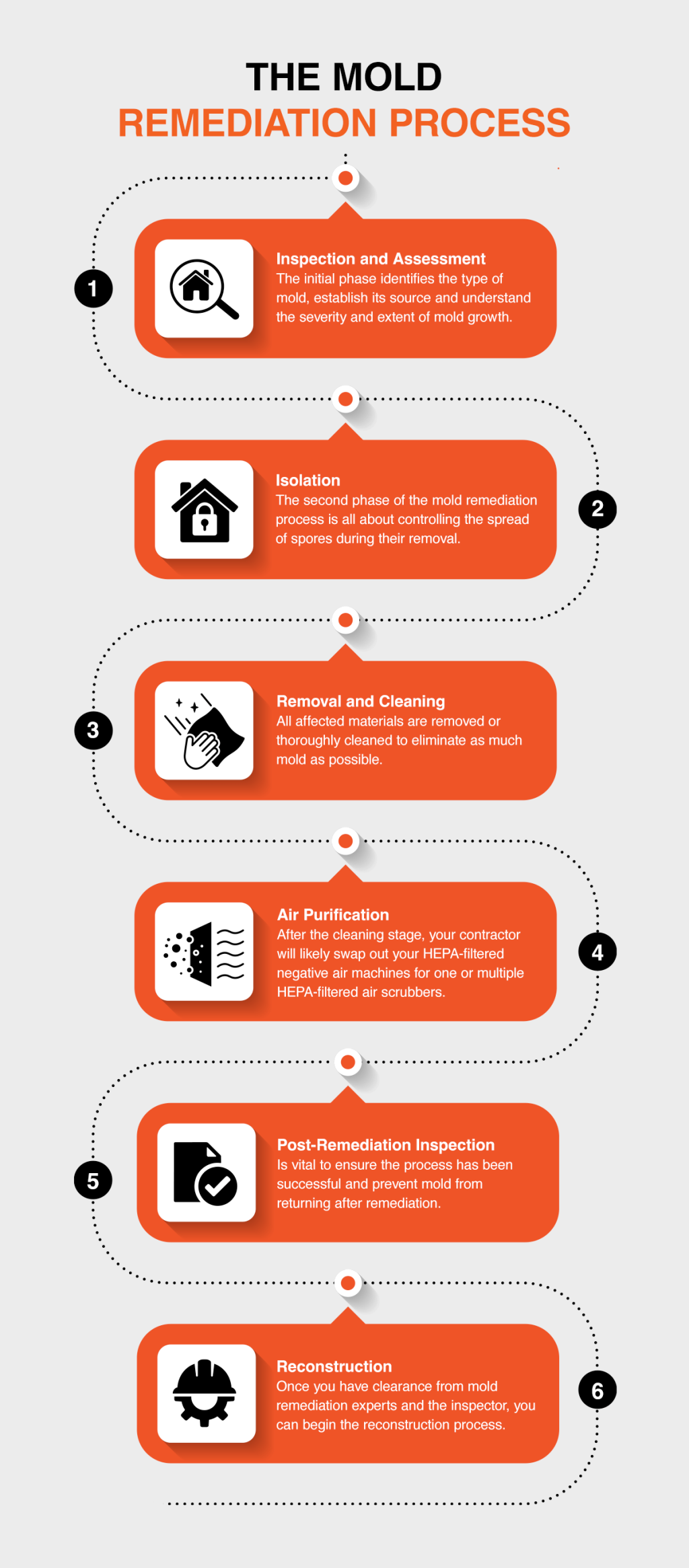
- Inspection, Thermal Imaging & Wood Moisture Mapping (WMC)
- Critical Isolation, HEPA Containment & Negative Pressure
- Source Elimination & Building Envelope Moisture Repairs
- Physical Abatement (Media Blasting / HEPA Mechanical Sanding)
- HEPA Micro-Vacuuming & EPA Antimicrobial Wash Application
- Structural Moisture Drawdown (Targeting WMC < 15%)
- Fungicidal Encapsulation & Surface Sealing
- Post-Remediation Verification (PRV) & Air Quality Clearance
Step 1: Inspection, Thermal Imaging, and Moisture Mapping
Before physical disturbance begins, certified environmental inspectors or remediation project managers perform a comprehensive diagnostic assessment:
- Wood Moisture Content (WMC) Mapping: Using pin-type and pinless moisture meters, technicians measure framing timber across multiple locations. Baseline framing moisture should range between 8% and 12%; readings above 19% indicate active mold risk, while readings exceeding 28% trigger structural decay concerns.
- Infrared Thermal Imaging: Thermographic cameras detect evaporative cooling patterns, exposing hidden plumbing leaks, roof flashing failures, or thermal bridging behind wall assemblies.
- Spore Trap & Surface Sampling: Baseline air samples (using cassette samplers like Air-O-Cell) and direct surface tape-lifts establish species composition (e.g., Aspergillus, Penicillium, Stachybotrys, Cladosporium) and quantitative spore concentrations.
Step 2: Critical Isolation and HEPA Air Management
To prevent microscopic spores from migrating into non-affected areas during mechanical cleaning, contractors build isolation barriers:
- Polyethylene Containment: Critical barriers constructed of 6-mil flame-retardant poly sheeting seal off doorways, HVAC supply/return registers, plumbing penetrations, and structural chases.
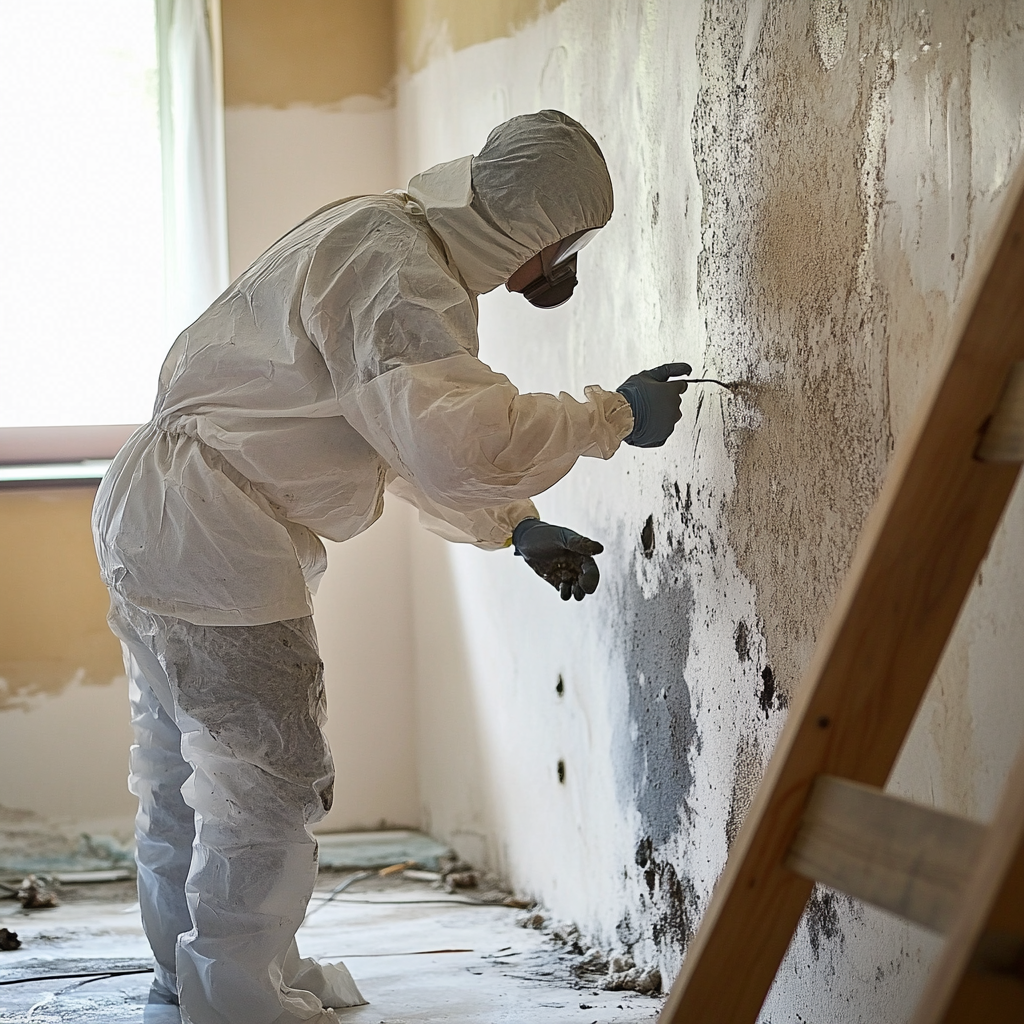
- Decontamination Chambers: Multi-stage airlock entries allow technicians to don Personal Protective Equipment (PPE)—including N-95 or P100 half-mask respirators, Tyvek suits, and nitrile gloves—without carrying spores outside the work area.
- Negative Pressure Differentiation: Industrial Air Scrubbers fitted with high-efficiency particulate air (HEPA) filtration (rated 99.97% efficiency at 0.3 microns) continuously exhaust filtered air outside the structure. This creates a continuous negative pressure gradient (-5 to -10 Pascals) that prevents fugitive spore emissions.
Step 3: Moisture Source Elimination
Mold cannot grow without available liquid water or extreme vapor pressure. Remediation cannot proceed to final restoration until the active water source is remediated. Common sources in whitewood framing include:
- Foundation groundwater intrusion through crawlspace soils or porous basement walls.
- Condensation on uninsulated cold water lines running along floor joists.
- Unvented bath exhausts venting directly into attic framing spaces.
- Exterior flashing failures around windows, doors, or roof valleys.
Step 4: Physical Abatement and Mechanical Extraction
Liquid surface sprays alone cannot eliminate fungal hyphae embedded inside whitewood sapwood. Physical removal of the top microscopic layer of wood fiber is mandatory under professional guidelines.
- Media Blasting (Dry Ice or Soda Blasting):
- Dry Ice Blasting: Micro-pellets of solid carbon dioxide ($CO_2$) are propelled at high velocity against moldy whitewood. Upon impact, the pellets sublimate instantly into gas, causing micro-thermal shocks that detach mold hyphae from structural lumber without producing secondary solid waste or introducing moisture.
- Soda Blasting: Sodium bicarbonate media is blasted against infected timber. Highly effective for intricate roof truss systems, though it leaves an alkaline dust residue that must be vacuumed.
- HEPA-Shrouded Mechanical Sanding and Wire Brushing:
- In tight framing cavities, crawlspaces, or localized sections, technicians use orbital sanders connected directly to HEPA vacuums or handheld wire brushes to physically strip growth down to bright, clean wood grain.
Step 5: HEPA Micro-Vacuuming and Antimicrobial Application
Following mechanical cleaning, all exposed timber surfaces, floor plates, subfloors, and containment walls undergo meticulous particulate cleanup:
- HEPA Vacuuming: Technicians vacuum every square inch of exposed whitewood using brush nozzles attached to true HEPA vacuums. This captures fine fungal fragments, hyphae dust, and disturbed spores.
- EPA-Registered Antimicrobial Treatment: Surfaces are wiped or low-pressure sprayed with a quaternary ammonium compound or botanical disinfectant (such as thymol formulations registered with the EPA). These agents neutralize lingering fungal cells and inhibit immediate spore re-settling.
Step 6: Structural Moisture Drawdown and Dehumidification
Cleaning wet timber is ineffective if wood fibers remain damp. The project transitions to structural drying to reduce the wood moisture content below the biological activity threshold.
- Low Grain Refrigerant (LGR) Dehumidifiers: LGR units pull absolute humidity in the containment zone down to low specific humidity levels (below 35 grains per pound), forcing moisture out from the core of thick framing studs.
- High-Velocity Air Movers: Directed along the length of joists and studs, air movers break boundary air layers and accelerate evaporative drying.
- Drying Target: Remediation standards require structural whitewood framing to reach a stable WMC of 15% or lower (ideally 10%–12%) prior to applying sealants or installing insulation and drywall.
Step 7: Encapsulation and Fungicidal Barrier Application
Once structural whitewood is verified dry, contractors apply a specialized coating to guard against future environmental fluctuations:
- Antimicrobial Fungicidal Encapsulants: These elastomeric or acrylic coatings contain embedded zinc, copper, or synthetic biocides. They form a breathable, semi-permeable seal that allows residual internal moisture to escape while blocking liquid water, surface humidity, and airborne spores from penetrating the wood matrix.
- Tinted vs. Clear Formulations: Encapsulants are applied in white, clear, or off-white finishes, providing a clear visual record of treated framing during future property inspections.
Step 8: Post-Remediation Verification (PRV)
Before containment structures are dismantled, an independent third-party Industrial Hygienist or certified Council-certified Indoor Environmental Consultant (CIEC) conducts unbiased clearance testing:
- Visual Inspection: Ensuring complete absence of visible dust, debris, microbial staining, or dampness.
- Odor Evaluation: Confirming the complete eradication of volatile organic compounds (MVOCs) responsible for musty odors.
- Air & Surface Clearance Sampling: Collecting comparative air samples inside the containment zone and outdoors. The containment area passes PRV when total spore counts inside are comparable to or lower than outdoor background control samples, and target amplifier species (such as Stachybotrys chartarum) are absent.
Remediation Methods for Whitewood Lumber
Selecting the appropriate abatement technique depends on accessibility, framing volume, budget, and structural constraints:
| Method | Mechanical Action | Substrate Impact | Secondary Waste | Primary Application | Relative Cost Range |
|---|---|---|---|---|---|
| Dry Ice Blasting | $CO_2$ pellet impact & thermal shock sublimation | Non-abrasive; preserves wood dimensions | None (pellets sublimate into gas) | Complex attic trusses, extensive crawlspaces | High |
| Soda Blasting | Sodium bicarbonate media impact | Soft abrasive; light wood surface profiling | Media dust (requires HEPA cleanup) | Heavy structural joist framing | Moderate to High |
| HEPA Manual Sanding | Abrasive sandpaper friction | Moderate surface removal down to clean grain | Wood dust contained by vacuum shroud | Localized stud bays, framing repairs | Moderate |
| Manual Wire Brushing | Metal bristle shearing | High surface scratching | Physical debris and scraped fibers | Confined corners, structural gussets | Low to Moderate |
| Chemical Surfactant Wash | Chemical oxidation and surfactant lifting | None; surface chemical exposure | Liquid runoff and wet residue | Non-porous surfaces; superficial light film | Low |
Financial Considerations and Project Cost Drivers
The cost of remediating mold in whitewood structural framing varies based on accessibility, contamination severity, and environmental controls. Typical factors influencing final project costs include:
- Framing Accessibility: Open basements or accessible attic spaces require less labor setup than low-clearance crawlspaces (under 24 inches) or sealed wall cavities requiring drywall removal.
- Square Footage & Surface Complexity: Open subfloors are faster to process than intricate engineered web trusses, which require significantly higher blast time or detailed hand scrubbing.
- Structural Repair vs. Abatement: If moisture exposure persisted long enough to cause structural fungal rot (brown rot, white rot, or Poria incrassata), simple abatement is insufficient. Compromised structural studs or floor joists must be sistered with new dimensional lumber or replaced by a licensed framing contractor.
- Environmental Testing Fees: Independent third-party Post-Remediation Verification (PRV) testing involves protocol design, laboratory analysis, and official clearance documentation.
Common Mistakes in Whitewood Mold Remediation
Improper remediation practices often exacerbate contamination or lead to structural decay. Avoid these critical mistakes:
1. Using Chlorine Bleach on Porous Structural Whitewood
Applying household bleach (sodium hypochlorite) to structural framing is counterproductive. Chlorine bleach consists of a chemical ion dissolved in water. The chlorine ion has a high surface tension that prevents it from penetrating the porous cellular structure of softwood lumber; it remains strictly on the surface. Meanwhile, the water carrier penetrates deep into the whitewood sapwood, feeding embedded fungal hyphae with the moisture required for secondary regrowth.
2. Encapsulating Wet Framing Lumber
Applying paint, standard primers, or encapsulating sealants over whitewood with a Wood Moisture Content above 15% traps internal moisture. This creates an anaerobic micro-environment that encourages internal wood decay fungi, causing structural weakening behind the sealed surface layer.
3. Neglecting Air Pressure Control
Scraping or sanding moldy studs without sealed poly containment and negative-pressure air scrubbers disperses millions of microscopic spores throughout the building's central HVAC network and uninfected living spaces.
4. Ignoring the Moisture Root Cause
Cleaning mold without fixing the underlying water intrusion—such as high soil height, failing drainage, roof leaks, or excessive indoor humidity—ensures mold spores will recolonize the structural framing once environmental conditions return to elevated moisture levels.
Frequently Asked Questions
Can moldy whitewood framing studs be saved, or must they be replaced?
Most mold-contaminated whitewood studs and joists can be saved through physical abatement, HEPA cleaning, structural drying, and antimicrobial treatment. Framing lumber only requires structural replacement if fungal rot has compromised the integrity, density, or load-bearing capacity of the wood fibers.
How long does structural drying take during the remediation process?
Structural drying of whitewood framing typically takes between 48 and 96 hours. Duration depends on initial wood moisture content, ambient air temperature, relative humidity, air velocity, and the capacity of the commercial LGR dehumidification equipment deployed.
Why is an independent clearance test necessary after remediation?
Independent clearance testing ensures that the remediation contractor successfully eliminated active contamination and brought airborne spore levels down to safe baseline standards. Utilizing an un-affiliated third-party inspector eliminates conflict of interest and provides verifiable documentation for property disclosures and insurance claims.
What wood moisture content (WMC) is acceptable before sealing walls back up?
Structural whitewood framing must achieve a Wood Moisture Content below 15% (ideally between 10% and 12%) before applying encapsulants, installing cavity insulation, or hanging drywall. Enclosing framing above 15% WMC invites trapped moisture and secondary fungal growth.
How does dry ice blasting differ from traditional sanding on framing?
Dry ice blasting uses frozen carbon dioxide pellets that sublimate into gas on impact, leaving zero secondary solid media waste to clean up. Sanding creates heavy wood dust and is labor-intensive, though sanding is often preferred in confined spaces where high carbon dioxide gas accumulation poses safety hazards.
Recommended Next Steps
If mold growth is suspected or identified on whitewood framing, subfloors, or attic assemblies, take the following actions:
- Stop Water Intrusion Immediately: Repair roof leaks, plumbing drips, or groundwater seepage, and eliminate standing water.
- Assess Environmental Controls: Avoid running standard comfort heating or cooling systems if ductwork traverses the affected space, preventing spore distribution.
- Engage Certified Professionals: Contact an IICRC-certified Firm (AMRT - Applied Microbial Remediation Technician) or a licensed Indoor Environmental Professional (IEP) to perform a comprehensive diagnostic inspection and develop a written scope of work.
- Require Protocol Verification: Ensure the chosen contractor adheres to IICRC S520 guidelines, utilizes true HEPA air scrubbing under negative pressure, verifies wood moisture content below 15%, and provides independent post-remediation clearance testing upon completion.
Image Gallery