How to Meet the Requirements for a Stafford Loan in 2026
To meet the requirements for a Stafford Loan (officially known as a Federal Direct Loan) in 2026, you must be a U.S. citizen or eligible non-citizen, be enrolled at least half-time in an eligible degree or certificate program, and comp...
To meet the requirements for a Stafford Loan (officially known as a Federal Direct Loan) in 2026, you must be a U.S. citizen or eligible non-citizen, be enrolled at least half-time in an eligible degree or certificate program, and complete the Free Application for Federal Student Aid (FAFSA). Additionally, you must maintain Satisfactory Academic Progress (SAP) and not be in default on any existing federal student aid.
Contents
While the term "Stafford Loan" is still widely used by students, parents, and guidance counselors, the U.S. Department of Education officially refers to these as Federal Direct Subsidized Loans and Federal Direct Unsubsidized Loans. These remain the primary vehicle for federal student lending in 2026, providing a standardized framework for funding higher education. Meeting the requirements is not a one-time event; it is a process that begins with your citizenship status and extends through your academic performance each semester.
Core Eligibility: The Baseline Requirements
Before evaluating your financial need or academic standing, you must satisfy the fundamental legal and administrative prerequisites established by the Higher Education Act. These are non-negotiable criteria that apply to nearly all forms of federal financial aid.
Citizenship and Residency
To qualify, you must be a U.S. citizen or a U.S. national. However, "eligible non-citizens" can also meet the requirements. This category includes:
- U.S. permanent residents with a Permanent Resident Card (I-551).
- Individuals with a conditional permanent resident status.
- Those holding an Arrival-Departure Record (I-94) from U.S. Citizenship and Immigration Services (USCIS) showing "Refugee," "Asylum Granted," "Cuban-Haitian Entrant," "Parolee," or "T-Visa holder."
Valid Identification and Documentation
You must possess a valid Social Security Number (SSN), with limited exceptions for students from the Freely Associated States (the Republic of the Marshall Islands, the Federated States of Micronesia, and the Republic of Palau). By 2026, the integration of the Social Security Administration database with the Department of Education's systems allows for near-instant verification of this data during the application process.
Educational Prerequisites
Meeting the requirements also involves your previous educational history. You must demonstrate that you are qualified to obtain a college or career school education by having one of the following:
- A high school diploma (public or private).
- A recognized equivalent, such as a General Educational Development (GED) certificate.
- Completion of a high school education in a homeschool setting that meets state law requirements.
Financial Need vs. Non-Need Requirements
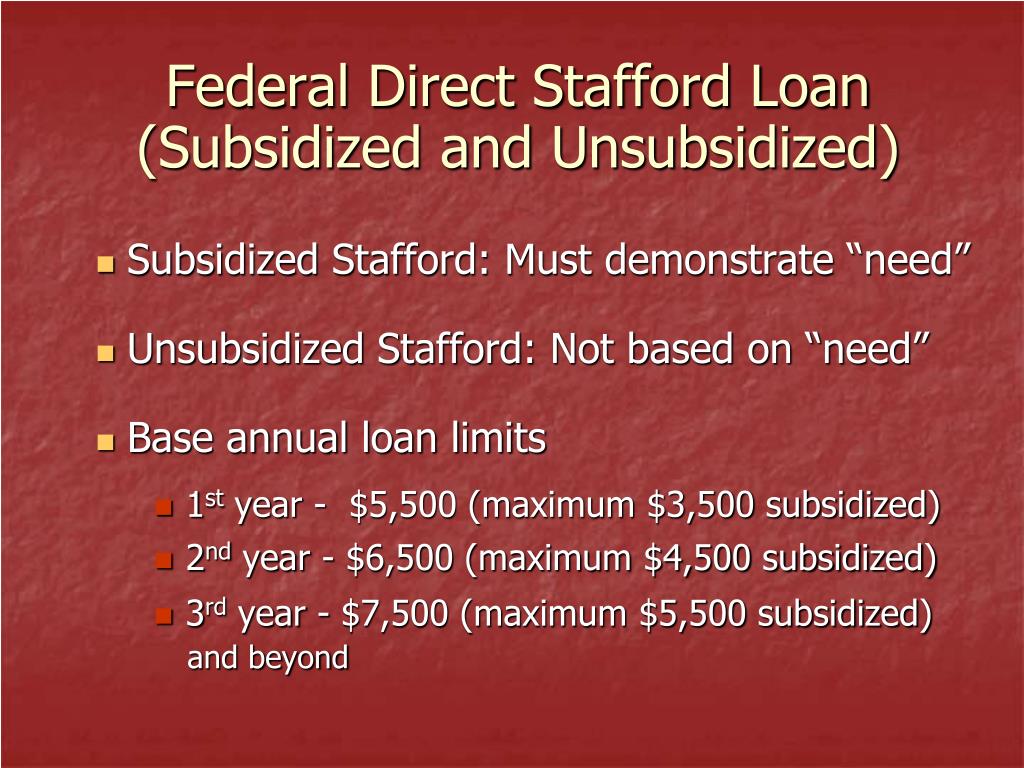
The requirements for a Stafford Loan diverge based on whether the loan is Subsidized or Unsubsidized. Understanding this distinction is critical because it dictates how much you can borrow and who pays the interest while you are in school.
Direct Subsidized Loan Requirements
Direct Subsidized Loans are reserved for undergraduate students who demonstrate financial need. In 2026, this need is determined by the Student Aid Index (SAI), which replaced the old Expected Family Contribution (EFC) formula.
- The Calculation: The school subtracts your SAI and other financial assistance (like scholarships) from the total Cost of Attendance (COA). If there is a remaining gap, you meet the financial requirement for a Subsidized Loan.
- The Benefit: The U.S. Department of Education pays the interest on these loans while you are in school at least half-time, during the first six months after you leave school (the grace period), and during periods of authorized deferment.
Direct Unsubsidized Loan Requirements
Direct Unsubsidized Loans are available to both undergraduate and graduate students, and there is no requirement to demonstrate financial need.
- The Eligibility: As long as you meet the general federal student aid requirements, you can qualify.
- The Responsibility: You are responsible for paying the interest during all periods. If you choose not to pay the interest while in school, it will capitalize (be added to the principal amount of your loan), increasing the total cost of the loan over time.
| Feature | Direct Subsidized Loan | Direct Unsubsidized Loan |
|---|---|---|
| Target Audience | Undergraduate students only | Undergraduate and Graduate students |
| Financial Need Requirement | Yes (Determined by SAI) | No |
| Interest Subsidy | Yes (Paid by Govt while in school) | No (Accrues immediately) |
| Credit Check Required | No | No |
| Application Method | FAFSA | FAFSA |
| Current Status (2026) | Active | Active |
The Application Process: Completing the FAFSA
The FAFSA is the single most important document for meeting Stafford Loan requirements. For the 2026-2027 academic year, the application window typically opens on October 1st (though this can vary based on administrative adjustments).
Creating an FSA ID
Before you can apply, you and—if you are a dependent student—at least one parent must create an FSA ID. This serves as your legal electronic signature. In 2026, the FSA ID is linked to verified email addresses and mobile phones to provide multi-factor authentication (MFA), ensuring the security of your financial data.
IRS Data Exchange
One of the most streamlined parts of meeting the requirements in 2026 is the direct exchange of data from the Internal Revenue Service (IRS). When you fill out the FAFSA, you must provide consent for the Department of Education to retrieve your federal tax information directly. This significantly reduces errors and simplifies the verification of your financial status.
Selecting Eligible Institutions
You must list at least one eligible school on your FAFSA. Not all vocational schools or international programs participate in the Federal Direct Loan program. You can verify a school's eligibility through the Federal School Code Search on the official Student Aid website.
Enrollment and Academic Standing Requirements
Once you have been approved for a loan based on your FAFSA, you must maintain certain academic standards to keep the funds and remain eligible for future disbursements.
The "Half-Time" Rule
To meet the requirements for a Stafford Loan disbursement, you must be enrolled at least half-time. The specific number of credit hours that constitute half-time is determined by your individual school. Generally, for undergraduates, this is 6 credit hours per semester. If you drop below half-time status, your six-month grace period begins, and you will eventually have to start repayment.
Satisfactory Academic Progress (SAP)
Meeting the requirements for a Stafford Loan is an ongoing commitment to your education. Every school has a Satisfactory Academic Progress (SAP) policy. To remain eligible, you typically must:
- Maintain a minimum cumulative GPA (usually a 2.0 or a "C" average).
- Complete a minimum percentage of the credits you attempt (the "Pace" requirement).
- Complete your degree within a maximum timeframe (usually 150% of the published length of the program).
If you fail to meet SAP, you may be placed on financial aid warning or probation. Continued failure to meet these standards will result in the loss of eligibility for Stafford Loans.
Legal and Administrative Obligations
The final stage of meeting the requirements involves the formalization of the loan through legal agreements.
Entrance Counseling
If you are a first-time borrower, you must complete Entrance Counseling. This is an online mandatory information session that explains your responsibilities as a borrower, the terms of the loan, and the consequences of default. It ensures you understand that a Stafford Loan is a legal obligation that must be repaid with interest.
The Master Promissory Note (MPN)
The MPN is a legal document in which you promise to repay your loan and any accrued interest and fees to the U.S. Department of Education. It also explains the terms and conditions of your loan. You cannot receive your loan funds until the MPN is signed and processed. In 2026, this is almost exclusively done electronically via the StudentAid.gov portal.
Common Obstacles and How to Resolve Them
Even if you meet the primary requirements, certain "flags" can interrupt your eligibility.
- Default Status: If you have previously defaulted on a federal student loan, you are ineligible for further Stafford Loans until you resolve the default. This can be done through loan rehabilitation or consolidation.
- Overborrowing: There are annual and aggregate limits on how much you can borrow. If you have reached your aggregate limit (e.g., $31,000 for a dependent undergraduate), you no longer meet the requirement for additional Stafford Loans.
- Incomplete Verification: Occasionally, the Department of Education selects a FAFSA for "verification." You will need to provide additional documentation (like W-2s or tax transcripts) to your school's financial aid office to prove your data is accurate.
Frequently Asked Questions
Can I get a Stafford Loan if I have bad credit? Yes. Unlike private student loans or Federal PLUS loans, Direct Subsidized and Unsubsidized (Stafford) Loans do not require a credit check. Your eligibility is based on financial need (for subsidized) and general federal requirements, not your credit score or history.
What is the maximum amount I can borrow in 2026? For the 2026-2027 academic year, undergraduate annual limits range from $5,500 to $12,500, depending on your year in school and your dependency status. Graduate students can borrow up to $20,500 annually in Unsubsidized Loans. Aggregate (lifetime) limits also apply.
Does my parent's income affect my eligibility for an Unsubsidized Loan? While you must report parental income on the FAFSA if you are a dependent student, it does not disqualify you from an Unsubsidized Loan. Parental income primarily affects your eligibility for Subsidized loans and grants by determining your Student Aid Index (SAI).
What happens to my loan requirements if I transfer schools? If you transfer, you must update your FAFSA with the new school's code. Your new school will evaluate your eligibility based on their Cost of Attendance and your remaining aggregate loan limits. You may also need to complete Entrance Counseling again if the new institution requires it.
Are Stafford Loans available for part-time students? Yes, as long as you are enrolled at least half-time. Students enrolled less than half-time are generally ineligible for federal student loans, though they may still qualify for certain grants like the Pell Grant depending on their SAI.
Practical Recommendation: Your first and most vital step is to create or update your FSA ID at StudentAid.gov. Once the 2026-2027 FAFSA becomes available, complete it as early as possible. Early submission ensures you meet both federal and state deadlines, maximizing your chances of receiving the full amount of subsidized funding you are entitled to before institutional funds are depleted.
Image Gallery