Choosing the Right Business Card Thickness: Technical & Buyer’s Guide
Choosing the right business card thickness depends on your brand identity, budget, and distribution strategy. Paper thickness is measured in points (PT), grams per square meter (GSM), or millimeters. While standard 16 PT cards provide...
Choosing the right business card thickness depends on your brand identity, budget, and distribution strategy. Paper thickness is measured in points (PT), grams per square meter (GSM), or millimeters. While standard 16 PT cards provide a durable, professional feel for everyday networking, thicker options like 24 PT or 32 PT create a premium tactile experience ideal for executive and luxury branding.
Contents
Understanding Business Card Measurement Units: PT, GSM, and Millimeters
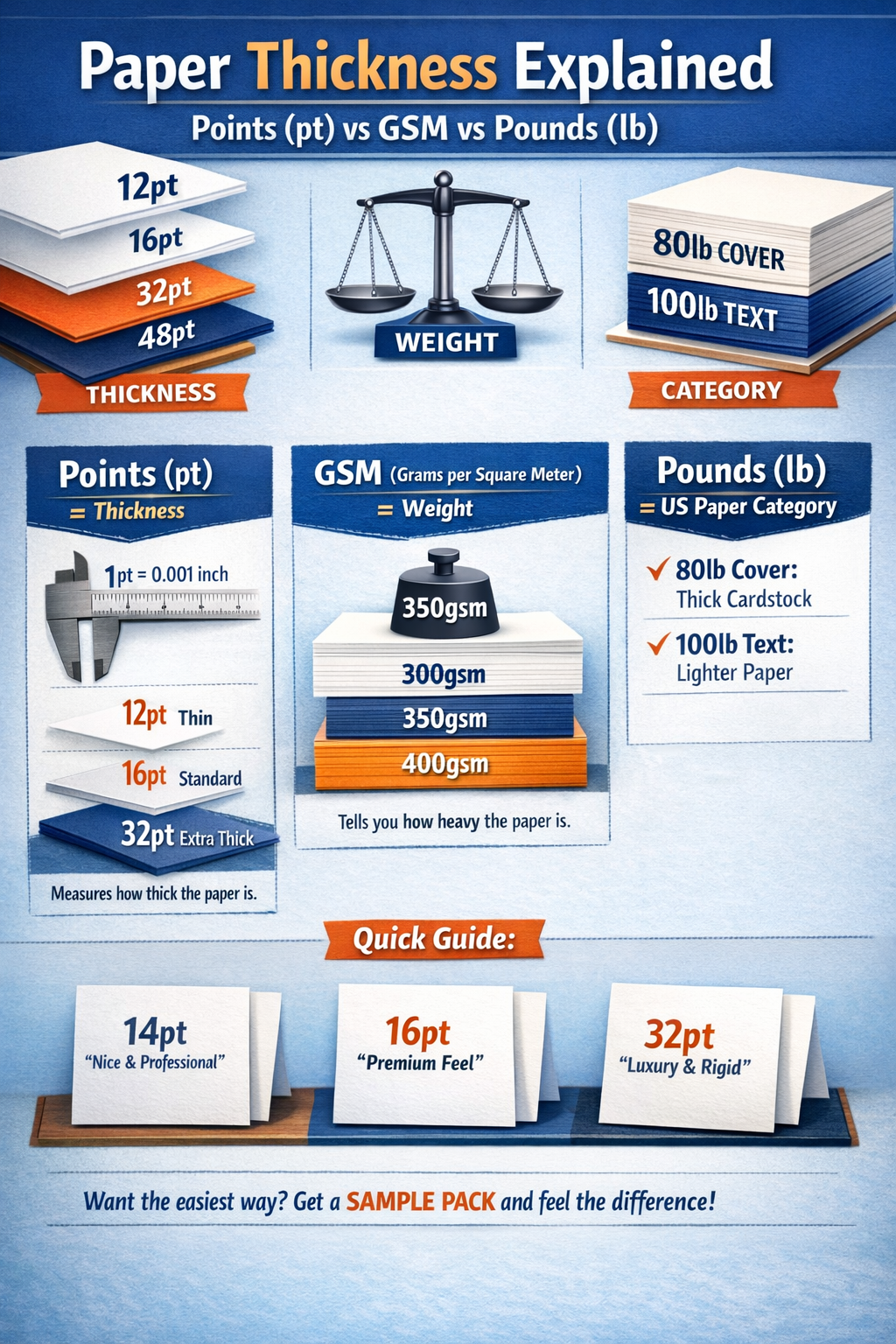
Selecting paper stock for commercial printing requires an understanding of how card thickness and weight are quantified. The printing industry relies on three primary measurement standards: points (PT), grams per square meter (GSM), and millimeters (mm) or microns ($\mu\text{m}$).
Points (PT) / Caliper
In North America, paper cardstock thickness is typically measured in points, where one point equals 0.001 inches (1/1000th of an inch). A card designated as 14 PT has a caliper thickness of 0.014 inches. The higher the point value, the thicker and more rigid the paper.
Grams per Square Meter (GSM)
Globally and within international printing standards, paper density is measured by weight in grams per square meter (GSM). Unlike PT, which measures literal physical thickness (caliper), GSM measures mass per unit area. While higher GSM generally correlates with a thicker card, two different paper stocks with the same GSM can have slightly different physical thicknesses depending on fiber density, compaction, and coatings applied during manufacturing.
Millimeters (mm) and Microns ($\mu\text{m}$)
Metric measurements represent direct physical caliper. One millimeter equals 1,000 microns. For context, a standard 16 PT business card measures approximately 0.406 mm (406 microns) in thickness.
| Unit of Measure | Abbreviation | Primary Region | What It Measures |
|---|---|---|---|
| Point | PT / pt | North America | Direct physical thickness (1 PT = 0.001 in) |
| Grams per Square Meter | GSM / $\text{g/m}^2$ | Europe & Global | Paper mass/density per unit area |
| Millimeter / Micron | mm / $\mu\text{m}$ | International / Metric | Absolute metric caliper thickness |
Standard vs. Premium vs. Ultra-Thick Cardstock Breakdown
Cardstock thickness dramatically alters how a recipient perceives your brand. Understanding the physical characteristics of each tier ensures your cards align with your professional goals.
Card Thickness Spectrum:
- 10-12 PT: Economy / Promo
- 14-16 PT: Industry Standard
- 18-24 PT: Premium Heavy
- 32-48 PT+: Luxury / Multi-Ply
10 PT to 12 PT (Economy / Promotional Grade)
- Approximate Metric: ~0.25 mm to 0.30 mm (~200 to 250 GSM)
- Characteristics: Lightweight, pliable, and prone to bending or creasing in wallets.
- Best Used For: High-volume promotional handouts, event inserts, tear-away loyalty coupons, or temporary contact cards.
- Pros & Cons: Extremely inexpensive to print and lightweight to ship, but lacks structural durability and feels cheap to the touch.
14 PT (Standard Budget / High-Volume Grade)
- Approximate Metric: ~0.356 mm (~300 GSM)
- Characteristics: Moderately firm paper stock that holds print colors well. It bends under light pressure but offers acceptable durability.
- Best Used For: Large trade shows, mass mailers, startup networking events, and budget-conscious bulk orders.
- Pros & Cons: Economical while maintaining a respectable appearance. However, it lacks the substantial tactile weight associated with established enterprise brands.
16 PT (Industry Standard / Corporate Baseline)
- Approximate Metric: ~0.406 mm (~350–400 GSM)
- Characteristics: The baseline standard for modern corporate business cards. It is sturdy, difficult to accidentally fold, and feels substantial in hand.
- Best Used For: Corporate employee cards, sales teams, consultants, and general commercial networking.
- Pros & Cons: Strikes an optimal balance between affordability, durability, wallet compatibility, and tactile quality. Compatible with almost all standard finishes (matte, gloss, soft-touch).
18 PT to 24 PT (Premium / Heavyweight Grade)
- Approximate Metric: ~0.457 mm to 0.610 mm (~400–600 GSM)
- Characteristics: Distinctly heavy and rigid. Cards in this range do not bend easily and immediately signal high quality upon exchange.
- Best Used For: Real estate agents, creative directors, legal advisors, financial planners, and boutique business owners.
- Pros & Cons: Highly durable and impactful. Cost per card is higher, and stacks of cards take up noticeably more physical space in cardholders.
32 PT to 48 PT+ (Ultra-Thick / Luxury Multi-Ply)
- Approximate Metric: ~0.813 mm to 1.22 mm+ (~700–1200+ GSM)
- Characteristics: Extremely thick, equivalent to the weight of a credit card or double/triple-layered paperboard. Often constructed by laminating two or three layers of paper together, sometimes featuring a colored core insert.
- Best Used For: C-level executives, luxury hospitality, high-end design agencies, and premium craft brands.
- Pros & Cons: Unmistakable luxury tactile feel; supports specialized finishing like deep debossing, foil stamping, and painted edges. However, these cards are expensive, heavy, and cannot fit into standard wallet multi-card slots easily.
Technical Comparison Matrix: Business Card Specifications
The table below outlines technical metrics, typical finish compatibility, and recommended use cases across common business card paper stocks.
| Thickness (PT) | Approx. GSM | Approx. mm | Rigidity Level | Ideal Finishing Options | Wallet & Holder Fit | Primary Use Case |
|---|---|---|---|---|---|---|
| 14 PT | ~300 GSM | 0.35 mm | Flexible | Gloss UV, Matte Coating | Fits 50+ in standard holder | Mass events, coupons, inserts |
| 16 PT | ~350 GSM | 0.40 mm | Moderate / Firm | Spot UV, Soft-Touch, Matte | Fits 30–40 in standard holder | General corporate, baseline sales |
| 18 PT | ~400 GSM | 0.45 mm | Very Firm | Foil Stamping, Matte, Soft-Touch | Fits 25–30 in standard holder | Agencies, professional services |
| 24 PT | ~550 GSM | 0.61 mm | Rigid | Debossing, Spot UV, Foil | Fits 15–20 in standard holder | Executives, real estate, design |
| 32 PT | ~750 GSM | 0.81 mm | Extra Rigid | Painted Edges, Deep Emboss, Foil | Fits 10–15 in standard holder | Luxury brands, C-Suite, creative directors |
| 48 PT | ~1100 GSM | 1.22 mm | Credit Card Grade | Colored Core, Triple-Layer, Edge Foil | Fits 5–8 in standard holder | Premium luxury, signature keepsakes |
Factors to Consider When Selecting Card Thickness
Choosing paper thickness requires balancing brand strategy, print techniques, distribution methods, and overall cost.
Selection Process:
- Brand Positioning
- Special Finishes
- Distribution Logistics
- Result: Target PT
1. Brand Identity and Industry Expectations
Your business card is often the first physical touchpoint a prospective client encounters.
- Corporate & Legal Services: Industries built on trust, financial stability, and authority (such as law firms, private wealth management, and commercial real estate) benefit from 16 PT to 24 PT stocks to communicate permanence and reliability.
- Tech & Digital Services: Fast-paced technology companies often use standard 16 PT cards with clean soft-touch coatings or recycled uncoated stock to emphasize modern minimalism.
- Luxury & High-End Retail: Premium architects, bespoke jewellers, and luxury hospitality venues frequently utilize 32 PT or thicker multi-ply cards to reflect high price points and exceptional attention to detail.
2. Print Finishing Techniques & Compatibility
The physical thickness of your paper directly limits or enables specific post-press finishing techniques:
- Embossing and Debossing: Pushing shapes into paper requires sufficient thickness so the impression does not puncture or distort the reverse side. A minimum of 18 PT to 24 PT is recommended for deep structural impressions.
- Foil Stamping: Heat-applied metallic foils perform reliably on stocks from 16 PT and above.
- Painted Edges / Colored Cores: Edge painting or multi-ply sandwich construction (where a contrasting paper layer is fused inside) requires at least 24 PT to 32 PT for the colored edge to be visually striking.
- Coatings (Soft-Touch, UV Gloss): Added laminates increase total caliper thickness. For example, a 16 PT card with heavy soft-touch lamination on both sides may measure closer to 18 PT in final caliper.
3. Practical Storage, Portability, and Scanning
While ultra-thick cards make a strong impression, they introduce logistical friction:
- Wallet Space: A recipient can easily store several 16 PT cards in a wallet pocket. A 32 PT or 48 PT card takes up the space of multiple credit cards, making recipients more likely to leave it on a desk rather than carrying it.
- Card Scanners: Many modern business card digital scanners and mobile OCR feed systems struggle to pull through cards thicker than 24 PT without jamming.
- Carrying Capacity: Representatives attending multi-day trade shows who carry hundreds of cards will find 16 PT cards significantly lighter and easier to transport than 24 PT or 32 PT inventory.
4. Cost and Logistics
Paper caliper directly influences production cost and freight shipping charges. Thicker cardstocks require heavier raw material, longer dry times for specialty inks, and custom die-cutting or laminating processes. When ordering in bulk (e.g., 10,000+ units across an enterprise sales force), the weight difference between 14 PT and 24 PT cardstock substantially increases shipping expenses.
Common Mistakes When Choosing Business Card Paper Stock
- Confusing Paper Weight (GSM) with Rigidity: A soft, uncalendered cotton paper of 400 GSM may feel softer and flex more easily than a highly compressed 350 GSM coated cover stock. Always request physical sample packs from printers rather than ordering based on numbers alone.
- Over-Designing Ultra-Thick Cards: Combining 32 PT cardstock with heavy foil, complex debossing, full-bleed gloss, and edge painting can result in an overly busy visual design. High-thickness stocks perform best with clean, understated typography and minimal layout clutter.
- Ignoring Coating Caliper: Ordering a budget 14 PT stock and adding cheap lamination to artificially increase stiffness can cause edge peeling over time. It is generally better to invest in a solid, unlaminated 16 PT or 18 PT base stock.
- Neglecting Distribution Use Cases: Providing field technicians or street-marketing teams with costly 32 PT cards wastes operational budget, whereas providing C-level executives with flimsy 12 PT cards undermines high-value negotiations.
Frequently Asked Questions
What is the standard thickness for a professional business card?
The standard thickness for a professional business card in North America is 16 PT (0.016 inches or approximately 0.40 mm / 350 GSM). It provides sufficient stiffness and durability for general corporate use without incurring custom printing premiums.
Is a thicker business card always better?
Not necessarily. While 24 PT to 32 PT cards convey high quality and luxury, they are heavier to transport in bulk, take up significant space in wallets, cost more to print, and may not pass through automated business card scanners. The ideal thickness depends on your industry, target audience, and distribution method.
How does paper finish affect overall business card thickness?
Applied coatings add measurable thickness to the base paper stock. High-gloss UV coatings, matte laminates, and soft-touch velvet films add between 1 to 2 PT to the final caliper of the card.
What thickness is required for edge painting or colored cores?
To make painted or foiled edges visually prominent, paper stock should be at least 24 PT, though 32 PT or 48 PT multi-ply stocks yield the best visual results. Thinner cards (like 14 PT or 16 PT) do not have enough edge surface area to showcase colored ink effectively.
Can standard office printers print on 16 PT or 24 PT cardstock?
Most standard desktop laser or inkjet printers cannot handle stock thicker than 10 PT to 12 PT (approx. 220–250 GSM) without jamming or smearing ink. Commercial offset or heavy-duty digital presses are required to cleanly print on 16 PT stock and above.
Next Steps for Ordering Your Business Cards
To ensure you achieve the optimal combination of cost, quality, and functionality:
- Request a Paper Sample Kit: Before committing to a bulk print run, request a physical sample pack from your print vendor to feel the difference between 14 PT, 16 PT, 18 PT, and 32 PT stocks firsthand.
- Align Thickness with Design Features: If your design features deep debossing or edge painting, select at least a 24 PT or 32 PT stock. For standard flat digital printing or spot UV highlights, stick with 16 PT.
- Segment by Role and Context: Consider ordering standard 16 PT cards for general event giveaways and trade shows, while reserving 24 PT or 32 PT cards for executive meetings and VIP client presentations.
Image Gallery