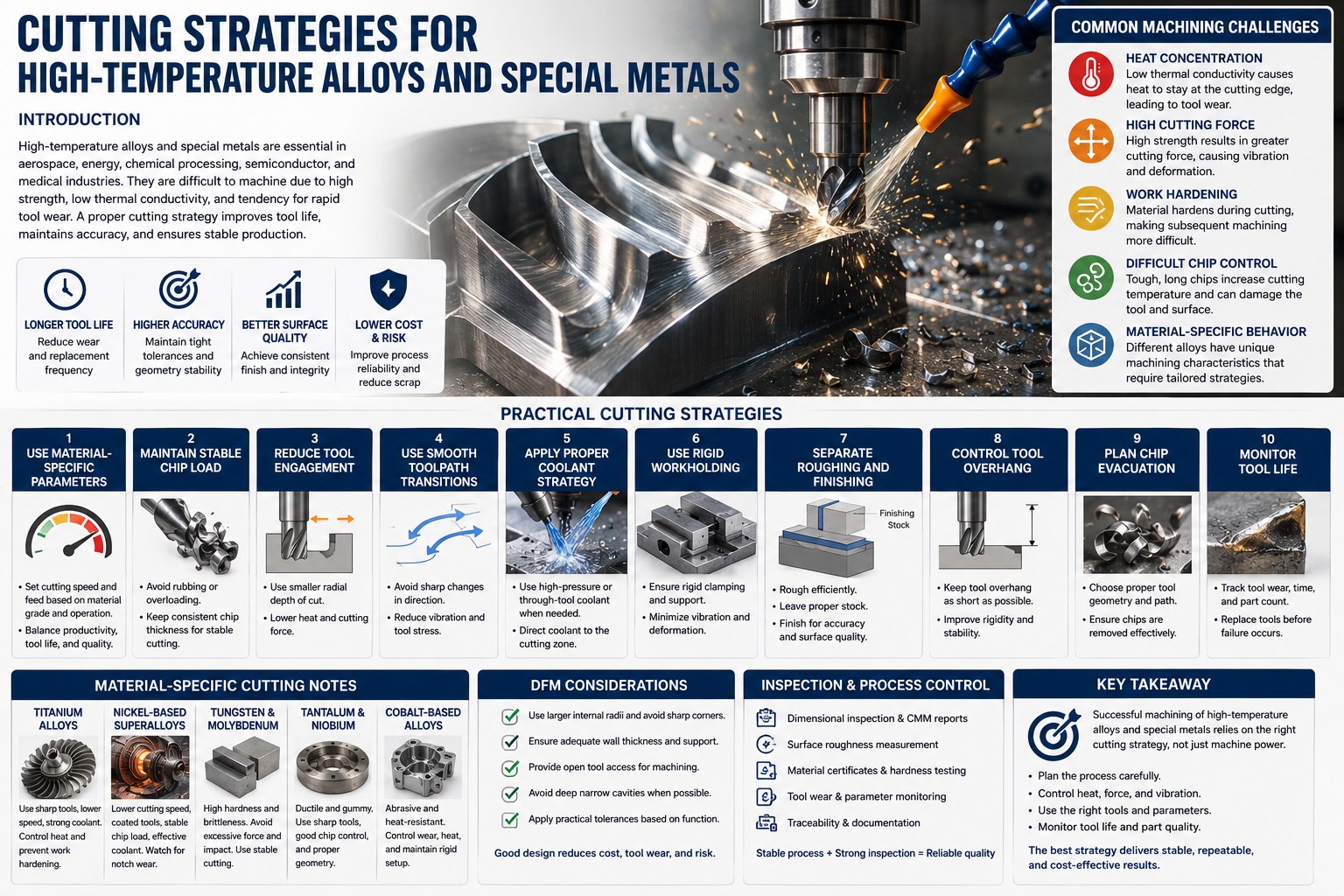
What the Latest Debate Means for High Temperature Alloys
The ongoing debate surrounding high-temperature alloys centers on whether industrial applications should continue pushing the thermodynamic boundaries of nickel- and cobalt-based superalloys or shift investments toward non-traditional...
The ongoing debate surrounding high-temperature alloys centers on whether industrial applications should continue pushing the thermodynamic boundaries of nickel- and cobalt-based superalloys or shift investments toward non-traditional material classes like Ceramic Matrix Composites (CMCs) and refractory high-entropy alloys (RHEAs). This divergence reshapes alloy design priorities, manufacturing workflows, supply chains, and testing frameworks across aerospace, power generation, and advanced defense sectors.
Contents
| High Temperature Alloy Debate at a Glance | Details |
|---|---|
| Core Material Dilemma | Incremental Nickel/Cobalt Superalloy Gains vs. Radical Shift to CMCs, RHEAs & ODS Alloys |
| Primary Technical Drivers | Extreme Creep Resistance, Thermal Efficiency, Oxidation/Corrosion, and Weight Reduction |
| Key Processing Bottlenecks | Additive Manufacturing Hot Cracking, HIPing, EBC Degradation, and Single-Crystal Casting |
| Geopolitical & Economic Factors | Scarcity of Rhenium/Tantalum/Cobalt vs. Scalability & Yield of Advanced Composites |
The Core Axes of the High-Temperature Alloy Debate
Material scientists and structural engineers are engaged in a fundamental re-evaluation of high-temperature metallic systems. For decades, performance improvements in gas turbines, jet engines, and high-heat industrial reactors relied on incremental chemistry modifications to nickel-based superalloys. By fine-tuning precipitation-strengthening $\gamma'$ (gamma-prime) phase fractions and adding refractory elements like rhenium (Re), ruthenium (Ru), and tantalum (Ta), single-crystal superalloys achieved operating temperatures close to their absolute melting points.
However, modern operational demands—driven by hydrogen-rich combustion, higher pressure ratios, and hypersonic flight regimes—have pushed conventional alloys to their absolute physical limits. The debate today revolves around four critical technology pathways:
Thermal Limits: Nickel-Based Superalloys vs. CMCs and Refractory Alloys
Conventional nickel-based single-crystal superalloys (such as CMSX-4 or René N5) operate effectively up to approximately 1,150°C to 1,200°C when protected by advanced thermal barrier coatings (TBCs) and active internal air cooling. Beyond these temperatures, the precipitation phases that grant these alloys their mechanical strength begin to dissolve, leading to rapid grain coarsening and severe creep deformation.
Proponents of transitioning to Silicon Carbide/Silicon Carbide (SiC/SiC) CMCs highlight operational temperature limits exceeding 1,300°C to 1,400°C with significantly lower material density—reducing engine weight by up to 50%. Conversely, alloy traditionalists emphasize that CMCs suffer from environmental degradation in high-moisture combustion atmospheres (recession due to silicic acid volatilization) and lack the strain tolerance, damage forgiveness, and repairability of ductal metals.
Simultaneously, refractory high-entropy alloys (RHEAs)—which combine multiple principal elements like niobium (Nb), molybdenum (Mo), tantalum (Ta), and tungsten (W)—are emerging as potential metallic alternatives capable of operating above 1,300°C. The debate focuses on overcoming the intrinsic brittleness at room temperature and poor oxidation resistance of RHEAs without sacrificing their exceptional high-temperature strength.
Additive Manufacturing Integrity vs. Monolithic Investment Casting
The rapid integration of additive manufacturing (AM), particularly Laser Powder Bed Fusion (L-PBF) and Electron Beam Powder Bed Fusion (E-PBF), has disrupted traditional alloy qualification methods. AM enables complex internal cooling channels within turbine blades and combustion liners that were previously impossible to produce via traditional investment casting.
However, high-performance superalloys designed for thermal strength (such as Inconel 738, René 80, or CM247LC) are notoriously susceptible to strain-age cracking and micro-hot cracking during rapid solidification in AM processes. Engineers are currently divided on strategy:
- Alloy Adaptation: Modify traditional alloy compositions by reducing cracking-sensitive elements (e.g., carbon, boron, silicon) at the expense of maximum high-temperature creep strength.
- Novel AM-Specific Alloys: Develop entirely new alloy formulations—such as oxide dispersion strengthened (ODS) alloys like NASA's GRX-810—that leverage stable yttria nanoparticles to arrest crack propagation and stabilize grain structures at extreme temperatures.
Critical Element Scarcity and Alloy Decarbonization
The geopolitical vulnerability of critical mineral supply chains has introduced an economic dimension to the debate. Single-crystal superalloys rely heavily on scarce, expensive refractory elements like rhenium (used in 2nd, 3rd, and 4th generation superalloys to suppress creep displacement) and cobalt.
Metallurgists are debating whether to pursue "lean" superalloys that optimize element utilization through computational thermodynamics (CALPHAD) or shift investment toward non-rhenium compositions, accepting slightly lower thermal thresholds in exchange for supply chain security and lower raw material costs.
Technical and Operational Impacts Across Key Industries
The outcomes of these engineering debates directly influence capital allocation, equipment maintenance cycles, and thermal efficiency targets across multiple sectors.
- Industry Operational Impacts
- Aerospace & Defense
- Higher Turbine Temp (TIT)
- Reduced Cooling Air Needs
- Hypersonic Heat Shields
- Lower Fuel Consumption
- Clean Power Generation
- Hydrogen Embrittlement
- Accelerated Water Vapor Oxidation
- Extended Service Life
- Aerospace & Defense
Aerospace and Propulsion
In commercial and military aviation, increasing Turbine Inlet Temperatures (TIT) directly correlates with improved fuel burn efficiency and reduced emissions. If the industry prioritizes CMCs over advanced superalloys for high-pressure turbine (HPT) vanes and blades, aircraft engines can reduce internal cooling air reliance, improving overall thermodynamic cycle efficiency.
However, defense applications operating in sand-ingestion or marine environments face severe environmental barrier coating (EBC) spallation risks, leading to unexpected degradation of composite components. Consequently, many military engine programs retain heavy reliance on advanced single-crystal nickel alloys paired with multi-layer ceramic coatings.
Clean Energy and Power Generation
The global transition toward hydrogen and ammonia combustion in power-generation gas turbines introduces severe environmental stress on high-temperature metals. Hydrogen combustion yields significantly higher flame temperatures and water vapor fractions compared to natural gas combustion.
High moisture environments accelerate oxidation rates and promote hydrogen embrittlement in conventional superalloys. The ongoing debate drives new material standards requiring enhanced chromia- and alumina-forming alloy chemistries capable of resisting steam oxidation, while maintaining mechanical integrity over 25,000+ continuous operating hours.
Comparative Analysis of Next-Generation High-Temperature Material Classes
The selection of next-generation materials requires trade-offs between operational thermal ceiling, mechanical ductility, environmental stability, and component cost.
| Material Class | Maximum Operating Temp (Uncooled) | Density ($\text{g/cm}^3$) | Key Advantage | Primary Operational Vulnerability | Manufacturing Maturity |
|---|---|---|---|---|---|
| 3rd/4th Gen Single-Crystal Superalloys (e.g., CMSX-4, René N5) | 1,100°C – 1,150°C | 8.6 – 9.0 | High fracture toughness; predictable creep behavior | Reaches intrinsic melting limit; heavy reliance on Re/Ta | High (Standard casting) |
| Oxide Dispersion Strengthened Alloys (e.g., GRX-810) | 1,100°C – 1,200°C | 8.0 – 8.5 | Exceptional thermal fatigue and oxidation resistance | Processing sensitive to AM parameter shifts | Emerging (AM-focused) |
| Silicon Carbide CMCs (SiC/SiC) | 1,300°C – 1,400°C | 2.1 – 3.2 | Low weight; retains strength at extreme temperatures | Brittle failure modes; water-vapor recession | Moderate (Specialized fabrication) |
| Refractory High-Entropy Alloys (RHEAs) | 1,350°C – 1,500°C+ | 7.5 – 12.0 | Outstanding elevated-temperature strength | Catastrophic low-temperature oxidation ("pest season") | Early Development |
| Gamma-Titanium Aluminides ($\gamma$-TiAl) | 700°C – 750°C | 3.9 – 4.2 | Low mass replacement for nickel alloys in low-pressure turbines | Low room-temperature ductility; difficult to machine | High (Targeted components) |
Key Engineering Considerations and Selection Frameworks
Navigating the choice between traditional, modified, and alternative high-temperature materials requires evaluating core performance metrics against lifecycle operating costs.
Creep Resistance and Microstructural Stability
Creep—the slow, permanent deformation of a material under constant mechanical stress at elevated temperatures—remains the primary failure mode for high-temperature components.
- In nickel superalloys, creep resistance depends on preserving coherent $\gamma/\gamma'$ interfaces. Prolonged exposure above design thresholds leads to rafting, where spherical $\gamma'$ precipitates coalesce into directional directional plates, accelerating deformation.
- For non-metallic alternatives like CMCs, creep occurs via fiber-matrix interfacial sliding and fiber degradation, requiring rigorous non-destructive evaluation (NDE) methods (such as acoustic emission monitoring and micro-computed tomography) to detect internal damage before catastrophic structural failure.
Environmental Degradation and Coating Dependencies
Modern high-temperature alloys do not operate in isolation; their performance is tied to protective surface coatings:
- Thermal Barrier Coatings (TBCs): Typically Yttria-Stabilized Zirconia (YSZ) applied via Electron Beam Physical Vapor Deposition (EB-PVD) or Air Plasma Spray (APS) to lower base metal temperatures by 100°C to 150°C.
- Environmental Barrier Coatings (EBCs): Required for SiC/SiC CMCs to prevent reaction with combustion moisture. Rare-earth disilicate coatings are standard, but thermal expansion mismatches between coating layers can lead to interfacial delamination under thermal cycling.
- CALCE/CMAS Vulnerability: Calcium-Magnesium-Alumino-Silicate (CMAS) sand and environmental dust melt at high operating temperatures, penetrating porous TBC/EBC coatings and causing premature coating spallation.
Coating Degradation Mechanism:
- Airborne Dust / Volcanic Ash / Sand Ingestion
- Melting at High Operating Temperatures (>1,200°C)
- Liquid CMAS Penetrates Porous TBC / EBC Microstructure
- Thermochemical Reaction & Phase Transformation Upon Cooling
- Delamination & Spallation of Protective Coating Layer
- Base Metal / Composite Exposed Directly to High-Heat Gas Stream
Processability and Post-Processing Economics
Adopting novel high-temperature alloys requires accounting for downstream post-processing costs. Additive manufacturing of high-temperature superalloys requires expensive post-processing steps:
- Hot Isostatic Pressing (HIP): Subjecting 3D-printed components to simultaneous high pressure (100–200 MPa) and elevated temperature (1,150°C–1,250°C) to close internal micro-porosity and un-voided regions.
- Complex Multi-Stage Heat Treatments: Required to recrystallize grain structures or re-precipitate critical reinforcing phases ($\gamma'$ or oxide dispersions).
The post-processing equipment, argon gas consumption, and extended heat-treatment cycles can account for up to 40% of the finished component cost, fundamentally altering the ROI when choosing AM-printed alloys over conventional casting.
Common Pitfalls and Risk Mitigation Strategies in Alloy Transition
Engineering teams transitioning to next-generation high-temperature alloys often encounter predictable failure points during qualification:
1. Over-relying on Short-Term Stress-Rupture Data
- The Risk: Extrapolating short-term elevated temperature performance to predict multi-thousand-hour service life. Many high-entropy alloys demonstrate high short-term yield strength but suffer from long-term phase instability or rapid embrittlement.
- Mitigation: Perform long-term creep-rupture testing alongside CALPHAD modeling to verify phase stability (avoiding detrimental Topological Close-Packed phases like $\sigma$ or $\mu$ phases) across the expected service lifespan.
2. Ignoring Anisotropy in Additively Manufactured Alloys
- The Risk: Assuming isotropic mechanical properties in 3D-printed superalloys. Columnar grain growth along the build direction ($Z$-axis) creates directional variations in yield strength, fatigue life, and creep performance.
- Mitigation: Establish strict build orientation controls, tailor laser scanning vectors, and validate post-print solution annealing and aging treatments to achieve tailored microstructures (either uniform equiaxed or deliberately columnar/single-crystal-like).
3. Underestimating Thermal Expansion Mismatch
- The Risk: Joining CMCs or refractory metals to traditional superalloy structural frames without accounting for differences in Coefficient of Thermal Expansion (CTE). High thermal stress during startup and shutdown cycles causes joint failure or fastener shearing.
- Mitigation: Design compliant metallic interlayers, transition joints, or graded ceramic-metal interfaces that absorb strain caused by differential thermal expansion.
Frequently Asked Questions
Why can't nickel-based superalloys simply be melted and re-alloyed for higher temperatures?
Nickel-based superalloys are bounded by the absolute melting point of nickel (1,455°C). As operating temperatures approach 85% to 90% of the alloy's absolute melting temperature in Kelvin, the strengthening phase ($\gamma'$) dissolves into the matrix. This leads to loss of mechanical strength and rapid creep deformation, regardless of minor chemical additions.
What is the role of Oxide Dispersion Strengthened (ODS) alloys in this debate?
ODS alloys introduce fine, thermally stable oxide particles (such as yttria, $\text{Y}_2\text{O}_3$) throughout the metallic matrix. Because these oxides do not dissolve at temperatures near the alloy's melting point, they lock dislocation movement and prevent grain growth, allowing metallic components to maintain strength at higher temperatures than conventional precipitation-hardened alloys.
How does hydrogen fuel impact high-temperature alloy selection?
Hydrogen combustion generates higher flame temperatures and significantly increased water vapor levels compared to hydrocarbon fuels. High water vapor accelerates oxidation, promotes chrome depletion, and increases moisture-driven degradation of protective oxide scales (like alumina and chromia). This requires alloys with higher aluminum/chromium balance or specialized protective coatings.
Are Ceramic Matrix Composites (CMCs) ready to fully replace superalloys?
No. While SiC/SiC CMCs are increasingly used in static, high-heat turbine components like shrouds and combustor liners, their low fracture toughness, susceptibility to environmental water-vapor attack, high production costs, and complex quality assurance testing limit their complete replacement of rotating components like high-pressure turbine blades.
How does Hot Isostatic Pressing (HIP) affect 3D-printed superalloys?
HIP subjects additively manufactured components to simultaneous high inert gas pressure (typically 100 to 200 MPa) and high temperatures. This process closes internal micro-voids, lack-of-fusion defects, and micro-cracks generated during laser powder bed fusion, restoring fatigue performance and structural integrity comparable to wrought or cast materials.
Strategic Recommendations for Engineering Leaders
To navigate shifting material standards in high-temperature applications, engineering and procurement teams should follow a structured evaluation framework:
- Alloy Adoption Decision Tree
- Is the continuous exposure temperature > 1,200°C?
- YES: Consider CMCs (for static parts) or RHEAs / EBC Coatings.
- NO: Evaluate Advanced Single-Crystal Superalloys or ODS AM Alloys.
- Is component geometry impossible to machine / cast traditionally?
- YES: Select AM-optimized alloys (e.g., GRX-810, Haynes 282) + HIP.
- NO: Utilize established investment casting (e.g., CMSX-4, Inconel 718).
- Is the operating environment rich in moisture / H2 combustion?
- YES: Mandate advanced EBCs / Alumina-forming alloy chemistries.
- NO: Standard YSZ TBC and conventional oxidation protection apply.
- Is the continuous exposure temperature > 1,200°C?
- Map Operational Limits Early: Determine whether component lifecycles are constrained by thermal degradation, oxidation, mechanical fatigue, or supply chain lead times. Avoid over-specifying refractory-dense alloys if operational temperatures remain below 1,000°C.
- Audit Total Cost of Ownership (TCO): Include post-processing steps (HIP, chemical etching, multi-stage heat treatments, EBC coating application) and defect reject rates when comparing additively manufactured or CMC components against investment-cast superalloys.
- Diversify Material Validation Pipelines: For high-heat, high-reliability systems, run parallel qualification streams: one focused on incremental improvements to nickel superalloys (low risk, known failure modes) and one dedicated to advanced non-metallic or ODS solutions (high performance ceiling, complex integration requirements).
Image Gallery