Brad Pitt’s Academy Award Legacy: Every Oscar Win and Nomination Explained
Brad Pitt has won two Academy Awards during his prolific career. His first Oscar was for Best Picture as a producer of 12 Years a Slave (2014), and his second was for Best Supporting Actor for his role as Cliff Booth in Once Upon a Tim...
Brad Pitt has won two Academy Awards during his prolific career. His first Oscar was for Best Picture as a producer of 12 Years a Slave (2014), and his second was for Best Supporting Actor for his role as Cliff Booth in Once Upon a Time in Hollywood (2020).
Contents
As of 2026, Brad Pitt remains one of the most influential figures in Hollywood, not only as a leading man but as a powerhouse producer. While the general public often recognizes him for his physical transformations and charismatic performances, his Academy Award history reveals a complex trajectory of a performer who transitioned from a "pretty boy" archetype to a respected character actor and a discerning filmmaker. To understand how Brad Pitt did win an Oscar—and why it took decades for him to win for acting—it is necessary to examine his specific wins, his near-misses, and the strategic shift he made through his production company, Plan B Entertainment.
The First Win: "12 Years a Slave" and Best Picture (2014)
Brad Pitt’s first Academy Award did not come for his acting, but for his role as a producer. In 2014, at the 86th Academy Awards, the historical drama 12 Years a Slave won the Oscar for Best Picture. Pitt, who founded Plan B Entertainment, was one of the primary producers credited on the film along with Dede Gardner, Jeremy Kleiner, Steve McQueen, and Anthony Katagas.
The Role of Plan B Entertainment
Plan B was instrumental in bringing Steve McQueen’s adaptation of Solomon Northup’s memoir to the screen. The film was a grueling, unflinching look at American slavery, a subject matter that many major studios found difficult to market. Pitt’s involvement provided the necessary "star power" and financial security to ensure the project’s completion.
Although Pitt had a small on-screen role in the film as Samuel Bass, a Canadian laborer who opposes slavery, his most significant contribution was behind the scenes. This win cemented his status as a "tastemaker" in the industry, proving that his eye for scripts and directorial talent was among the best in the business.
The Acting Milestone: "Once Upon a Time in Hollywood" (2020)
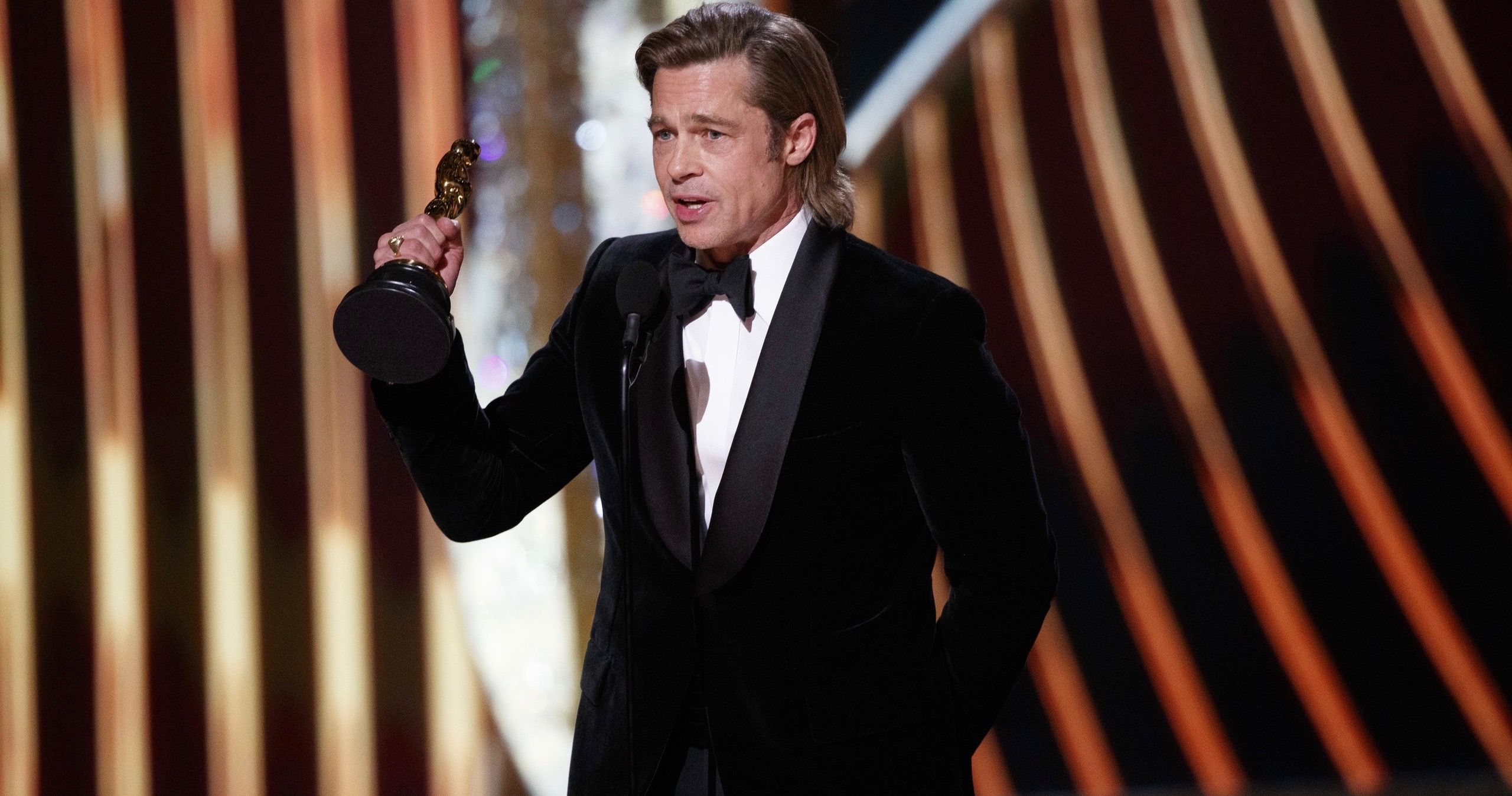
After decades of nominations and being a perennial favorite, Brad Pitt finally won an acting Oscar at the 92nd Academy Awards in 2020. He was awarded Best Supporting Actor for his portrayal of Cliff Booth, the cool-headed, aging stuntman to Leonardo DiCaprio’s Rick Dalton, in Quentin Tarantino's Once Upon a Time in Hollywood.
Why Cliff Booth Won
The character of Cliff Booth resonated with the Academy for several reasons:
- The Narrative: Pitt played a character that reflected the "Old Hollywood" era, a theme the Academy traditionally loves.
- The Performance: It was a masterclass in understated charisma. Pitt managed to be both menacing and immensely likable, often stealing scenes with minimal dialogue.
- The "Due" Factor: By 2020, there was a collective sense within the industry that Pitt was "due" for an acting win, having delivered consistently high-quality work since the early 1990s.
His acceptance speech was noted for its humor and political brevity, marking a high point in his public-facing career. The win effectively ended the narrative that Pitt was an actor who the Academy respected but refused to reward with a statuette.
A Chronological History of Brad Pitt’s Oscar Nominations
To understand the scope of his career as of 2026, we must look at the nominations that preceded and followed his wins. Pitt has been nominated across three different decades, showcasing remarkable longevity.
Early Acting Recognition
- Twelve Monkeys (1995) – Best Supporting Actor: This was Pitt’s first nomination. He played Jeffrey Goines, a manic mental patient. This role was a deliberate attempt to break away from his "heartthrob" image from Legends of the Fall, proving he could handle eccentric, character-driven work. He lost to Kevin Spacey (The Usual Suspects).
- The Curious Case of Benjamin Button (2008) – Best Actor: His first Lead Actor nomination. The film required Pitt to act through heavy prosthetics and CGI as a man who ages backward. While he lost to Sean Penn (Milk), the nomination confirmed his status as a leading man capable of carrying a massive, high-concept epic.
The Producing and Acting "Double Threats"
- Moneyball (2011) – Best Actor & Best Picture: Pitt received two nominations this year. As the star (Billy Beane) and a producer, he was the driving force behind the film. Although it was a critical darling, he lost Best Actor to Jean Dujardin (The Artist).
- The Big Short (2015) – Best Picture: As a producer, Pitt earned another nomination when this film about the 2008 financial crisis became a surprise Oscar heavyweight.
| Year | Film | Category | Result |
|---|---|---|---|
| 1996 | Twelve Monkeys | Best Supporting Actor | Nominated |
| 2009 | The Curious Case of Benjamin Button | Best Actor | Nominated |
| 2012 | Moneyball | Best Actor | Nominated |
| 2012 | Moneyball | Best Picture (Producer) | Nominated |
| 2014 | 12 Years a Slave | Best Picture (Producer) | Won |
| 2016 | The Big Short | Best Picture (Producer) | Nominated |
| 2020 | Once Upon a Time in Hollywood | Best Supporting Actor | Won |
| 2023 | Women Talking | Best Picture (Producer) | Nominated |
Analyzing the "Acting" Win Gap: Why Did it Take So Long?
A common question among film enthusiasts is why an actor of Brad Pitt’s caliber took until 2020 to win for acting. Several factors contributed to this "Oscar drought."
The "Pretty Boy" Stigma
Early in his career, Pitt was often categorized by his physical appearance. The Academy has historically been hesitant to reward actors who are perceived primarily as "movie stars" rather than "thespians" until they have "proven" themselves through aging or grittier roles. Pitt countered this by taking unconventional roles in films like Fight Club and Snatch, but these were often too counter-cultural for the Academy voters of the time.
Competitive Fields
In the years Pitt was nominated, he often faced legendary performances. In 1996, Kevin Spacey’s Verbal Kint was an undeniable force. In 2009, Sean Penn’s portrayal of Harvey Milk was a transformative political biopic performance that aligned perfectly with the Academy’s preferences. Pitt’s wins were not delayed by a lack of talent, but by the strength of the competition in his respective years.
Shift to Producing
By the mid-2000s, Pitt began focusing heavily on his production company. This shift allowed him to win his first Oscar for 12 Years a Slave as a producer. Some analysts believe that his success as a producer actually helped his acting career by showing the Academy he was a serious "student of cinema" rather than just a face on a poster.
The Significance of Plan B Entertainment in 2026
As of 2026, Plan B Entertainment remains a powerhouse in the independent and prestige film space. Brad Pitt's strategy as a producer has been to find "difficult" material—often literary adaptations or socially conscious stories—and use his leverage to get them made.
This approach has resulted in a high "Oscar-to-film" ratio for the company. By producing films like Moonlight (which won Best Picture, though Pitt was not a personally named producer for that specific win under Academy rules for the limit on producer names), The Big Short, and Minari, Pitt has influenced the Academy Awards landscape far more than most of his acting peers.
Frequently Asked Questions
Did Brad Pitt win an Oscar for "Fight Club" or "Seven"?
No. Despite being two of his most iconic and culturally significant films, Brad Pitt did not receive Oscar nominations for either Fight Club or Seven. Seven was largely ignored by the Academy except for a Film Editing nomination, and Fight Club received only one nomination for Sound Effects Editing.
How many Oscars does Brad Pitt have in total?
As of 2026, Brad Pitt has two Academy Awards. One is for Best Picture (12 Years a Slave) and one is for Best Supporting Actor (Once Upon a Time in Hollywood).
Is Brad Pitt a producer on all his movies?
No, he does not produce every project he stars in. However, for a significant portion of his prestige work since 2006 (starting with The Departed), he has served as a producer through Plan B Entertainment. He often produces films in which he does not appear at all, such as Selma or Women Talking.
Has Brad Pitt ever won a Best Actor (Lead) Oscar?
No. While he has been nominated for Best Actor twice—once for The Curious Case of Benjamin Button and once for Moneyball—he has not yet won in the Lead Actor category. His only acting win remains in the Supporting Actor category.
Why was he not credited for the "Moonlight" Best Picture win?
While Plan B Entertainment produced Moonlight, the Academy of Motion Picture Arts and Sciences (AMPAS) has strict rules on how many and which specific producers receive the statuette. For Moonlight, the credited producers were Adele Romanski, Dede Gardner, and Jeremy Kleiner. Brad Pitt served as an Executive Producer, a role that does not receive an Oscar statuette.
Final Verdict and Summary
Brad Pitt’s journey to the Oscar podium was a marathon, not a sprint. He successfully navigated the transition from a 1990s icon to a 2020s elder statesman of cinema. By diversifying his career into production, he ensured his legacy would be defined by both his individual performances and his contribution to the medium of film as a whole. For those asking "did brad pitt win an oscar," the answer is a definitive yes—twice—representing both his talent in front of the camera and his vision behind it.
Image Gallery