How a VA Loan Works After Chapter 13 Bankruptcy: Rules, Timelines, and Requirements
Eligible veterans and service members can qualify for a VA loan during or after Chapter 13 bankruptcy. If the Chapter 13 plan is active, borrowers must complete at least 12 months of on-time repayment and obtain Bankruptcy Trustee appr...
Eligible veterans and service members can qualify for a VA loan during or after Chapter 13 bankruptcy. If the Chapter 13 plan is active, borrowers must complete at least 12 months of on-time repayment and obtain Bankruptcy Trustee approval. Once discharged, the Department of Veterans Affairs permits immediate home purchase eligibility, though individual lenders may apply custom credit score requirements.
Contents
Chapter 13 Bankruptcy and VA Loan Eligibility Explained
Chapter 13 bankruptcy—often referred to as a wage earner's plan—allows individuals with regular income to develop a structured repayment plan to pay all or part of their debts over a three- to five-year period. Unlike Chapter 7 bankruptcy, which liquidates non-exempt assets to discharge qualifying debt, Chapter 13 reorganizes financial obligations under court supervision.
Because a Chapter 13 reorganization demonstrates an ongoing commitment to satisfying debts, the U.S. Department of Veterans Affairs (VA) maintains far more flexible home financing guidelines for Chapter 13 than for Chapter 7. VA loan guaranty rules allow military personnel, veterans, and surviving spouses to purchase or refinance a home while still under an active Chapter 13 plan, or immediately following court discharge, provided specific underwriting standards are satisfied.
However, navigating a mortgage application in conjunction with federal bankruptcy proceedings involves adhering strictly to federal rules, judicial approval protocols, and lender-specific guidelines known as lender overlays.
Disclaimer: Mortgage rules and bankruptcy proceedings involve complex legal and financial regulations. This guide provides instructional overview information and does not constitute formal legal or financial advice. Consult a qualified bankruptcy attorney and a licensed VA mortgage specialist regarding your specific financial situation.
Timelines: Buying During vs. After Chapter 13
The rules for securing a VA loan depend heavily on whether your Chapter 13 bankruptcy is still active or has been formally discharged by the bankruptcy court.
- Chapter 13 Filing
- Active Plan (Months 1–12): Ineligible for VA Home Loan
- Active Plan (Month 12+) (12 Months of On-Time Plan Payments Completed): Eligible with Trustee/Court Consent & Manual Underwriting
- Formal Court Discharge (Completion of Repayment Plan): Immediately Eligible under VA Guidelines (Lenders may apply overlays)
Qualifying During Active Chapter 13 (The 12-Month Rule)
You do not have to wait until your Chapter 13 plan is completely finished to purchase a home or refinance an existing mortgage with a VA loan. According to the VA Lenders Handbook (VA Pamphlet 26-7), a borrower currently making payments under an active Chapter 13 plan can qualify if they satisfy two core rules:
- 12 Consecutive Months of On-Time Plan Payments: You must have completed at least 12 months of scheduled payments under the Chapter 13 repayment plan. Every payment during this period must have been made strictly on time according to the terms set by the court trustee.
- Written Permission from the Bankruptcy Trustee or Court: You must obtain formal written approval (often a Trustee Consent Letter or court order) authorizing you to incur new mortgage debt. The court evaluates whether the proposed housing expense will jeopardize your ability to complete your Chapter 13 plan.
Applications processed while under an active Chapter 13 plan automatically require manual underwriting, as automated underwriting systems (AUS) generally issue a "Refer" status when active court supervision is present.
Qualifying After Chapter 13 Discharge
Once your Chapter 13 plan is successfully completed and the court issues a formal Order of Discharge, VA guidelines specify that there is no mandatory waiting period (0-day waiting period) before you can apply for a VA loan.
In contrast to Chapter 7 bankruptcy—which requires a minimum two-year waiting period from the discharge date—a Chapter 13 discharge allows immediate eligibility under official VA rules.
Understanding Lender Overlays
While the VA home loan program does not enforce a post-discharge waiting period, individual private mortgage lenders retain the legal right to set stricter internal standards. These internal rules are called lender overlays.
- Some lenders follow standard VA guidelines and allow immediate financing upon discharge.
- Other lenders enforce an internal overlay requiring a 12-month waiting period post-discharge, or requiring 12 to 24 months of established clean credit following the filing date.
- If a lender rejects your application despite a clean Chapter 13 discharge, you can shop around for an investor-direct VA lender that underwriters strictly to standard VA guidelines without additional overlays.
What Happens If the Chapter 13 Was Dismissed?
It is critical to distinguish between a court discharge and a court dismissal:
- Discharge: You completed your plan (or received a hardship discharge), and remaining qualified unsecured debts were legally eliminated.
- Dismissal: The court closed your bankruptcy case without discharging debts, usually due to missed payments or failure to comply with court directives.
If your Chapter 13 case was dismissed rather than discharged, mortgage underwriters view the situation as an uncompleted bankruptcy. In most instances, lenders will require a two-year waiting period from the dismissal date and will scrutinize the reasons behind the dismissal before approving a VA loan.
Comparing VA Loan Rules Across Bankruptcy Statuses
The following table summarizes the core underwriting criteria, waiting periods, and documentation required depending on your bankruptcy status.
| Parameter | Active Chapter 13 Plan | Discharged Chapter 13 | Dismissed Chapter 13 | Chapter 7 Bankruptcy |
|---|---|---|---|---|
| Minimum Waiting Period | 12 months of on-time plan payments | 0 days (Immediately after discharge) | 24 months from dismissal date | 24 months from discharge date |
| Court / Trustee Approval Required? | Yes (Formal Trustee letter or court order required) | No (Court jurisdiction has ended) | No | No |
| Underwriting Type | Manual Underwrite mandatory | Automated (AUS) or Manual depending on credit profile | Manual Underwrite standard | Automated (AUS) standard after 2 years |
| Credit History Verification | 12-month verified court payment record | Verification of plan completion & post-discharge credit | Standard credit re-establishment required | 24 months of re-established positive credit |
| Verification of Rent (VOR) | Mandatory 12-month clean housing payment history | Mandatory 12-month housing payment history | Mandatory 12–24 month clean history | Mandatory 12–24 month clean history |
Manual Underwriting Requirements for Chapter 13 Applicants
When applying for a VA loan during Chapter 13 or shortly after discharge, your mortgage file will likely be processed through manual underwriting. Automated underwriting software automatically flags active or recent bankruptcies, requiring a human underwriter to manually review and assess your complete risk profile.
Manual underwriting follows strict regulatory frameworks set by the VA and the Consumer Financial Protection Bureau (CFPB). To pass manual underwriting, applicants must meet specific financial benchmarks:
1. Housing Payment History (Verification of Rent)
Underwriters must verify that you have maintained an impeccable rental or housing payment history over the past 12 consecutive months. A single 30-day late rental payment within the past 12 months is usually an automatic cause for manual underwriting denial. Verification is established using cancelled checks, official bank statements, or direct management company verification reports.
2. Debt-to-Income (DTI) Ratios and Residual Income Standards
While standard automated VA approvals might allow higher Debt-to-Income (DTI) ratios, manual underwriting enforces conservative limits:
- Benchmark DTI Limit: The standard maximum DTI ratio for a manually underwritten VA loan is typically 31% housing expense / 43% total debt expense.
- DTI Exceptions: Underwriters can exceed 43% DTI (up to 45% or occasionally 50%) only if strong compensating factors exist, such as substantial cash reserves post-closing, minimal debt usage, or significant residual income.
VA Residual Income Requirement
The VA places greater emphasis on residual income than on DTI ratios. Residual income is the net discretionary income remaining each month after paying all household housing expenses, income taxes, monthly debt obligations, and child care.
The VA calculates residual income requirements based on home square footage, regional cost-of-living tiers (Northeast, Midwest, South, West), and family size. For manually underwritten loans where the DTI exceeds 45%, the VA often requires the applicant to exceed the regional residual income benchmark by at least 20%.
3. Comprehensive Letter of Explanation (LOE)
Applicants must provide a signed, detailed Letter of Explanation detailing the facts surrounding the bankruptcy filing. The underwriter must verify that the financial hardship causing the Chapter 13 (such as medical emergencies, loss of secondary employment, or divorce) was due to derogatory circumstances beyond the borrower's control and is unlikely to recur.
Step-by-Step Guide to Getting a VA Loan After Chapter 13
Navigating the mortgage journey following a bankruptcy filing requires clear coordination between your attorney, loan officer, and bankruptcy trustee.
- Step 1: Obtain Certificate of Eligibility (COE)
- Step 2: Obtain Bankruptcy Documentation (Discharge or 12-Mo Payment History)
- Step 3: Secure Trustee Consent Letter (If Plan is Still Active)
- Step 4: Partner with a Manual-Underwriting Experienced VA Lender
- Step 5: Execute Contract & Complete Manual Underwriting Review
- Step 6: Final Loan Closing & Property Transfer
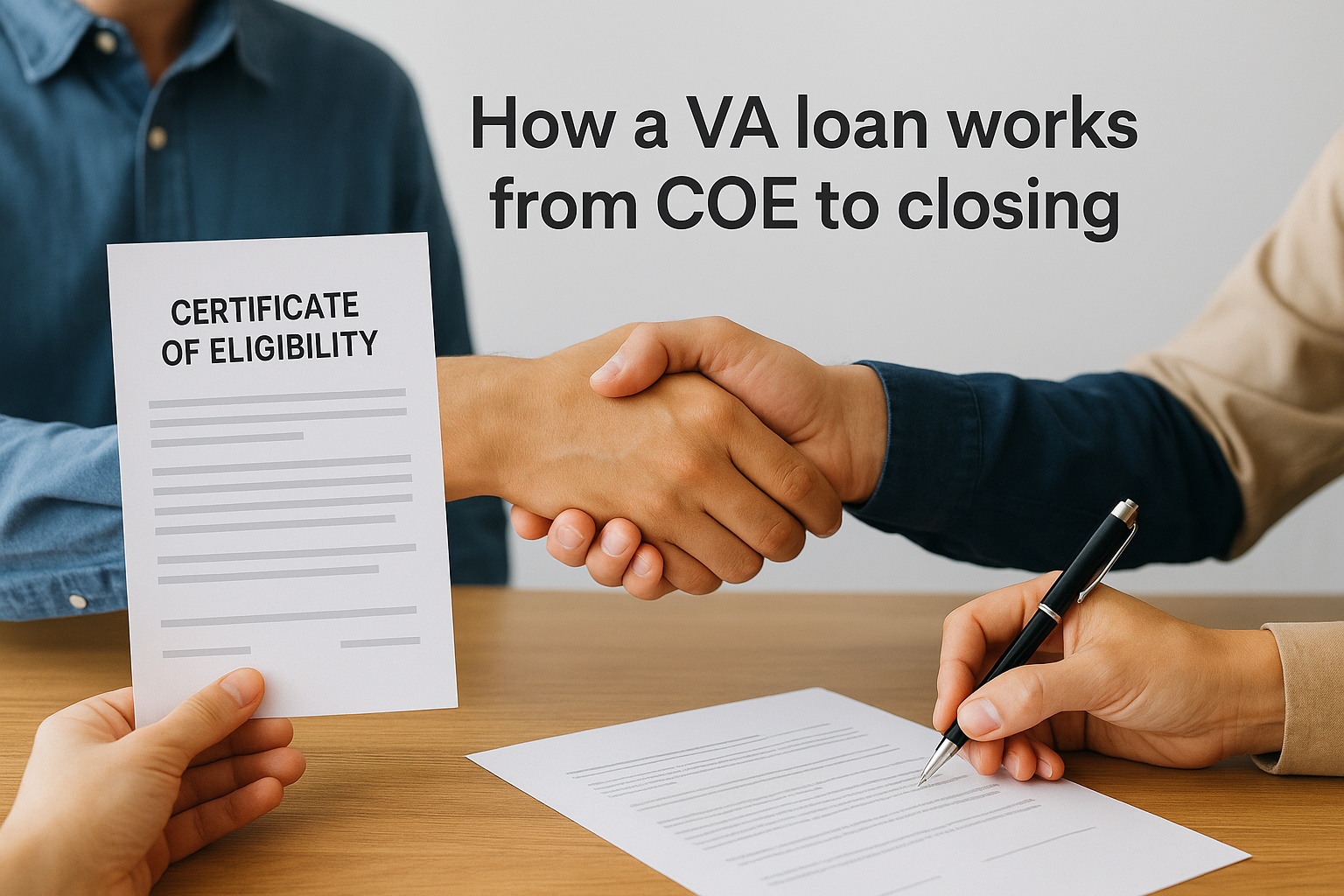
Step 1: Obtain Your Certificate of Eligibility (COE)
Your Certificate of Eligibility proves to the lender that you possess valid military entitlement for a VA-backed home loan. You can request your COE online via the official eBenefits or VA.gov portal, or your mortgage lender can retrieve it electronically on your behalf through the WebLGY system.
Step 2: Gather All Bankruptcy Records
Gather complete legal documentation associated with your bankruptcy. Lenders require full copies of the following official documents filed with the U.S. Bankruptcy Court:
- The complete Chapter 13 Bankruptcy Petition and Schedules (Schedules A through J).
- The court-approved Chapter 13 Repayment Plan.
- Official Trustee Payment Ledger confirming 12+ months of consecutive, on-time payments.
- The formal Order of Discharge (if the plan has been completed).
Step 3: Secure a Trustee Consent Letter (If Plan is Active)
If you are currently making payments under an active Chapter 13 plan, instruct your bankruptcy attorney to file a motion requesting court permission to incur new mortgage debt. The trustee or judge will review:
- The proposed purchase price, monthly principal, interest, taxes, and insurance (PITI).
- The impact of the new housing payment on your court-ordered monthly plan payments.
- Proof that you possess sufficient income to handle both obligations simultaneously.
Once approved, the trustee issues a Trustee Consent Letter or signed court order authorizing the specific purchase terms.
Step 4: Work with a Manual Underwriting Specialist
Not all loan officers or mortgage lenders understand manual underwriting or VA guidelines regarding active Chapter 13 plans. Select a VA-specialized lender whose underwriters routinely process manual files without applying restrictive overlays.
Step 5: Finalize Underwriting and Property Appraisal
Once under contract, the lender orders a standard VA appraisal to verify that the property meets VA Minimum Property Requirements (MPRs) and fair market valuation. Concurrently, the underwriter executes a full manual audit of your credit history, employment stability, liquid reserves, and housing history.
Practical Strategies to Improve Approval Odds
Even with flexible federal guidelines, credit scoring models and manual underwriting policies require applicants to demonstrate financial stability.
Rebuilding Credit Score Post-Bankruptcy
While the VA does not establish a statutory minimum credit score requirement, most mortgage lenders mandate an internal minimum credit score benchmark—typically between 580 and 620 for manually underwritten VA loans.
To elevate your credit score while under a Chapter 13 plan or after discharge:
- Maintain Zero Late Payments: Ensure all non-discharged debts, utility bills, and housing payments are paid strictly on or before their due dates.
- Use Secured Credit Cards Wisely: If allowed under your plan or post-discharge, open one or two secured credit cards. Keep credit utilization below 10% of the available credit limit and pay the full balance every month.
- Monitor Credit Reports: Request official copies of your credit reports from Equifax, Experian, and TransUnion. Verify that debts discharged through your Chapter 13 plan are accurately reported with a zero balance and listed as "Discharged in Bankruptcy."
Build Documented Cash Reserves
Manual underwriting guidelines heavily favor applicants who possess liquid cash reserves remaining in their bank accounts after closing. Reserves are measured in months of total PITI housing payments.
- Accumulating 2 to 4 months of PITI reserves (liquid funds in checking, savings, or non-retirement investment accounts) significantly strengthens your file.
- Cash reserves demonstrate to the underwriter that an unexpected financial emergency will not cause a default on your mortgage or Chapter 13 payments.
Frequently Asked Questions
Can I get a VA cash-out refinance during a Chapter 13 bankruptcy?
Yes, but it requires meeting the same 12-month payment history requirement and securing written approval from the Bankruptcy Trustee. The court will evaluate how cash proceeds from the refinance are distributed, and in many cases, the trustee may require a portion of the cash equity to pay off remaining creditors under your plan.
Does a Chapter 13 bankruptcy impact my full VA loan entitlement?
No. Bankruptcy proceedings do not forfeit or permanently reduce your earned VA loan entitlement. As long as you meet military service requirements and do not have an unpaid default on a prior VA loan that resulted in an unrecovered loss to the government, your full entitlement remains intact.
What credit score do I need for a VA loan after Chapter 13?
The VA itself does not set a hard minimum credit score limit. However, individual lenders enforce overlays. For a manually underwritten loan during or immediately following a Chapter 13 bankruptcy, most lenders require a minimum FICO score between 580 and 620, along with a clean 12-month payment record.
How does the Chapter 13 payment factor into my DTI calculation?
If your Chapter 13 plan is active while applying for a VA loan, the court-ordered monthly plan payment must be included as a recurring monthly liability when calculating your total Debt-to-Income (DTI) ratio.
Can I use a VA loan if my Chapter 13 was converted to a Chapter 7?
If your Chapter 13 bankruptcy was converted to a Chapter 7 bankruptcy, lenders treat the file under Chapter 7 guidelines. This means you must generally wait two full years from the date of the Chapter 7 discharge before becoming eligible for a VA home loan.
Summary and Next Steps
Securing a VA loan after filing for Chapter 13 bankruptcy is entirely achievable thanks to favorable government guidelines designed to support military service members and veterans.
If your Chapter 13 plan is currently active, focus on completing 12 consecutive months of on-time plan payments, preserving perfect housing payment verification, and consulting your bankruptcy attorney to petition the trustee for consent. If your plan has already been discharged, gather your court records and connect with a VA-specialized mortgage lender that adheres strictly to standard VA guidelines without imposing unnecessary post-discharge waiting periods.
Image Gallery