Inside the Quant Hedge Fund: Deconstructing the Math-Driven Investment Engine
A quantitative hedge fund functions as a high-stakes engineering environment where mathematical models, rather than human intuition, dictate investment decisions. These firms ingest massive datasets to identify fleeting market ineffici...
A quantitative hedge fund functions as a high-stakes engineering environment where mathematical models, rather than human intuition, dictate investment decisions. These firms ingest massive datasets to identify fleeting market inefficiencies, executing trades through automated algorithms designed to minimize risk while capturing consistent, albeit often narrow, arbitrage opportunities across global financial markets.
Contents
At the core of a quantitative hedge fund lies a rigorous scientific process. Unlike traditional discretionary managers who rely on fundamental analysis—such as evaluating corporate management, supply chain health, or brand value—quantitative managers treat the market as a massive, noisy signal processing problem. Their objective is to extract predictive patterns from historical and real-time data using statistical inference, machine learning, and high-performance computing.
The Lifecycle of a Quantitative Trade
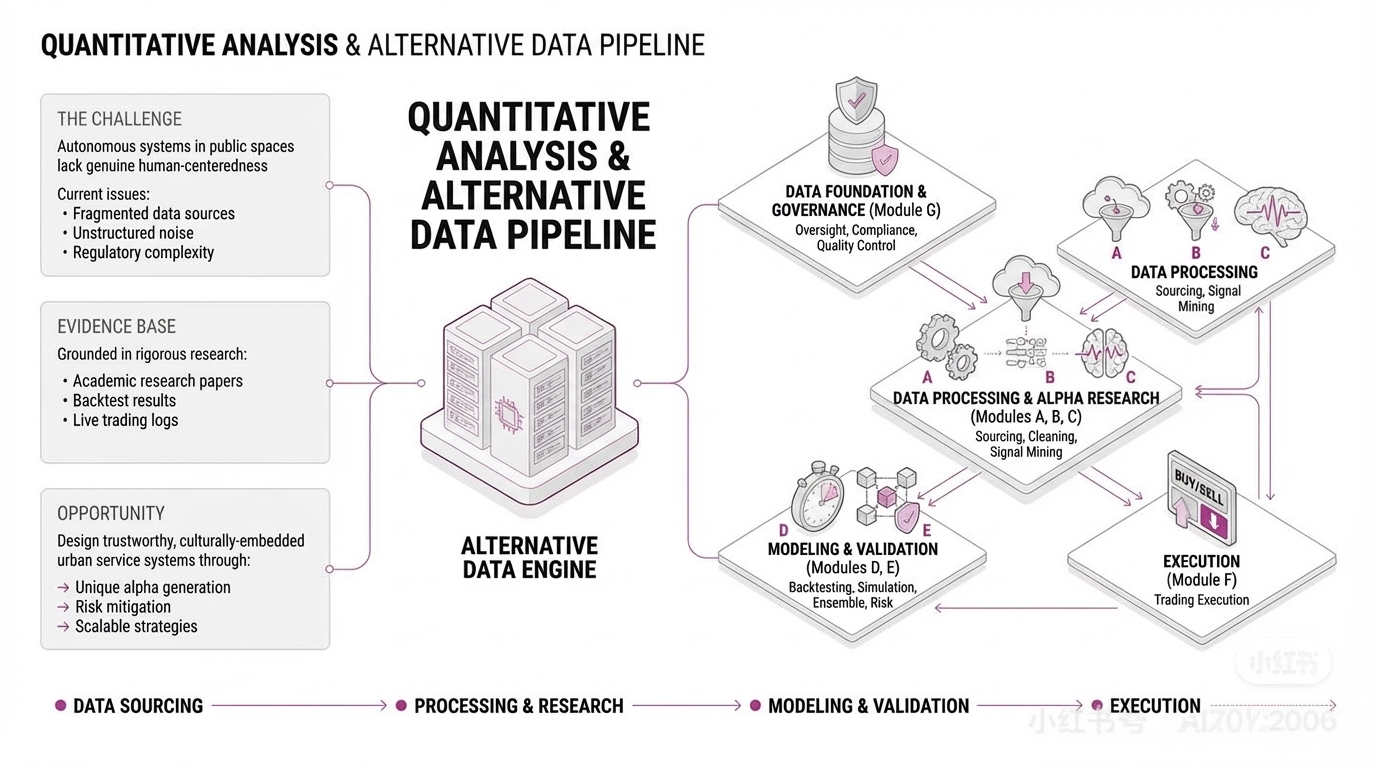
The "investment engine" is not a single piece of software but a multi-stage assembly line of data processing and execution. Each stage requires precise engineering to ensure the fund remains profitable while managing transaction costs.
1. Data Ingestion and Normalization
Quant funds operate on the principle that more data is better, provided it is high quality. Beyond traditional price and volume metrics, funds integrate alternative data sources—such as satellite imagery of retail parking lots, credit card transaction flows, sentiment analysis from social media, and ocean freight logistics data. This raw information is stored in massive data lakes where it is "cleaned" to remove errors, outliers, and survivorship bias.
2. Alpha Research and Strategy Development
The "alpha" is the excess return generated over a benchmark. In this phase, researchers (often PhDs in physics, mathematics, or computer science) develop hypotheses about market behavior. They test these hypotheses against historical data (backtesting). A common mistake in this phase is "overfitting"—creating a model that works perfectly on past data but fails to predict future outcomes because it has memorized the noise of the past rather than the signal of the market.
3. Portfolio Construction and Risk Management
Once a strategy shows promise, it is handed to the optimizer. The optimizer determines how much capital to allocate to a specific trade based on the expected return and the risk contribution. Risk management is the "stop-loss" mechanism that prevents a single bad trade from endangering the entire fund. Modern funds use sophisticated Value-at-Risk (VaR) models and stress testing to ensure the portfolio remains resilient during "black swan" events or period-specific market liquidity crunches.
4. Execution Engines
Execution is where theory meets reality. Because large orders can move market prices (slippage), quant funds use "execution algorithms" that break large orders into thousands of tiny, inconspicuous slices. These algorithms interact directly with exchange order books to minimize market impact and optimize the timing of each fill.
Key Components of the Math-Driven Stack
| Component | Technical Function | Typical Objective |
|---|---|---|
| Data Warehouse | Storing structured/unstructured data | Ensuring low-latency access for research |
| Backtesting Engine | Simulating trades on historical data | Validating strategy robustness |
| Optimizer | Solving convex/non-convex functions | Maximizing risk-adjusted returns |
| Execution Gateway | Direct Market Access (DMA) | Minimizing slippage and latency |
| Risk Monitor | Real-time exposure tracking | Preventing catastrophic loss |
The Role of Technology and Talent
The competitive advantage of a top-tier quant fund in 2026 is defined by two factors: latency and intellectual capital.
In the high-frequency trading (HFT) sub-sector, speed is measured in microseconds. Firms invest heavily in microwave towers and fiber-optic cables to shave milliseconds off their connection to exchange data centers. However, for strategies with longer time horizons—such as statistical arbitrage or trend following—the competitive edge lies in the sophistication of the machine learning models. Deep learning architectures and generative models are now being employed to identify non-linear relationships that traditional linear regression models miss.
Talent acquisition is equally critical. These firms compete directly with major technology corporations for the same pool of software engineers and research scientists. The internal culture is intensely collaborative but also meritocratic, where the performance of a model is tracked in real-time. If a strategy's returns fall below a defined threshold, it is typically taken offline, recalibrated, or abandoned.
Risks and Operational Limitations
While the math-driven engine aims to remove human emotion from the equation, it introduces its own set of risks. The most significant is "model risk"—the danger that the underlying assumptions of the model become invalid due to structural shifts in the market.
Furthermore, quant funds are susceptible to "crowding." When multiple funds identify the same profitable pattern, they all attempt to exploit it simultaneously, which can lead to the "alpha" being competed away. This often results in periods of high volatility where models simultaneously attempt to deleverage or exit positions, potentially creating a feedback loop that exacerbates market crashes.
Investors should also be aware of the "black box" nature of these funds. Because the strategies are often highly complex, it can be difficult for external investors to understand exactly why a fund is underperforming during specific market regimes. Due diligence in this space requires a focus on the firm's operational stability, risk management framework, and the turnover rate of its research personnel.
Frequently Asked Questions
What is the difference between a quant fund and a high-frequency trading (HFT) firm? While both use quantitative methods, HFT is a specific subset of quant trading focused on extreme speed and high volume, often holding positions for only seconds or milliseconds. Other quant hedge funds may hold positions for days, weeks, or even months, focusing on structural trends rather than millisecond-level arbitrage.
Can a quant hedge fund "lose" money? Yes. Quantitative funds are subject to the same market risks as any other investment vehicle. Models can be wrong, data can be corrupted, and unexpected political or economic events can render historical models ineffective. While math can manage risk, it cannot predict the future with 100% certainty.
What is "alpha" in the context of quantitative finance? Alpha represents the return of an investment portfolio that exceeds the benchmark index (such as the S&P 500). A quant fund’s success is measured by its ability to generate "pure" alpha that is uncorrelated with the general movement of the market.
Why do quant funds require so much computing power? The sheer volume of data ingested daily requires vast infrastructure. Furthermore, the iterative process of testing thousands of model permutations (backtesting) requires high-performance clusters to ensure that insights are generated before the market opportunity disappears.
Is quant trading legal and regulated? Yes. Quant hedge funds are subject to the same financial regulations as other investment firms, including oversight by regulators like the SEC in the United States. They must adhere to strict reporting requirements regarding their holdings, leverage, and risk profiles.
Next Steps for Understanding Quantitative Portfolios
If you are considering an allocation to a quantitative fund, begin by reviewing the firm's Form ADV, which discloses the fund’s business practices and potential conflicts of interest. Evaluate the firm’s track record not just on raw performance, but on the "Sharpe Ratio," which measures the return earned in excess of the risk-free rate per unit of volatility. A high-quality quant fund will provide clear documentation on its risk management protocols and the specific market environments—or "regimes"—in which its models are designed to thrive.
Image Gallery