What an LLC Is Considered: Legal Status, Tax Classifications, and Structure
A Limited Liability Company (LLC) is legally considered a hybrid business entity created under state law that combines the liability protection of a corporation with the pass-through tax treatment and operational flexibility of a partn...
A Limited Liability Company (LLC) is legally considered a hybrid business entity created under state law that combines the liability protection of a corporation with the pass-through tax treatment and operational flexibility of a partnership. For federal tax purposes, the Internal Revenue Service (IRS) does not have a dedicated LLC tax category; instead, it considers single-member LLCs "disregarded entities" and multi-member LLCs "partnerships," unless the company explicitly elects corporate taxation.
Contents
The Core Legal Definition: How the Law Views an LLC
At its core, a Limited Liability Company is a distinct legal entity established by filing formal documentation—typically called Articles of Organization or a Certificate of Formation—with a state's secretary of state or business registration agency. Once formed, the law considers the LLC a separate "legal person" apart from its owners, who are designated as members.
This separation creates a legal barrier commonly referred to as the corporate shield or corporate veil. Under state corporate and business statutes, the debt, obligations, and legal liabilities incurred by the LLC belong solely to the business entity itself. Consequently, creditors of the company generally cannot claim the personal bank accounts, homes, vehicles, or personal assets of individual members to satisfy business liabilities.
- STATE LEVEL: LLC = Distinct Legal Entity (Created via Articles of Organization)
- LEGAL CHARACTERISTICS
- Separate legal person
- Limited personal liability
- Owned by "Members"
- Flexible governance
- FEDERAL TAX OPTIONS
- Disregarded Entity (1 Member)
- Partnership (Multi-Member)
- C-Corp Election (Form 8832)
- S-Corp Election (Form 2553)
- LEGAL CHARACTERISTICS
LLC vs. Corporation: Key Distinctions
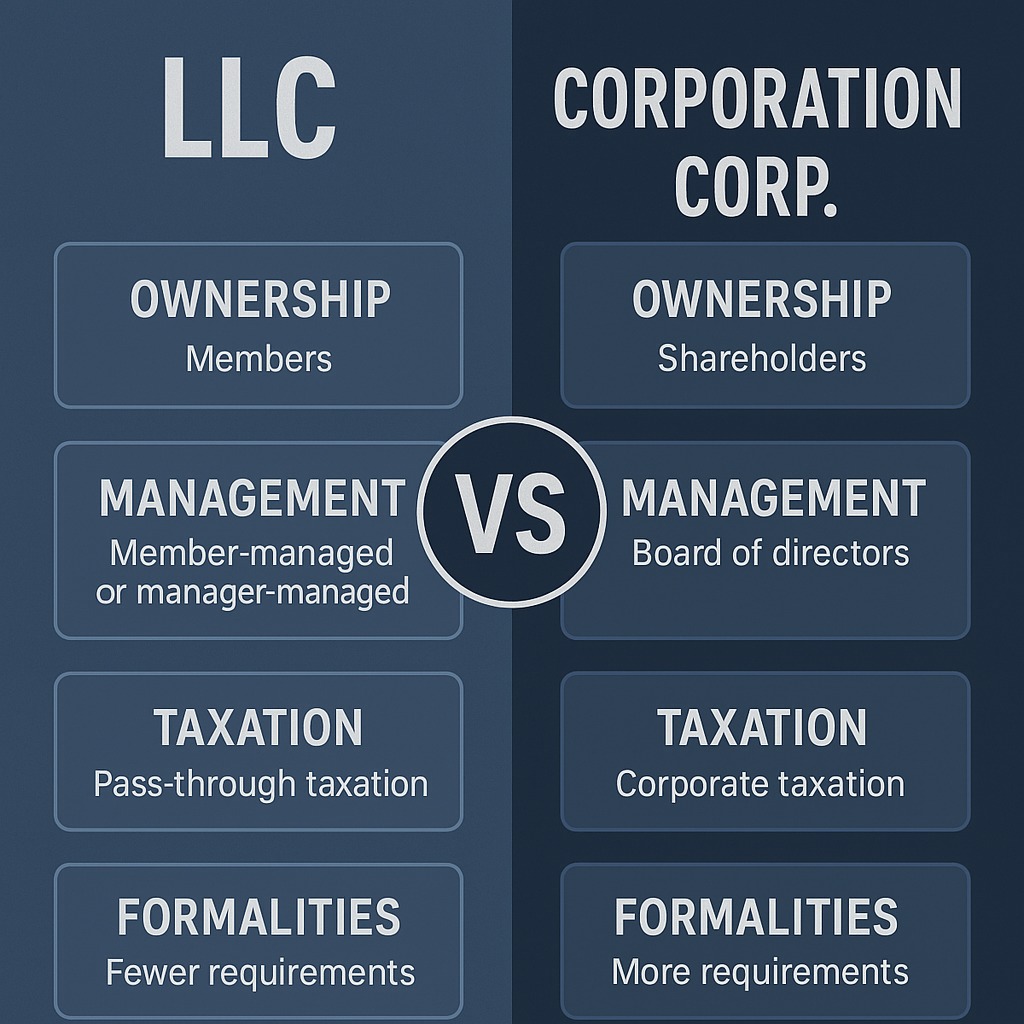
While an LLC shares liability protections with a corporation, it differs in several fundamental ways:
- Ownership Units: Corporations issue shares of stock to shareholders. LLCs grant percentage ownership interests or financial units to members.
- Governance Requirements: Corporations must adhere to rigid statutory formalities, including maintaining a board of directors, holding annual shareholder meetings, and maintaining detailed corporate minutes. LLCs operate under a flexible management framework defined by a private contract called an Operating Agreement.
- Capital Structure: Corporations have rigid structures regarding stock classes (common vs. preferred), whereas LLCs allow tailored allocation of profits, losses, and voting rights among members regardless of initial capital contributions.
Federal Tax Classifications: How the IRS Views an LLC
A common source of confusion is that an LLC is purely a state-level legal entity. The Internal Revenue Code does not contain a specific tax classification for an LLC. Instead, the IRS uses the "check-the-box" rules governed by Treasury Regulations to categorize LLCs into established federal tax classifications.
- LLC FORMATION AT STATE LEVEL
- IRS TAX CLASSIFICATION
- Single-Member LLC (Default: Disregarded Entity)
- Schedule C (Form 1040)
- Pass-through to owner
- Multi-Member LLC (Default: Partnership)
- Form 1065
- Schedule K-1 to members
- Elect Corporate Taxation?
- C-Corporation Status (File Form 8832)
- Form 1120 taxation
- Corporate rate applies
- S-Corporation Status (File Form 2553)
- Form 1120-S pass-through
- W-2 wages + distributions
- C-Corporation Status (File Form 8832)
- Single-Member LLC (Default: Disregarded Entity)
1. Disregarded Entity (Single-Member Default)
When a single individual or entity forms an LLC, the IRS automatically considers it a disregarded entity for income tax purposes unless an alternative election is filed.
Under disregarded status, the business entity is ignored for income tax reporting. All revenues, deductible expenses, and net profit flow directly to the individual owner's personal tax return via Schedule C (Form 1040) (or Schedule E for real estate rentals, Schedule F for farming). Although income taxes pass through, the business retains its separate legal status for liability protection under state law.
2. Partnership Taxation (Multi-Member Default)
If an LLC has two or more members, the IRS automatically considers it a partnership for tax purposes.
The LLC itself does not pay federal income tax. Instead, it files an informational tax return using Form 1065 (U.S. Return of Partnership Income). The company generates a Schedule K-1 for each member, detailing their proportional share of net profits, losses, deductions, and credits. Each member then reports these numbers on their individual Form 1040.
3. C Corporation Taxation (Elected Status)
An LLC can elect to be treated as a C Corporation for tax purposes by filing IRS Form 8832 (Entity Classification Election).
When this election is made:
- The business pays corporate income tax directly at the federal corporate rate on taxable net income using Form 1120.
- Owners pay individual taxes only on salaries drawn from the business or dividends distributed to them, giving rise to potential "double taxation" (taxation at the corporate level and again at the shareholder dividend level).
- This classification is often preferred by companies retaining profits for reinvestment or preparing to attract institutional venture capital.
4. S Corporation Taxation (Elected Status)
An LLC can also elect S Corporation tax status by filing IRS Form 2553 (Election by a Small Business Corporation), provided it satisfies statutory eligibility criteria (such as having fewer than 100 members and allowing only allowable U.S. resident/citizen shareholders).
Under S-Corp status:
- The business remains a pass-through entity filing Form 1120-S, avoiding corporate-level double taxation.
- Active owner-operators must pay themselves a "reasonable salary" subject to standard FICA payroll taxes (Social Security and Medicare).
- Net profits remaining after reasonable compensation can be paid out as profit distributions, which are generally free from self-employment taxes.
Legal Protections and Asset Isolation
An LLC is considered a separate legal identity, but its liability shield is not absolute. Understanding the boundary between personal liability and entity liability is essential for maintaining asset protection.
The Liability Shield
When an LLC enters into a commercial lease, signs a vendor agreement, or incurs liability during standard operations, the company itself is the named obligor. If the business defaults on a commercial lease or faces a contractual dispute, the counterparty generally can only seek recovery from the business's bank accounts, equipment, and assets.
Exceptions to Limited Liability
Courts can set aside the limited liability protection—a legal outcome known as piercing the corporate veil—under specific circumstances:
- Commingling of Funds: Mixing business bank accounts with personal funds, paying personal expenses directly from corporate accounts, or failing to maintain distinct financial records.
- Personal Guarantees: Signing personal guarantees for commercial loans or real property leases. In such cases, members contractually pledge their personal assets regardless of the LLC structure.
- Direct Tortious Conduct: A member remains personally liable for their own personal negligence, intentional torts, or professional malpractice, even if committed while performing business duties.
- Failure to Maintain Separation: Operating without a written Operating Agreement, failing to maintain accurate meeting records (where required by state rule), or failing to file annual reports with state authorities.
Comparison Matrix: Legal and Tax Classifications
The following table summarizes how different business setups compare legally and tax-wise under current guidelines:
| Classification Parameter | Single-Member LLC (Default) | Multi-Member LLC (Default) | LLC taxed as S-Corp | LLC taxed as C-Corp | Traditional C-Corporation |
|---|---|---|---|---|---|
| Legal Entity Type | State Legal LLC | State Legal LLC | State Legal LLC | State Legal LLC | State Corporation |
| IRS Default Tax Status | Disregarded Entity | Partnership | Elected (Form 2553) | Elected (Form 8832) | Corporation |
| Primary IRS Form | Schedule C (Form 1040) | Form 1065 + Schedule K-1 | Form 1120-S + Schedule K-1 | Form 1120 | Form 1120 |
| Pass-Through Taxation? | Yes | Yes | Yes | No (Corporate Taxed) | No (Corporate Taxed) |
| Owner Compensation | Owner Draws | Owner Draws | Reasonable W-2 Salary + Distributions | W-2 Salary + Dividends | W-2 Salary + Dividends |
| Self-Employment Tax | Applies to 100% of net profits | Applies to 100% of general member profits | Applies to W-2 wages only | Standard Payroll Taxes on Salary | Standard Payroll Taxes on Salary |
| Liability Shield | Separate legal entity shield | Separate legal entity shield | Separate legal entity shield | Separate legal entity shield | Corporate legal shield |
Self-Employment Taxes and Member Compensation
Because members of a standard LLC (taxed as a disregarded entity or partnership) are not considered traditional employees of the business, they do not receive a standard W-2 payroll check. Instead, their financial compensation is handled through owner draws or distributions.
How SECA Tax Applies
Under the Self-Employed Contributions Act (SECA), individual members operating a active standard LLC must pay self-employment tax on their entire share of net business earnings. The self-employment tax rate consists of:
- 12.4% for Social Security (up to the annual statutory wage base threshold set by federal law).
- 2.9% for Medicare (with additional Medicare tax surcharges applying to high earners).
Members calculate and report this tax on Schedule SE (Form 1040) during regular tax filing cycles, making quarterly estimated tax payments throughout the tax year to avoid IRS underpayment penalties.
- LLC NET EARNINGS (DEFAULT)
- Social Security Portion
- 12.4% up to annual cap
- Medicare Portion
- 2.9% on all earnings
- High-earner surcharge applies
- Social Security Portion
- Total SECA Tax: 15.3% Combined (Reported on Schedule SE)
Reducing Self-Employment Tax via S-Corp Status
For businesses generating substantial net income, electing S Corporation status can yield payroll tax savings. Under S-Corp classification:
- The active member pays themselves a compensation rate categorized as a reasonable wage, subject to standard 15.3% FICA payroll taxes split between employee and employer portions.
- Remaining business profits above that reasonable salary are distributed to the member as S-Corp distributions, which are exempt from self-employment taxes.
Example: If an LLC nets $150,000 in income, under standard partnership status, the entire $150,000 is subject to self-employment tax. Under S-Corp status, if a reasonable salary is set at $80,000, FICA taxes apply only to the $80,000 wage, while the remaining $70,000 distribution is exempt from self-employment tax.
Common Misconceptions About LLC Status
Misconception 1: "An LLC is a tax classification by itself."
An LLC is exclusively a legal entity created under state statutes. The IRS does not have an LLC tax return or an LLC tax rate; it assigns existing tax categories (disregarded entity, partnership, or corporation) to the company.
Misconception 2: "Forming an LLC automatically lowers your income tax rate."
Forming an LLC does not automatically lower your baseline federal income tax rate. In default pass-through configurations, business profits are added to your personal adjusted gross income and taxed at your applicable individual income tax brackets.
Misconception 3: "An LLC eliminates all personal legal liability."
An LLC insulates owners from business contracts and operational liabilities incurred by the company. It does not shield individuals from liability for personal wrongdoing, negligence, fraudulent conduct, or obligations secured with personal guarantees.
Frequently Asked Questions
Is an LLC considered a corporation?
No. An LLC is a legal business entity distinct from a corporation. While both provide limited liability protection to owners, an LLC offers more flexible governance without board requirements and is taxed as a pass-through entity by default. A corporation operates under rigid shareholder and board frameworks and is taxed under corporate tax provisions unless an S-Corp election is made.
What is a single-member LLC considered for tax purposes?
By default, the IRS considers a single-member LLC a disregarded entity. For federal income tax purposes, the owner reports all revenues and expenses directly on Schedule C of their individual Form 1040. However, for employment tax and specific excise tax obligations, the single-member LLC remains a distinct entity.
Is an LLC considered self-employed?
Yes, members of a default single-member or multi-member LLC who perform services for the company are considered self-employed for federal tax purposes. They do not receive W-2 payroll wages; instead, they take owner draws and pay self-employment tax (SECA) on their share of net business profits via Schedule SE.
Can an LLC be considered a non-profit organization?
An LLC can be organized for non-profit purposes and apply for tax-exempt status under Section 501(c)(3) of the Internal Revenue Code, but specific conditions apply. The IRS requires that all members of a tax-exempt non-profit LLC themselves be 501(c)(3) organizations or government entities, which makes non-profit LLCs uncommon compared to non-profit corporations.
What state agency registers and recognizes an LLC?
An LLC is created and legally recognized at the state level by submitting Articles of Organization to the state's Secretary of State, Department of State, or business regulatory commission. The entity must also maintain legal standing by filing periodic reports (such as annual or biennial reports) as mandated by state laws.
Actionable Steps: Selecting the Right LLC Configuration
When forming or managing an LLC, ensure your legal and tax classifications match your operating model:
- Draft a Custom Operating Agreement: Avoid using off-the-shelf templates. Ensure your operating agreement clearly specifies voting rights, capital contribution terms, profit allocations, and member management roles.
- Open Separate Business Accounts: Maintain strict separation between personal and business finances to preserve the legal protection shield.
- Review Tax Election Timing: If considering an S Corporation election to reduce self-employment tax liabilities, ensure IRS Form 2553 is filed within 2 months and 15 days of the start of the tax year in which the election takes effect.
- Consult Professionals: Because tax laws and state LLC statutes vary across jurisdictions, consult a licensed business attorney and a Certified Public Accountant (CPA) to align your setup with your risk profile and financial goals.
Disclaimer: This article provides general educational information regarding business entity structures and tax rules. It does not constitute formal legal, financial, or tax advice. Consult a qualified professional for guidance tailored to your specific circumstances.
Image Gallery