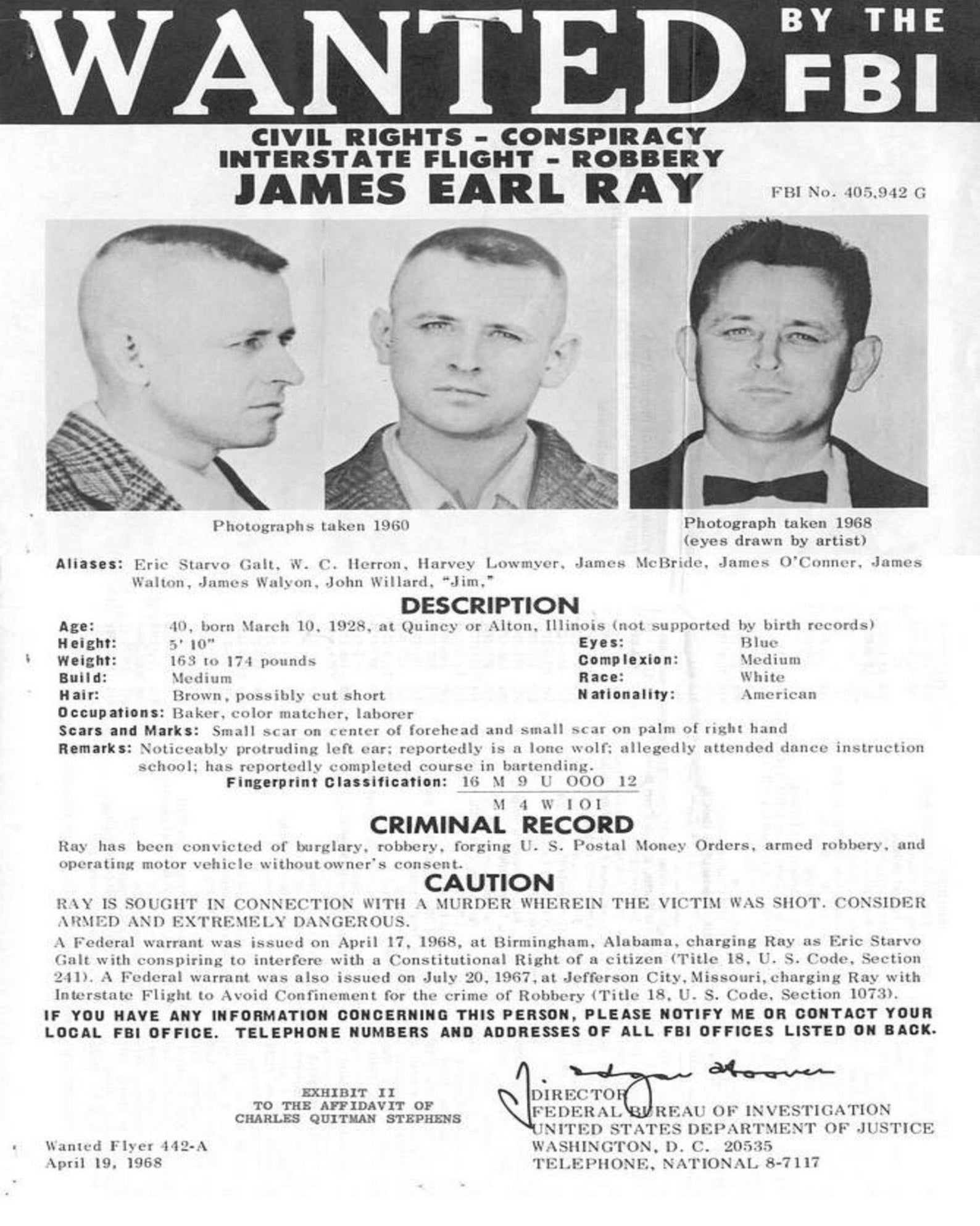
The 1966 Ford Mustang and the Investigation of James Earl Ray
The 1966 Ford Mustang, a white hardtop coupe, became a pivotal piece of physical evidence in the 1968 assassination investigation of Dr. Martin Luther King Jr. Purchased by James Earl Ray under the alias "Eric Starvo Galt" in Birmingha...
The 1966 Ford Mustang, a white hardtop coupe, became a pivotal piece of physical evidence in the 1968 assassination investigation of Dr. Martin Luther King Jr. Purchased by James Earl Ray under the alias "Eric Starvo Galt" in Birmingham, Alabama, this vehicle served as a primary instrument in his flight across the United States, Canada, and eventually to Europe.
Contents
Acquisition and the "Eric Starvo Galt" Persona
In the spring of 1968, James Earl Ray, utilizing the identity of Eric Starvo Galt, sought to establish a plausible background to support his movements. On April 5, 1968—one day after the assassination of Dr. King—Ray arrived in Atlanta, Georgia. However, the purchase of the white 1966 Ford Mustang took place earlier. Ray purchased the vehicle in Birmingham, Alabama, on April 4, 1968, hours before the shooting in Memphis, Tennessee.
The purchase itself was a calculated attempt to distance the driver from his true identity. By using the alias Galt, Ray created a trail of documentation that was intended to baffle federal authorities. The Mustang, at the time of purchase, was a mass-produced, relatively unremarkable vehicle, which was precisely what Ray needed to blend into the suburban and interstate traffic of the late 1960s. The vehicle was equipped with a standard six-cylinder engine, designed for efficiency and reliability rather than high-performance speed.
Physical Evidence and Forensic Significance
The Mustang became the centerpiece of the Federal Bureau of Investigation’s (FBI) massive manhunt. When authorities eventually recovered the vehicle in Atlanta, it provided a wealth of forensic data. The interior of the car contained personal items, clothing, and documents that corroborated the timeline established by investigators. Among the most significant finds were items that linked the driver to the hotel room in Memphis where a Remington Model 760 Gamemaster rifle had been abandoned.
Forensic teams processed the vehicle for fingerprints, hair samples, and fiber evidence. This collection process was intensive, as the FBI sought to verify that the person who operated the vehicle was indeed the same individual who checked into the boarding house in Memphis. The car’s trunk and glove compartment yielded maps, receipts, and identification cards that were critical in reconstructing the route Ray took from the Deep South toward the Canadian border.
The Journey Across North America
The white Mustang was not merely a stationary exhibit; it was a mobile hub for Ray’s navigation. The car traveled hundreds of miles through multiple states, demonstrating the mobility of suspects in the era before widespread digital surveillance. Ray drove the Mustang from Birmingham toward the vicinity of Memphis and then eastward toward Atlanta.
The transit of this vehicle was mapped through gas station receipts and motor vehicle department records. Because the Mustang was a popular model, it attracted little attention at service stations or motels. This ubiquity allowed Ray to cross state lines without triggering immediate suspicion. The investigation into the vehicle's mileage and maintenance history eventually led investigators to piece together the specific timeframe of Ray’s movements during the first week of April 1968.
Comparative Specifications: 1966 Ford Mustang
To understand the operational capabilities of the vehicle Ray utilized, it is necessary to examine the specifications of the 1966 model year. While there were high-performance variants, the version associated with the investigation was a standard fleet-grade model.
| Feature | Specification Details |
|---|---|
| Body Style | 2-door Hardtop Coupe |
| Engine Type | 200 cubic inch (3.3L) Thriftpower I6 |
| Transmission | 3-speed manual or C4 Cruise-O-Matic |
| Curb Weight | Approximately 2,500 lbs |
| Wheelbase | 108 inches |
| Standard Color Options | Wimbledon White, Raven Black, Silver Blue, etc. |
The choice of a white coupe was statistically favorable for avoiding detection in the mid-1960s, as white was a high-production color for the Mustang line. This provided a "chameleon effect" in traffic, as there were thousands of nearly identical vehicles on the road, making visual identification by eyewitnesses notoriously unreliable.
The Role of the Vehicle in the FBI Investigation
The FBI’s recovery of the Mustang was the turning point in the identification of James Earl Ray. Once the car was linked to the aliases used by the suspect, the bureau was able to track his path through Florida and finally toward Canada. The Mustang served as a physical repository of the suspect’s habits. By analyzing the contents of the car, the FBI could verify the suspect's intent to flee the country.
The vehicle remained in legal custody for years as a core exhibit for the Department of Justice. The preservation of the Mustang allowed for multiple re-evaluations of the evidence as the case moved through various congressional investigations in the 1970s, specifically the House Select Committee on Assassinations.
Legacy of the Evidence
In the decades following the assassination, the white 1966 Mustang has been cited in nearly every historical account of the investigation. It serves as a stark reminder of the intersection between common consumer products and historical tragedy. For historians and forensic investigators, the car represents a milestone in the transition toward modern forensic techniques, where the contents of a vehicle are considered as crucial as the vehicle itself.
The Mustang was eventually transferred to the custody of government archives, where it remains part of the historical record associated with the investigation. Its status as an object of infamy is tied directly to the movements of James Earl Ray and the subsequent failure of the suspect to evade the vast interstate search grid established by the FBI.
Frequently Asked Questions
1. Was the Mustang a high-performance model? No. Historical records indicate the vehicle was a standard hardtop coupe with a six-cylinder engine, which was consistent with an effort to maintain a low profile during interstate travel.
2. Where was the Mustang finally abandoned? The vehicle was left in Atlanta, Georgia. It was recovered by law enforcement authorities who were tracing the registration and identification details linked to the alias "Eric Starvo Galt."
3. Did the Mustang contain the weapon used in the crime? No. The rifle associated with the shooting was a Remington Model 760, which was abandoned at a boarding house in Memphis, not inside the vehicle.
4. Why is the 1966 Mustang important to the assassination case? It is critical because it established the primary link between the various aliases used by James Earl Ray and his physical location during the critical days following the assassination.
5. How did the FBI track the vehicle across state lines? The FBI used a combination of vehicle identification numbers (VIN), gas station records, and witness reports to reconstruct the movement of the white Mustang from Alabama through Tennessee and Georgia.
Next Steps for Researchers
For those interested in the formal documentation of the investigation, the primary sources remain the records of the House Select Committee on Assassinations (HSCA) and the public files released by the Department of Justice. Researchers should focus on the forensic inventory reports of the vehicle to understand how physical evidence was processed in the late 1960s. These documents are archived at the National Archives and Records Administration and provide the most accurate account of the car's role in the legal proceedings.
Image Gallery