Understanding the Latin American Revolutions: A Comprehensive Historical Overview
The Latin American revolutions were a series of interconnected uprisings and independence movements that occurred between 1808 and 1833. These conflicts successfully dismantled centuries of Spanish and Portuguese colonial rule, resulti...
The Latin American revolutions were a series of interconnected uprisings and independence movements that occurred between 1808 and 1833. These conflicts successfully dismantled centuries of Spanish and Portuguese colonial rule, resulting in the creation of numerous sovereign nations across Central and South America, fundamentally reshaping the political, social, and economic landscape of the Western Hemisphere.
Contents
Historical Context and Prerequisites
To understand the Latin American revolutions, one must first recognize the structural fragility of the Iberian colonial system. For over three centuries, the Spanish Crown maintained a rigid hierarchical caste system—the sociedad de castas—which prioritized individuals born in Spain (peninsulares) over those of European descent born in the Americas (criollos).
The catalyst for change arrived in 1808 when Napoleon Bonaparte invaded Spain, deposed King Ferdinand VII, and installed his brother, Joseph Bonaparte, on the Spanish throne. This created a profound crisis of legitimacy. Throughout the colonies, criollo elites questioned the authority of a French-appointed monarch. Initially, many local councils, or juntas, declared their loyalty to the deposed Ferdinand VII. However, as the realization set in that colonial autonomy was a viable possibility, these sentiments rapidly shifted toward full independence.
The Dynamics of Conflict
The transition from administrative autonomy to open revolution was rarely uniform. It was influenced by local demographics, the strength of royalist military presence, and the influence of Enlightenment ideals.
The Role of Enlightenment Ideology
The American Revolution (1776) and the French Revolution (1789) provided the intellectual framework for independence. Ideas regarding popular sovereignty, constitutional governance, and the rights of the individual—though primarily championed by the criollo elite—began to permeate colonial society. These movements were not merely about national independence; they were about ending the mercantilist restrictions imposed by the metropole, which forbade colonies from trading directly with other nations.
Key Stages of the Conflict
Independence movements are generally categorized into two main waves:
- The Early Phase (1808–1814): Characterized by the formation of juntas and regional power struggles. Most early attempts, such as the initial uprisings in Mexico led by Miguel Hidalgo and José María Morelos, were crushed by loyalist forces.
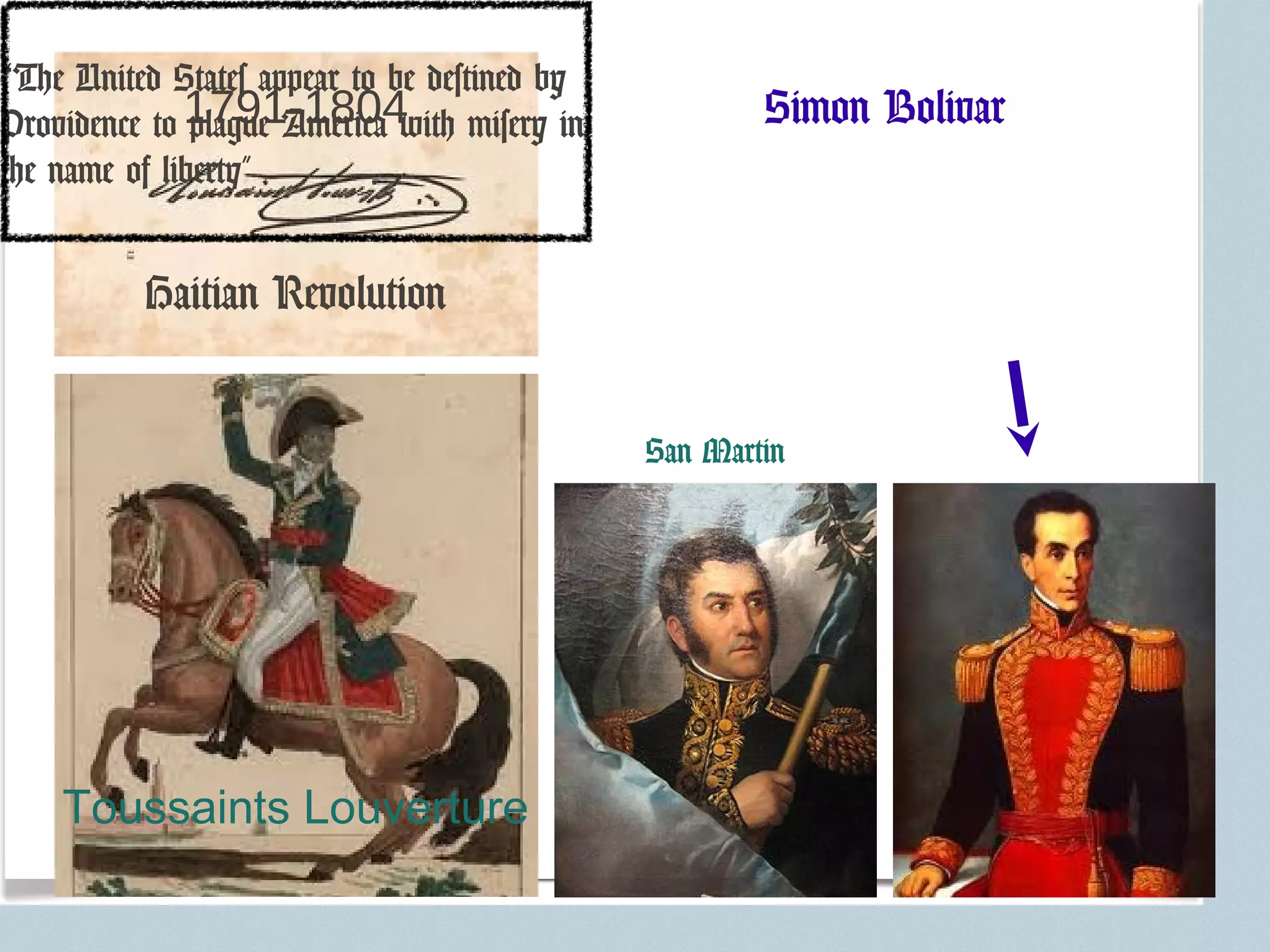
- The Final Phase (1815–1833): Marked by the rise of organized military campaigns under leaders like Simón Bolívar and José de San Martín. These movements succeeded by coordinating across borders and securing naval or financial support from Britain and the United States.
Regional Variations: A Comparative Analysis
The path to independence was distinct for every region, determined by the internal social dynamics of the specific colony. The following table summarizes the primary characteristics of the major movements.
| Region | Primary Leadership | Key Characteristics | Outcome |
|---|---|---|---|
| Rio de la Plata | José de San Martín | Highly organized military, focus on crossing the Andes. | Independence of Argentina and Chile. |
| Gran Colombia | Simón Bolívar | Ideological focus on Pan-American unity and republicanism. | Creation of Colombia, Venezuela, Ecuador, Panama. |
| Mexico | Hidalgo, Morelos, Iturbide | Strong social mobilization of indigenous and mestizo classes. | Constitutional monarchy followed by Republic. |
| Brazil | Dom Pedro I | Non-violent transition from colony to independent empire. | Constitutional monarchy maintained until 1889. |
The Brazilian Anomaly
Unlike the Spanish colonies, which suffered through decades of brutal civil war, Brazil achieved independence with relatively little bloodshed. When Napoleon invaded Portugal in 1807, the Portuguese royal family fled to Rio de Janeiro, effectively making the colony the seat of the empire. In 1821, King João VI returned to Portugal but left his son, Dom Pedro, behind. When the Portuguese parliament attempted to re-subjugate Brazil, Dom Pedro declared independence in 1822, becoming the Emperor of Brazil. This allowed the nation to maintain social and political continuity, avoiding the fragmented instability that plagued its neighbors.
Post-Independence Realities and Challenges
The aftermath of the revolutions was marked by profound instability. The departure of the Spanish administration left a power vacuum that was frequently filled by caudillos—regional military strongmen who exercised personalistic rule.
- Political Fragmentation: The dream of a united "Gran Colombia," as envisioned by Simón Bolívar, failed due to vast geographic barriers and competing regional interests among the elites.
- Economic Dependency: Despite ending the Spanish trade monopoly, the new nations remained economically vulnerable. They were heavily reliant on foreign loans from Great Britain and the export of raw materials, creating a pattern of debt and economic dependence that persisted through the 19th and early 20th centuries.
- Social Stratification: While the revolutions successfully ended colonial rule, they did little to dismantle the underlying social hierarchies. Slavery persisted in many regions for decades, and the indigenous populations remained largely marginalized within the new republican frameworks.
Frequently Asked Questions
Why did the Latin American revolutions occur? The revolutions were driven by a combination of the power vacuum created by the Napoleonic Wars in Europe, resentment among criollos toward Spanish trade restrictions and political exclusion, and the influence of Enlightenment-era liberal ideology.
Did these revolutions result in democracy? Initially, no. While the movements were framed by republican language and constitutions, the immediate result was often authoritarian rule under caudillos. True democratic institutions took nearly a century to develop and faced numerous reversals throughout the 20th century.
What was the role of the United States? The United States provided moral support and early recognition of these new nations. In 1823, the Monroe Doctrine was issued, declaring that the U.S. would view any attempt by European powers to colonize the Americas as an act of aggression.
Why was the Mexican revolution unique? The Mexican struggle was distinct because of the heavy involvement of the lower classes, including indigenous peasants, early in the conflict. This frightened the conservative criollo elites, who initially sided with Spain, only supporting independence later when they feared the rise of a liberal government in Spain.
How did the geography affect the outcome? The immense distance between regional hubs—separated by the Andes Mountains, dense jungles, and vast plains—made centralized control nearly impossible. This geographic reality contributed to the balkanization of the region into many separate, smaller nations rather than one unified entity.
Recommendation and Further Study
To deepen your understanding of these events, it is recommended to examine the primary source documents, such as the Jamaica Letter (1815) by Simón Bolívar, which outlines his vision for the continent. For those researching specific regional histories, the archives provided by the Organization of American States (OAS) and national historical commissions in countries like Argentina and Mexico offer digitized primary accounts of the transition from colony to statehood.
Image Gallery