Why Nest Beats Echo for Smart Home Control in 2026
Google Nest outperforms Amazon Echo for smart home control by leveraging superior natural language processing through Gemini AI, more aesthetic hardware design, and a sophisticated automation engine that caters to both casual users and...
Google Nest outperforms Amazon Echo for smart home control by leveraging superior natural language processing through Gemini AI, more aesthetic hardware design, and a sophisticated automation engine that caters to both casual users and power enthusiasts. While Amazon maintains a lead in total device compatibility, Nest provides a more cohesive, context-aware experience that transforms a collection of gadgets into a unified intelligent environment.
Contents
Determining the "best" smart home ecosystem has shifted from a count of supported light bulbs to the quality of the intelligence governing them. As of 2026, the battle between Google Nest and Amazon Echo has moved into a new phase dominated by generative AI and the maturity of the Matter protocol. While Echo once dominated through sheer volume and early-mover advantage, Nest has secured its position as the premium choice for users who prioritize logical automation, design language, and ecosystem synergy.
The Intelligence Gap: Why Gemini Outpaces Alexa
The most significant differentiator in 2026 is the underlying artificial intelligence. Google has fully transitioned the Nest ecosystem to run on specialized versions of Gemini, its multimodal LLM (Large Language Model). Unlike the traditional command-and-response structure of legacy Alexa, Gemini allows Nest controllers to understand complex, multi-part instructions and, more importantly, context.
When a user tells a Nest Hub, "It’s getting a bit bright in here for a movie," the system doesn't just look for a "movie" scene. It analyzes current light levels via built-in sensors, checks the status of smart blinds, and dims specific zones while keeping the kitchen lights at a safe level for snacks. Amazon’s Alexa has made strides with its own LLM updates, but it often struggles with "hallucinations" or falling back on "I'm not sure about that" when a command deviates from a specific syntax.
Furthermore, Google’s mastery of the Knowledge Graph allows Nest to be more proactive. A Nest Hub can cross-reference your Google Calendar, current traffic data on Google Maps, and your home’s thermal profile to suggest turning on the HVAC system ten minutes earlier than scheduled. This level of predictive control is where Nest fundamentally beats Echo; it isn't just a remote control for your house—it's an assistant that understands how your home functions.
Hardware Aesthetics and Sensory Superiority
Smart home control is as much about the physical interface as it is about the software. Google Nest hardware has consistently prioritized a "home-first" design language. Nest Hubs and Nest WiFi points are designed with fabric textures and soft curves that blend into interior decor, whereas many Amazon Echo devices maintain a more industrial, plastic-heavy aesthetic.
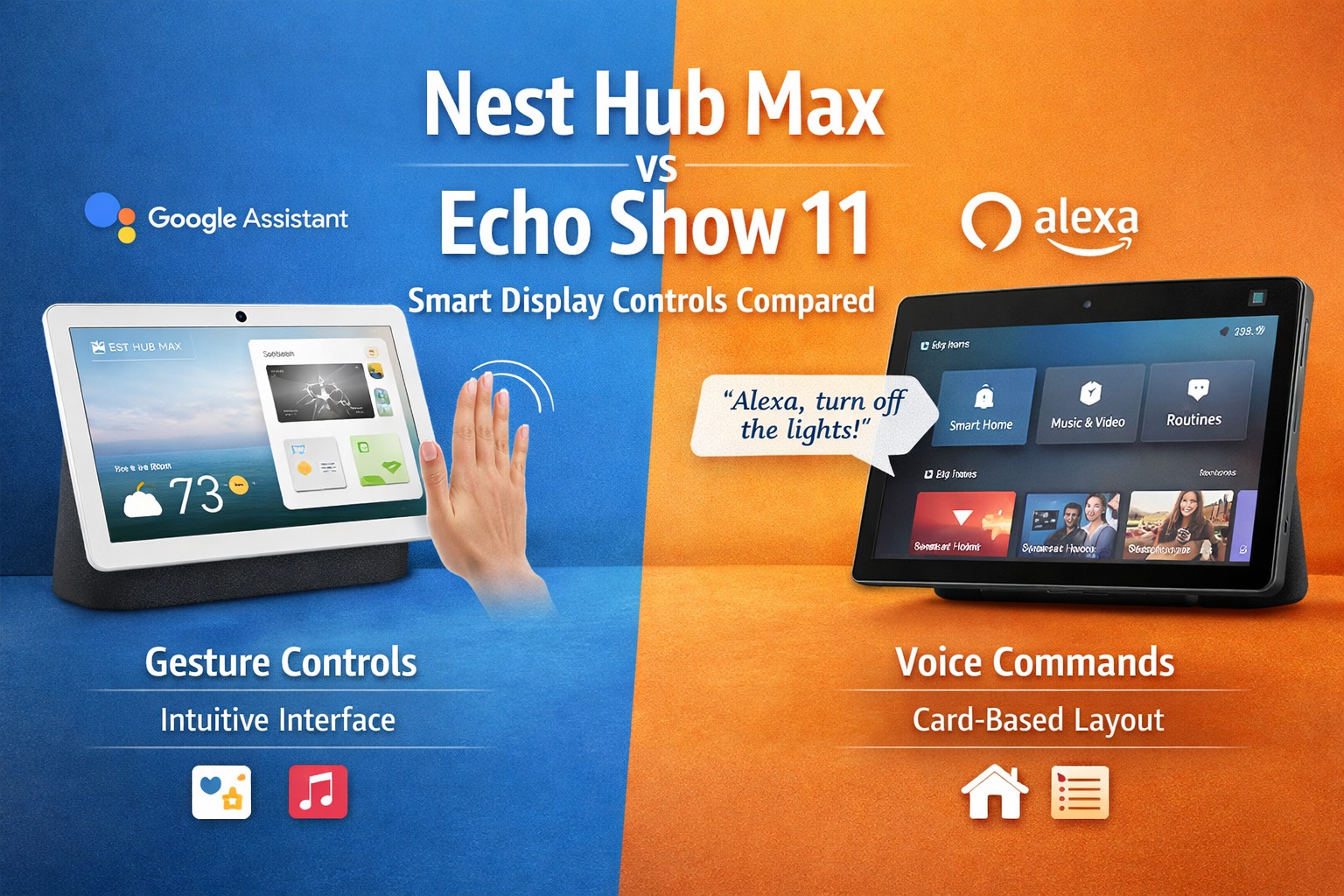
Beyond looks, the technical specifications of Nest hardware provide better control. The inclusion of Soli radar technology in Nest Hubs allows for Quick Gestures. You can pause music or dismiss an alarm by simply waving your hand in the air—no voice command or physical touch required. This is particularly useful in "messy" environments like kitchens or workshops where touching a screen is inconvenient.
Additionally, Nest devices often serve as more effective sensors for the home. The Nest Learning Thermostat and Nest Protect (smoke/CO detector) act as occupancy sensors that feed data back into the Google Home ecosystem. This creates a high-fidelity map of where people are in the house, allowing for "Follow Me" lighting and climate control that is significantly more accurate than the ultrasound motion detection used in many Echo devices.
Advanced Automation and the Power of Scripting
For years, Amazon Echo’s "Routines" were considered the gold standard for ease of use. However, Google has leapfrogged this with the introduction of the Google Home Script Editor. While casual users can still use simple "If This, Then That" logic, power users can now write complex YAML-based scripts that allow for granular control that Alexa cannot match.
For example, a Nest script can be written to say: "If the front door is unlocked AND it is after sunset AND the occupant's Pixel phone is connected to the home Wi-Fi, THEN turn on the hallway lights to 30% and play a specific Spotify playlist." Alexa’s routine builder remains somewhat linear and struggles with complex "And/Or" logic gates.
Even for the non-technical user, the Google Home app (refreshed significantly in late 2025) offers a more intuitive "Star" system for favorites and a cleaner organization of rooms. Amazon’s Alexa app has frequently been criticized for being cluttered with advertisements for Amazon shopping and "Things to Try," which can distract from the primary goal of home control.
Matter and Thread: Nest as the Ultimate Border Router
In 2026, the Matter protocol is the universal language of the smart home, and Thread is its preferred networking mesh. While both Google and Amazon support Matter, Google’s implementation is more deeply integrated into the hardware's core networking stack.
Most modern Nest devices—including the Nest Hub Max, Nest WiFi Pro, and the latest Nest Learning Thermostat—act as Thread Border Routers. This creates a self-healing, low-latency mesh network specifically for smart devices. While high-end Echo devices also act as border routers, Google’s background in networking (via the Nest WiFi line) ensures a more stable handoff between devices. This results in "instant-on" performance for lights and switches, eliminating the 1-2 second lag often experienced in cloud-dependent Echo setups.
Comparison of Flagship Controllers (2026 Models)
The following table compares the primary control interfaces for both ecosystems, highlighting the technical specifications that influence home management.
| Feature | Google Nest Hub Max (2nd Gen) | Amazon Echo Show 10 (4th Gen) |
|---|---|---|
| Primary AI Engine | Gemini (Multimodal) | Alexa LLM |
| Display | 10-inch LCD | 10.1-inch Rotating HD |
| Motion Sensing | Soli Radar (High Precision) | Ultrasound & Camera Tracking |
| Local Processing | High (On-device AI chip) | Moderate |
| Connectivity | Wi-Fi 6E, Thread, Matter, BLE | Wi-Fi 6, Thread, Matter, Zigbee |
| Camera Features | Face Match / Gesture Control | Manual Shutter / Auto-Framing |
| Ecosystem Synergy | Deep Android / Google Workspace | Amazon Shopping / Fire TV |
Energy Intelligence and Sustainability
A unique area where Nest beats Echo is in energy management. Nest Renew is a service that allows Nest thermostats to shift energy usage to times when the grid is cleaner or energy is cheaper. This isn't just about saving money; it’s about a holistic approach to smart home control that includes the home’s environmental impact.
Amazon has introduced "Energy Dashboards," but they are largely reactive, showing you how much power you used. Nest is proactive, automatically adjusting the heat or cooling based on "Renewable Optimization" windows. For users concerned with sustainability, Nest provides a level of automated environmental stewardship that Amazon has yet to replicate.
Privacy and Data Transparency
Privacy remains a cornerstone of the smart home debate. While both companies have faced scrutiny, Google has implemented more transparent physical hardware toggles for microphones and cameras across the Nest line. The "Home & Away" routines in Nest are also processed with a focus on presence sensing that stays local to the device whenever possible.
Google’s "Safety Check" features also integrate more cleanly with Nest Cam and Nest Doorbell. The ability to view a live feed on a Chromecast-enabled TV or a Nest Hub with virtually zero latency is a byproduct of Google’s superior video encoding and local networking protocols.
Frequently Asked Questions
Does Nest work with more devices than Echo in 2026?
Historically, Amazon Echo supported more third-party devices. However, with the full adoption of the Matter standard in 2026, the "compatibility gap" has effectively closed. Almost any new smart light, plug, or lock will work equally well with both Nest and Echo. Nest's advantage now lies in how it manages those devices rather than just how many it can talk to.
Is the Google Home app better than the Alexa app?
For control-focused users, yes. The Google Home app offers a "Fast Pair" feature for new devices and a dedicated "Automations" tab that is more powerful than Alexa's Routines. The Alexa app often includes promotional content for the Amazon storefront, which can make it feel less like a utility and more like a marketplace.
Can I use Nest devices if I have an iPhone?
Yes. While Nest devices have a special synergy with Android and Pixel phones (such as the "At a Glance" widget), the Google Home app for iOS is highly rated and offers nearly identical functionality. You do not need to be an Android user to benefit from Nest's superior AI and automation features.
Which system is better for a multi-room audio setup?
Nest often wins in multi-room audio due to the "Cast" protocol. Google Nest speakers can be easily grouped, and the "Stream Transfer" feature allows you to move music from one room to another using voice or the touchscreen ("Move the music to the kitchen"). While Alexa has "Everywhere" groups, the handoff is often less fluid than Google’s casting technology.
Does Nest require a subscription for basic control?
No. Basic smart home control, routines, and AI interactions do not require a subscription. However, features like 30-day video history for cameras or the Nest Aware "Sound Detection" (which listens for breaking glass) do require a monthly Nest Aware subscription. This is comparable to the "Alexa Emergency Assist" subscription model.
Final Recommendation
For those building a smart home in 2026, Google Nest is the superior choice for users who value intelligence over volume. By choosing Nest, you are investing in an ecosystem that understands the nuance of human language through Gemini, utilizes precise radar-based sensing for touchless control, and offers a robust scripting engine for truly custom automation.
To get started, prioritize a Nest Hub as your central command center and ensure your high-bandwidth devices are connected via Thread to maximize the speed and reliability of your home network.
Image Gallery