Federal Verification Worksheet Explained: A Complete Guide for the 2026–2027 Academic Year
The federal verification worksheet is a document used by college financial aid offices to confirm that the data reported on a student’s FAFSA is accurate. If you are selected for verification, you must complete this worksheet and provi...
The federal verification worksheet is a document used by college financial aid offices to confirm that the data reported on a student’s FAFSA is accurate. If you are selected for verification, you must complete this worksheet and provide supporting documentation, such as tax transcripts, to remain eligible for federal grants and loans.
Contents
Navigating the financial aid process can feel like a secondary education in itself, and receiving a request for "Federal Verification" is a common hurdle for millions of students. In the 2026–2027 academic year, the Department of Education continues to use verification as a primary tool for ensuring the integrity of the Title IV federal student aid programs. While the term "audit" often causes anxiety, verification is a routine quality-control process. This guide provides a comprehensive breakdown of what the worksheet is, why you need it, and how to complete it without delaying your financial aid.
What is a Federal Verification Worksheet?
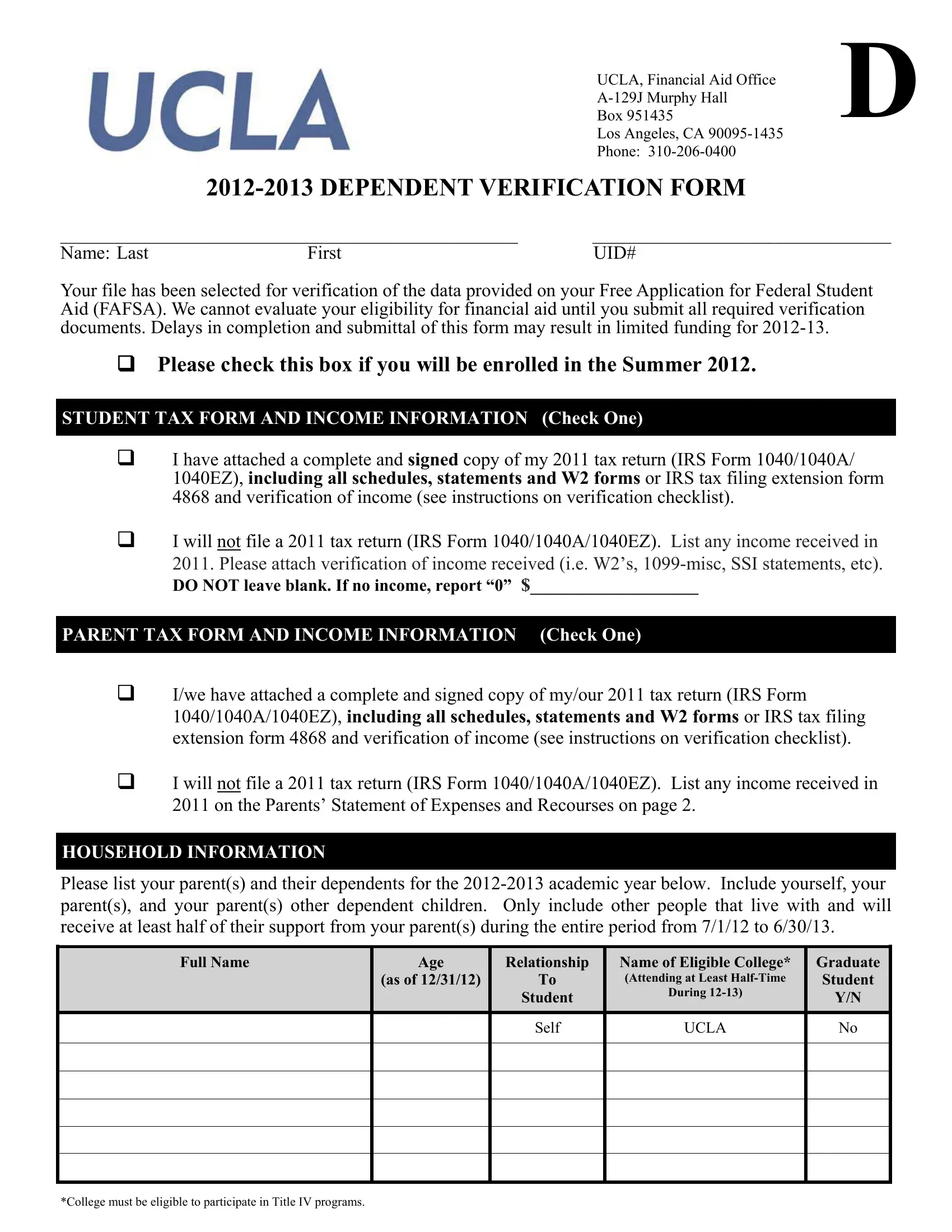
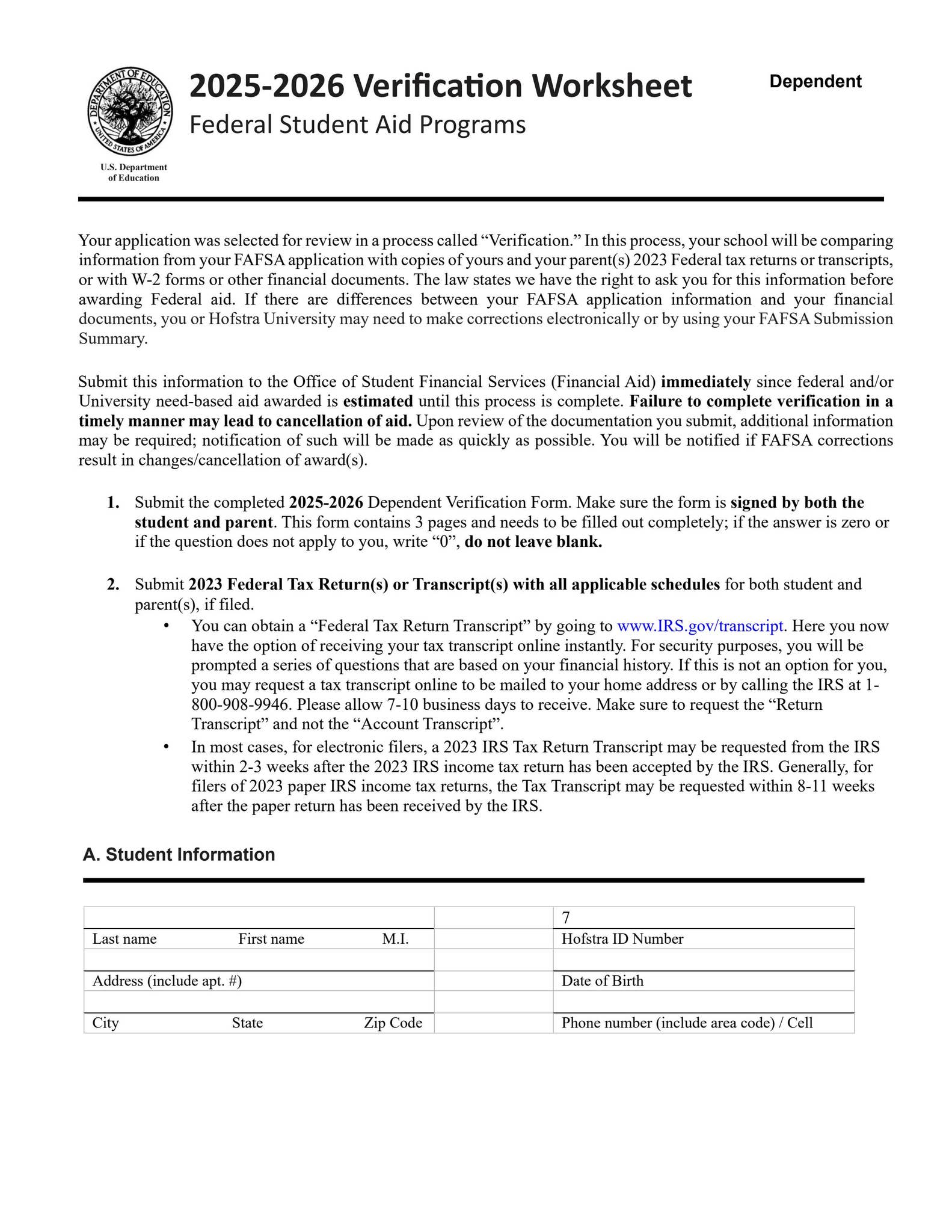
A federal verification worksheet is a school-specific form that collects detailed household and financial information to cross-reference against your Free Application for Federal Student Aid (FAFSA). While the U.S. Department of Education sets the requirements for what must be verified, each individual college or university typically designs its own version of the worksheet.
The primary purpose of the worksheet is to resolve any discrepancies or "flags" generated during the FAFSA filing process. By signing the worksheet, the student (and often a parent) provides a legal statement that the information provided is true. Once the financial aid office receives the completed worksheet and supporting documents, they compare the values to the FAFSA. If differences are found, the school will make corrections to your FAFSA electronically, which may result in a change to your Student Aid Index (SAI).
Why You Were Selected for Verification
Selection for verification does not necessarily mean you made a mistake. In 2026, approximately 20% to 30% of FAFSA applicants are selected for this process. There are several reasons why a student might be flagged:
- Random Selection: The Department of Education selects a percentage of all applications at random to ensure the overall accuracy of the federal aid pool.
- Data Inconsistency: If the income reported on your FAFSA significantly differs from the data retrieved via the Direct Data Exchange (DDX) from the IRS, a verification flag is triggered.
- Incomplete Information: Missing signatures, blank fields that should have been filled, or logical errors (e.g., reporting $0 income but significant assets) can lead to selection.
- Institutional Choice: Even if the federal government does not select you, your specific college has the authority to select any student for verification if they believe the financial information provided is unclear.
Understanding Federal Verification Groups
The Department of Education categorizes students into specific "Verification Tracking Groups." Your school will inform you which group you belong to, as this determines which sections of the worksheet you must complete.
Group V1: Standard Verification
This is the most common group. Students in V1 must verify tax and income information as well as household size. Since the implementation of the FAFSA Simplification Act, much of the tax data is transferred directly, but the worksheet is still used to confirm the number of people in the household and any untaxed income that may not have appeared on tax returns.
Group V4: Custom Verification
This group focuses on identity and educational purpose rather than finances. Students in V4 must usually appear in person at the financial aid office to present a government-issued ID and sign a Statement of Educational Purpose. If you are a distance learner, you may need to have this specific worksheet notarized.
Group V5: Aggregate Verification
V5 combines the requirements of both V1 and V4. You must verify your household and financial data and provide proof of identity and a Statement of Educational Purpose. This is often the most time-consuming group to complete.
| Verification Group | Focus Area | Required Documentation |
|---|---|---|
| V1 (Standard) | Income and Household Size | Tax Return Transcripts, W-2s, Worksheet |
| V4 (Custom) | Identity and Purpose | Valid ID, Statement of Educational Purpose |
| V5 (Aggregate) | All of the Above | Tax Info, ID, and Signed Statement |
How to Complete the Verification Worksheet Step-by-Step
Completing the worksheet requires precision. Errors in this stage can lead to "conflicting information" flags, which can stop your aid processing for weeks.
Step 1: Access the Correct Form
Ensure you are using the worksheet for the correct academic year (2026–2027) and for the correct school. Most institutions provide these forms through their online student portals (e.g., Banner, Workday, or PeopleSoft). Ensure you download the version that corresponds to your status: Dependent or Independent.
Step 2: Household Size and Member Information
You must list every member of your household. For dependent students, this includes yourself, your parents (or stepparents), and your parents' other children if the parents provide more than half of their support. In 2026, even though the FAFSA no longer uses "number in college" to calculate the SAI, many schools still ask for this on the worksheet for institutional aid considerations.
Step 3: Reporting Income for Tax Filers
If you used the IRS Direct Data Exchange (DDX) when filing the FAFSA and did not change the data, you may not need to provide tax transcripts. However, if you filed an amended return or did not use the DDX, you must provide an Official IRS Tax Return Transcript. A simple copy of your 1040 form is often insufficient unless it is signed and the school specifically allows it.
Step 4: Reporting Income for Non-Tax Filers
If you (or your parents) did not work and were not required to file a tax return, you must check the "Non-Filer" box on the worksheet. You will often be required to provide a Verification of Non-Filing Letter from the IRS, which confirms that no return was processed for that tax year.
Step 5: Signatures
This is where many students fail. A "wet" signature (handwritten) is frequently required for verification worksheets. While some schools have moved to secure digital signatures (like DocuSign), many still require a scanned copy of a physically signed document. Dependent students must have a parent sign the worksheet as well.
Required Supporting Documentation
The worksheet is rarely submitted alone. Depending on your situation, you will likely need to gather the following evidence:
- IRS Tax Return Transcript: Requested via the IRS website.
- W-2 Forms: Required for all employers worked for during the 2024 tax year (the "prior-prior" year used for 2026–2027 aid).
- Schedules 1, 2, or 3: If you filed these with your 1040, the school might request them to verify "Adjustments to Income."
- Proof of Identity: A valid, unexpired government-issued photo ID (Driver’s license, Passport, or State ID).
Deadlines and the Impact of Delay
The deadline for federal verification is technically 120 days after the last day of your enrollment or a date in September 2027 (whichever is earlier). However, institutional deadlines are much sooner.
If you do not submit your worksheet by your school’s priority deadline (often in March or April for the following fall), you risk losing out on "first-come, first-served" aid like the Federal Supplemental Educational Opportunity Grant (FSEOG) or state-funded grants. Furthermore, your school cannot disburse your Federal Pell Grant or Direct Loans until verification is complete. This means you could be dropped from your classes if your tuition bill remains unpaid because your aid is "pending."
Common Mistakes to Avoid
- Leaving Blank Spaces: If a question doesn't apply to you, enter "0" or "N/A." Financial aid officers often return forms that have empty fields, assuming they were overlooked.
- Mismatched Marital Status: Ensure the marital status on the worksheet matches the status on the day the FAFSA was filed.
- Conflict with Tax Transcripts: If your worksheet says you made $20,000 but your W-2s show $25,000, the school must investigate the discrepancy. Ensure your numbers are consistent across all documents.
- Using White-Out: Most financial aid offices will reject a form with corrective fluid. If you make a mistake, cross it out, write the correct info, and initial the change.
Frequently Asked Questions
Does being selected for verification mean I'm in trouble?
No. Verification is a standard compliance procedure required by federal law. It is an audit of the data, not a criminal investigation. As long as you provide the requested documentation, your aid will proceed normally.
Can I get an extension on the verification deadline?
While federal deadlines are firm, schools may offer some flexibility with their internal deadlines. However, an "extension" won't prevent the delay of your aid disbursement. It is always better to submit documents as soon as they are requested.
What if my parents refuse to provide their tax information for the worksheet?
If you are a dependent student, your parents' information is required by law for federal aid. If they refuse, you generally cannot be verified and will not be eligible for most federal aid, with the exception of Unsubsidized Direct Loans (and only under specific "parental refusal" circumstances documented by the school).
Why does the school need a "Tax Return Transcript" instead of my 1040?
The IRS Tax Return Transcript is a direct record from the IRS. A 1040 is just the form you intended to file. The transcript ensures that the numbers you are showing the school are the same numbers the IRS actually processed.
How long does the verification process take?
Once you submit all documents, most schools take 2 to 4 weeks to review the file. During peak seasons (July and August), the wait time can extend to 6 weeks or more.
Next Steps for Students
If you have been notified that you are selected for verification, your first action should be to log into your college's financial aid portal and download the specific 2026–2027 Federal Verification Worksheet. Gather your 2024 tax documents immediately. If you need an IRS transcript, request it today, as mail delivery can take up to 10 business days.
Once submitted, monitor your student email daily. The financial aid office may reach out for clarification or additional documents. Completing this process early ensures that your financial aid is "packaged" and ready to pay your tuition before the semester begins, preventing unnecessary stress and late fees.
Image Gallery