How Nonimmigrant Visas Work in the United States: A Complete Guide
A U.S. nonimmigrant visa is an official entry document issued by the U.S. Department of State that allows foreign nationals to travel to a U.S. port of entry and request permission to enter the country temporarily for a specific purpos...
A U.S. nonimmigrant visa is an official entry document issued by the U.S. Department of State that allows foreign nationals to travel to a U.S. port of entry and request permission to enter the country temporarily for a specific purpose, such as tourism, business, study, or specialized employment.
Contents
Disclaimer: This guide is intended for informational purposes only and does not constitute formal legal counsel. Immigration regulations are subject to statutory updates; consult the U.S. Department of State or a qualified U.S. immigration attorney for individualized legal guidance.
Foundational Concepts: Nonimmigrant Intent vs. Immigrant Visas
To understand how U.S. nonimmigrant visas work, you must first distinguish between immigrant and nonimmigrant visas. An immigrant visa is intended for foreign citizens who plan to reside permanently in the United States as Lawful Permanent Residents (LPRs or Green Card holders). In contrast, a nonimmigrant visa is designed for individuals seeking temporary entry for a predefined duration and specific activity.
Section 214(b) and the Presumption of Immigrant Intent
Under the Immigration and Nationality Act (INA), specifically Section 214(b), U.S. immigration law presumes that every nonimmigrant visa applicant intends to abandon their home country and stay in the United States permanently. The burden of proof rests entirely on the applicant to overcome this legal presumption during the application process.
To overcome Section 214(b), an applicant must demonstrate strong, unsevered ties to their country of residence. Consular officers evaluate these ties based on several key factors:
- Financial and Economic Ties: Proof of local employment, business ownership, property deeds, investments, or bank accounts in the home country.
- Social and Family Ties: Immediate family members residing in the home country, community obligations, or caregiving responsibilities.
- Long-Term Intent: A realistic and logical plan showing why the stay in the United States is temporary and why returning home is imperative upon conclusion of the authorized activity.
The Concept of Dual Intent
While most nonimmigrant categories require a pure nonimmigrant intent, U.S. law makes an explicit exception for certain work visa categories under the doctrine of dual intent. Categories such as H-1B (specialty occupation workers), L-1 (intracompany transferees), and O-1 (individuals with extraordinary ability) allow applicants to hold temporary nonimmigrant status while actively seeking permanent residence (a Green Card) without violating their visa terms.
Major U.S. Nonimmigrant Visa Categories
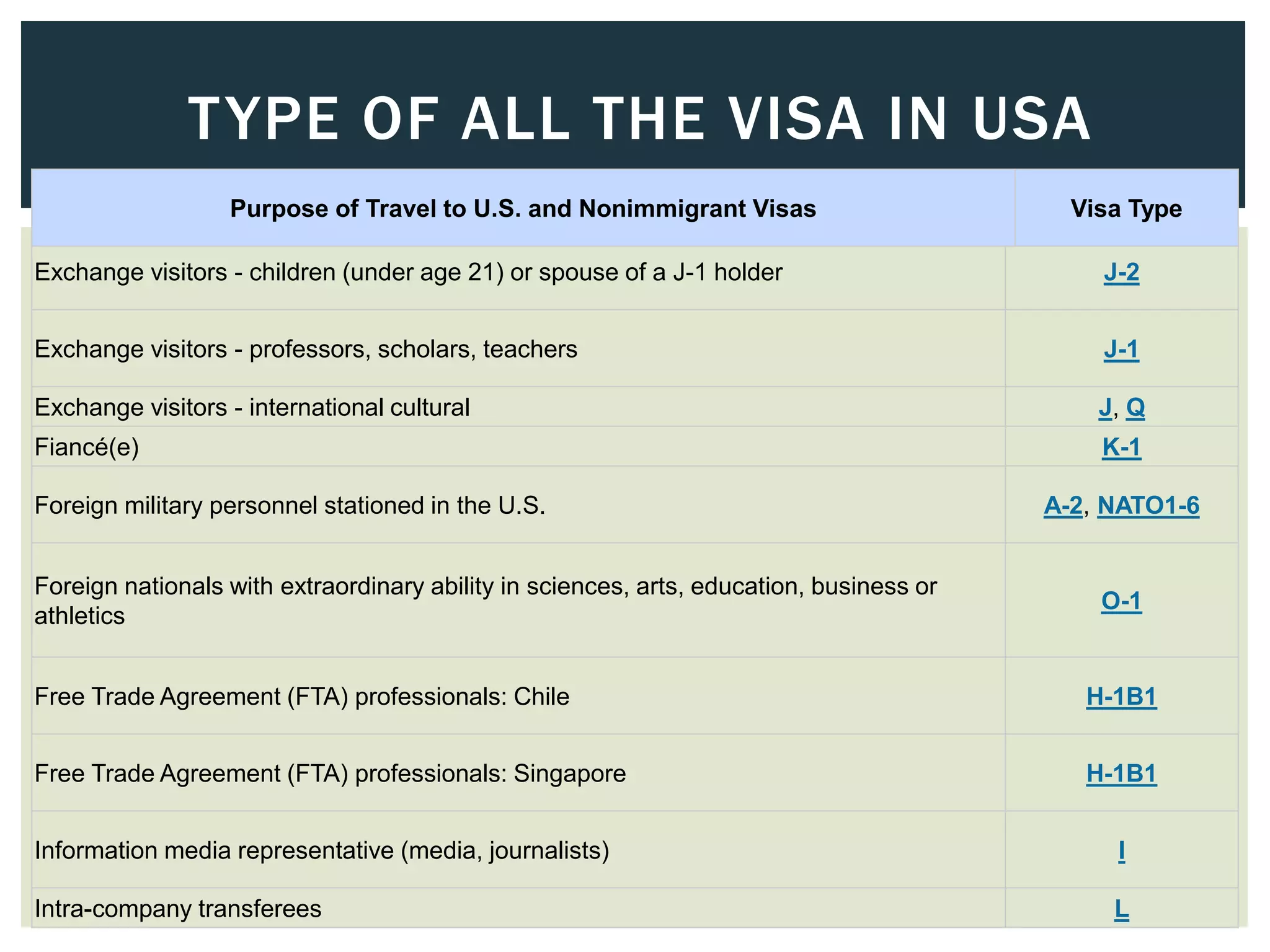
The U.S. government maintains dozens of nonimmigrant visa classifications, each identified by a specific letter and number designation. Choosing the correct classification is essential, as performing activities unauthorized by your visa classification constitutes a legal violation of status.
- U.S. Nonimmigrant Visa Types
- B-1/B-2: Business/Tourism
- F-1/J-1: Academic/Exchange
- H-1B/L-1: Temporary Work
1. Tourism, Visitor, and Business Visas (B-1 / B-2)
- B-1 (Temporary Business Visitor): Designed for attending professional conventions, negotiating contracts, consulting with business associates, or conducting short-term independent research. It does not permit direct employment or receiving compensation from a U.S. source.
- B-2 (Temporary Visitor for Pleasure): Granted for tourism, vacations, medical treatment, visiting relatives, or participating in unpaid social events.
- Visa Waiver Program (VWP) / ESTA: Citizens of designated countries under the Visa Waiver Program can travel to the U.S. for B-1/B-2 purposes for up to 90 days without obtaining a traditional visa stamp, provided they receive authorization through the Electronic System for Travel Authorization (ESTA).
2. Academic and Exchange Visas (F-1, M-1, J-1)
- F-1 (Academic Student): Covers full-time academic studies at accredited colleges, universities, high schools, or language instruction programs approved by the Student and Exchange Visitor Program (SEVP).
- M-1 (Vocational Student): Reserved for students pursuing recognized non-academic or vocational training programs.
- J-1 (Exchange Visitor): Designed for individuals participating in work-and-study-based exchange visitor programs approved by the Department of State, including au pairs, research scholars, professors, short-term interns, and summer work-travel participants.
3. Temporary Worker Visas (H, L, O, P, E, TN)
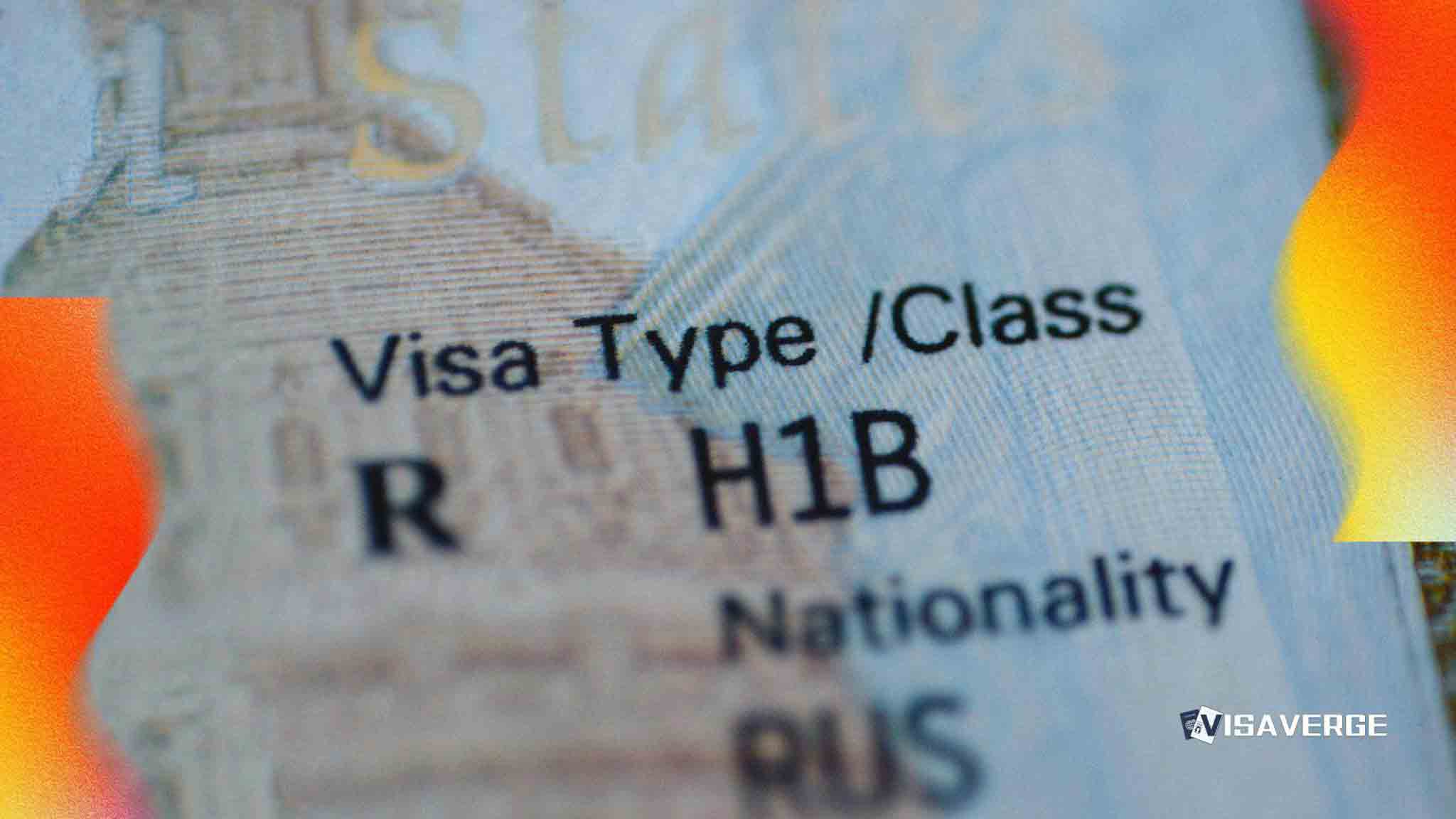
- H-1B (Specialty Occupations): For foreign professionals in positions requiring specialized theoretical and practical application of a body of highly specialized knowledge and a bachelor's degree (or higher) in the specific specialty.
- L-1 (Intracompany Transferees): Allows multinational companies to transfer key employees—executives, managers (L-1A), or specialized knowledge workers (L-1B)—from an overseas office to a U.S. office.
- O-1 (Extraordinary Ability): Reserved for individuals demonstrating extraordinary ability in science, education, business, athletics, or the arts.
- E-2 (Treaty Investors): Granted to nationals of countries maintaining a treaty of commerce and navigation with the United States who invest a substantial amount of capital in a U.S. business.
- TN (NAFTA/USMCA Professionals): Created under the United States-Mexico-Canada Agreement for qualifying Canadian and Mexican citizens in designated professional fields.
Step-by-Step Application Process
While specific steps vary based on visa category and individual embassy rules, the standard workflow for securing a U.S. nonimmigrant visa follows a strict legal and administrative sequence.
- Step 1: Obtain Sponsorship / Petition Approval (If Applicable)
- Step 2: Complete Form DS-160 Online
- Step 3: Pay the Nonrefundable Visa Application Fee (MRV Fee)
- Step 4: Schedule and Attend Embassy/Consulate Interview
- Step 5: Visa Processing, Issuance, and Border Inspection
Step 1: Obtain Sponsorship or Petition Approval (If Applicable)
For temporary work visas (H, L, O, P categories), an applicant cannot apply directly to an embassy first. The prospective U.S. employer must submit a petition—such as Form I-129 (Petition for a Nonimmigrant Worker)—to U.S. Citizenship and Immigration Services (USCIS). Consular processing can only proceed once USCIS approves the petition and issues an official Form I-797 (Notice of Action).
Similarly, academic students (F-1/M-1) must first apply to an SEVP-certified school, obtain acceptance, pay the SEVIS I-901 fee, and receive Form I-20. Exchange visitors (J-1) require a Form DS-2019 from their sponsoring organization.
Step 2: Complete Form DS-160
The primary application document for all nonimmigrant visa applicants is Form DS-160 (Online Nonimmigrant Visa Application). Submitted through the Department of State's Consular Electronic Application Center (CEAC), the form collects background, employment, educational, and travel details.
- Accuracy is critical: Any discrepancy between details in your DS-160, supporting documents, or interview responses can trigger administrative delays or visa refusals.
- Once submitted, a confirmation page with a unique barcode is generated, which is required to book an interview.
Step 3: Pay the Application Fee
Applicants must pay the Machine Readable Visa (MRV) processing fee. Fee amounts vary depending on the category:
- Standard visitor, student, and exchange visas (B-1/B-2, F-1, J-1) typically require the baseline fee.
- Petition-based categories (H, L, O, P, E) require higher fees to reflect processing requirements.
- Certain nationalities may also be subject to an additional reciprocity fee upon approval, designed to match fees charged by that applicant's country to U.S. citizens.
Step 4: Schedule and Attend the Consular Interview
Most applicants between the ages of 14 and 79 must schedule and attend an in-person interview at a U.S. embassy or consulate in their home country or country of legal residence.
During the interview, a U.S. consular officer reviews the application, verifies biometrics (digital fingerprint scans), and asks questions regarding the applicant's travel purpose, travel history, financial standing, and long-term plans. The interview typically lasts only 2 to 5 minutes, making clear, direct answers essential.
Step 5: Visa Issuance and Customs Entry Inspection
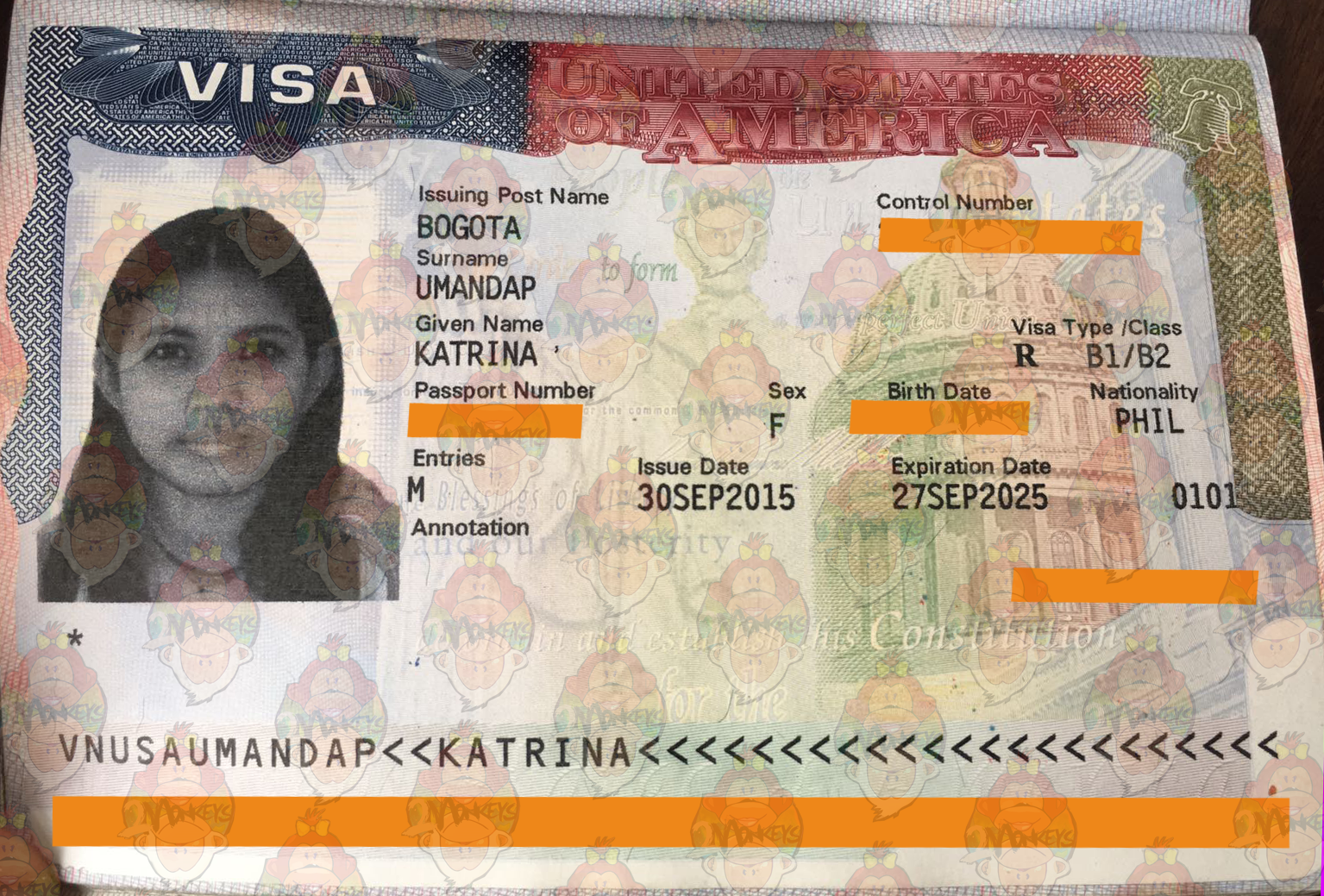
If approved, the embassy retains the applicant's passport to affix the physical visa foil (a machine-readable sticker). Once received, the individual can travel to a U.S. port of entry.
Nonimmigrant Visa Categories Compared
| Visa Category | Primary Purpose | Initial Max Stay | Direct Work Permitted? | Dual Intent Allowed? |
|---|---|---|---|---|
| B-1 / B-2 | Business Visitor / Tourism | 6 months | No | No |
| F-1 | Academic Study | Duration of Status (D/S) | Limited (On-campus / CPT / OPT) | No |
| J-1 | Exchange Visitor / Scholar | Varies by program (1-5 yrs) | Program-specific only | No |
| H-1B | Specialty Occupation Worker | Up to 3 years | Yes (Sponsoring employer only) | Yes |
| L-1A / L-1B | Executive / Specialized Transferee | Up to 3 years | Yes (Petitioning employer only) | Yes |
| O-1 | Extraordinary Ability | Up to 3 years | Yes (Sponsoring employer/agent) | Yes |
| E-2 | Essential Treaty Investor / Employee | Up to 2 years | Yes (Treaty enterprise only) | No (Strict nonimmigrant intent) |
| TN | USMCA Qualified Professional | Up to 3 years | Yes (Sponsoring employer only) | No |
Visa vs. Status: Understanding the Difference at the Border
One of the most frequent points of confusion for travelers is the distinction between a U.S. Visa and U.S. Immigration Status.
- Physical Visa Foil (Travel Key to Entry)
- U.S. Port of Entry Inspection (CBP Officer Review)
- Electronic Form I-94 (Legal Status & Stay)
The Visa is a Travel Document (The Key)
A visa stamped inside your passport acts as an entry clearance document. It allows you to travel to an international port of entry (such as an airport or land border) and request permission to enter the country. The expiration date on the visa stamp indicates the last day you can use the document to request entry into the United States—it does not dictate how long you can remain in the country.
Status Determines Legal Presence (The Clock)
Upon arrival at a port of entry, a officer from U.S. Customs and Border Protection (CBP) evaluates your admissibility. If admitted, CBP assigns an electronic Form I-94 (Arrival/Departure Record).
The I-94 record dictates your legal nonimmigrant status, the operational parameters of your stay, and your mandatory departure date (or an entry marked "D/S" for Duration of Status, common for F-1 students).
- Even if your physical visa stamp expires while you are in the United States, your legal presence remains valid as long as your Form I-94 remains unexpired and you adhere to status terms.
- Conversely, if your visa is valid for ten years, but your I-94 grants entry for 30 days, remaining beyond those 30 days results in an illegal overstay, rendering your visa void under Section 222(g) of the INA.
Common Reasons for Nonimmigrant Visa Refusals
If a consular officer determines an applicant does not meet legal requirements, the application will be refused under specific provisions of the Immigration and Nationality Act.
1. Refusal Under INA Section 214(b)
The most common cause for visa refusal is failing to satisfy the consular officer that you maintain sufficient ties to your foreign residence, or failing to prove that your intended activities match the requested visa category.
- Remedy: A 214(b) refusal is not permanent, but reapplying without demonstrating a material change in financial, employment, or personal circumstances usually yields the same outcome.
2. Administrative Processing Under INA Section 221(g)
A refusal under Section 221(g) indicates that the consular officer lacks necessary information to make a final decision, or that the application requires additional administrative background processing.
- Remedy: The consulate will provide a letter detailing whether the applicant must submit supplemental documentation (such as updated financial records or resumes) or simply wait for background clearances to resolve.
3. Inadmissibility Grounds Under INA Section 212(a)
Section 212(a) lists statutory bars to entry based on past actions, including:
- Misrepresentation or fraud during visa applications.
- Prior unlawful presence or overstays in the United States.
- Specific criminal convictions or security concerns.
- Remedy: Depending on the violation and visa classification, an applicant may need to apply for a nonimmigrant waiver of inadmissibility (such as Form I-192 or consular recommendation under INA 212(d)(3)).
Frequently Asked Questions
How far in advance should I apply for a U.S. nonimmigrant visa?
It is advisable to apply 3 to 6 months prior to your intended travel date. Consular appointment wait times vary by embassy and region, and potential administrative processing under Section 221(g) can add several weeks or months to overall processing timelines.
Can I work legally on a B-1/B-2 tourist visa?
No. B-1/B-2 visa holders are prohibited from taking up gainful local employment or receiving compensation from U.S. source entities. Performing unauthorized work on a visitor visa violates nonimmigrant status and can lead to visa revocation and deportation.
What happens if my visa expires while I am inside the United States?
Your visa stamp is strictly an entry document. As long as your Form I-94 remains valid and you continue to comply with the terms of your status, you are legally permitted to remain in the United States even if your physical visa stamp expires. However, if you travel internationally, you must obtain a new valid visa before re-entering the country.
Is an interview required for all nonimmigrant applicants?
Not always. Consulates frequently offer interview waiver options (often called "dropbox" processing) for eligible renewal applicants within the same visa classification, or for children and senior citizens, provided specific regulatory criteria established by the Department of State are met.
What is the difference between a single-entry and a multiple-entry visa?
A single-entry visa allows you to request entry into the United States once. Once you depart the U.S., the visa becomes invalid for future travel, even if the expiration date has not passed. A multiple-entry visa allows you to travel to a U.S. port of entry repeatedly within the validity period of the visa stamp.
Key Recommendations for Applicants
Navigating the U.S. nonimmigrant visa system requires strict adherence to procedural detail and transparent reporting:
- Select the Correct Visa Category: Confirm that your planned activities in the U.S. align fully with statutory guidelines for the requested visa classification.
- Audit the Form DS-160 for Accuracy: Review all names, employment dates, travel histories, and background questions carefully before electronic submission.
- Prepare Strong Supporting Documentation: Gather evidence proving financial stability, legitimate program intent, and strong economic or social ties to your home country.
- Monitor Your Form I-94 Post-Arrival: Always retrieve your digital Form I-94 from the official CBP online portal immediately after entering the United States to confirm your authorized duration of stay.
Image Gallery