Navigating Capital Lease Amortization: What the Latest Accounting Rules Mean for Your Balance Sheet
The latest lease accounting rules under ASC 842 and IFRS 16 require companies to record right-of-use assets and corresponding lease liabilities on their balance sheets, fundamentally changing how capital leases—now often classified as...
The latest lease accounting rules under ASC 842 and IFRS 16 require companies to record right-of-use assets and corresponding lease liabilities on their balance sheets, fundamentally changing how capital leases—now often classified as finance leases—are amortized, tracked, and reported for financial transparency.
Contents
Understanding the Shift: From Legacy Operating Leases to Modern Finance Leases
The accounting landscape for leases underwent a profound transformation with the implementation of Accounting Standards Codification (ASC) 842 by the Financial Accounting Standards Board (FASB) and International Financial Reporting Standard (IFRS) 16 by the International Accounting Standards Board (IASB). Historically, under ASC 840, companies aggressively structured equipment, real estate, and vehicle agreements as "operating leases" to keep them off the balance sheet. This off-balance-sheet accounting allowed organizations to present lower leverage ratios, making their financial health appear stronger to lenders and investors than it truly was.
The modern framework eliminates this structural loophole. Under the current standards, almost all leases with a term exceeding twelve months must be recognized on the balance sheet. While the old terminology referred to "capital leases," US GAAP now officially designates these as finance leases. Despite the name change, the core economic concept remains: if a lease transfers substantially all the risks and rewards of ownership to the lessee, it is accounted for as the acquisition of an asset financed by borrowing.
For finance leases, the amortization of the right-of-use (ROU) asset and the accretion of the lease liability are decoupled on the income statement. This separation creates distinct financial reporting outcomes that affect EBITDA, operating cash flows, and key financial ratios. Understanding these mechanics is essential for corporate controllers, chief financial officers (CFOs), and external auditors navigating modern compliance.
Core Criteria: How Leases Are Classified as Finance Leases
Before calculating amortization, organizations must correctly classify a contract as either an operating lease or a finance lease. Under ASC 842, a lease is classified as a finance lease if it meets any of the following five distinct criteria at the commencement date:
- Transfer of Ownership: The lease transfers ownership of the underlying asset to the lessee by the end of the lease term.
- Purchase Option: The lease grants the lessee an option to purchase the underlying asset that the lessee is reasonably certain to exercise.
- Lease Term Test: The lease term is for a major part of the remaining economic life of the underlying asset (typically benchmarked at 75% or more).
- Present Value Test: The present value of the sum of lease payments equals or exceeds substantially all of the fair value of the underlying asset (typically benchmarked at 90% or more).
- Specialized Nature: The underlying asset is of such a specialized nature that it is expected to have no alternative use to the lessor at the end of the lease term.
Meeting even one of these criteria forces the classification into a finance lease. Consequently, the accounting treatment requires recognizing a finance lease ROU asset and a lease liability, which are subsequently amortized and measured using specific financial formulas.
Mechanics of Capital Lease Amortization Under ASC 842 and IFRS 16
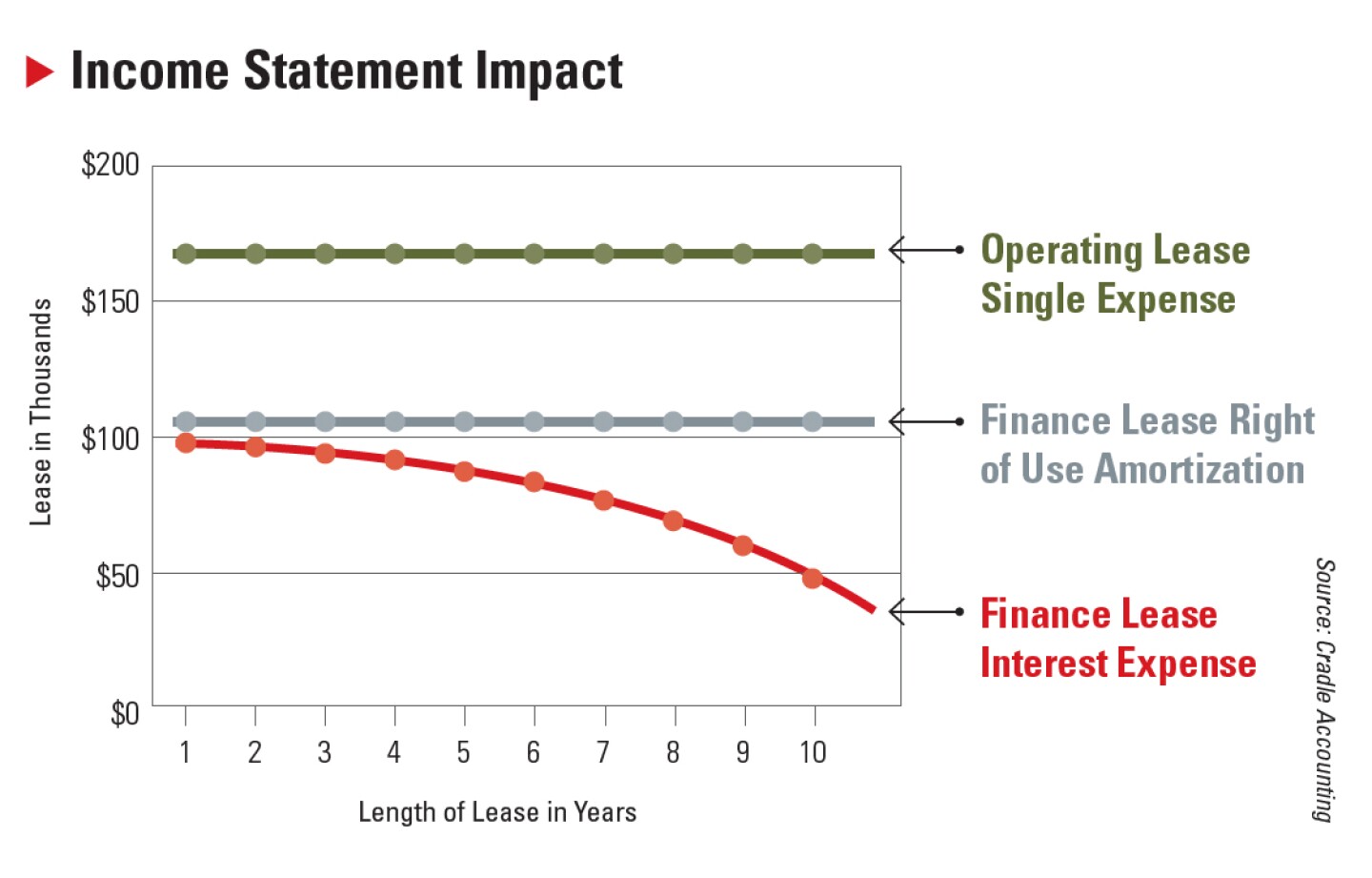
Once a lease is classified as a finance lease, the ongoing accounting workflow requires tracking two distinct components: the ROU asset and the lease liability. Unlike operating leases—where a single, straight-line lease expense is recognized—finance leases front-load total expense over the life of the agreement.
1. Initial Measurement
At the commencement date, the lease liability is measured at the present value of the lease payments not yet paid, discounted using the rate implicit in the lease or, if that rate cannot be readily determined, the lessee’s incremental borrowing rate. The ROU asset is measured at the initial amount of the lease liability, adjusted for any lease payments made at or before the commencement date, initial direct costs incurred, and any lease incentives received.
2. Subsequent Measurement of the Lease Liability
The lease liability is accounted for using the effective interest method. It is increased to reflect interest accrued on the liability and reduced by the lease payments made during the period. The interest expense is calculated by multiplying the beginning lease liability balance by the discount rate.
3. Subsequent Measurement of the Right-of-Use Asset
The finance lease ROU asset is typically amortized on a straight-line basis from the commencement date to the earlier of the end of the useful life of the underlying asset or the end of the lease term. However, if the lease transfers ownership of the asset to the lessee or if the lessee is reasonably certain to exercise a purchase option, the ROU asset is amortized over the economic life of the underlying asset.
| Accounting Element | Operating Lease Treatment | Finance (Capital) Lease Treatment |
|---|---|---|
| Balance Sheet Presentation | Single ROU Asset & Single Lease Liability | Single ROU Asset & Single Lease Liability |
| Income Statement Expense | Single lease cost (straight-line presentation) | Front-loaded expense split into amortization and interest |
| Amortization Pattern | Combined into operating lease expense | Straight-line asset amortization (unless ownership transfers) |
| Classification of Cash Flows | Operating activities | Principal payments in financing; interest in operating |
Financial Statement and Ratio Impacts
The transition from legacy rules to the current amortization framework alters corporate financial statements in ways that every finance professional must monitor. Because finance lease expense is bifurcated into asset amortization (typically reported within depreciation and amortization) and interest expense, operating income (EBIT) and EBITDA appear higher for companies with significant finance leases compared to how they would look if those costs were classified entirely as operating expenses.
However, this structural shift introduces complexities for financial covenant compliance:
- Debt-to-Equity Ratios: Adding substantial lease liabilities to the balance sheet increases total debt, which can negatively impact leverage ratios and restrict additional borrowing capacity under existing credit agreements.
- Return on Assets (ROA): Because total assets increase due to the ROU asset recognition while net income fluctuates, ROA can experience downward pressure.
- Current Liabilities: The portion of the lease liability due within the next twelve months must be classified as a current liability, impacting current ratios and working capital assessments.
Lenders and credit rating agencies are well-aware of these adjustments and frequently normalize financial statements by applying proprietary adjustments when evaluating borrower creditworthiness. Maintaining clear footnote disclosures regarding lease portfolios is vital for transparent communication with stakeholders.
Step-by-Step Guide to Managing Finance Lease Amortization Schedules
Implementing compliant amortization schedules requires a disciplined operational workflow. Organizations managing complex asset portfolios should follow a structured procedure to ensure accuracy:
- Data Extraction and Centralization: Review all master lease agreements (MLAs), equipment schedules, and real estate contracts to extract key data points: commencement dates, payment amounts, frequencies, escalation clauses, renewal options, and discount rates.
- Determine the Discount Rate: Identify the rate implicit in each lease. If unavailable, establish an appropriate incremental borrowing rate based on the currency, asset class, and lease term matching the corporate debt profile.
- Perform Classification Tests: Run automated or manual tests against the five ASC 842 / IFRS 16 classification criteria to accurately separate operating and finance leases.
- Establish Initial ROU Asset and Liability Values: Calculate the present value of future cash flows to set up the baseline ledger entries.
- Build the Amortization Schedule: Construct a month-by-month schedule separating interest expense accretion from ROU asset straight-line amortization.
- Automate and Reconcile: Utilize dedicated lease accounting software or robust enterprise resource planning (ERP) modules to handle monthly journal entries, currency revaluations, and impairment reviews.
Common Compliance Pitfalls and How to Avoid Them
Even with sophisticated accounting software, organizations frequently encounter specific pitfalls when administering capital and finance lease amortization:
- Ignoring Remeasurement Triggers: Leases are not static. Modifications such as exercising a renewal option, changing the scope of the asset, or altering lease payments require immediate remeasuring of both the lease liability and the ROU asset using updated discount rates.
- Miscalculating the Discount Rate: Using a blanket corporate borrowing rate across all asset classes instead of term-matched incremental borrowing rates distorts present value calculations and subsequent amortization schedules.
- Overlooking Impairment: ROU assets are subject to long-lived asset impairment testing under ASC 360. Failing to test assets when adverse business events occur can lead to overstated asset balances on the balance sheet.
- Inadequate Documentation: Auditors closely scrutinize management judgments regarding whether a lessee is "reasonably certain" to exercise renewal or purchase options. Documenting the business rationale behind these assumptions prevents restatements.
Frequently Asked Questions
What is the difference between a capital lease and a finance lease under current rules?
Under current US GAAP (ASC 842), the term "capital lease" has been officially replaced by "finance lease." While the underlying economic substance and accounting mechanics remain largely identical—recognizing asset amortization and interest expense separately—the terminology was updated to align more closely with international standards (IFRS 16).
How does finance lease amortization affect EBITDA?
Finance lease expense is split into two line items on the income statement: interest expense and asset amortization (depreciation). Because neither interest nor depreciation is included in EBITDA (Earnings Before Interest, Taxes, Depreciation, and Amortization), having finance leases rather than operating leases typically results in a higher reported EBITDA, though total net income over the life of the lease remains comparable.
What discount rate should be used to calculate lease liabilities?
Lessee companies should first use the rate implicit in the lease if it is readily determinable. If the lessor does not make this rate available, private companies can use a risk-free rate (such as the Treasury rate corresponding to the lease term) as a practical expedient, while public companies must use their incremental borrowing rate.
How are lease modifications handled in amortization schedules?
When a lease is modified—such as through a change in lease term or payment structure—the lessee must remeasure the lease liability using the discount rate effective at the modification date. The difference between the remeasured liability and the carrying amount of the liability is adjusted directly against the ROU asset.
Are short-term leases subject to these capitalization rules?
No. Entities can elect an accounting policy exemption for short-term leases, defined as leases with a term of 12 months or less that do not include a purchase option that the lessee is reasonably certain to exercise. These leases continue to be expensed on a straight-line basis over the lease term without balance sheet recognition.
Practical Next Steps for Finance Teams
For organizations seeking to ensure absolute compliance and operational efficiency regarding capital and finance lease amortization, the immediate priority is conducting a comprehensive internal audit of all active contracts. Verify that your lease administration software correctly segregates finance leases from operating leases and accurately automates the effective interest method alongside straight-line asset amortization. Collaborating closely with independent auditors ahead of reporting cycles ensures that management judgments surrounding discount rates, lease terms, and impairment testing remain defensible and fully compliant with current regulatory expectations.
Image Gallery