Navigating the Singapore Ministry of Finance in the 2024 Budget: Key Policies and Economic Strategies
The Singapore Ministry of Finance formulated the 2024 budget to balance near-term cost-of-living pressures with long-term economic restructuring, focusing heavily on workforce upskilling, enterprise digital transformation, and targeted...
The Singapore Ministry of Finance formulated the 2024 budget to balance near-term cost-of-living pressures with long-term economic restructuring, focusing heavily on workforce upskilling, enterprise digital transformation, and targeted household support.
Contents
Introduction to the 2024 Singapore Budget
The Singapore Ministry of Finance (MOF) plays a pivotal role in shaping the nation's economic landscape, fiscal policies, and social development frameworks. Released against a backdrop of global economic uncertainty, high inflation, and rapid technological shifts, the 2024 Singapore Budget—delivered by then-Deputy Prime Minister and Minister for Finance Lawrence Wong—centered on the theme of a "vibrant, resilient, and inclusive" society.
Understanding the mechanics and policy directions of the MOF in this specific legislative and fiscal cycle requires looking closely at how public funds were allocated. The budget sought to address immediate cost-of-living pressures faced by citizens while simultaneously investing in structural capabilities like artificial intelligence, green transition technologies, and workforce capabilities. This analysis breaks down the core pillars of the 2024 budget, examining how the ministry structured its fiscal measures to support businesses, empower individuals, and secure Singapore's long-term economic competitiveness.
Economic Context and Fiscal Objectives
Before dissecting individual policy measures, it is essential to understand the economic environment that dictated the Ministry of Finance's strategy for 2024. Singapore’s open economy faced moderating global growth, persistent inflationary pressures stemming from supply chain realignments, and structural labor constraints due to an aging population.
The MOF designed the fiscal package to achieve three primary objectives:
- Immediate Relief: Cushioning households and enterprises against rising costs of living and doing business.
- Enterprise Transformation: Equipping local businesses with the digital and financial tools necessary to scale and compete globally.
- Workforce Development: Providing citizens with continuous learning opportunities to secure higher-value jobs in an evolving economy.
Fiscal prudence remained a cornerstone of the policy. Despite substantial spending packages, the government maintained a balanced approach, utilizing projected surpluses and past reserves responsibly to fund future-oriented initiatives without imposing unsustainable tax burdens.
Support for Households and Cost-of-Living Measures
A major focus of the 2024 budget involved direct assistance for Singaporean households managing inflationary pressures. The Ministry of Finance enhanced several existing schemes and introduced new one-off disbursements to ensure lower- to middle-income families received adequate cushioning.
Enhancements to the Assurance Package
The Assurance Package (AP), originally introduced to offset the Goods and Services Tax (GST) rate increase, was substantially topped up in 2024. Key components included:
- Cash Payouts: Additional cash disbursements ranging from SGD 200 to SGD 600 for eligible adult Singaporeans, tiered by income and property ownership.
- Community Development Council (CDC) Vouchers: Additional CDC vouchers distributed to every Singaporean household to help defray everyday expenses at heartland merchants and supermarkets.
- U-Save and Service and Conservancy Charges (S&CC) Rebates: HDB households received targeted rebates to offset utilities and local council charges, mitigating the impact of rising energy costs.
These measures reflected the MOF's intent to target relief progressively, ensuring that those with greater needs received proportionately higher support.
Empowering Businesses and Driving Enterprise Transformation
For businesses, the 2024 budget shifted away from broad pandemic-era survival grants toward targeted capability-building, innovation, and internationalization. The Ministry of Finance recognized that Singaporean enterprises must move up the value chain to remain viable amid rising domestic operational costs.
Key Corporate Fiscal Incentives
| Scheme / Measure | Target Beneficiaries | Primary Objective |
|---|---|---|
| Enterprise Financing Scheme (EFS) | Small and Medium Enterprises (SMEs) | Enhanced maximum loan quantum for trade, working capital, and green investments. |
| SkillsFuture Enterprise Credit (SFEC) | Eligible employers | Financial support for employer-led training and business transformation efforts. |
| Corporate Income Tax (CIT) Rebate | All companies taxable in Singapore | A 50% CIT rebate for corporate tax payable for the Year of Assessment 2024 to ease business costs. |
| Refundable Investment Credit (RIC) | High-value economic activities | A tax credit mechanism to attract strategic investments in advanced manufacturing, green tech, and R&D. |
The introduction of the Refundable Investment Credit (RIC) was particularly significant. Designed as a sensible response to global minimum tax rules under the OECD Base Erosion and Profit Shifting (BEPS 2.0) initiative, the RIC ensures Singapore remains competitive in attracting multinational and high-value domestic investments through refundable tax credits.
Workforce Development and Upskilling Initiatives
Human capital remains Singapore's primary economic asset. The 2024 budget introduced landmark enhancements to workforce training programs, spearheaded by the Ministry of Finance in collaboration with the Ministry of Manpower and SkillsFuture Singapore.
The SkillsFuture Level-Up Programme
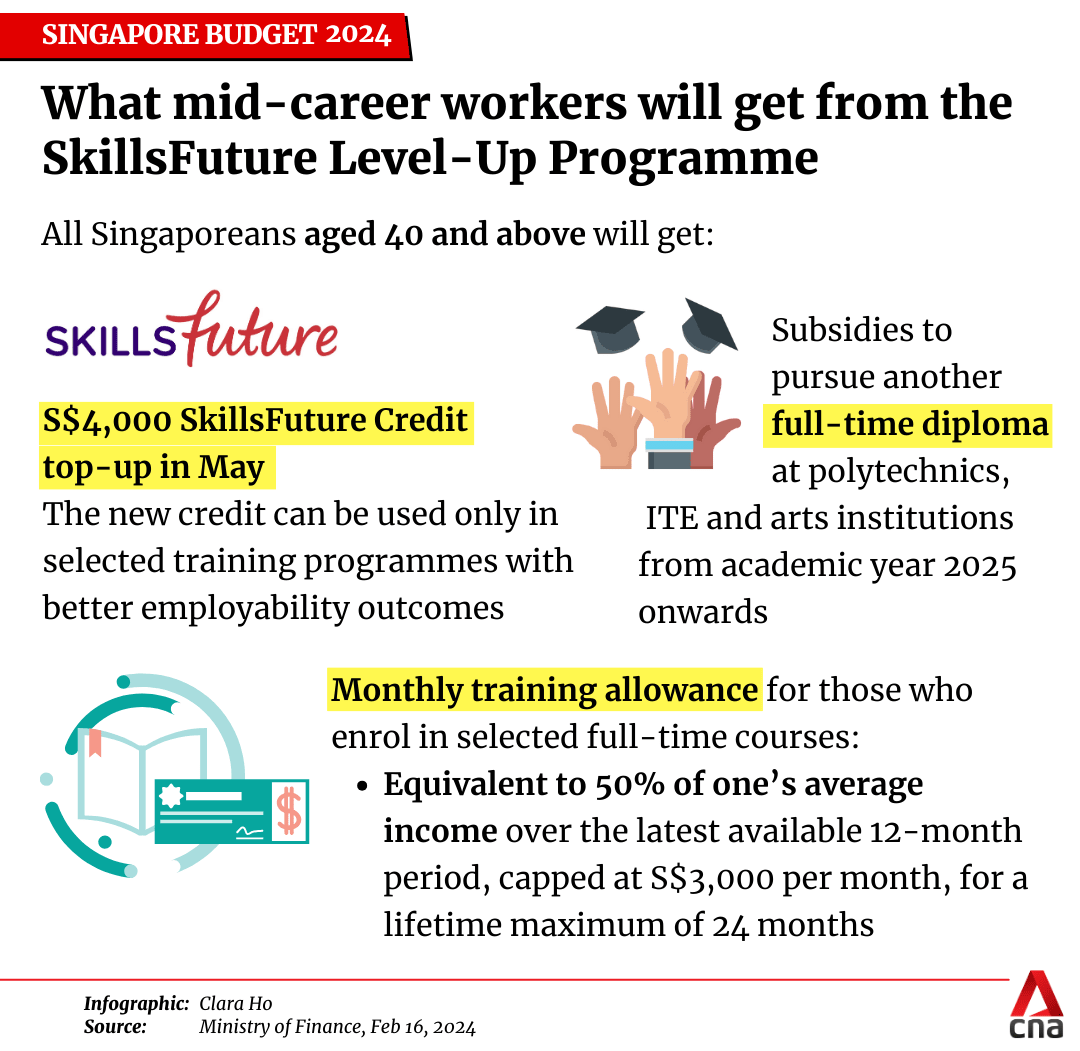
To address structural unemployment and encourage mid-career transformation, the MOF launched the SkillsFuture Level-Up Programme. This initiative specifically targeted Singaporeans aged 40 and above:
- Top-Up Credits: A substantial SGD 4,000 SkillsFuture credit top-up dedicated to subsidized training programs with higher employment relevance.
- Training Allowances: Subsidies for individuals taking time off work to pursue full-time, long-form institutional training courses, reducing the opportunity cost of upskilling.
These measures marked a strategic evolution in manpower policy, shifting from episodic training to sustained, career-long professional renewal.
Strengthening Social Safety Nets and Retirement Adequacy
Beyond immediate relief and economic growth, the 2024 budget addressed long-term social security, particularly regarding retirement funding and healthcare affordability for an aging demographic.
Central Provident Fund (CPF) Adjustments
The MOF implemented several structural adjustments to the Central Provident Fund (CPF) system:
- Closure of the Special Account: For members aged 55 and above, the Special Account was closed to streamline retirement savings into the Retirement Account, optimizing interest accumulation for retirement payouts.
- Enhanced CPF Transition Support: Lower-income and middle-income workers received increased CPF contributions from employers, backed by government co-funding, to accelerate retirement adequacy.
- MediSave Updates: Higher CPF MediSave contribution rates and increased limits for MediSave accounts helped offset escalating healthcare and insurance costs for seniors.
Frequently Asked Questions
What was the primary focus of the Singapore Ministry of Finance in the 2024 budget?
The 2024 budget focused on addressing immediate cost-of-living pressures through enhanced household support packages while simultaneously investing in enterprise digital transformation, workforce upskilling, and long-term economic resilience.
How did the 2024 budget assist businesses facing rising operating costs?
Businesses benefited from a 50% Corporate Income Tax rebate for the Year of Assessment 2024, enhanced loan maximums under the Enterprise Financing Scheme, and targeted tax credits like the Refundable Investment Credit to encourage high-value investments.
What changes were introduced for older workers under SkillsFuture?
Singaporeans aged 40 and above received a SGD 4,000 SkillsFuture credit top-up along with training allowances to support enrollment in full-time, career-relevance training courses and mid-career pivots.
How were cost-of-living pressures mitigated for Singaporean households?
The government topped up the Assurance Package, providing tiered cash payouts, additional Community Development Council vouchers, and enhanced utility and service charge rebates for eligible HDB households.
What structural adjustments were made to the Central Provident Fund in 2024?
Key CPF changes included the closure of the Special Account for members aged 55 and above to streamline retirement funds into the Retirement Account, alongside increased employer contribution rates and government co-funding for lower-wage workers.
Conclusion and Next Actions
The Singapore Ministry of Finance's 2024 budget demonstrated a disciplined, comprehensive approach to balancing fiscal responsibility with progressive social support. For individuals and business owners navigating these policies, the key takeaway is active engagement with available government schemes. Citizens should review their eligibility for Assurance Package disbursements and maximize their SkillsFuture credits for professional development. Meanwhile, enterprises should consult official portal guidance from Enterprise Singapore and the Inland Revenue Authority of Singapore (IRAS) to leverage tax rebates, financing schemes, and capability grants effectively.
Image Gallery