How Long After a Heart Attack Can You Get Life Insurance?
Most life insurance companies require a waiting period of at least 3 to 6 months after a heart attack before considering an application for traditional fully underwritten coverage. To secure competitive rates on term or permanent polic...
Most life insurance companies require a waiting period of at least 3 to 6 months after a heart attack before considering an application for traditional fully underwritten coverage. To secure competitive rates on term or permanent policies, carriers typically prefer to see 6 to 12 months of stable cardiac recovery, documented follow-up care, and compliance with prescribed treatment.
Contents
Life Insurance Eligibility Timelines After a Heart Attack
Securing life insurance following a myocardial infarction (heart attack) depends heavily on the time elapsed since the event, the extent of cardiac damage, and your ongoing health management. Life insurance underwriters view a recent heart attack as a period of heightened risk for secondary cardiovascular events. Consequently, approval timelines are structured into clear post-event windows.
Post-Heart Attack Timeline & Coverage Availability:
- 0 - 3 Months: Postponed for fully underwritten policies. Group/Guaranteed Issue available.
- 3 - 6 Months: Initial consideration window for mild, single-vessel events.
- 6 - 12 Months: Standard window for fully underwritten coverage with Table Ratings.
- 12+ Months: Optimal window for improved ratings with stable echo, stress tests, & compliance.
0 to 3 Months Post-Heart Attack: The Postponement Window
During the first 90 days following a heart attack, virtually all traditional life insurance carriers will postpone an application for fully underwritten term or whole life coverage. Insurance medical directors view this immediate post-event period as unstable. The primary objective for underwriters during these early months is to observe whether complications arise, such as arrhythmias, recurrent ischemia, or heart failure.
If coverage is urgent during this window, guaranteed issue life insurance or employer-sponsored group life insurance are usually the only available avenues, as neither requires medical underwriting or cardiac health questionnaires.
3 to 6 Months Post-Heart Attack: Early Evaluation
Between 3 and 6 months post-event, some life insurance companies will accept applications for mild or uncomplicated heart attacks (such as a single-vessel event treated successfully with a stent). However, approval during this period requires a clean follow-up record, including:
- A post-event echocardiogram demonstrating restored or preserved heart function.
- Complete adherence to medications like antiplatelets, statins, and beta-blockers.
- Resolution of any acute symptoms such as angina or shortness of breath.
Most policies approved in this window carry higher risk classifications, known as table ratings, or temporary fee additions called flat extras.
6 to 12 Months Post-Heart Attack: Standard Underwriting Window
The 6 to 12-month mark represents the standard timeframe where mainstream life insurance carriers actively underwrite applicants with a history of cardiovascular disease. By this stage, medical records usually contain a complete cardiac workup, including a post-rehabilitation exercise stress test and stable laboratory results. Applicants who have completed cardiac rehabilitation and maintained stable health metrics can often secure term or whole life insurance at manageable rates.
12 Months and Beyond: Optimal Underwriting Conditions
After one full year of stability, insurance companies have sufficient clinical data to measure long-term prognosis. If follow-up appointments show no residual ischemia, normal or near-normal left ventricular function, and well-controlled blood pressure and cholesterol, the risk premium decreases significantly. After 2 to 5 years of stability, some applicants with minor initial events may even qualify for standard health classifications.
How Underwriters Rate Applicants with a History of Heart Attack
Life insurance companies utilize specific medical indicators from an applicant's Attending Physician Statement (APS) to assess long-term risk post-myocardial infarction. Underwriters do not evaluate heart attacks strictly on a pass/fail basis; instead, they analyze several distinct clinical parameters.
1. Left Ventricular Ejection Fraction (LVEF)
The Left Ventricular Ejection Fraction measures the percentage of blood pumped out of the heart's main pumping chamber with each contraction. A normal LVEF ranges between 55% and 70%.
- LVEF 55% or higher: Favorable for underwriting; indicates minimal damage to heart muscle tissue.
- LVEF 45% to 54%: Mild impairment; results in moderate table ratings (higher premiums).
- LVEF 35% to 44%: Moderate impairment; results in severe table ratings or simplified issue options.
- LVEF below 35%: Significantly elevated risk; generally results in decline for traditional coverage, directing applicants toward guaranteed issue products.
2. Type and Severity of the Event
Underwriters distinguish between different types of cardiac events:
- NSTEMI (Non-ST-Segment Elevation Myocardial Infarction): Typically involves partial blockage of a coronary artery and milder tissue injury. Underwritten more favorably if caught early.
- STEMI (ST-Segment Elevation Myocardial Infarction): Indicates a complete coronary artery blockage and greater potential for permanent tissue necrosis. Requires rigorous documentation of recovery.
- Single-Vessel vs. Multi-Vessel Disease: Blockages limited to a single coronary artery carry lower long-term risk than multi-vessel disease involving the Left Main or Left Anterior Descending (LAD) arteries (often referred to as high-risk anatomical locations).
3. Revascularization Procedures
The method used to restore blood flow to the heart muscle alters the risk calculation:
- Percutaneous Coronary Intervention (PCI / Stent Placement): Less invasive with faster recovery times. If stents remain open (patent) and follow-up stress testing is normal, underwriting is straightforward.
- Coronary Artery Bypass Grafting (CABG): Major open surgery requiring a longer recovery window (often 6 to 12 months postponed) before traditional underwriters will accept an application.
Comparing Life Insurance Options Post-Heart Attack
Depending on the time elapsed since your heart attack and your overall medical standing, different life insurance policy types offer distinct advantages and limitations.
| Policy Type | Typical Waiting Period | Medical Exam Required? | Coverage Limits | Premium Level |
|---|---|---|---|---|
| Fully Underwritten Term / Whole Life | 3 to 12 months | Yes (Paramedical exam & APS) | $100,000 to $5,000,000+ | Lowest available rate for high-risk profiles (Substandard) |
| Simplified Issue Life Insurance | 1 to 2 years post-event | No (Medical questionnaire only) | $25,000 to $250,000 | Moderate to high; built-in risk margin |
| Guaranteed Issue Life Insurance | None (Immediate eligibility) | No (No medical questions) | $5,000 to $25,000 | Highest cost per thousand dollars of coverage |
| Group Life Insurance (Employer) | None (During open enrollment) | No (Up to guaranteed issue limit) | 1x to 4x Annual Salary | Low to moderate; subsidized by employer |
Understanding Substandard Table Ratings and Flat Extras
When an insurance company approves an applicant after a heart attack, the policy is rarely issued at "Standard" or "Preferred" pricing. Instead, underwriters assign a Substandard Rating (also known as a Table Rating) or apply a Flat Extra.
Table Ratings Explained
Standard rates are designed for individuals with average life expectancy. Table ratings increase the standard premium by a fixed percentage for every step down in the rating scale:
- Table A (or 1): Standard Premium + 25%
- Table B (or 2): Standard Premium + 50%
- Table C (or 3): Standard Premium + 75%
- Table D (or 4): Standard Premium + 100% (Double the standard premium)
- Table E through H: Incremental increases up to +200% or higher.
For example, an applicant who would normally pay $50 per month for a standard term policy might pay $100 per month if rated Table D due to a moderate heart attack two years prior.
Flat Extra Fees
In some cases, an insurer will add a Flat Extra fee—a specific dollar amount added per $1,000 of coverage for a temporary duration (e.g., $2.50 to $5.00 per $1,000 for 2 to 5 years). This extra charge offsets the heightened statistical risk of recurrent cardiac events during the initial recovery years.
Steps to Prepare for a Post-Heart Attack Life Insurance Application
To maximize your chances of policy approval and secure the lowest possible table rating, proper preparation before applying is critical.
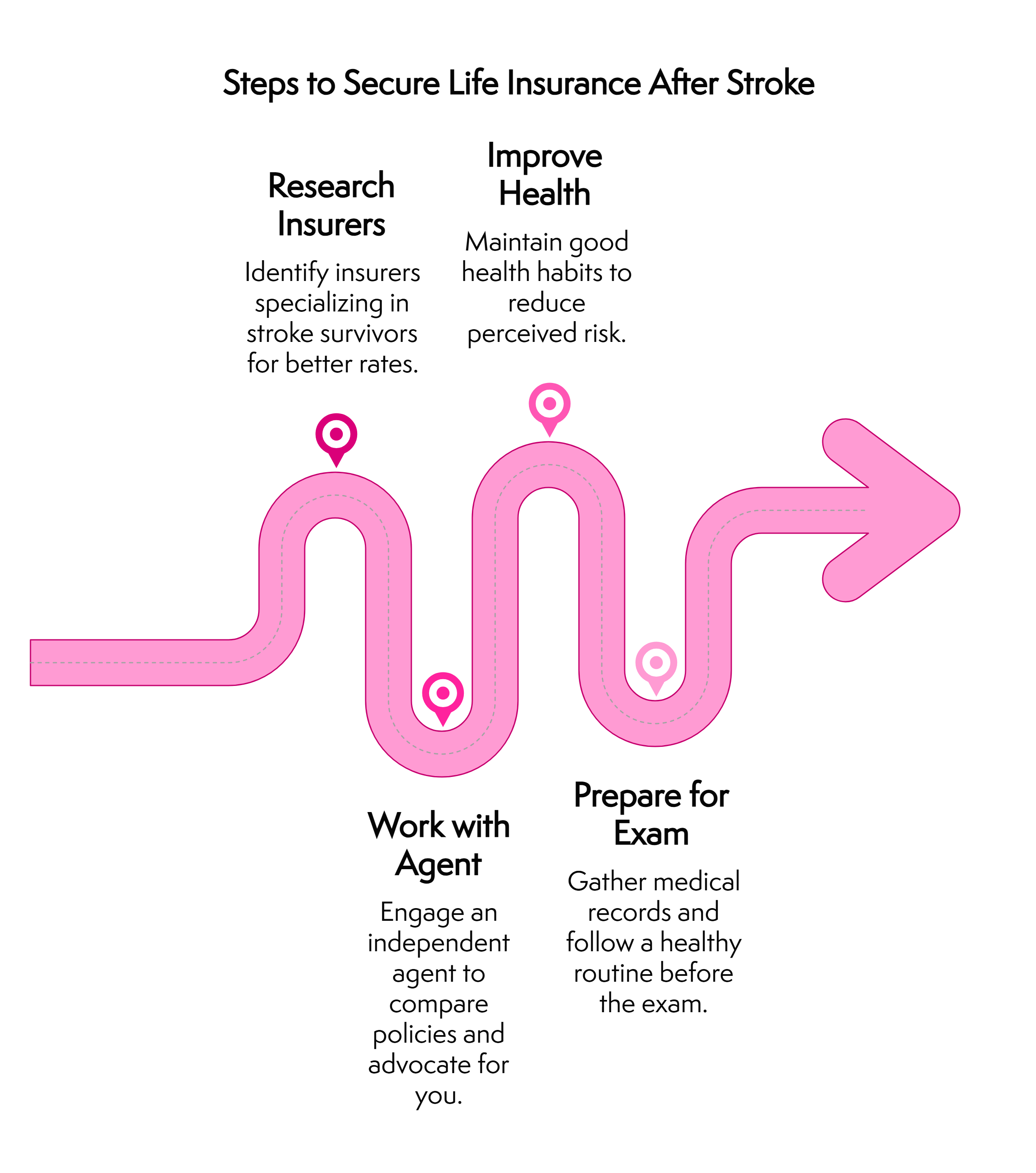
Step-by-Step Preparation Pathway:
- Gather Medical Records
- Verify Stability Metrics
- Consult Independent Broker
- Submit Pre-Market Inquiry
Step 1: Gather Complete Medical Documentation
Insurance companies will request an Attending Physician Statement (APS) from your cardiologist and primary care physician. You can expedite the process by securing these documents in advance:
- Discharge summaries from the hospital admission.
- Operative reports for stent placement (PCI) or bypass surgery (CABG).
- Recent Echocardiogram (Echo) reports confirming LVEF percentage.
- Recent Exercise Stress Test (EST) or nuclear cardiology imaging results.
- Current lab work showing lipid panels (HDL, LDL, triglycerides) and HbA1c levels.
Step 2: Ensure Strict Treatment Compliance
Underwriters prioritize patient compliance above almost all other qualitative factors. To demonstrate low risk:
- Maintain consistent filled prescriptions for prescribed cardiac medications (e.g., statins, antiplatelets, ACE inhibitors).
- Complete an accredited Cardiac Rehabilitation Program if prescribed by your physician.
- Attend all scheduled follow-up appointments with your cardiologist.
Step 3: Address Modifiable Risk Factors
Combining a cardiac history with other unmanaged risk factors significantly increases policy denial rates. Prior to applying:
- Stop All Tobacco Use: Smoking after a heart attack causes significant underwriting penalties, often resulting in immediate declines for fully underwritten policies.
- Control Blood Pressure and Blood Sugar: Ensure resting blood pressure readings are consistently below 130/80 mmHg and blood glucose or HbA1c levels are within normal parameters.
- Manage Body Mass Index (BMI): Weight control reduces cardiovascular strain and improves risk scoring.
Step 4: Work with an Independent High-Risk Broker
Avoid applying directly to a single insurance carrier without prior screening. Different insurance companies maintain varying risk appetites for cardiovascular conditions; one carrier may postpone an applicant for 12 months, while another may offer Table C rates at 6 months. An independent broker specialized in impaired-risk underwriting can submit anonymous pre-market inquiries to multiple carriers simultaneously without triggering a formal application decline on your record.
Frequently Asked Questions
Can I get life insurance immediately after getting a heart stent placed?
No, traditional fully underwritten life insurance policies cannot be obtained immediately after stent placement. Most carriers enforce a 3 to 6-month postponement period from the date of the procedure to ensure the blood vessel remains open (patent) and that no early post-procedural complications occur. Guaranteed issue policies remain available immediately without a medical exam.
Will my life insurance rates decrease as more time passes after my heart attack?
Yes. As time elapses without further cardiac events or symptoms, your statistical risk decreases. If you purchase a policy with a high table rating shortly after your heart attack, you can request a re-evaluation or rate reduction from your carrier after 1 to 2 years of proven medical stability, normal follow-up stress tests, and maintained health metrics. Alternatively, you can apply for a new policy at a lower rate.
What happens if my life insurance application is postponed?
A postponement is not a permanent denial. It simply means the insurer requires more time to observe your recovery or needs updated clinical testing (such as an upcoming annual cardiology exam or stress test) before making a final underwriting decision. If postponed, work with your doctor to fulfill the necessary health milestones and reapply at the recommended future date.
How does Left Ventricular Ejection Fraction (LVEF) affect underwriting decisions?
LVEF measures how effectively your heart pumps blood. An LVEF of 55% or higher is considered normal and allows for the best available health ratings post-heart attack. An LVEF below 45% indicates mild-to-moderate heart muscle damage, leading to higher table ratings (higher premiums). An LVEF below 35% typically results in a decline for traditional term or whole life insurance.
Is employer group life insurance affected by a heart attack?
No. Basic employer-sponsored group life insurance typically offers guaranteed acceptance up to a specified coverage threshold (e.g., 1x or 2x your annual salary) during open enrollment or initial hire periods. Employer group policies generally do not require medical underwriting or health questionnaires, making them an important source of immediate protection post-event.
Strategic Recommendations for Applicants
If you have survived a heart attack and need life insurance, follow this practical checklist to navigate the application process effectively:
- Wait Out the Initial Recovery Period: Unless you require immediate short-term coverage via guaranteed issue policies, wait at least 6 months post-event before submitting a formal application for term or whole life insurance to avoid avoidable postponements.
- Complete All Recommended Cardiac Testing: Ensure your cardiologist has conducted a post-event echocardiogram and a treaded exercise stress test. Up-to-date, favorable diagnostic reports are essential for securing substandard table ratings instead of policy denials.
- Maintain Unbroken Prescription Records: Insurers audit pharmacy records. Consistently filling and taking your prescribed medications demonstrates proactive management of your cardiovascular health.
- Utilize Anonymous Pre-Underwriting Enquiries: Have an experienced impaired-risk insurance agent present your medical file anonymously to multiple underwriting desks. This strategy identifies the most favorable carrier before any official underwriting decision is recorded.
Disclaimer: This article provides general financial and educational information regarding life insurance underwriting practices as of 2026. It does not constitute medical diagnosis, treatment advice, or formal legal advice. Insurance underwriting guidelines vary by state, jurisdiction, and individual insurance carrier. Consult a licensed life insurance professional and your primary healthcare provider for individual guidance.
Image Gallery