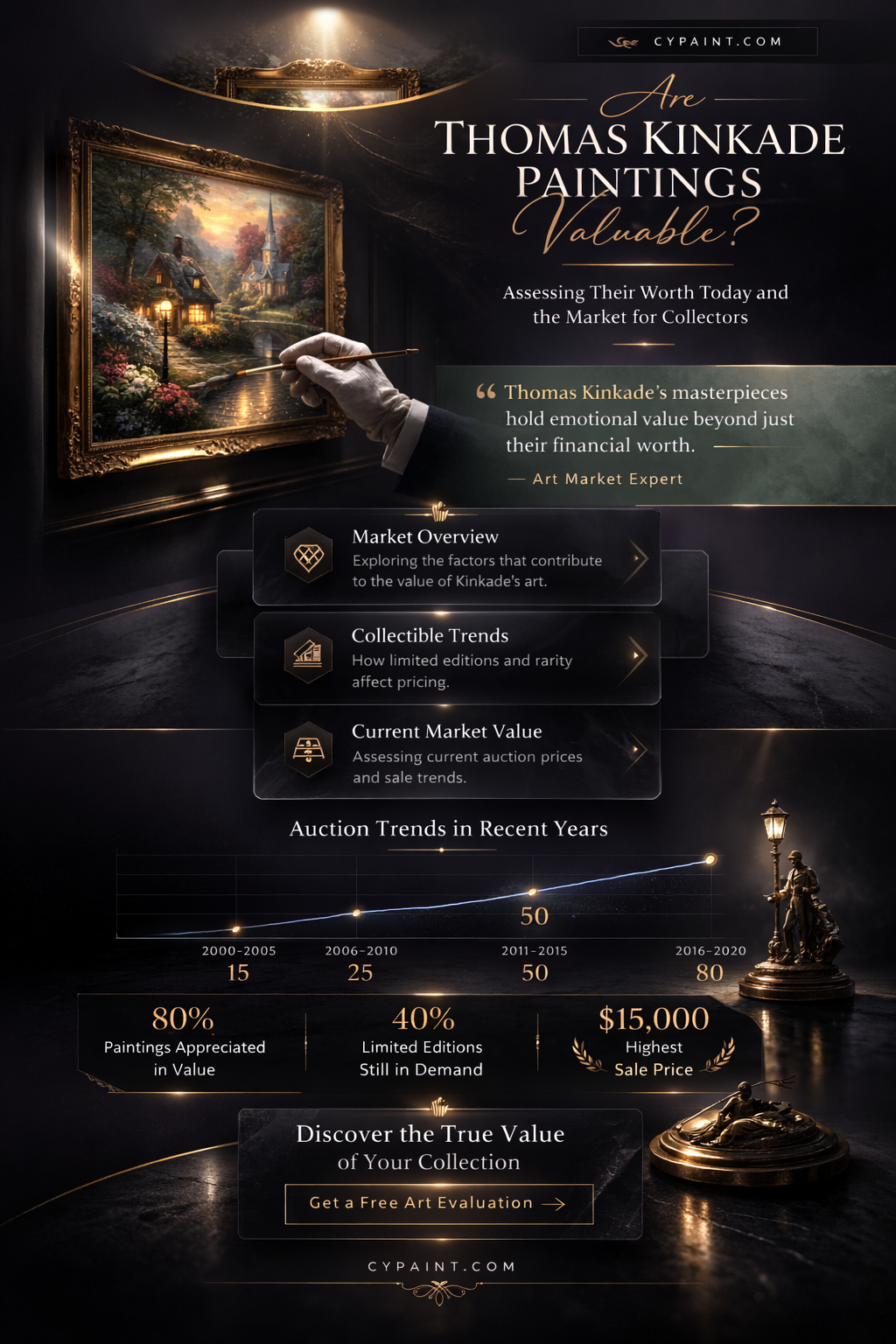
Exploring Thomas Kinkade’s Most Valuable Paintings: Market Highlights and Provenance in 2026
The most valuable Thomas Kinkade paintings are his original oil-on-canvas works, which in 2026 command prices ranging from $20,000 to over $150,000 at auction and private sales. Unlike the mass-produced limited editions found in many h...
The most valuable Thomas Kinkade paintings are his original oil-on-canvas works, which in 2026 command prices ranging from $20,000 to over $150,000 at auction and private sales. Unlike the mass-produced limited editions found in many homes, these rare originals are distinguished by their unique provenance, hand-painted brushwork, and historical significance within the artist’s "Painter of Light" era.
Contents
Thomas Kinkade’s legacy remains a unique phenomenon in the American art market. While his name is synonymous with widely distributed prints, the market for his original oil paintings exists in a different stratosphere of valuation and collector scrutiny. As we move through 2026, the distinction between "reproductions" and "originals" has become the primary driver of market stability. For collectors and estate executors, understanding the nuances of Kinkade’s high-value works requires a deep dive into the artist's production methods, the specific series that hold value, and the critical role of verified provenance.
The Hierarchy of Value: Originals vs. Limited Editions
To understand the market highlights of Kinkade’s work, one must first navigate the complex hierarchy of his output. Kinkade did not simply paint a picture and sell it; he created a multi-tiered system of reproductions that often confuses novice collectors.
Original Oil Paintings
These are the "holy grail" of Kinkade collecting. An original oil painting is a one-of-a-kind work executed entirely by Kinkade’s hand. In 2026, these pieces are increasingly rare on the open market, as most are held in private estates or the Kinkade family archives. These works do not have a "limited edition" number on them; they are unique canvases. Their value is driven by their size, the complexity of the light effects, and the era in which they were painted.
The "Studio Proof" and "Master Edition" Trap
Many owners believe they possess a valuable original because the canvas features hand-painted highlights. However, these are typically Limited Edition (LE) prints on canvas. While "Master Editions" (ME) or "Renaissance Editions" (RE) are hand-enhanced by "Master Highlighters" or even touched by Kinkade himself, they remain reproductions. While these can sell for $5,000 to $15,000 depending on the size and demand, they do not reach the six-figure heights of true original oils.
Market Highlights: Which Kinkade Paintings Command the Highest Prices?
In the current 2026 market, certain themes and periods of Kinkade’s career outperform others. Collectors generally prioritize "Classic Kinkade"—the idyllic, glowing cottages and landscapes produced between the late 1980s and the late 1990s.
The Disney Dreams Collection
Perhaps the most resilient segment of the Kinkade market is the Disney Dreams Collection. Original studies and major canvases featuring Disney characters (such as Cinderella Wishes Upon a Dream or The Little Mermaid) are highly sought after. These cross-collectible pieces appeal to both Kinkade enthusiasts and Disney fine art collectors, often driving auction prices 20-30% higher than his standard pastoral scenes.
Early Plein Air Works
Before Kinkade became a commercial powerhouse, he produced "Plein Air" (outdoor) paintings that were more impressionistic and less stylized. These works, often signed "Robert Girrard" (a pseudonym he used early on to explore different styles), have seen a surge in value among serious art critics and collectors who appreciate the technical skill over the commercial "glow" of his later works.
Major "Milestone" Canvases
Paintings that served as the basis for his most famous prints—such as The Garden of Prayer, A Peaceful Retreat, or Lamplight Lane—are the pinnacle of the market. If the original canvas for one of these "Top 10" images hits the market, it acts as a benchmark for the entire Kinkade estate valuation.
The Critical Role of Provenance and Authenticity
In 2026, the secondary market for Kinkade is fraught with challenges regarding authenticity. Because his style was so specific and his studio used apprentices, verifying that a work is a 100% Kinkade original is essential for maintaining value.
Documentation Requirements
A high-value Kinkade must be accompanied by a Certificate of Authenticity (COA) issued by the Thomas Kinkade Company (formerly Media Arts Group). However, for original oils, the COA must specifically state that the work is an "Original Oil on Canvas." Collectors should also look for:
- The DNA Matrix: In later years, Kinkade used a signature ink containing his own DNA to prevent forgery. Verifying this through authorized galleries is a standard procedure for high-value transfers.
- Gallery Labels: Original labels from the Nanette Kinkade Gallery or early California galleries where he sold his work provide a "paper trail" that significantly boosts value.
The Importance of Chain of Custody
Provenance is the chronological history of ownership. For a Kinkade to reach its maximum price point at an auction house like Heritage Auctions or Sotheby’s, the seller must prove where the painting has been since it left Kinkade’s easel. A direct purchase record from the artist or an authorized signature gallery is the gold standard.
Comparative Value Table: Kinkade Work Types (2026 Market Data)
The following table outlines the estimated market values for different types of Kinkade works found in the 2026 secondary market. These figures represent auction averages and private gallery listings.
| Work Category | Description | Primary Value Driver | Estimated Value Range (USD) |
|---|---|---|---|
| Original Oil | 1/1 Unique canvas by Kinkade | Scarcity, Hand-execution | $25,000 — $150,000+ |
| Master Edition (ME) | Highest level of print; heavily highlighted | Rarity within the edition | $8,000 — $18,000 |
| Renaissance Edition (RE) | Print with textured brushstrokes | Signature and embellishment | $4,000 — $9,000 |
| Studio Proof (SP) | Artist-reserved prints | Limited availability | $2,000 — $5,500 |
| Standard Numbered (SN) | Base level canvas lithograph | Image popularity | $400 — $1,500 |
Factors Influencing Valuation in 2026
Several external and internal factors dictate whether a Kinkade painting will sell at the high or low end of its estimated range.
- Size and Scale: Large-scale original oils (e.g., 24"x36" or larger) are exponentially more valuable than small studies or sketches. The "grandeur" of the piece is a significant factor for the "Painter of Light" brand.
- Subject Matter: "Cottage" scenes and "Cityscapes" (especially San Francisco or Paris) generally outperform his more religious or strictly floral works.
- Physical Condition: Kinkade’s canvases are prone to "yellowing" if not kept in climate-controlled environments or if the varnish was applied inconsistently. Professional restoration can cost thousands and must be disclosed during sale.
- The "Hidden" Elements: Kinkade famously hid initials (often the letter 'N' for his wife Nanette) and symbols in his paintings. Works with a high number of these "Easter eggs" often hold a sentimental premium for dedicated fans.
Navigating the Secondary Market as a Seller
If you believe you own a high-value Thomas Kinkade original, the first step is not to list it on a general marketplace like eBay. High-value art requires a sophisticated sales funnel.
- Appraisal: Hire a certified appraiser specializing in 20th-century American art. They will distinguish between a "hand-highlighted print" and a "true original."
- Specialized Auction Houses: Houses that regularly handle "Americana" or "Illustrative Art" are the best venues. They have the database of collectors specifically looking for Kinkade legacy pieces.
- Legal Disclosures: Given the history of litigation involving the Thomas Kinkade Company in the early 2000s, ensuring all sales contracts include clear authenticity guarantees is vital for protecting both the buyer and seller.
FAQs About Thomas Kinkade’s Most Valuable Works
How can I tell if my Kinkade is an original oil or a high-quality print?
In 2026, the easiest way is to use a magnifying loupe to look for a "dot pattern" (Ben-Day dots). If you see a consistent pattern of tiny dots under the paint, it is a lithograph reproduction. A true original oil will show organic, irregular thread patterns of the canvas and fluid, varying depths of paint strokes that don't follow a printed image underneath.
Did Thomas Kinkade paint every "signed" painting himself?
No. For his limited edition prints, Kinkade often signed the work, but "Master Highlighters" added the actual paint. Only his "Original Oils" were painted entirely by him. The market in 2026 clearly distinguishes between these, with original oils worth 10 to 50 times more than the most expensive prints.
Is the value of Thomas Kinkade paintings going up in 2026?
The market has bifurcated. Common prints (Standard Numbered) have largely depreciated or stayed flat due to oversupply. However, original oils and rare editions (like Master Editions) have seen a modest appreciation as they are treated more like historical artifacts of a specific era in American culture.
What is the most expensive Thomas Kinkade ever sold?
While private sales are often undisclosed, several major original canvases have cleared the $150,000 mark at specialized auctions. Pieces that were used for the primary promotional materials for his Disney or National Park series tend to reach these record prices.
Does a "Certificate of Authenticity" guarantee a high price?
A COA is necessary but not sufficient. It guarantees what the item is, but the market determines what it is worth. A COA for a "Standard Numbered" print confirms it is one of thousands, which actually keeps the price lower compared to a unique original.
Practical Recommendations for Collectors
For those looking to acquire or sell a high-value Kinkade in 2026, the focus must be on verification over aesthetics. While the "glow" of a cottage may be appealing, the financial value is rooted in the paper trail. Always request a high-resolution scan of the back of the canvas to check for gallery stamps and original inventory numbers. If you are buying, prioritize works from the 1990s, as this period is currently viewed as the peak of Kinkade’s artistic and commercial influence.
Image Gallery