What the CISA Exam Pass Rate Means for Candidates
The CISA exam pass rate, traditionally estimated between 45% and 60%, indicates a rigorous professional barrier that prioritizes conceptual mastery over rote memorization. For candidates, this means success requires more than technical...
The CISA exam pass rate, traditionally estimated between 45% and 60%, indicates a rigorous professional barrier that prioritizes conceptual mastery over rote memorization. For candidates, this means success requires more than technical knowledge; it demands an "auditor’s mindset" that aligns with ISACA’s specific frameworks for risk management, governance, and control.
Contents
For decades, the Certified Information Systems Auditor (CISA) designation has served as the global standard for professionals who audit, control, monitor, and assess an organization’s information technology and business systems. As we move through 2026, the complexity of the IT environment—driven by autonomous systems, decentralized finance, and evolving regulatory landscapes—has only heightened the significance of this credential. Understanding the pass rate is the first step in developing a realistic and effective preparation strategy.
The Mystery of the Official Pass Rate
One of the most frequent questions from prospective candidates is: "What is the exact pass rate for the CISA exam?" Historically, ISACA (the Information Systems Audit and Control Association) does not publicly disclose official, real-time pass rates for any given testing window. This lack of transparency is common among high-stakes professional certifications, such as the CISSP or the CPA, to prevent the devaluation of the credential and to maintain focus on the competency standards rather than the statistics.
However, based on historical data, independent surveys of training providers, and candidate self-reporting, the consensus is that the pass rate generally fluctuates around the 50% mark. In 2026, this suggests that for every two candidates who sit for the exam, only one will successfully achieve a passing score on their first attempt.
The stability of this pass rate over the years reflects ISACA’s commitment to a psychometric scoring process. This process ensures that the difficulty remains consistent regardless of when a candidate takes the exam. For the candidate, a 50% pass rate should not be viewed as a reason for discouragement but as a confirmation of the certification’s market value. If the exam were easy to pass, the "CISA" acronym would not command the salary premiums and leadership opportunities it currently does.
Decoding the CISA Scaled Scoring System
To understand what the pass rate means, one must first understand how ISACA calculates success. The CISA exam consists of 150 multiple-choice questions to be completed within four hours. These questions are not weighted equally, and the raw score is converted into a "scaled score."
The scaled score ranges from 200 to 800. A score of 450 or higher is required to pass. This system allows ISACA to maintain a consistent standard of excellence across different versions of the exam. For example, if a specific exam form is statistically "harder" than another, the scaled scoring adjustment ensures that a candidate’s chance of passing is not unfairly penalized by the luck of the draw.
What a 450 Truly Represents
A passing score of 450 represents a minimum consistent level of knowledge as established by the ISACA Certification Working Group. It does not mean you answered 45% of the questions correctly, nor does it mean you got 60% right. Instead, it signifies that your performance met the predefined competency threshold for an entry-level to mid-career IT auditor.
For candidates, this means that every domain matters. You cannot simply "ace" Domain 5 (Protection of Information Assets) to make up for a complete lack of knowledge in Domain 1 (The Process of Auditing Information Systems). The scoring algorithm favors candidates who demonstrate a balanced proficiency across all five job practice areas.
Why the Pass Rate Remains Low: The "Auditor's Mindset"
The primary reason candidates fail the CISA exam is not a lack of technical knowledge, but a failure to adopt the "ISACA mindset." Many candidates come from highly technical backgrounds, such as system administration or cybersecurity engineering. When these professionals encounter a question about a security breach, their instinct is to "fix the server" or "patch the vulnerability."
However, from an auditor’s perspective—the perspective the exam tests—the correct answer is often to "review the incident response log," "verify the escalation procedure," or "report the risk to management."
The Challenge of "Best" and "First"
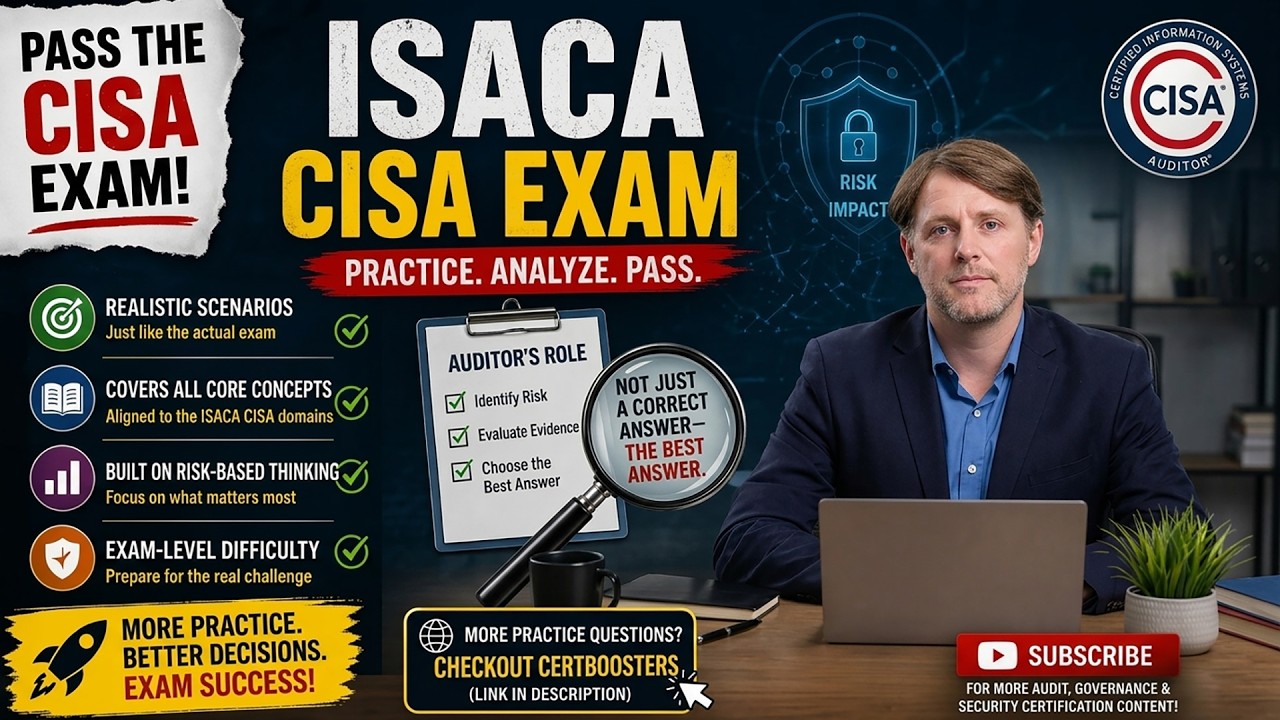
The CISA exam is famous (and often frustratedly discussed) for its use of "Best," "First," and "Most" qualifiers. A question might provide four options that are all technically "correct" in a real-world scenario. The candidate's task is to identify which action an auditor would perform first according to ISACA’s standards.
This nuance contributes significantly to the 50% failure rate. It requires a transition from being a "doer" to being an "evaluator." Candidates who fail to make this mental shift often find themselves scoring in the 400-440 range—painfully close to passing, but missing the mark on the judgmental aspects of the profession.
The 2026 Landscape: New Challenges for Candidates
As of 2026, the CISA Job Practice domains have been updated to reflect the ubiquity of artificial intelligence (AI), the shift toward "Zero Trust" architectures, and the increased focus on ESG (Environmental, Social, and Governance) reporting.
| Domain | Weight | Core Focus in 2026 |
|---|---|---|
| Domain 1: Information System Auditing Process | 18% | Risk-based audit planning; remote auditing techniques. |
| Domain 2: Governance and Management of IT | 18% | IT strategy alignment; AI governance frameworks; third-party risk. |
| Domain 3: IS Acquisition, Development, and Implementation | 12% | Agile/DevSecOps; cloud-native application audits; legacy migration. |
| Domain 4: IS Operations and Business Resilience | 26% | Disaster recovery in a hybrid cloud; incident response maturity. |
| Domain 5: Protection of Information Assets | 26% | Encryption standards; identity and access management (IAM); privacy. |
In 2026, Domain 4 and Domain 5 remain the most heavily weighted, representing over half of the exam. Candidates often find Domain 4 particularly challenging because it requires a deep understanding of business continuity, which many technical IT professionals haven't managed directly. The pass rate suggests that candidates who focus exclusively on security (Domain 5) while neglecting operations (Domain 4) are at high risk of failure.
Strategic Preparation: How to Beat the Statistics
Given that roughly half of the candidates fail, a "standard" approach to studying is often insufficient. To place yourself in the successful 50%, a structured approach is mandatory.
1. The Power of the Official Q&A Database
The ISACA CISA Review Questions, Answers & Explanations (QAE) Database is arguably the most critical resource. It does not provide the actual questions you will see on the exam, but it teaches you how to think like the exam writers. Successful candidates in 2026 typically report going through the entire database of 1,000+ questions at least twice.
2. Time Investment
The pass rate implies a significant "learning curve." Most successful candidates invest between 120 and 200 hours of study over a period of 3 to 6 months. Cramming for the CISA is notoriously ineffective because the exam tests the application of concepts rather than the recall of facts.
3. Professional Experience Requirements
It is important to remember that the CISA is not just an exam; it is a certification. To be fully certified, even after passing the exam, you must provide evidence of five years of professional work experience in information systems auditing, control, or security. While waivers exist for university degrees, this requirement ensures that those who carry the CISA title possess the practical wisdom that a multiple-choice test cannot fully measure.
Comparison with Other Professional Certifications
To put the CISA pass rate into perspective, it is helpful to see how it compares to other industry-leading certifications in the 2026 market.
| Certification | Estimated Pass Rate | Focus Area | Difficulty Level |
|---|---|---|---|
| CISA (ISACA) | 45% - 60% | IT Audit & Risk Control | High (Conceptual) |
| CISSP (ISC²) | 40% - 50% | Security Leadership | Very High (Broad) |
| CISM (ISACA) | 50% - 65% | Information Security Management | Moderate/High |
| CIA (IIA) | 40% - 45% | Internal Audit (General) | High (3-Part Exam) |
| Security+ (CompTIA) | 70% - 80% | Foundational Security | Entry/Moderate |
The CISA remains one of the most difficult "single-paper" exams. While the CISSP is often considered more difficult due to its sheer breadth of domains, the CISA is frequently cited as more "tricky" because of the ambiguity in its question phrasing.
Frequently Asked Questions
Does the pass rate vary by region?
ISACA maintains a global standard, meaning the exam content and passing threshold (450 scaled score) are identical regardless of whether you take the exam in New York, London, or Tokyo. While individual pass rates might vary by region based on the availability of training resources and local education standards, the exam's difficulty remains constant.
If I fail, how long must I wait to retake the exam?
According to ISACA’s 2026 retake policy, if you do not pass on your first attempt, you must wait 30 days before your second attempt. For a third attempt, the waiting period is 60 days, and for a fourth, it is 90 days. You are limited to four attempts within any 12-month period. Each attempt requires a full registration fee.
Is the CISA exam "curved" based on other candidates' performance?
No. The CISA is a criterion-referenced exam, not a norm-referenced one. This means your score is based on your ability to meet a set standard, not on how well you performed relative to other test-takers that day. If everyone in the room meets the standard, everyone passes.
How much does the CISA exam cost in 2026?
As of 2026, ISACA member pricing for the exam is typically around $575, while non-member pricing is approximately $760. Given the cost and the roughly 50% pass rate, candidates are strongly incentivized to invest in quality study materials to avoid the expense of a retake.
Does the pass rate change when the Job Practice is updated?
There is often a slight, temporary dip in pass rates immediately following a major Job Practice update as study materials and training providers catch up to the new content. However, ISACA usually provides a transition period, and the scaled scoring system helps mitigate dramatic swings in success rates.
Final Recommendation: Focus on Logic, Not Just Content
What the CISA exam pass rate ultimately means for you is that preparation is non-negotiable. To beat the odds, you must move beyond the "what" of IT systems and understand the "why" of IT auditing.
If you are a candidate in 2026, begin your journey by downloading the official CISA Job Practice guidelines from the ISACA website. Prioritize your study time on Domain 4 and Domain 5, but do not ignore the procedural rigor of Domain 1. Most importantly, practice with the QAE database until you stop choosing the answer that "fixes the problem" and start choosing the answer that "evaluates the control." Success on the CISA exam is a marathon of logic, and those who respect the 50% pass rate are the ones most likely to overcome it.
Image Gallery