Should You Choose the SAVE Plan or an Alternative Repayment Plan?
Choosing the SAVE plan versus an alternative repayment plan depends on your income, public service forgiveness eligibility, and debt balance. SAVE offers lower payments and prevents interest growth for low-to-moderate earners, but high...
Choosing the SAVE plan versus an alternative repayment plan depends on your income, public service forgiveness eligibility, and debt balance. SAVE offers lower payments and prevents interest growth for low-to-moderate earners, but higher earners or those pursuing Public Service Loan Forgiveness (PSLF) during legal holds may benefit more from Income-Based Repayment (IBR) or standard options.
Contents
Understanding the Federal Repayment Landscape
Selecting the correct repayment structure for federal student loans requires evaluating your current financial position, long-term earnings potential, and legal status of available programs. The U.S. Department of Education provides multiple repayment pathways, broadly categorized into Income-Driven Repayment (IDR) plans and fixed repayment plans.
Among these, the Saving on a Valuable Education (SAVE) plan replaced the former REPAYE option to offer expanded interest subsidies and reduced discretionary income percentages. However, legal challenges, administrative injunctions, and specific income thresholds mean SAVE is not universally optimal for every borrower.
Borrowers frequently compare SAVE against two distinct categories of "alternatives":
- Alternative IDR and Fixed Plans: Established federal structures such as Income-Based Repayment (IBR), Income-Contingent Repayment (ICR), the Standard 10-Year Plan, or Extended/Graduated options.
- The Servicer "Alternative Repayment Plan": A specific, fallback technical designation assigned by federal loan servicers when a borrower fails to recertify income or involuntarily exits an IDR plan.
Understanding how these programs operate is critical to avoiding unexpected balance increases, missed forgiveness credits, or sudden monthly payment spikes.
What Is the SAVE Plan?
The SAVE plan is an income-driven repayment framework designed to minimize monthly obligations and eliminate negative amortization. Under standard operating guidelines, SAVE calculates monthly payments using a percentage of discretionary income, defined as the difference between your Adjusted Gross Income (AGI) and 225% of the Federal Poverty Guideline for your family size and state.
Discretionary Income = AGI - (225% × Federal Poverty Guideline)
Key Features of the SAVE Plan
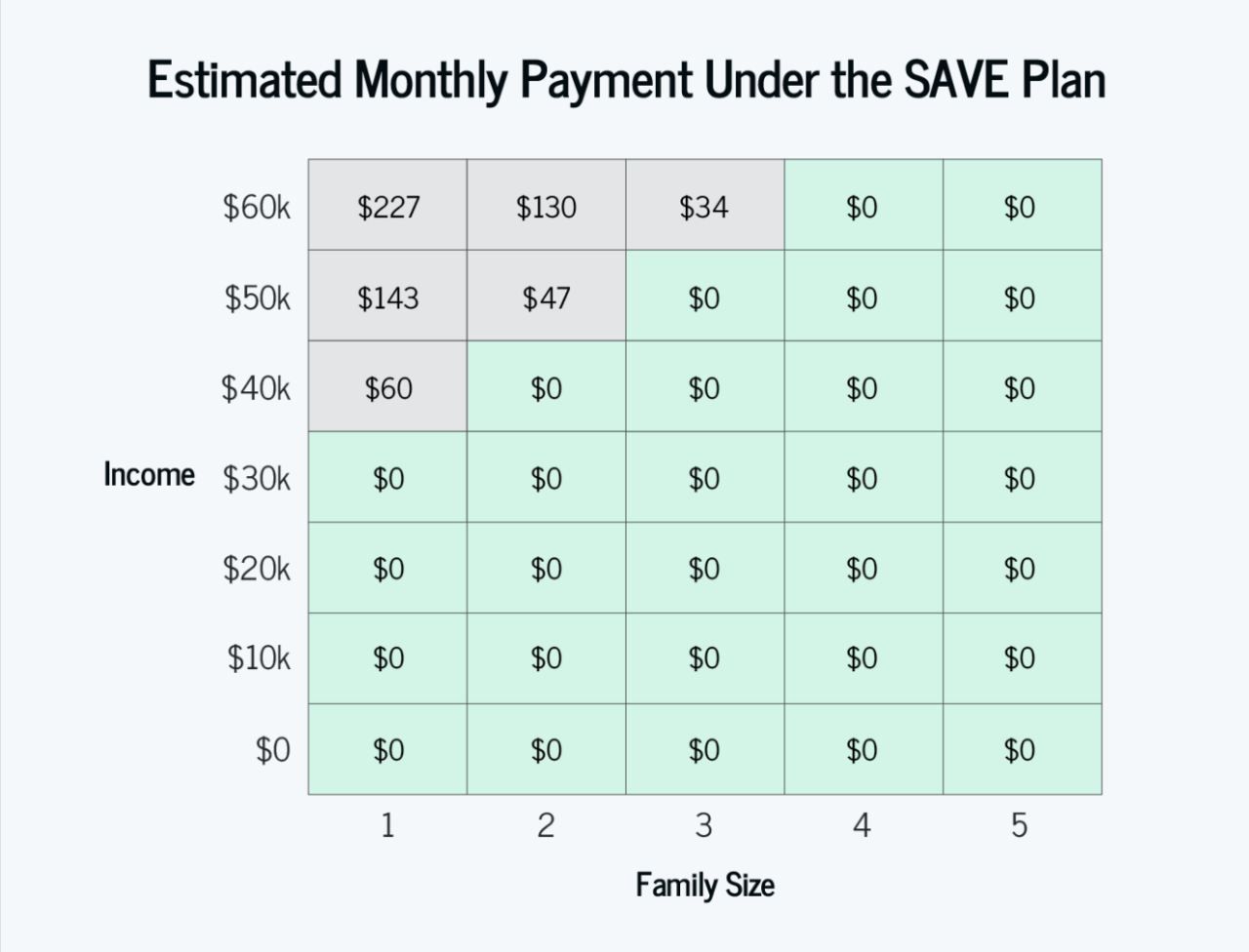
- Higher Income Protection: By shielding income up to 225% of the Federal Poverty Guideline, a single borrower earning under approximately $33,800 (adjusted annually for inflation) pays $0 per month.
- 100% Unpaid Interest Subsidy: If your calculated monthly payment does not cover the interest accruing on your loans, the federal government waives the remaining interest. Your loan principal balance does not grow due to unpaid interest.
- Reduced Payment Percentages: Payments are set at 5% of discretionary income for undergraduate loans, 10% for graduate loans, or a weighted average for mixed loan portfolios.
- Accelerated Forgiveness Timelines: Borrowers with original principal balances of $12,000 or less can qualify for loan balance forgiveness after 10 years (120 qualifying payments), with one year added for each additional $1,000 borrowed.
What Is an Alternative Repayment Plan?
The term "alternative repayment plan" carries two meanings depending on whether you are selecting a strategy intentionally or reacting to a servicer notice.
1. Alternative Federal Repayment Options
Borrowers looking for options outside of SAVE can choose from several official plans:
- Income-Based Repayment (IBR): An IDR plan capping payments at 10% of discretionary income (above 150% of the poverty line) for new borrowers after July 1, 2014, or 15% for older borrowers. IBR includes a payment cap—your monthly payment can never exceed what you would pay under the Standard 10-Year Repayment Plan established when you entered IBR.
- Income-Contingent Repayment (ICR): Calculates payments as 20% of discretionary income or a fixed payment adjusted for income over 12 years. It is primarily used by Parent PLUS borrowers who consolidate their loans into a Direct Consolidation Loan.
- Standard 10-Year Repayment Plan: A fixed monthly payment that amortizes your loan over 120 months. Payments count toward Public Service Loan Forgiveness (PSLF).
- Extended and Graduated Repayment Plans: Plans that stretch payments up to 25 years or start with lower payments that increase every two years. Crucially, these plans do not count toward PSLF or IDR forgiveness.
2. The Servicer-Assigned "Alternative Repayment Plan"
If you are enrolled in an IDR plan and fail to submit annual income recertification documentation on time, your loan servicer automatically removes you from the active IDR calculation and places you on the Alternative Repayment Plan.
Under this technical designation, the servicer recalculates your monthly obligation as a fixed amount designed to pay off the remaining balance within 10 years (or the remaining term of a 12-year window).
Important Warning: Payments made under a servicer-assigned Alternative Repayment Plan do not qualify for Public Service Loan Forgiveness (PSLF) or 20/25-year IDR forgiveness. If your servicer places you on this plan, you must re-certify your income or request transfer to a qualifying IDR plan immediately to resume earning forgiveness credits.
Key Decision Factors: SAVE vs. Alternative Plans
Deciding whether to save under the SAVE plan or switch to an alternative strategy requires weighing several financial parameters.
- Do you qualify for low payments/PSLF?
- If Yes:
- Pursuing PSLF? (Check current status & switch to IBR if forbearance halts payment credits)
- Prioritizing Interest Subsidy? (Stay/Enroll in SAVE Plan)
- If No:
- High Income / Capped Payment? (Choose IBR or Standard Plan)
- Seeking Fixed Payoff Timeline? (Standard 10-Yr or Extended)
- If Yes:
1. High Earners vs. Low Earners: The Payment Cap Factor
Unlike IBR, the SAVE plan does not have a payment cap. On IBR, no matter how much your income increases, your monthly payment is capped at the 10-year Standard Repayment Plan amount calculated when you initially entered the plan.
On SAVE, because the calculation is strictly 5% to 10% of discretionary income without a ceiling, a substantial salary increase could cause your SAVE monthly payment to exceed the 10-year Standard Repayment amount.
- Low-to-Moderate Income: SAVE is almost always superior due to the 225% poverty shield and interest subsidy.
- High Household Income relative to Debt: IBR or the Standard 10-Year Plan may result in a lower monthly obligation than SAVE.
2. Public Service Loan Forgiveness (PSLF) Strategy
Borrowers working for qualifying government or non-profit employers need 120 qualifying monthly payments to receive tax-free forgiveness under PSLF.
During periods when the SAVE plan is affected by federal court injunctions or administrative pauses, enrollees may be placed into administrative forbearance. While this forbearance requires $0 monthly payments, months spent in injunction-related administrative forbearance generally do not count toward PSLF credit, unless covered by specific Department of Education buyback provisions or regulatory adjustments.
Borrowers on tight PSLF timelines often choose to switch from SAVE to IBR or the Standard 10-Year Plan to ensure every calendar month continues counting directly toward their 120-payment requirement.
3. Interest Accumulation and Capitalization
If your monthly IDR payment is less than the monthly interest accruing on your principal, non-SAVE plans allow that unpaid interest to accumulate. Under SAVE, the government eliminates unpaid interest at the end of each month.
- Example: If your loan accrues $300 in interest each month, but your calculated SAVE payment is $50, the remaining $250 is waived. On IBR or ICR, that $250 remains on the account balance.
Comparison Matrix: Repayment Plans at a Glance
| Repayment Plan | Payment Formula (% Discretionary Income) | Income Protection Threshold | Payment Cap? | Unpaid Interest Subsidy? | Counts Toward PSLF? |
|---|---|---|---|---|---|
| SAVE Plan | 5% (Undergrad), 10% (Grad), or weighted average | 225% Poverty Line | No | Yes (100% of unpaid interest) | Yes (when actively paying) |
| IBR (New Borrowers) | 10% | 150% Poverty Line | Yes (Standard 10-Yr Rate) | Partial (Subsidized loans for 3 yrs) | Yes |
| IBR (Older Borrowers) | 15% | 150% Poverty Line | Yes (Standard 10-Yr Rate) | Partial (Subsidized loans for 3 yrs) | Yes |
| ICR Plan | 20% (or 12-yr fixed formula) | 100% Poverty Line | No | None | Yes |
| Standard 10-Year | Fixed amortized amount | N/A | Fixed schedule | N/A | Yes |
| Servicer Alternative | Fixed amortized amount (up to 12 yrs) | N/A | Fixed schedule | No | No |
How to Determine Your Optimal Strategy
To make an informed choice between remaining on SAVE, transferring to an alternative IDR plan, or choosing a standard structure, complete the following analysis:
Step 1: Calculate Your Discretionary Income Crossover Point
Compare your projected SAVE payment against the Standard 10-Year payment rate.
- Locate your Adjusted Gross Income (AGI) from your most recent federal tax return.
- Find the current 225% Federal Poverty Guideline for your household size and state.
- Subtract the poverty threshold from your AGI to get discretionary income.
- Multiply by 0.05 (for undergraduate debt) or 0.10 (for graduate debt).
- If this number exceeds the fixed 10-year Standard monthly payment, IBR may provide a lower monthly ceiling.
Step 2: Evaluate Your PSLF Timeline
If you have 24 or fewer payments remaining until you reach 120 PSLF credits, staying in an administrative forbearance on SAVE without earning credit could delay your forgiveness date. Switching to IBR allows you to make qualifying payments immediately, preserving your target discharge date.
If you have many years remaining on PSLF, staying on SAVE or utilizing PSLF Buyback mechanisms later may remain cost-effective despite temporary administrative delays.
Step 3: Check Your Parent PLUS Status
Direct Parent PLUS loans are not eligible for SAVE or IBR directly. To access an IDR plan, Parent PLUS borrowers must consolidate their loans into a Direct Consolidation Loan, which opens access to ICR. Under historic double-consolidation rules, some borrowers navigated multi-step consolidations to access SAVE or IBR, but single-consolidated Parent PLUS debt defaults strictly to ICR or standard options.
Action Plan: Switching or Recertifying Repayment Plans
If you decide to exit SAVE, enter an alternative plan, or correct an accidental placement on a servicer Alternative Repayment Plan, follow these operational steps:
How to Switch Plans
- Log into StudentAid.gov: Access your federal student aid account using your FSA ID.
- Navigate to IDR Application: Select "Apply for an Income-Driven Repayment Plan" or "Change My Repayment Plan."
- Select Your Target Plan: Specify whether you are requesting IBR, ICR, or allowing the system to place you on the lowest-cost available option.
- Provide Income Documentation: Connect your IRS account via the direct tax data transfer tool or upload your most recent pay stubs.
- Submit to Servicer: Your application will be routed to your assigned servicer (e.g., MOHELA, Nelnet, Aidvantage, EdFinancial) for processing.
What to Do If Placed on the Servicer Alternative Plan
If your servicer sends notice that you have been moved to an "Alternative Repayment Plan" due to missed recertification deadlines:
- Immediate Recertification: Submit an updated IDR application immediately through StudentAid.gov.
- Request Processing Forbearance: Ask your servicer to place your account in a temporary processing forbearance while your new IDR application is reviewed, preventing high non-qualifying payments from drafting from your bank account.
- Confirm Qualifying Status: Once processed, verify that your monthly statement explicitly names a qualifying plan (e.g., IBR or SAVE) rather than "Alternative."
Common Pitfalls to Avoid
- Failing to Recertify Annually: Missing your annual recertification window triggers auto-enrollment into the non-qualifying servicer Alternative Repayment Plan and can cause accumulated unpaid interest to capitalize (add to your principal balance) depending on the plan rules.
- Assuming All Forbearances Count for PSLF: Administrative forbearances applied during legal injunctions or plan processing do not automatically generate PSLF credits. Always verify credit status on your Federal Student Aid dashboard.
- Ignoring Married Filing Status: On both SAVE and IBR, if you file taxes separately from your spouse, your spouse's income is excluded from the payment calculation. If you file jointly, both incomes are included. Calculate taxes both ways to determine if tax savings outweigh higher loan payments.
Frequently Asked Questions
Is the SAVE plan better than Income-Based Repayment (IBR)?
For most undergraduate borrowers and low-to-moderate earners, SAVE offers lower payments (5% vs. 10/15%) and superior interest protections. However, IBR is better for high earners who need a payment cap or borrowers pursuing PSLF who want to avoid SAVE-related administrative injunction pauses.
What happens if my loan servicer puts me on an Alternative Repayment Plan?
Placement on a servicer Alternative Repayment Plan usually means your annual income recertification was missed or not processed. Your payments will recalculate to a higher fixed amount, and payments made under this plan will not count toward PSLF or IDR forgiveness until you submit new income documentation and switch back to a qualifying IDR plan.
Can high earners use the SAVE plan?
Yes, there is no maximum income limit to enroll in SAVE. However, because SAVE does not cap payments at the Standard 10-Year amount, high earners with small loan balances relative to their income may end up with a higher monthly payment on SAVE than on IBR or the Standard 10-Year Plan.
Does unpaid interest accrue while enrolled in SAVE?
No. Under the SAVE plan's interest benefit, if your calculated monthly payment is less than the interest accruing that month, the federal government waives the remaining unpaid interest. Your total loan balance will not grow as long as you make your required SAVE payment.
How do I leave the SAVE plan to join IBR?
You can request a plan switch by submitting an Income-Driven Repayment Plan Request online at StudentAid.gov. Select Income-Based Repayment (IBR) as your preferred option and provide income verification. Your loan servicer will process the request and transition your account.
Practical Recommendation
If your primary goal is minimizing short-term monthly costs and preventing balance growth from interest, staying in or applying for the SAVE plan remains the most financially beneficial path for low-to-moderate earners.
However, if you are actively pursuing Public Service Loan Forgiveness (PSLF) and cannot afford delays in your 120-month timeline due to legal injunctions or forbearance holds on SAVE, switching to the Income-Based Repayment (IBR) plan or the Standard 10-Year Plan is the safest operational move to ensure every month counts towards tax-free forgiveness. Always evaluate your Adjusted Gross Income against the standard 10-year payment ceiling before finalizing a plan change.
Disclaimer: Federal student loan regulations, interest subsidies, and repayment program availabilities are subject to statutory adjustments and judicial rulings. This guide provides structural financial analysis and educational information. Consult your federal loan servicer or a certified financial planner regarding specific legal and financial decisions.
Image Gallery