Understanding the Role of Committed Capital in Private Equity
Committed capital represents the total amount of money that Limited Partners (LPs) have legally pledged to provide to a private equity fund over a specified timeframe. Unlike traditional retail investments, these funds are not delivere...
Committed capital represents the total amount of money that Limited Partners (LPs) have legally pledged to provide to a private equity fund over a specified timeframe. Unlike traditional retail investments, these funds are not delivered upfront but are "called" by the fund managers as specific investment opportunities arise.
Contents
In the sophisticated landscape of 2026, private equity remains a cornerstone of institutional portfolios. At the heart of this asset class lies a fundamental structural element: committed capital. For the uninitiated, the term might sound like a simple accounting entry, but in practice, it is a legally binding obligation that dictates the relationship between investors and fund managers, determines the fee structures, and influences the overall performance metrics of the fund.
To understand the role of committed capital, one must first understand the lifecycle of a private equity fund. Unlike a mutual fund, where an investor buys shares and the cash is immediately deployed into a liquid market, a private equity fund operates on a "drawdown" basis. This structure is designed to align the availability of cash with the long-term, illiquid nature of acquiring and improving private companies.
The Structural Mechanics of Capital Commitments
When a private equity firm (the General Partner, or GP) launches a new fund, they seek "commitments" from institutional investors such as pension funds, endowments, and sovereign wealth funds (the Limited Partners, or LPs). These commitments are codified in a Limited Partnership Agreement (LPA).
The commitment is essentially a line of credit that the LP extends to the GP. If an LP commits $100 million to a fund, they are legally bound to provide that capital whenever the GP issues a capital call (also known as a drawdown notice). This process ensures that the GP has a guaranteed pool of "dry powder" to execute deals quickly when they identify a target company, without having to raise funds for each individual transaction.
The Investment Period and Capital Calls
The lifecycle of a fund is typically divided into two main stages: the investment period and the harvest period. Committed capital is most relevant during the investment period, which usually lasts between five and seven years. During this time, the GP identifies acquisition targets and "calls" portions of the committed capital to fund these purchases.
A capital call notice typically provides LPs with a short window—often 10 business days—to transfer the requested funds to the GP. These funds are used for:
- Direct investments in portfolio companies.
- Fund organizational expenses.
- Management fees.
- Follow-on investments in existing portfolio companies.
Committed Capital vs. Invested Capital
A common point of confusion for those new to private equity is the distinction between committed capital and invested capital.
- Committed Capital: The total amount an LP has promised to give (the "ceiling").
- Invested Capital (or Contributed Capital): The portion of the commitment that has actually been called and deployed by the GP.
- Uncalled Capital (Dry Powder): The remaining balance of the commitment that the GP has yet to request.
As of 2026, the gap between committed and invested capital is a key metric monitored by market analysts. If a GP has a high amount of uncalled capital late in the investment period, it may signal a "deployment drag," where the manager is struggling to find attractive deals, potentially leading to rushed, lower-quality investments to avoid returning the capital.
Comparative Analysis of Capital States
| Feature | Committed Capital | Invested Capital | Distributed Capital |
|---|---|---|---|
| Legal Status | Legally binding pledge in the LPA. | Cash already transferred to the GP. | Cash returned to LPs after asset sales. |
| Fee Basis | Basis for management fees during the investment period. | Basis for fees after the investment period (often). | Not used for fee calculation. |
| Liquidity Impact | LP must maintain liquid reserves for calls. | Capital is illiquid and "locked up." | LP regains liquidity for re-investment. |
| Performance Metric | Used to calculate the "Commitment Ratio." | Used to calculate the "Multiple of Invested Capital" (MOIC). | Used to calculate the "Distributed to Contributed" (DPI) ratio. |
The Role of Management Fees
One of the most critical roles of committed capital is its function as the primary basis for calculating management fees. In a standard "2 and 20" structure (2% management fee, 20% carried interest), the 2% fee is usually calculated on the total committed capital during the fund's investment period.
This is a point of contention for some LPs, as it means they are paying fees on money that is still sitting in their own bank accounts. However, GPs argue that the fee covers the overhead costs of sourcing deals, performing due diligence, and managing the team required to find the best investment opportunities.
Once the investment period ends and the fund enters the harvest period, the fee structure often shifts. At this stage, fees are typically calculated based on net invested capital (the cost basis of the investments still held by the fund) rather than the original commitment. This shift ensures that the GP is incentivized to exit investments and return capital to LPs.
LP Liquidity Management and the "Over-commitment" Strategy
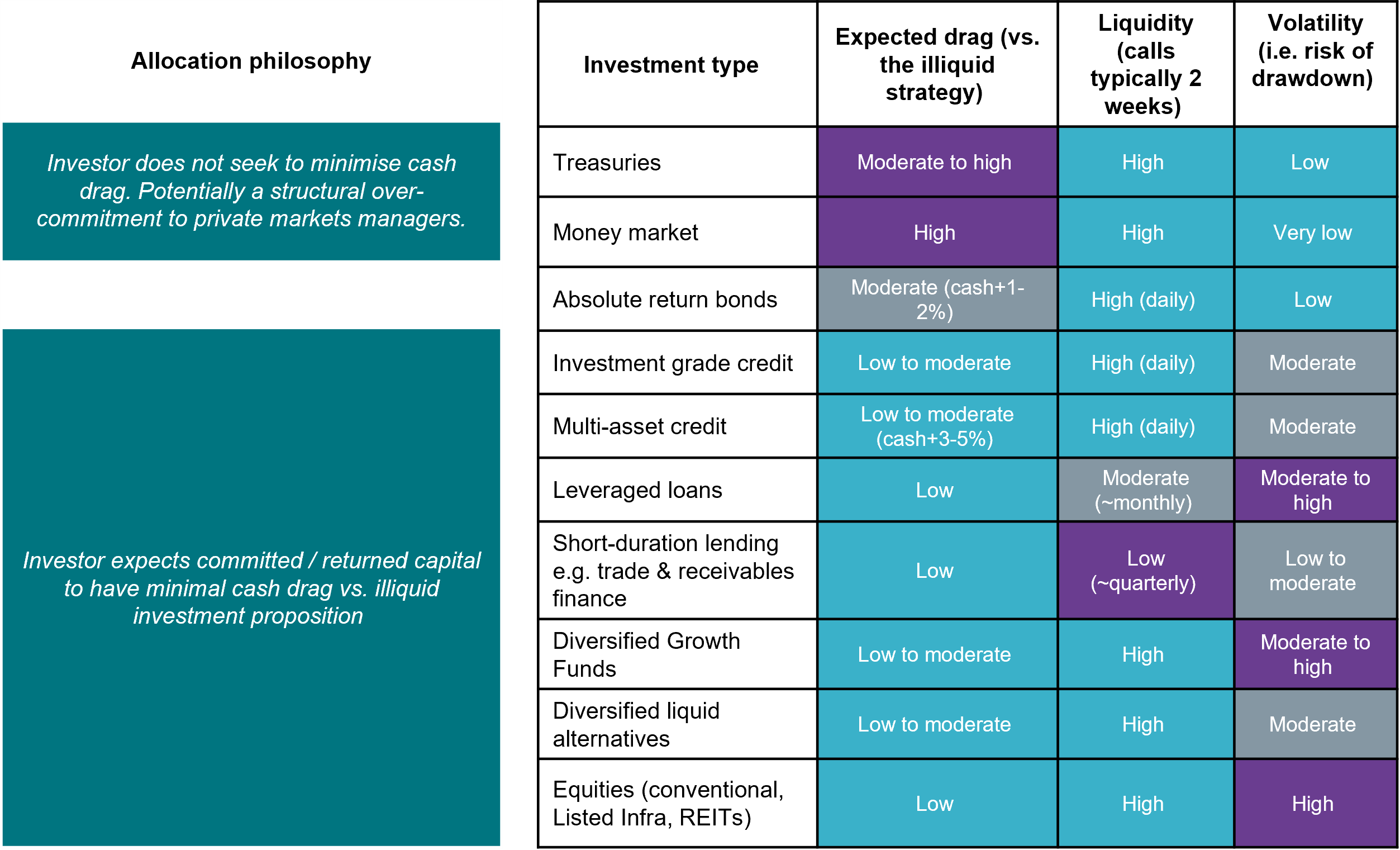
For Limited Partners, managing committed capital is a complex treasury function. Because they do not know exactly when a GP will call capital, they must keep a certain amount of liquidity available. However, keeping $100 million in a low-yield cash account while waiting for a capital call creates "cash drag," which can lower the LP’s overall portfolio returns.
To combat this, many institutional investors employ an over-commitment strategy. They commit more capital than they actually have in liquid cash, banking on the fact that older funds in their portfolio will be distributing cash (returning capital) at the same time newer funds are calling it. In the high-interest-rate environment of the mid-2020s, this balancing act has become even more critical as the cost of liquidity has risen.
Legal Obligations and the Consequences of Default
A commitment to a private equity fund is not a suggestion; it is a rigorous legal obligation. If an LP fails to meet a capital call—known as a default—the consequences are severe. Under the terms of most LPAs, the GP has several "nuclear options" to protect the fund and other LPs:
- Forfeiture of Interest: The defaulting LP may lose a significant portion (often 50% or more) of their existing interest in the fund.
- Forced Sale: The GP may force the LP to sell their interest to another buyer at a steep discount.
- Loss of Voting Rights: The LP is stripped of any rights to participate in fund governance.
- Legal Action: The GP may sue for breach of contract to recover the missing funds and damages.
In 2026, with increased regulatory scrutiny from bodies like the Securities and Exchange Commission (SEC), the transparency around default procedures and LP rights has improved, but the underlying severity of a capital call default remains a major deterrent.
Impact on Performance Metrics: IRR vs. MOIC
Committed capital plays a nuanced role in how fund performance is reported. The two most common metrics are the Internal Rate of Return (IRR) and the Multiple of Invested Capital (MOIC).
- IRR is highly sensitive to the timing of cash flows. Because GPs only call capital when they need it, the "clock" for IRR doesn't start on the full commitment amount until the money is actually drawn. This allows GPs to report higher IRRs than if the money had been sitting in the fund from day one.
- MOIC (or TVPI - Total Value to Paid-In capital) ignores time and simply looks at how much money was returned compared to how much was invested. Committed capital that has not been called does not affect this ratio.
Savvy investors in 2026 look at both metrics to understand if a GP is truly generating value or simply managing the timing of capital calls to inflate their IRR.
Trends and Evolution in 2026
As we move through 2026, several trends are altering the traditional view of committed capital:
1. Subscription Line Financing
Many GPs now use "subscription lines"—short-term bridge loans secured by the LPs' committed capital. Instead of calling capital from LPs for every small expense or deal, the GP draws on a bank line of credit and then makes one large capital call once or twice a year to pay down the debt. While this smooths out cash flows, it also delays capital calls, which artificially boosts the fund's IRR—a practice that continues to face scrutiny for its impact on transparency.
2. Tokenization and Retail Access
The "democratization" of private equity has led to the emergence of platforms that allow smaller investors to participate. In these models, "committed capital" is often managed through smart contracts on a blockchain, where the commitment is verified and held in escrow, or automatically triggered based on fund requirements. This reduces the administrative burden of manual capital calls.
3. Secondary Markets
The market for "secondaries"—where LPs sell their commitments to other investors—has exploded. An investor might buy another LP’s interest in a fund that is 50% called. The buyer then takes on the obligation of the remaining 50% of the committed capital. This provides liquidity to LPs who can no longer meet their commitment obligations.
Frequently Asked Questions
What happens to committed capital that is never called?
If the investment period expires and the GP has not called all the committed capital, the "uncalled" portion is typically released. The LPs are no longer obligated to provide that money, except for specific "follow-on" investments or fund expenses as defined in the LPA.
Is committed capital the same as Assets Under Management (AUM)?
Not exactly. In private equity, AUM usually refers to the total committed capital of all active funds managed by a firm. However, some firms report AUM based on the fair market value of their current holdings plus uncalled commitments. It is important to check the firm’s specific valuation methodology.
Can a GP increase the amount of committed capital after the fund closes?
Generally, no. Once the "final close" of a fund occurs, the total committed capital is capped. If the GP wants more capital, they must launch a new fund (e.g., Fund II, Fund III) or create a "side-car" vehicle for specific co-investment opportunities.
Why do LPs prefer capital calls over upfront payments?
LPs prefer capital calls because it allows them to keep their capital invested in other interest-bearing or liquid assets until the very moment the private equity GP needs it. This "just-in-time" funding model maximizes the LP's own internal rate of return across their entire portfolio.
Are management fees paid on committed capital forever?
No. Management fees are typically paid on committed capital only during the investment period (the first 5–6 years). After that, the fee base usually switches to the "acquisition cost of unrealized investments," meaning the LP only pays fees on the money that is actually working in the remaining portfolio companies.
Strategic Recommendations for Investors
For those engaging with private equity in 2026, the management of committed capital requires a proactive approach. Institutional investors should utilize sophisticated cash-flow modeling software to predict the timing of drawdowns and distributions.
Furthermore, during the due diligence phase, LPs must closely examine the LPA’s language regarding recycling provisions. Some agreements allow GPs to "recycle" committed capital—meaning if an investment is exited quickly, the GP can reinvest that capital rather than returning it to the LPs, effectively extending the life and utility of the original commitment. Understanding these nuances is essential for maintaining a balanced and liquid investment portfolio in the current market environment.
Image Gallery