The Best Automated Valuation Model (AVM) Providers for 2026
The best automated valuation model (AVM) providers for 2026 include CoreLogic, ICE Mortgage Technology, Veros Real Estate Solutions, and HouseCanary. These firms lead the industry by providing high-precision, AI-enhanced property valua...
The best automated valuation model (AVM) providers for 2026 include CoreLogic, ICE Mortgage Technology, Veros Real Estate Solutions, and HouseCanary. These firms lead the industry by providing high-precision, AI-enhanced property valuations derived from vast datasets including public records, MLS listings, and proprietary historical trends, which are critical for mortgage lending and risk assessment.
Contents
Automated Valuation Models (AVMs) have evolved from simple regression algorithms into sophisticated, machine-learning-driven engines. By 2026, the reliance on these models has reached an all-time high, driven by the need for instant collateral valuation in digital mortgage workflows and the implementation of rigorous federal quality control standards. For lenders, investors, and portfolio managers, selecting the right AVM provider is no longer just about "hit rates" (the percentage of properties a model can value); it is about the defensibility of the data, the reduction of valuation bias, and the transparency of the underlying logic.
Criteria for Evaluating Top AVM Providers
Before selecting a provider, it is essential to understand the technical benchmarks that define a "best-in-class" model. In the 2026 landscape, the industry evaluates providers based on several core performance metrics.
Forecast Standard Deviation (FSD) and Accuracy
The Forecast Standard Deviation is a measure of the probability that a particular AVM estimate falls within a certain range of the actual market value. A lower FSD indicates a higher level of confidence in the result. Leading providers offer an FSD for every property valuation, allowing users to set thresholds for when a manual appraisal might be necessary.
Data Depth and Latency
An AVM is only as good as the data it consumes. The best providers aggregate data from thousands of counties, including tax assessor records, deeds of trust, and multiple listing services (MLS). Crucially, the "latency" of this data—how quickly a recent sale or listing update is reflected in the model—is a primary differentiator.
Regulatory Compliance and Quality Control
In 2024, the Consumer Financial Protection Bureau (CFPB) and other federal agencies finalized rules regarding quality control standards for AVMs. By 2026, these rules are fully integrated into the lending cycle. Top-tier providers must demonstrate that their models are designed to ensure a high level of confidence in estimates, protect against the manipulation of data, and avoid conflicts of interest.
Leading Professional AVM Providers
The following providers are recognized as the industry leaders for institutional-grade property valuations. These companies serve the "Big Four" banks, secondary market investors, and government-sponsored enterprises (GSEs).
1. CoreLogic
CoreLogic remains the dominant force in the AVM space due to its ownership of the most extensive property database in the United States. Their flagship models, including TotalHome and Pass, are the gold standard for many institutional lenders.
- Core Strengths: CoreLogic covers 99% of U.S. residential properties. Their models integrate not just sales data, but also unique proprietary data points such as property floor plans, construction costs, and natural hazard risk assessments.
- Target Audience: Large mortgage originators, capital market participants, and insurance carriers.
- Integration: Their RealQuest platform and robust API suites allow for seamless integration into Loan Origination Systems (LOS).
2. ICE Mortgage Technology (formerly Black Knight)
Following the integration of Black Knight’s assets into the Intercontinental Exchange (ICE) ecosystem, their AVM offerings have become deeply embedded in the mortgage lifecycle. Their CAVM (Composite Automated Valuation Model) is a standout for its reliability.
- Core Strengths: ICE benefits from the "virtuous cycle" of data originating from its own mortgage servicing and origination platforms. Their models often show superior performance in distressed property markets and high-turnover urban areas.
- Why it Ranks: The CAVM utilizes a multi-model approach, effectively running several algorithms simultaneously and selecting the one that best fits the specific property type and geography.
3. Veros Real Estate Solutions
Veros has built a reputation as the "valuation provider for the regulators." They are the technology provider for the Uniform Collateral Data Portal (UCDP) used by Fannie Mae and Freddie Mac.
- Core Strengths: Their VeroVALUE AVM is specifically tuned for compliance and risk management. Veros is often cited for having the highest levels of transparency regarding how their models handle data outliers.
- Strategic Advantage: Because of their deep ties to the GSEs, Veros models are often the preferred choice for lenders looking to ensure their loans are "salable" on the secondary market.
4. HouseCanary
HouseCanary represents the modern, tech-forward segment of the AVM market. By 2026, their focus on predictive analytics and hyper-local market trends has made them a favorite among Real Estate Investment Trusts (REITs) and fix-and-flip investors.
- Core Strengths: HouseCanary excels at "indexing"—predicting what a property will be worth in six months or a year based on neighborhood trajectory. Their interface is highly visual, providing heat maps that help users understand the context of a valuation.
- Innovation: They pioneered the use of "similarity scores," which explain exactly which comparable properties were used and why they were deemed similar to the subject property.
5. Clear Capital
Clear Capital bridges the gap between pure technology and human expertise. While their ClearAVM is a highly competitive technical product, their strength lies in the verification of data through a massive network of local real estate professionals.
- Core Strengths: Clear Capital often uses a "Hybrid" approach. If an AVM result has a high FSD (low confidence), they can immediately trigger a "Broker Price Opinion" (BPO) or a desktop appraisal through the same platform.
- Suitability: Excellent for home equity lending (HELOCs) and portfolio seasoning, where a balance of speed and human oversight is required.
Technical Comparison of Top Providers
The following table summarizes the key attributes of the leading AVM providers in the 2026 market.
| Provider | Primary Model Name | Key Differentiator | Best For |
|---|---|---|---|
| CoreLogic | TotalHome / Pass | Massive data ownership and coverage | Institutional originations |
| ICE Mortgage Tech | CAVM | Integration with Encompass and servicing data | End-to-end mortgage workflows |
| Veros | VeroVALUE | Regulatory and GSE alignment | Secondary market compliance |
| HouseCanary | ComeHome / Analytics | Predictive market forecasting | Investors and REITs |
| Clear Capital | ClearAVM | Hybrid human-verified data models | HELOCs and portfolio risk |
The Role of Consumer vs. Professional AVMs
It is important to distinguish between consumer-facing "estimates" and professional-grade AVMs. While Zillow (Zestimate) and Redfin provide highly accessible property valuations, they are primarily used for lead generation and consumer education.
In 2026, while the accuracy of consumer models has improved, they generally lack the rigorous back-testing and "confidence scores" required for federally regulated lending. Professional AVMs, such as those from CoreLogic or Veros, undergo independent validation by third-party firms to ensure they meet the standards set by the Federal Housing Finance Agency (FHFA). For professional use cases—such as underwriting a loan or valuing a billion-dollar mortgage-backed security—consumer models are typically insufficient.
How to Implement a "Cascading" AVM Strategy
Many high-volume firms do not rely on a single provider. Instead, they use a Cascading AVM strategy. This involves setting a hierarchy of models to maximize "hit rates" while maintaining accuracy.
- Primary Model: Use the provider with the highest historical accuracy in that specific geographic region (e.g., CoreLogic in the Northeast).
- Secondary Model: If the first provider cannot find the property or returns a high FSD, the system automatically queries a second provider (e.g., HouseCanary for more granular neighborhood data).
- Tertiary / Verification: A third model might be used to "triple-check" valuations for high-value properties.
- Human Intervention: If all models fail to return a low-FSD result, the workflow automatically triggers a traditional or hybrid appraisal.
This cascading approach is often managed through a Valuation Management System (VMS), which provides a single API gateway to multiple AVM providers.
Understanding the Regulatory Shift of 2026
The regulatory environment in 2026 is a major factor in provider selection. Under the Quality Control Standards for Automated Valuation Models rule, lenders must now ensure that their AVM providers have rigorous protections against "biased" outcomes.
This has led to the rise of AVM Model Validation Services. Companies like Fitch Ratings and various specialized consultancies now audit AVM providers to verify that their algorithms do not inadvertently use prohibited factors (such as race or neighborhood demographics) as proxies for value. When choosing a provider, asking for their latest Third-Party Model Validation Report is a critical step in due diligence.
Frequently Asked Questions
Are AVMs as accurate as human appraisals?
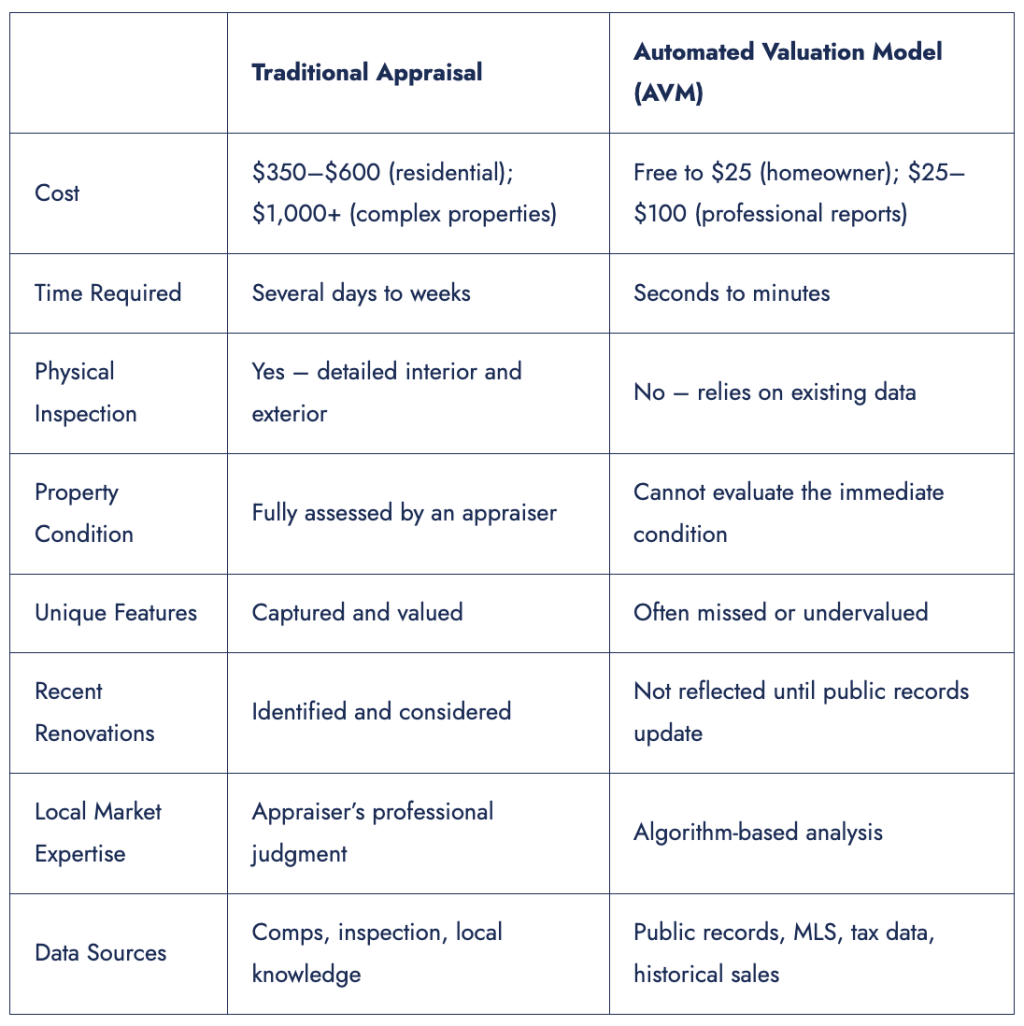
In homogeneous neighborhoods with high turnover (like suburban subdivisions), AVMs can be as accurate as, or even more consistent than, human appraisals. However, for unique properties, rural areas, or homes with significant unrecorded renovations, human appraisers remain the gold standard. AVMs struggle with "interior condition" unless paired with recent photo-analysis technology.
How much does an AVM report cost?
For individual lookups, professional AVM reports typically cost between $10 and $30. For high-volume institutional users, the price can drop significantly via subscription or bulk API pricing. This is a fraction of the cost of a traditional appraisal, which averages $400–$700 in 2026.
Can an AVM be used for a first mortgage?
Yes, but with limitations. The Consumer Financial Protection Bureau (CFPB) and GSEs allow AVMs for certain loan types, such as low-LTV (loan-to-value) refinances or small-balance loans. For most standard purchase transactions, a traditional appraisal or a "Hybrid Appraisal" is still required, though AVMs are used in the background for quality control.
How do AVM providers account for home improvements?
This is a major area of development in 2026. Top providers now use computer vision to analyze listing photos from the MLS to determine if a kitchen has been renovated or if a bathroom is updated. If no recent photos exist, the AVM typically assumes a "standard" condition for the neighborhood.
What is a "Hit Rate" in AVM terminology?
A hit rate is the percentage of time an AVM successfully returns a valuation for a given list of addresses. A provider might have a 95% hit rate in Los Angeles but only a 60% hit rate in rural Wyoming due to a lack of public record data.
Recommendations for Next Actions
If you are looking to integrate an AVM into your business workflow in 2026, your first step should be a Retrospective Test. Provide 1,000–5,000 recent, anonymized sales records to 2-3 different providers and ask them to run their models against those addresses. Compare their estimated values against the actual known sales prices to calculate each provider's "Mean Absolute Percent Error" (MAPE) for your specific target market.
For small-to-medium-sized firms, using an aggregator or a VMS is often more cost-effective than building direct API integrations with multiple providers. For large institutions, prioritizing a provider with a robust compliance and audit trail—such as Veros or CoreLogic—is essential to satisfy the current federal quality control mandates.
Image Gallery