Top Life and Health Insurance Licensing Programs with High Exam Pass Rates
Life and health insurance licensing programs with high exam pass rates—such as Kaplan Financial Education, ExamFX, and A.D. Banker—provide structured pre-licensing education designed to meet rigorous state requirements. These programs...
Life and health insurance licensing programs with high exam pass rates—such as Kaplan Financial Education, ExamFX, and A.D. Banker—provide structured pre-licensing education designed to meet rigorous state requirements. These programs utilize adaptive learning technologies, simulated exams, and pass guarantees to ensure candidates are prepared for state-proctored examinations in 2026, often yielding internal pass rates exceeding 80%.
Contents
Successfully obtaining a life and health insurance license is the foundational step for any career in the insurance industry. In 2026, the regulatory environment remains stringent, requiring candidates to not only understand complex policy language but also demonstrate a mastery of state-specific laws. Because the state exam is a high-stakes hurdle, selecting a program with a proven track record of success is critical for minimizing retake costs and accelerating time-to-market for new agents.
Understanding the Role of Pass Rates in Licensing Programs
When evaluating life and health insurance licensing programs, "pass rates" are often the primary metric cited by education providers. However, it is essential to distinguish between a provider’s internal pass rate and the overall state average. Internal pass rates represent the percentage of students who completed the course and subsequently passed their state exam on the first attempt. Leading providers in 2026 often report rates significantly higher than the national average, which typically hovers between 60% and 70% for first-time takers.
High pass rates are rarely a matter of luck; they are the result of instructional design that mirrors the actual testing environment. Programs with the highest success levels integrate "readiness indicators"—diagnostic tools that predict a student's likelihood of passing based on their performance in simulated exams. If a student consistently scores above 80% on these simulations, their probability of passing the actual state exam increases exponentially.
Furthermore, top-tier programs are updated in real-time to reflect changes in the National Association of Insurance Commissioners (NAIC) standards and individual state statutes. In 2026, this includes updated sections on long-term care (LTC) partnership programs, health savings account (HSA) contribution limits, and evolving regulations surrounding artificial intelligence in underwriting.
Top-Rated Insurance Licensing Providers for 2026
Several established organizations dominate the pre-licensing landscape by offering comprehensive curricula tailored to the Life, Accident, and Health (LAH) lines of authority.
Kaplan Financial Education
Kaplan remains a benchmark for insurance education due to its modular approach and the depth of its "InsurancePro" QBank. Kaplan’s methodology focuses on active recall. Rather than just reading through a digital textbook, students are prompted to answer thousands of practice questions that vary in difficulty.
For 2026, Kaplan has enhanced its live-online options, allowing students to interact with instructors who are subject-matter experts. This is particularly beneficial for the health insurance portion of the exam, where concepts like "Coordination of Benefits" (COB) and "Maximum Out-of-Pocket" limits can be technically challenging. Their Mastery Exam, taken at the end of the course, is widely regarded as being more difficult than the actual state exam, ensuring that students who pass it are more than ready for the real thing.
ExamFX
ExamFX is frequently chosen by large insurance carriers for their new recruits because of its robust reporting features. Managers can track a candidate's progress in real-time, seeing exactly where they are struggling within the "Candidate Management System."
The defining feature of ExamFX is its "Pass or Your Money Back" guarantee. To qualify, students must typically pass a "Guarantee Exam" within a specific timeframe before their state test date. This structure enforces a disciplined study schedule, which is often the missing component for candidates who fail. Their 2026 platform utilizes "Focus on the Facts" summaries, which condense several hundred pages of material into high-impact bullet points that are likely to appear on the exam.
A.D. Banker & Company
A.D. Banker has built a reputation on customer service and content clarity. They are one of the few providers that still offer high-quality physical textbooks alongside digital versions, catering to students who prefer tactile learning. Their program is structured around a "Course Map" that aligns perfectly with the state-specific exam content outlines provided by testing vendors like Prometric or Pearson VUE.
In 2026, A.D. Banker’s virtual study manuals include interactive overlays that explain the "why" behind insurance laws, such as the Incontestable Clause or the Suicide Provision. This depth of understanding helps students tackle "situational" questions where the answer isn't a simple definition but requires an application of the law.
XCEL Solutions
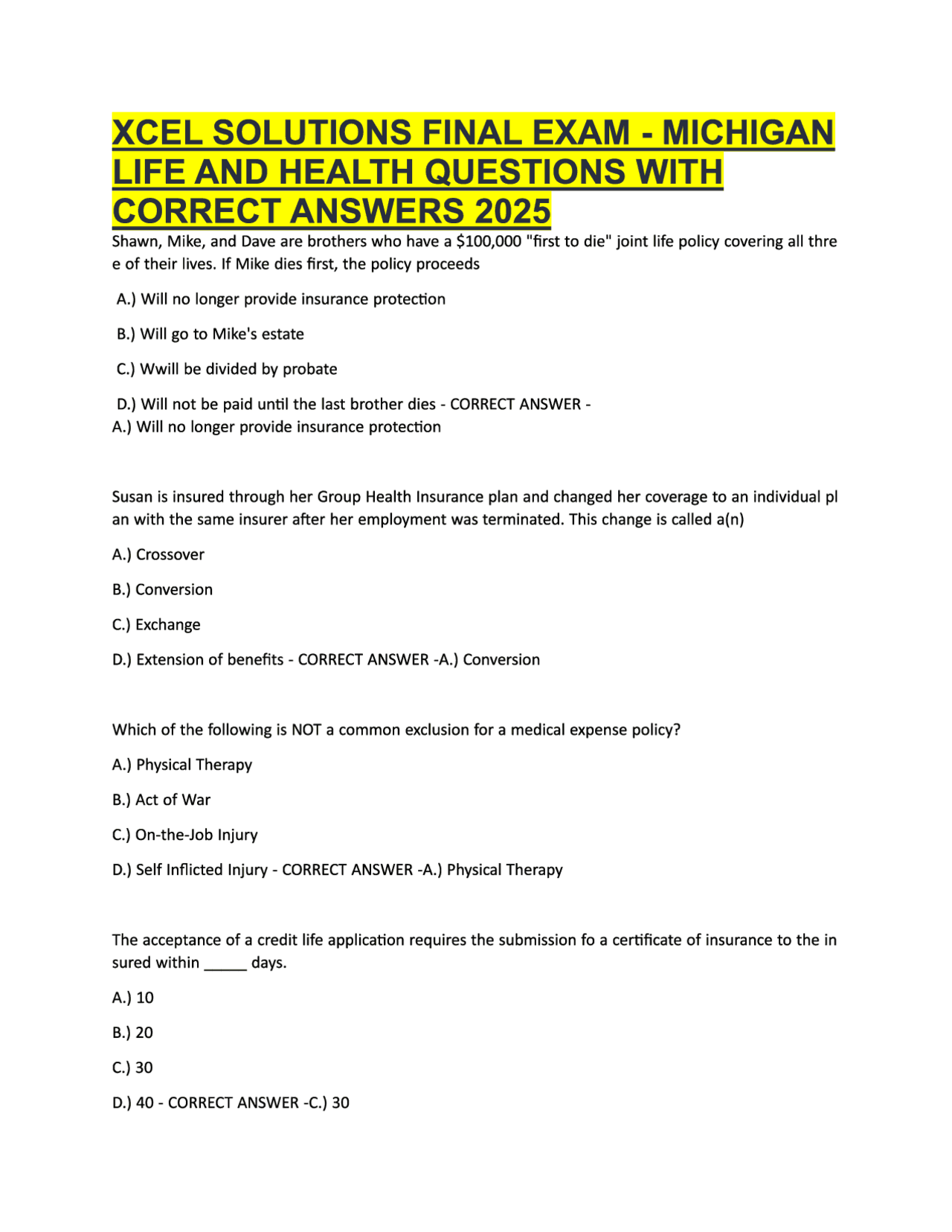
XCEL is designed for speed and efficiency. Their "prep-to-pass" model is popular among those who need to get licensed quickly to begin a scheduled training program with an agency. XCEL utilizes a mobile-friendly interface, allowing students to study in short bursts throughout the day. Their content is highly streamlined, removing "nice-to-know" information and focusing exclusively on "need-to-know" facts that correlate with the highest percentage of exam questions.
Comparative Analysis of Leading Programs
The following table summarizes the key features of the top-performing life and health insurance licensing programs available in 2026.
| Provider | Primary Format | Key Feature | Pass Guarantee | Best For |
|---|---|---|---|---|
| Kaplan | Self-Study / Live Online | InsurancePro QBank | Yes (Select Packages) | Comprehensive learning |
| ExamFX | On-Demand Video | Manager Tracking Tools | Yes | Agency recruits |
| A.D. Banker | Digital / Print / Webinar | Detailed Study Manuals | Yes | Visual & tactile learners |
| XCEL | Mobile-First Digital | Streamlined Content | No (Varies by state) | Quick turnaround |
| CompuCram | Adaptive Simulation | All-in-one Exam Prep | Yes | Final-stage testing |
Technical Components of an Effective Licensing Course
A high pass rate is supported by specific technical tools within the learning management system (LMS). When choosing a program in 2026, look for these three pillars of insurance education technology:
1. Adaptive Learning Engines
Modern programs use algorithms to identify a student's weak areas. If a student consistently misses questions related to "Whole Life Policy Dividends" but excels at "Health Insurance Taxability," the system will automatically increase the frequency of life insurance dividend questions in subsequent quizzes. This ensures that study time is optimized and that no knowledge gaps remain before the exam.
2. State-Specific Content Outlines
Insurance is regulated at the state level, not the federal level. A "national" course is insufficient. The best programs have dedicated editors for each state to ensure that the "Common Policy Provisions" section reflects the exact grace periods and free-look periods required by that state's Department of Insurance. For example, a Life and Health course in Florida will have significantly different requirements regarding "Long-Term Care" than a course in California.
3. High-Fidelity Practice Exams
The state exam is timed and proctored. Effective programs offer "Simulated Exams" that mimic the actual testing interface, including the countdown timer and the inability to go back to certain sections if that is a state rule. Getting used to the pressure of the clock is often as important as knowing the material itself.
The Life and Health Insurance Licensing Process
Securing a license involves more than just passing a course. In 2026, the process generally follows these steps:
- Pre-Licensing Education: Complete a state-approved course (usually 20 to 40 hours per line of authority). Upon completion, you receive a "Certificate of Completion."
- Fingerprinting and Background Check: Most states require a criminal background check. This should be done early, as it can take several weeks to process.
- State Exam Registration: Use the certificate to register for the exam via a third-party vendor like Pearson VUE or Prometric.
- The Examination: The exam is divided into two parts: General Knowledge (national insurance concepts) and State Law (specific statutes and regulations). You must pass both sections.
- License Application: Once the exam is passed, you must formally apply for the license through the National Insurance Producer Registry (NIPR) and pay the state's licensing fee.
Common Obstacles to Passing the Exam
Despite using high-quality programs, some candidates struggle. The most common pitfall is "over-studying" the national content while neglecting the state-specific laws. State law questions often make up 20% to 30% of the exam and include specific numbers—days for a grace period, dollar amounts for fines, and years for record-keeping—that must be memorized exactly.
Another issue is "test-taking anxiety." In 2026, many state exams are administered remotely via "Live Proctored" sessions. The technical requirements (clean desk policy, camera angles, stable internet) can be stressful. Programs that offer "Proctor Simulation" or detailed guides on what to expect during the remote session help mitigate this anxiety.
Financial Considerations and Costs
In 2026, the total investment for a life and health license typically ranges from $300 to $800.
- Course Fees: $150 – $300 (depending on whether you choose basic self-study or live-online packages).
- Exam Fees: $40 – $150 (paid to the testing vendor).
- Fingerprinting: $50 – $100.
- Application Fees: $50 – $200 (paid to the State Department of Insurance).
While it may be tempting to choose the cheapest course, the cost of failing the exam once—including the retake fee and the delay in earning commissions—often exceeds the price difference between a budget course and a premium program like Kaplan or ExamFX.
Frequently Asked Questions
Which insurance license is the hardest to pass?
Generally, the Health insurance portion is considered more technical than the Life insurance portion. Health insurance involves complex federal laws like COBRA, HIPAA, and the Affordable Care Act (ACA), as well as intricate details regarding disability income and Medicare Supplements. Combining them into a single "Life and Health" exam requires significant stamina and memory retention.
How many hours should I study for the Life and Health exam?
Most successful candidates report studying for 40 to 60 hours. This is typically spread over two to three weeks of intensive study. Cramming in a single weekend is rarely effective due to the volume of state-specific statutes that require rote memorization.
Can I take the insurance exam online in 2026?
Yes, most states allow for "Remote Proctored" exams through vendors like Pearson VUE. However, you must meet strict technical and environmental requirements, such as a private room with a locked door and a webcam that provides a 360-degree view of your workspace.
What happens if I fail the state exam?
If you fail, you must wait for a state-mandated cooling-off period (usually 24 to 48 hours) before rescheduling. Some states limit the number of attempts you can make within a year. Most high-quality licensing programs will provide additional coaching or a free course extension if you provide a copy of your failing score report.
Do these programs provide continuing education (CE) as well?
Many do. Companies like Kaplan and A.D. Banker are major providers of Continuing Education (CE). Once you are licensed, you will typically need to complete 24 hours of CE every two years, including 3 hours of ethics, to maintain your license in good standing.
Expert Recommendation for Success
For most aspiring agents in 2026, the recommended path is to choose a "Total Prep" package from a provider like Kaplan or ExamFX. The inclusion of a "Pass Guarantee" and a high-volume QBank provides the necessary safety net. Candidates should aim to complete the pre-licensing course and take the state exam within 7 days of each other. The information is highly perishable; the longer the gap between study and testing, the lower the probability of a first-time pass. Prioritize the simulated exams and do not schedule the actual state test until you are consistently scoring 80% or higher on the practice versions.
Image Gallery