The Best Verizon Internet Choice for Most Households: Fios Home Internet
For most households within its coverage footprint, the best Verizon internet choice is Verizon Fios Home Internet, specifically the 300 Mbps or 500 Mbps fiber-optic tiers, because they deliver symmetrical upload and download speeds, un...
For most households within its coverage footprint, the best Verizon internet choice is Verizon Fios Home Internet, specifically the 300 Mbps or 500 Mbps fiber-optic tiers, because they deliver symmetrical upload and download speeds, unlimited data, and reliable performance without contracts or hidden equipment fees.
Contents
Selecting a residential internet service provider involves weighing bandwidth, reliability, pricing, and infrastructure availability. For millions of consumers, Verizon stands out as a major telecommunications provider, but its portfolio is split between two distinct technologies: fiber-optic infrastructure (Fios) and fixed wireless access (5G Home Internet and LTE Home Internet). Understanding which option suits a typical household requires looking closely at technical capabilities, geographic availability, and household usage patterns.
Understanding Verizon's Internet Landscape
Verizon delivers residential internet primarily through two entirely different network architectures. Knowing the distinction between fiber-optics and wireless fixed broadband is essential for determining which service matches your household's requirements.
Verizon Fios (Fiber-Optic Network)
Verizon Fios relies on a 100% fiber-optic network running directly to the home (FTTH). Unlike older cable infrastructures that combine fiber lines with copper coaxial cables for the final stretch, pure fiber uses pulses of light to transmit data. This architecture yields distinct performance characteristics:
- Symmetrical Speeds: Upload speeds match download speeds. This is crucial for video conferencing, uploading large files to cloud storage, and hosting live streams.
- Low Latency: Fiber inherently produces minimal packet delay, making it ideal for online competitive gaming, real-time financial trading, and responsive voice-over-IP (VoIP) communication.
- Signal Integrity: Fiber cables are immune to electromagnetic interference, electrical surges, and weather-related degradation that can impact copper or wireless systems.
Verizon 5G Home Internet and LTE Home Internet
For households outside the Fios footprint, Verizon offers fixed wireless broadband utilizing its cellular towers.
- 5G Home Internet: Leverages Verizon's 5G Ultra Wideband (C-band and mmWave) network to beam internet service wirelessly to a gateway receiver placed inside the home.
- LTE Home Internet: Acts as a backup or alternative in areas lacking 5G coverage, using 4G LTE frequencies. While deployment is rapid and installation requires no wired hookups, wireless signals are subject to environmental interference, distance limitations from the cell tower, and network congestion during peak hours.
Why Fios Is the Default Choice for Most Households
Where available, Verizon Fios represents the optimal choice for the vast majority of households due to its technical superiority, predictable pricing, and overall value.
Symmetrical Speeds Explained
Traditional cable internet is asymmetric, offering high download speeds (for streaming movies or downloading games) but severely restricted upload speeds (often capped at 10 to 20 Mbps). Asymmetric connections function well for passive consumption, but modern households are no longer just consumers; they are creators and remote workers.
Consider a household where two adults work remotely on video calls, a teenager uploads school projects to a cloud server, and security cameras continuously stream HD footage back to a remote host. This scenario demands heavy upstream bandwidth. Fios provides identical upload and download capacities across all tiers, eliminating bottlenecks during heavy upstream usage.
Pricing Structure and Equipment Policies
Beyond raw performance, Verizon Fios maintains transparent consumer policies:
- No Annual Contracts: Subscribers are not locked into multi-year service agreements, allowing flexibility to change tiers or providers without early termination fees.
- No Data Caps: Fios does not enforce bandwidth caps or overage charges, regardless of whether a household consumes 100 gigabytes or 3 terabytes of data per month.
- Included Router: Standard Fios plans typically include the Wi-Fi router rental or offer promotional credits that offset equipment costs, keeping monthly bills consistent with advertised rates (excluding local taxes and optional digital TV bundles).
Comparing Verizon Internet Tiers
Verizon structures its Fios and 5G Home Internet portfolios into clear speed tiers designed to accommodate various household sizes and intensity of use.
| Service Type | Speed Tier (Download/Upload) | Best Suited For | Key Characteristics |
|---|---|---|---|
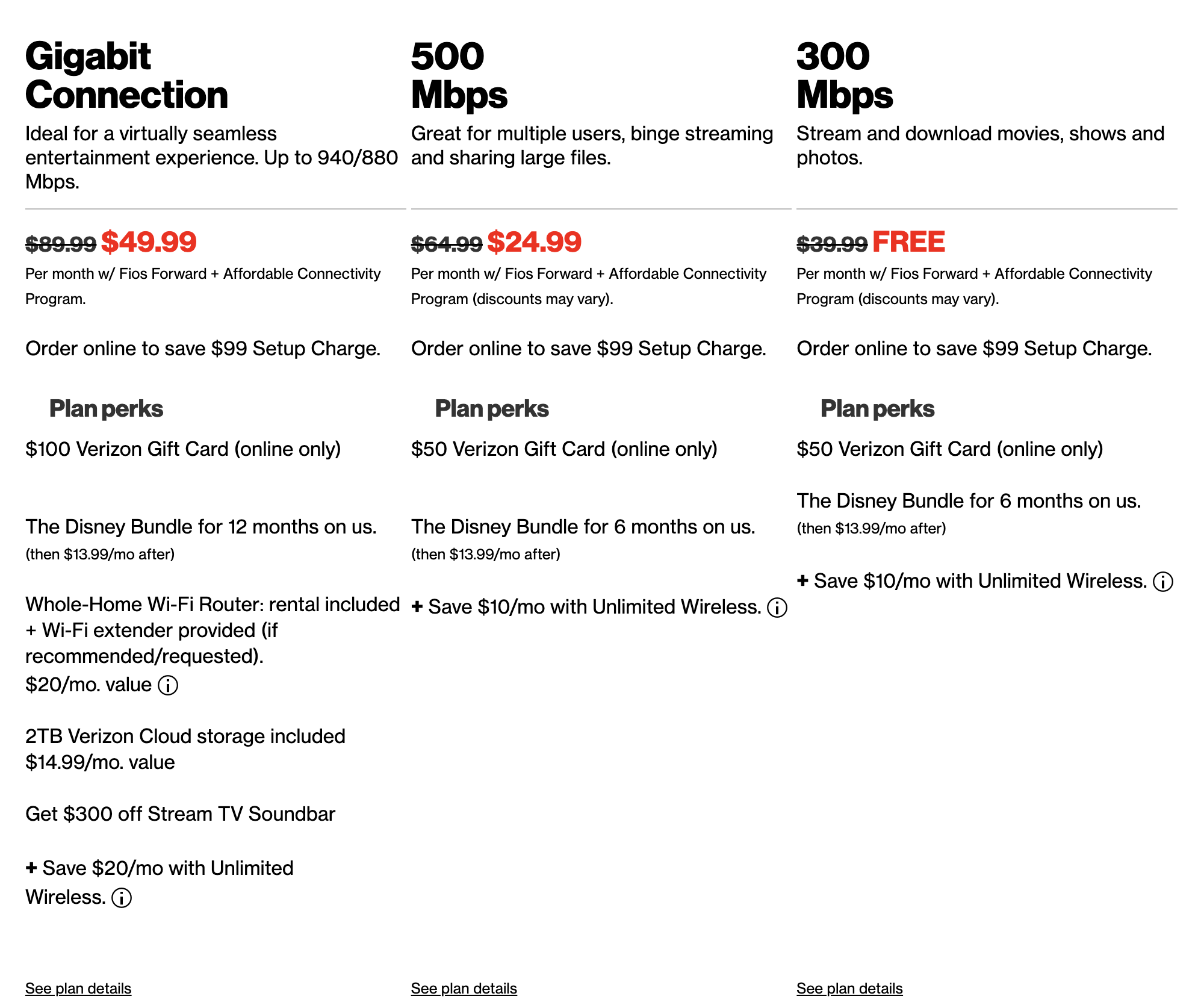
| Fios 300 Mbps | 300 / 300 Mbps | 1-3 users, casual streaming, smart home devices, single remote worker. | Symmetrical fiber, no data caps, router included. |
| Fios 500 Mbps | 500 / 500 Mbps | 3-5 users, 4K streaming, heavy remote work, online gaming. | Best value for most multi-person households. |
| Fios 1 Gig | 940+ / 880+ Mbps | Large households, avid gamers, frequent large file transfers, smart homes. | Maximum fiber capacity, often includes perks like whole-home Wi-Fi gear. |
| 5G Home Internet | 85 – 300+ Mbps (Down) / 10 – 20+ Mbps (Up) | Households outside the Fios footprint needing reliable broadband. | Wireless gateway, dependent on cell tower proximity and signal strength. |
Determining the Right Speed Tier for Your Household
Resisting the urge to overpay for unneeded bandwidth is critical when evaluating internet plans. Marketing campaigns often push consumers toward gigabit speeds, but the reality of digital consumption is more modest.
The 300 Mbps Tier: The Efficiency Standard
For a household of one to three people streaming HD video, browsing the web, and running standard smart home appliances (such as smart bulbs, thermostats, and voice assistants), a 300 Mbps connection provides ample headroom. Multiple devices can stream simultaneously without buffering.
The 500 Mbps Tier: The Sweet Spot for Families
The 500 Mbps tier represents the optimal balance for most modern American households. Families with multiple children, dual remote-working adults, and intensive cloud-dependent workflows benefit from this tier. It absorbs sudden network spikes—such as downloading a 100-gigabyte video game update while simultaneous video conferences are running—without degrading overall network responsiveness.
When to Consider 1 Gig or Higher
Gigabit fiber (1 Gig or 2 Gig plans) is typically unnecessary for standard residential use unless the household includes professional video editors transferring massive media files daily, or large multi-generational families running dozens of bandwidth-intensive applications concurrently.
When 5G Home Internet Is the Best Choice
Because Verizon Fios is limited to the Mid-Atlantic and Northeastern regions of the United States, millions of potential customers live outside its footprint. For these consumers, Verizon 5G Home Internet becomes the default and often superior alternative to legacy cable or DSL providers.
Advantages of 5G Home Internet
- Rapid Deployment: No technician visit or line installation is required. The gateway device is shipped directly to the customer, who plugs it in and uses a mobile application to find the optimal signal placement in the home.
- Competitive Pricing: Verizon offers aggressive promotional pricing for 5G Home Internet, particularly for customers who also subscribe to qualifying Verizon mobile phone plans.
- No Contracts or Data Caps: Like Fios, Verizon applies its consumer-friendly policy of no annual service contracts and zero data caps to its 5G fixed wireless offerings.
Limitations to Consider
- Geographic Availability: 5G Home Internet depends heavily on proximity to Verizon cell towers equipped with C-band or mmWave spectrum. Service availability can vary down to the specific neighborhood block.
- Variable Speeds: While download speeds often reach 300 Mbps or higher, wireless connections can experience fluctuations based on local network traffic, weather conditions, and physical obstructions between the tower and the home.
- Asymmetrical Performance: Unlike fiber, 5G wireless upload speeds are significantly lower than download speeds (typically capping out around 20 Mbps), which may affect heavy upstream users.
Frequently Asked Questions
Is a contract required for Verizon Fios or 5G Home Internet?
No. Verizon does not require annual service contracts for its standard Fios or 5G Home Internet plans. Customers can cancel or modify their service at any time without facing early termination fees.
Do Verizon internet plans include unlimited data?
Yes. Neither Verizon Fios nor Verizon 5G Home Internet enforces data caps or throttling based on monthly consumption. Households can stream, game, and work without monitoring data usage thresholds.
What is the difference between Fios and Verizon 5G Home Internet?
Fios is a 100% fiber-optic wired network delivering symmetrical upload and download speeds with maximum reliability. Verizon 5G Home Internet is a fixed wireless service that uses cellular towers to beam broadband to a home gateway, offering fast downloads but variable speeds depending on signal strength.
Can I use my own router with Verizon Fios?
Yes. While Verizon provides a compatible router (often included at no extra cost with certain plans), you can connect your own third-party router or mesh Wi-Fi system directly to the Optical Network Terminal (ONT) via an Ethernet cable.
How do I check if Verizon Fios is available at my address?
You can verify service availability by visiting the official Verizon website and entering your specific street address and ZIP code. If Fios is unavailable, the tool will automatically display whether 5G Home Internet is offered at your location.
Practical Next Steps and Verification
Before committing to a Verizon internet plan, verify exact address-level availability on the Verizon Home Internet Availability Page. Compare your current broadband bill and speed test results against Verizon's advertised tiers to ensure you select the appropriate bandwidth for your household's actual consumption patterns rather than paying for excess capacity.
Image Gallery