How to Use a Compound Inequalities Worksheet PDF: Complete Guide & Step-by-Step Examples
A compound inequalities worksheet PDF is a practical practice tool designed to help algebra students master solving, graphing, and interpreting complex inequalities that join two algebraic statements with "AND" or "OR." Using these wor...
A compound inequalities worksheet PDF is a practical practice tool designed to help algebra students master solving, graphing, and interpreting complex inequalities that join two algebraic statements with "AND" or "OR." Using these worksheet PDFs effectively requires understanding how to isolate variables across multiple boundaries, flip inequality symbols correctly, plot intersection or union solution sets on a number line, and verify results against provided answer keys.
Contents
What Are Compound Inequalities?
In algebra, a simple inequality involves a single comparison statement, such as $x > 4$ or $2y \le 10$. A compound inequality combines two separate inequalities into a single mathematical statement using either the conjunction "AND" or the disjunction "OR".
Mastering compound inequalities is a core milestone in high school algebra because it builds the mathematical foundation for absolute value equations, domain and range restrictions, linear programming, and advanced calculus concepts.
- CONJUNCTION ("AND")
- Solution is the INTERSECTION.
- Both conditions must be true.
- DISJUNCTION ("OR")
- Solution is the UNION.
- At least one condition must be true.
1. Conjunctions ("AND" Inequalities)
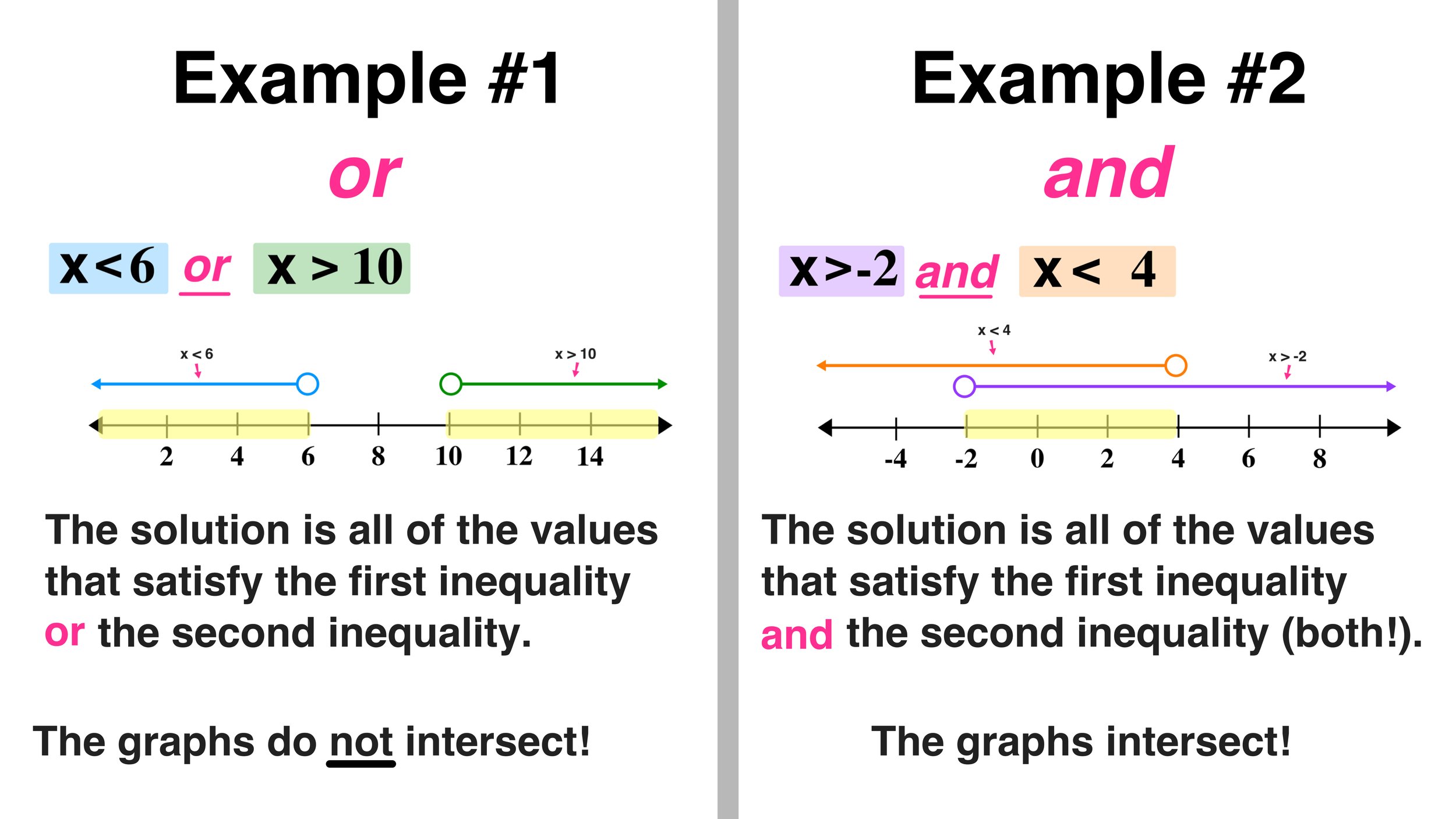
An "AND" compound inequality requires both mathematical conditions to be true simultaneously. The solution set represents the overlap, or intersection, of both individual inequalities.
- Three-Part Form: Compound inequalities of the "AND" type are frequently written as a compact three-sided continuous statement, such as $-3 \le 2x + 1 < 9$. This means $2x + 1$ is greater than or equal to $-3$ AND $2x + 1$ is strictly less than $9$.
- Graphing Characteristics: On a standard horizontal number line, an "AND" inequality graph typically features a single shaded segment bounded between two endpoints (unless there is no overlap, resulting in no solution).
2. Disjunctions ("OR" Inequalities)
An "OR" compound inequality requires at least one of the mathematical conditions to be true. The solution set represents the combined total, or union, of both individual inequalities.
- Separated Form: Disjunctions are always written as two distinct inequalities separated explicitly by the word "OR," such as $3x - 5 \le -11 \text{ or } 2x + 4 > 12$.
- Graphing Characteristics: On a number line, an "OR" inequality graph usually consists of two separate shaded arrows pointing in opposite directions toward positive and negative infinity (though in special cases, the rays may overlap to cover the entire real number line).
Steps to Solve Compound Inequalities on a Worksheet PDF
Working through a compound inequalities worksheet PDF systematically prevents common errors. Follow this four-step standard protocol for every problem on your practice sheet.
- STEP 1: Separate or Isolate
- "AND" (3-part): Perform operations on Left, Center, and Right.
- "OR" (2 parts): Solve each independent equation separately.
- STEP 2: Apply the Negative Inversion Rule
- If multiplying/dividing by a negative number, FLIP the symbol!
- Example: -2x < 6 ==> x > -3
- STEP 3: Write the Solution Set
- Inequality form: -2 <= x < 4
- Interval notation: [-2, 4)
- STEP 4: Graph on the Number Line
- Inclusive (<=, >=): Closed Circle [ solid dot ]
- Strict (<, >): Open Circle [ hollow dot ]
- Shade INTERSECTION for "AND" | Shade UNION for "OR"
Step 1: Isolate the Variable
- For 3-part "AND" inequalities: Perform inverse operations on all three sections (left, middle, right) simultaneously to isolate the variable in the center. Whatever balance operation you apply to the middle must also be applied to both outer sides.
- For "OR" inequalities: Treat the problem as two distinct, standard linear inequalities. Solve the left-hand inequality completely, then solve the right-hand inequality completely. Keep the word "OR" written between your working steps.
Step 2: Apply the Negative Inversion Rule
When multiplying or dividing any part of an inequality by a negative number, you must reverse (flip) the direction of the inequality sign ($<$ becomes $>$, and $\le$ becomes $\ge$).
- Example: If you divide $-3x \le 12$ by $-3$, the inequality transforms into $x \ge -4$.
- In a 3-part continuous inequality, if you divide by a negative, both inequality symbols must flip, and the entire expression should be rewritten so that smaller numerical values remain on the left.
Step 3: Express the Solution Set
Algebra worksheets frequently ask for solutions in multiple standard formats:
- Inequality Form: e.g., $-2 \le x < 5$ or $x < -1 \text{ or } x \ge 3$
- Interval Notation:
- Use square brackets
[or]for inclusive boundaries ($\le, \ge$). - Use soft parentheses
(or)for strict/exclusive boundaries ($<, >$) and infinity ($\infty, -\infty$). - Conjunction example: $[-2, 5)$
- Disjunction example: $(-\infty, -1) \cup [3, \infty)$ (where the symbol $\cup$ represents "union").
- Use square brackets
Step 4: Graph the Solution on a Number Line
Visual representation is a key component of standard algebra PDF worksheets.
- Circle Selection: Draw an open circle ($\circ$) for strict inequalities ($<$ or $>$). Draw a closed/solid circle ($\bullet$) for inclusive inequalities ($\le$ or $\ge$).
- Shading Direction:
- For "AND", shade only the region between the two boundary endpoints where both conditions overlap.
- For "OR", shade outwards along the rays defined by each inequality statement.
Detailed Step-by-Step Problem Examples
To maximize the utility of your compound inequalities worksheet PDF, examine these fully solved example problems demonstrating both types of statements.
Example 1: Solving a Continuous "AND" Compound Inequality
Problem: Solve and graph $-7 < 3x + 2 \le 14$. Express the answer in both inequality form and interval notation.
Solution Breakdown:
Subtract 2 from all three regions: $$-7 - 2 < 3x + 2 - 2 \le 14 - 2$$ $$-9 < 3x \le 12$$
Divide all three regions by 3: $$\frac{-9}{3} < \frac{3x}{3} \le \frac{12}{3}$$ $$-3 < x \le 4$$
Format the Output:
- Inequality Notation: $-3 < x \le 4$
- Interval Notation: $(-3, 4]$
Graphing Instructions:
- Place an open circle at $-3$.
- Place a closed circle at $4$.
- Draw a solid shaded line segment connecting $-3$ and $4$.
Example 2: Solving an "OR" Compound Inequality with Negative Coefficients
Problem: Solve and graph $4x - 1 < -9 \quad \text{OR} \quad -2x + 3 \le -5$.
Solution Breakdown:
Solve the left inequality ($4x - 1 < -9$):
- Add 1 to both sides: $4x < -8$
- Divide by 4: $x < -2$
Solve the right inequality ($-2x + 3 \le -5$):
- Subtract 3 from both sides: $-2x \le -8$
- Divide by $-2$ and flip the inequality sign: $x \ge 4$
Format the Output:
- Inequality Notation: $x < -2 \text{ or } x \ge 4$
- Interval Notation: $(-\infty, -2) \cup [4, \infty)$
Graphing Instructions:
- Place an open circle at $-2$ and shade an arrow extending to the left toward $-\infty$.
- Place a closed circle at $4$ and shade an arrow extending to the right toward $+\infty$.
How to Work Through a Compound Inequalities Worksheet PDF
Whether you are a student working through homework, a tutor providing extra practice, or a classroom teacher preparing lesson plans, utilizing digital PDF files effectively enhances learning speed and accuracy.
STUDENT WORKFLOW
- Download / Open PDF (Kami / GoodNotes / Print)
- Complete Problems (Show balance steps)
- Self-Check via Answer Key (Identify sign/interval err)
TEACHER WORKFLOW
- Select Skill-Level PDF (Basic vs Multi-step)
- Print or Assign Digitally (LMS / Classroom)
- Review Error Patterns (Focus on negative flip)
1. Digital Workflows vs. Physical Printouts
PDF worksheets offer flexibility across both paper and screen setups:
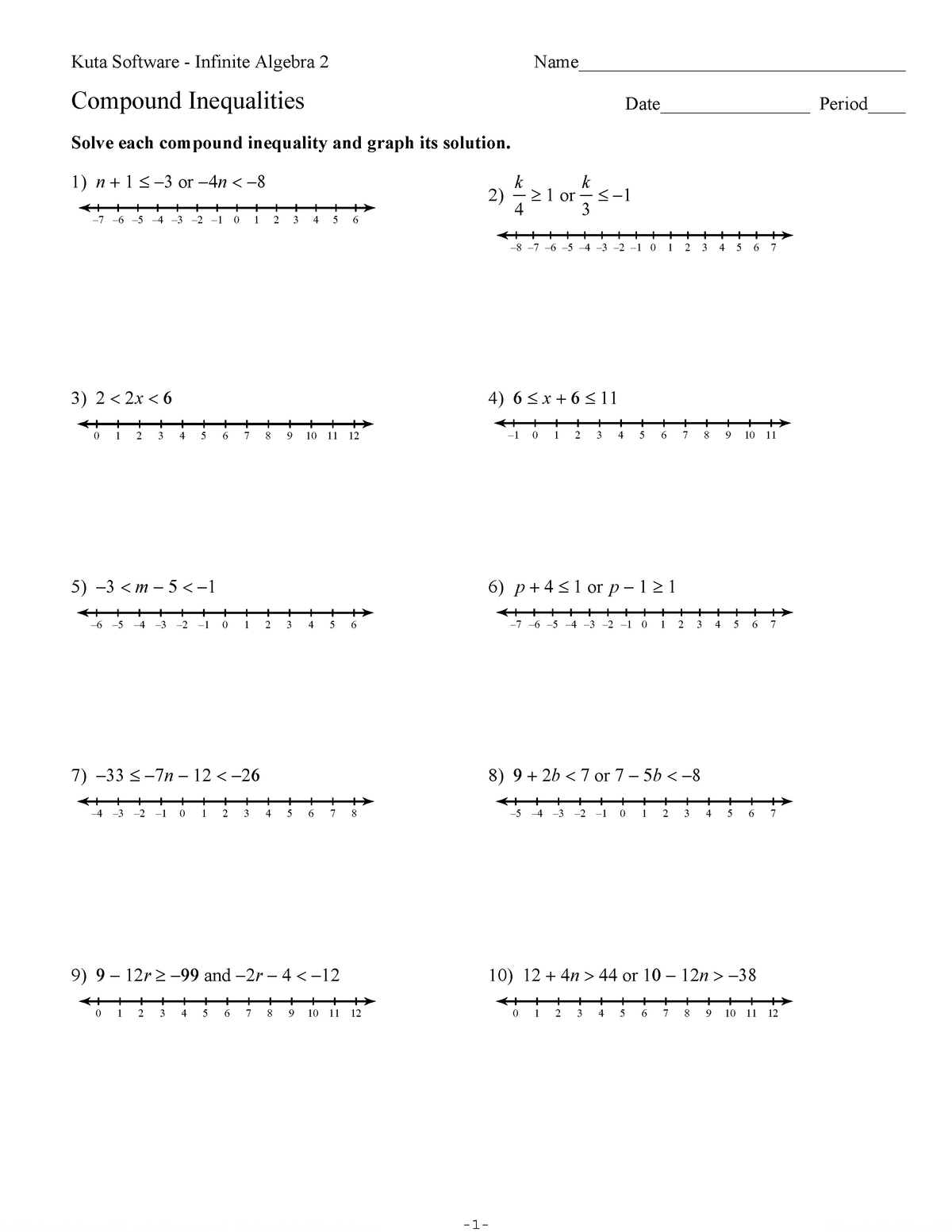
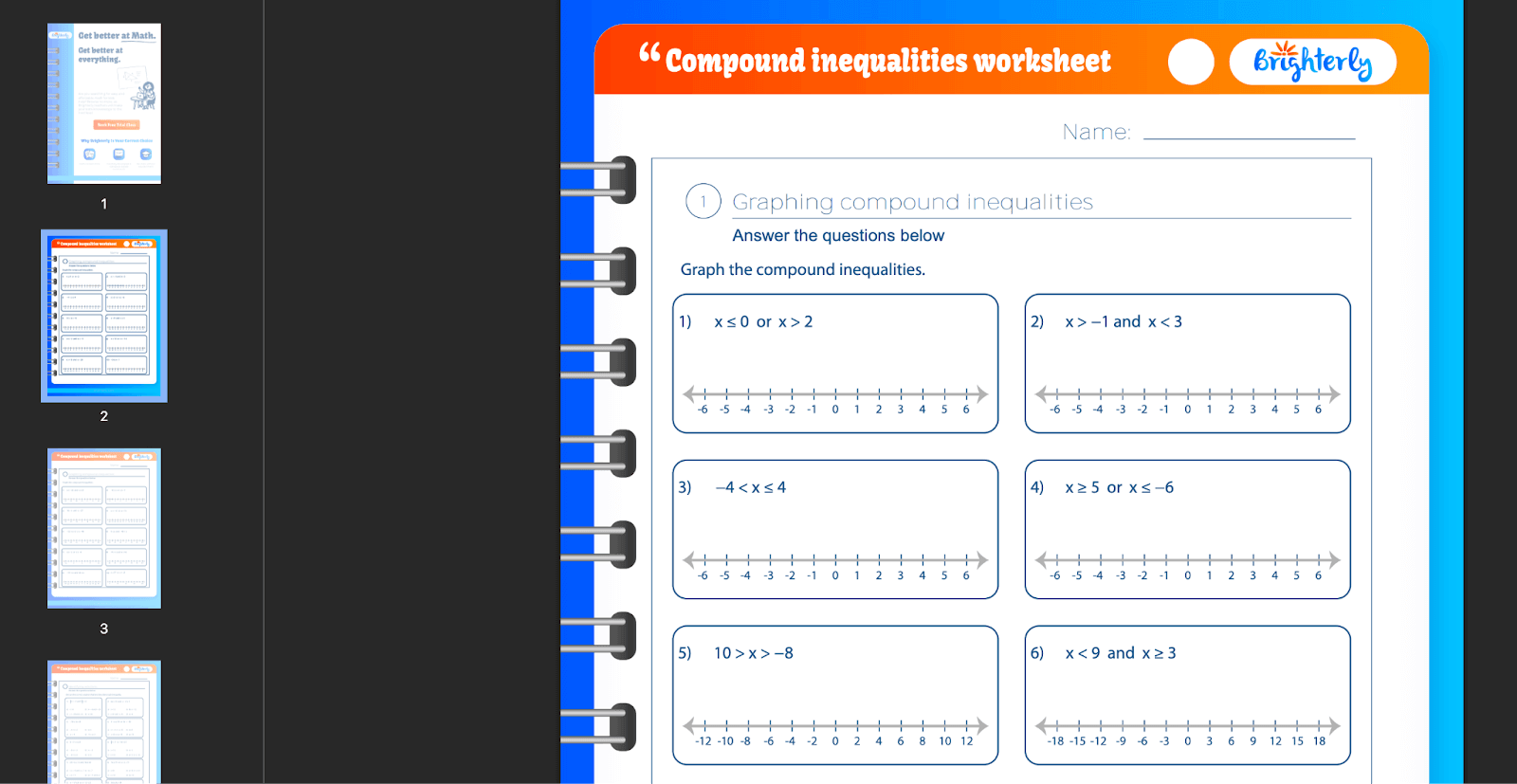
- Digital Annotation Tools: If you prefer working paperlessly on a tablet or laptop, open your PDF in interactive annotation software such as Kami, GoodNotes, Notability, or Adobe Acrobat Reader. These applications allow you to write math symbols directly onto the document, draw lines for graphs, and highlight key boundaries.
- Printing Strategies: For paper practice, ensure your printer scaling is set to "Fit to Page" or "100% Actual Size." Graphs on algebra worksheets rely on evenly spaced tick marks on number lines; proper scaling ensures numbers and circles remain clear.
2. Utilizing Answer Keys for Self-Assessment
Most educational PDF worksheets come accompanied by an answer key on the final page. To maximize retention:
- Work without looking: Complete an entire page or section before flipping to the solution key.
- Diagnose discrepancies: If your answer differs from the answer key, check three specific areas:
- Did you forget to reverse an inequality symbol after dividing by a negative number?
- Did you confuse open ($\circ$) and closed ($\bullet$) circles on the graph?
- Did you use soft parentheses
()instead of square brackets[]in interval notation?
Technical Comparison: AND vs. OR Compound Inequalities
Understanding the structural differences between these two inequality types prevents conceptual errors during problem-solving.
| Feature | Conjunction ("AND") | Disjunction ("OR") |
|---|---|---|
| Logical Condition | Both conditions must be satisfied simultaneously | At least one condition must be satisfied |
| Typical Algebraic Appearance | Compact 3-part: $a \le f(x) \le b$ or joined by "AND" | Two distinct inequalities joined by "OR" |
| Set Theory Operation | Intersection ($\cap$) | Union ($\cup$) |
| Number Line Graph | Shaded segment between two endpoints | Two shaded rays pointing outward in opposite directions |
| Interval Notation Format | Single continuous interval: $[a, b]$ | Combined dual intervals: $(-\infty, a) \cup [b, \infty)$ |
| Special Case: No Solution | Occurs when intervals do not overlap (e.g., $x < 2$ AND $x > 5$) | Rare, but occurs if conditions contradict real values |
| Special Case: All Real Numbers | Rare, requires full domain coverage | Occurs when opposing rays overlap completely (e.g., $x > 1$ OR $x < 4$) |
Common Mistakes and How to Avoid Them
When working through algebra worksheets, students often make repeatable procedural errors. Being aware of these pitfalls helps maintain accuracy.
- OPERATING ON ONLY TWO SIDES OF A THREE-PART INEQUALITY
- Incorrect: -4 <= 2x + 2 <= 8 ==> -4 <= 2x <= 6 [Left forgotten]
- Correct: -4 <= 2x + 2 <= 8 ==> -6 <= 2x <= 6
- FORGETTING TO FLIP THE INEQUALITY SYMBOL
- Incorrect: -3x < 12 ==> x < -4
- Correct: -3x < 12 ==> x > -4
- MISAPPLYING INTERVAL NOTATION BRACKETS
- Incorrect: (-inf, 5] ==> Infinity can NEVER have a square bracket
- Correct: (-inf, 5] ==> Always use soft parentheses for -inf/+inf
- SHADING THE WRONG DIRECTION ON "OR" GRAPH
- Incorrect: Shading the middle segment for an "OR" statement
- Correct: Shading outward arrows unless rays overlap completely
1. Operating on Only Two Sides of a 3-Part Inequality
- The Error: Subtracting a constant from the middle and right-hand side of a continuous inequality while forgetting the left-hand side.
- The Fix: Treat a three-part inequality like a three-pan balance scale. Whatever mathematical operation you perform on the middle section must be duplicated on both the far-left and far-right sections.
2. Forgetting to Flip Inequality Symbols
- The Error: Dividing by a negative coefficient without changing the direction of the inequality sign.
- The Fix: Highlight every negative coefficient attached to a variable before solving. Train yourself to flip the symbol the exact moment your pencil writes down the division step.
3. Misapplying Infinity in Interval Notation
- The Error: Writing $[\infty$ or $-\infty]$ with hard square brackets.
- The Fix: Infinity ($\infty$) is a concept representing unbounded quantity, not a concrete number. Consequently, infinity and negative infinity must always be enclosed with soft parentheses: $(-\infty$ or $\infty)$.
4. Overlapping "OR" Graphs Misinterpretation
- The Error: Assuming all "OR" graphs point outward in opposite directions.
- The Fix: Always graph both rays independently. If an "OR" problem results in $x > 2 \text{ or } x < 5$, the two rays overlap and cover every number on the number line. In this specific scenario, the correct solution is All Real Numbers, represented in interval notation as $(-\infty, \infty)$.
Pedagogical Guidance for Educators and Tutors
For secondary math educators and private tutors, compound inequality PDF worksheets serve as effective assessment tools. To maximize instructional value when assigning these materials:
- Scaffold Problem Complexity: Start worksheets with one-step inequalities containing positive coefficients before progressing to multi-step problems involving distribution, fractional terms, and negative division.
- Require Graph Verification: Encourage students to test a sample test point within their shaded graph region. Substituting a test point back into the original algebraic statement verifies whether their graphed solution is mathematically correct.
- Integrate Real-World Contexts: Supplement abstract numeric problems with practical word problems on your worksheets. Common real-world examples include business profit margins, temperature ranges, speed limits, and quality control tolerance thresholds.
For standardized curriculum benchmarks and detailed scope-and-sequence alignment on linear inequalities, teachers can consult the mathematics standards provided by the Common Core State Standards Initiative.
Frequently Asked Questions
What is the difference between an open circle and a closed circle on a PDF worksheet number line?
An open circle ($\circ$) indicates that the boundary number itself is excluded from the solution set, corresponding to strict inequality symbols ($<$ or $>$). A closed circle ($\bullet$) indicates that the boundary number is included in the solution set, corresponding to inclusive inequality symbols ($\le$ or $\ge$).
How do I write an "AND" compound inequality in interval notation?
To write an "AND" inequality in interval notation, list the lower boundary value followed by the upper boundary value, separated by a comma. Enclose each side with a bracket [ ] if the boundary is included, or a parenthesis ( ) if it is excluded. For example, $-4 \le x < 3$ becomes [-4, 3).
Why does multiplying or dividing by a negative number flip the inequality sign?
Multiplying or dividing by a negative number reverses the relative position of values on the number line. For example, $2 < 5$ is a true statement. Multiplying both sides by $-1$ gives $-2$ and $-5$. Because $-2$ is greater than $-5$ on a standard number line, the sign must flip to maintain truth: $-2 > -5$.
What should I do if an "AND" compound inequality has no overlapping region?
If the two conditions in an "AND" inequality do not overlap on a number line (for example, $x < 1$ AND $x > 4$), no real number can satisfy both conditions simultaneously. The correct mathematical answer is No Solution, denoted by the empty set symbol $\emptyset$.
Can I open and complete a PDF worksheet on a tablet without printing it?
Yes. You can open any standard worksheet PDF on an iPad, Android tablet, or touch-screen laptop using PDF annotation software such as Kami, GoodNotes, Notability, or Adobe Acrobat. These tools let you annotate, solve equations, and draw number line graphs directly onto the PDF file.
Next Steps for Mastering Compound Inequalities
To build fluency with compound inequalities using PDF practice sheets:
- Download a Tiered Worksheet Set: Start with basic single-step compound inequalities to master notation before advancing to multi-step distribution problems.
- Practice Dual Formats: Ensure you write every answer in both standard inequality form (e.g., $-2 < x \le 5$) and interval notation (e.g., $(-2, 5]$).
- Verify with Answer Keys: Check your work against the worksheet solution sheet after completing each page, carefully auditing negative sign flips and open/closed circle graph boundaries.
Image Gallery