Understanding Whole Life Insurance Quotes in New Jersey
Whole life insurance quotes in New Jersey represent binding or illustrative proposals detailing your guaranteed death benefit, fixed ongoing premium, and projected cash value accumulation. Regulated by the New Jersey Department of Bank...
Whole life insurance quotes in New Jersey represent binding or illustrative proposals detailing your guaranteed death benefit, fixed ongoing premium, and projected cash value accumulation. Regulated by the New Jersey Department of Banking and Insurance (DOBI), these quotes reflect strict state nonforfeiture minimums, statutory mortality tables, and insurer-specific underwriting guidelines tailored to your age, health classification, and selected coverage amount.
Contents
Evaluating a life insurance quote requires more than comparing headline monthly premiums. Whole life insurance is a permanent contract designed to last your entire lifetime, combining a death benefit with an internal cash value savings component. Because these contracts involve decades-long financial commitments, understanding the nuances of a New Jersey policy illustration—from guaranteed interest crediting rates to local consumer protections—is essential to making an informed financial decision.
Anatomy of a Whole Life Insurance Quote
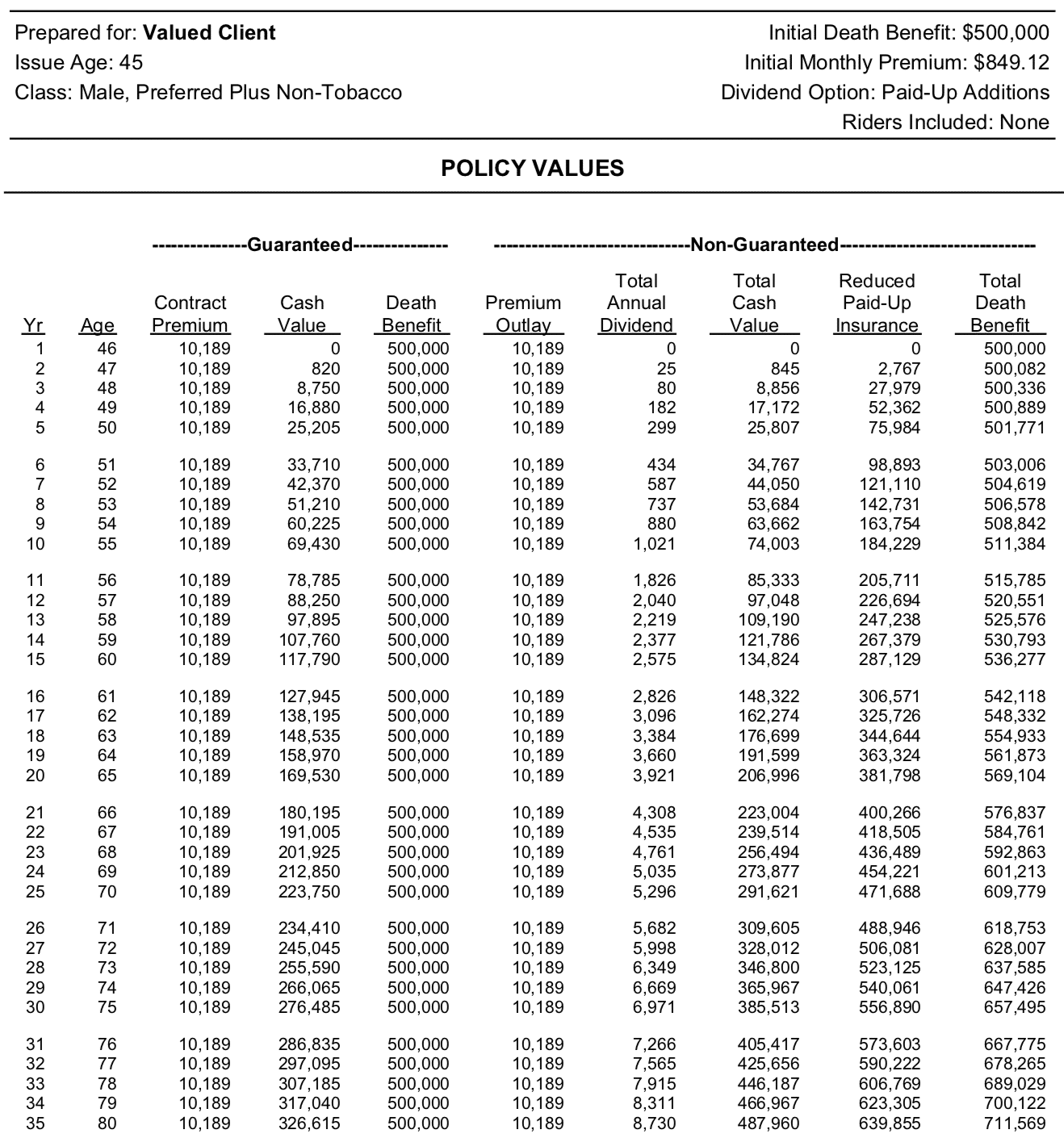
When an agent or broker presents a whole life quote in New Jersey, they typically supply a primary summary alongside a comprehensive policy illustration. While the summary highlights the proposed face amount and the recurring premium, the illustration reveals the financial mechanics of the contract over thirty years or more.
A complete quote illustration contains several non-negotiable data fields:
- Face Amount (Death Benefit): The stated monetary benefit paid to your beneficiaries upon your death, free of federal and New Jersey state income taxes in most circumstances.
- Guaranteed vs. Non-Guaranteed Columns: The guaranteed column outlines the legal baseline of the contract—the minimum cash value and death benefit guaranteed under statutory nonforfeiture laws, assuming zero dividend payments. The non-guaranteed column demonstrates performance based on the insurer's current dividend scale, which fluctuates based on mortality claims, operational expenses, and investment earnings.
- Net Premium Outlay: The exact dollar figure due annually, semi-annually, quarterly, or monthly. In a traditional whole life policy, this premium remains level for the duration of the payment schedule.
- Surrender Value: The liquid capital available to the policyholder if the policy is surrendered before maturity. In early policy years, surrender charges and administrative amortization lower this value significantly below cumulative premiums paid.
- Paid-Up Additions (PUA): Optional riders or dividend election options that purchase micro-increments of fully paid-up whole life coverage, accelerating internal cash value growth.
Reading beyond the non-guaranteed ledger is crucial. While mutual life insurance carriers frequently cite consecutive decades of paying policyholder dividends, non-guaranteed dividends can change annually. The guaranteed ledger represents the true contractual floor.
New Jersey Regulatory Framework and Consumer Protections
New Jersey enforces rigorous consumer-oriented insurance codes that directly affect how whole life quotes are formulated, sold, and administered. The primary governing entity is the New Jersey Department of Banking and Insurance (DOBI), which enforces Title 17 and Title 17B of the New Jersey Statutes.
The New Jersey Free-Look Period
Under New Jersey law (N.J.S.A. 17B:25-2.1), consumers receive a mandatory "free-look" period starting the day the policy is delivered. For a standard new issue, New Jersey mandates a 10-day period during which you can cancel the contract for any reason and receive a full refund of all premiums paid. If the whole life contract replaces an existing policy, New Jersey administrative regulations expand this window to a mandatory 30-day replacement free-look period to protect policyholders from predatory churning.
Standard Nonforfeiture Law
New Jersey enforces standard nonforfeiture requirements ensuring that policyholders who stop paying premiums do not forfeit all accumulated equity. If premium payments cease after cash value has accrued, the contract mandates that the owner may select one of three statutory options:
- Cash Surrender: Liquidate the policy and receive the net accumulated cash value minus outstanding loans.
- Reduced Paid-Up Insurance: Use accumulated cash value to purchase a reduced, fully paid-up death benefit requiring no future premium payments.
- Extended Term Insurance: Use the cash value to purchase term insurance for the full original death benefit for a specified duration of time.
State Guaranty Association Safety Net
If a life insurance carrier licensed in New Jersey becomes financially impaired or insolvent, the New Jersey Life and Health Insurance Guaranty Association provides statutory coverage. For individual life insurance policies, the state guaranty association provides protection up to $500,000 in life insurance death benefits and up to $100,000 in net cash surrender values per individual, regardless of how many policies are held with the insolvent insurer.
Core Underwriting Factors Influencing Quotes in New Jersey
Insurers issuing coverage in the Garden State calculate whole life premiums based on actuarial risk assessments. The underwriting process assigns the applicant to a specific rate class, which dictates the cost per $1,000 of coverage.
Rate Classes Explained
- Preferred Plus (Super Preferred): Reserved for individuals in pristine health, with optimal blood pressure, optimal cholesterol-to-HDL ratios, clean family health histories, and zero tobacco or nicotine use. This tier commands the lowest premiums.
- Preferred: Awarded to individuals in excellent health who may have minor, well-managed health conditions or a family history of specific hereditary diseases.
- Standard Plus: Indicates better-than-average health, but slight deviations in body mass index (BMI) or minor lab markers prevent a preferred classification.
- Standard: Represents average life expectancy. Most applicants with common managed conditions, such as treated hypertension or mild cholesterol elevations, fall into this category.
- Substandard (Table Ratings): Applied to applicants with elevated medical risks (such as type 2 diabetes, a history of cancer, or cardiovascular disease) or hazardous avocations. These policies use a standard rate baseline augmented by flat extras or percentage-based table steps (e.g., Table A through Table H).
Medical Exam vs. Accelerated Underwriting
Many life insurers operating in New Jersey now leverage automated and accelerated underwriting engines. If an applicant meets specific criteria, carriers cross-reference pharmacy prescription databases, motor vehicle records from the New Jersey Motor Vehicle Commission, clinical laboratories, and Medical Information Bureau (MIB) records to issue quotes without requiring a paramedical blood draw or physical examination. However, traditional paramedical exams remain standard for large face amounts—typically $1,000,000 and above—or for applicants over age 50.
Whole Life Policy Structures: Comparing Quotes
Whole life insurance is not a monolithic product. When collecting quotes in New Jersey, you will encounter diverse premium structures and carrier corporate setups.
The primary distinction exists between participating policies (offered primarily by mutual life insurance companies) and non-participating policies (issued primarily by stock life insurance companies). Participating policies are eligible to receive policyholder dividends, which can purchase paid-up additions, reduce future premiums, or be paid in cash. Non-participating policies offer fixed guarantees with no potential for dividend participation.
| Policy Feature / Dimension | Standard Ordinary Whole Life | Limited-Pay Whole Life (e.g., 10-Pay, 20-Pay) | Single-Premium Whole Life |
|---|---|---|---|
| Payment Duration | Payable to age 100 or 121 | Payable for a set number of years (10, 20) or to a specific age (e.g., Age 65) | Paid in full via a single lump sum at policy inception |
| Annual Premium Cost | Moderate; spread evenly over entire lifetime | Higher; compressed premium timeline requires larger annual outlays | Maximum upfront capital requirement |
| Cash Value Velocity | Slow initial growth; accelerates after year 7–10 | Rapid early growth due to heavy early funding | Immediate, high cash surrender value |
| MEC Status Risk | Low risk of becoming a Modified Endowment Contract | Moderate risk depending on design and rider configuration | Automatically classified as a Modified Endowment Contract (MEC) |
| Ideal Use Case | Permanent estate planning, income replacement, foundational asset protection | Wealth accumulation, funding during peak earning years, pre-retirement planning | Legacy transfers, wealth transfer to grandchildren, immediate liquidity creation |
Key Policy Riders and Their Impact on Quotes
Quotes often include optional contractual modifications known as riders. While riders customize coverage to address specific contingencies, they directly alter your bottom-line premium.
Accelerated Death Benefit Rider (Terminal and Chronic Illness)
In New Jersey, most modern whole life quotes incorporate living benefits either automatically or for a nominal fee. Under N.J.A.C. 11:4-30, accelerated death benefits allow the policyholder to access a significant portion of the death benefit if diagnosed with a qualifying terminal illness (typically 12 to 24 months to live) or a qualifying chronic illness requiring continuous long-term care assistance.
Waiver of Premium
If you suffer a total and permanent disability before reaching a specified age (commonly age 60 or 65), the insurer waives all future premiums while keeping the policy in force, allowing cash value to continue growing uninterrupted. This rider adds approximately 2% to 5% to the annual premium quote.
Guaranteed Insurability Option (GIO)
Particularly valuable when quoting coverage for children or young adults, the GIO rider permits the purchase of additional increments of whole life insurance at predetermined future dates or major life milestones (such as marriage or the birth of a child) without undergoing new medical exams or demonstrating insurability.
Term Conversion Riders
If you currently hold a convertible term life insurance policy in New Jersey, your contract contains a provision allowing you to convert that term policy into a whole life policy without submitting fresh evidence of medical insurability. The quote for the new whole life policy is calculated using your attained age at conversion, but locks in the original underwriting risk class earned when the term policy was initially approved.
Step-by-Step: How to Evaluate and Verify a Quote
Navigating whole life quotes involves an organized approach to confirm underwriting viability, carrier solvency, and cost efficiency:
- Verify Agent and Carrier Licensing: Ensure that the selling producer and the underwriting insurance company are in good standing by running a license query on the New Jersey DOBI Insurance Licensing Portal.
- Scrutinize Financial Strength Ratings: Because whole life contracts span multiple decades, select carriers holding superior balance sheets. Prioritize companies rated A+ or higher by A.M. Best, Fitch, Moody’s, or S&P Global.
- Request Full Numerical Illustrations: Never evaluate a quote based solely on a single summary page. Demand the full illustration spanning ages 0 to 121. Inspect columns showing:
- Guaranteed Cash Value
- Non-Guaranteed Cash Value
- Guaranteed Death Benefit
- Surrender Charges by year
- Confirm Dividend Treatment: Clarify how projected dividends are handled within the quote. Choosing Paid-Up Additions maximizes death benefit expansion and compound cash value growth. Choosing Reduce Premium lowers your ongoing out-of-pocket costs.
- Audit the Internal Rate of Return (IRR): Request an IRR report on both the cash surrender value and the death benefit at life expectancy (e.g., age 85). This demonstrates the true annualized efficiency of your capital.
Common Mistakes When Reviewing Whole Life Quotes
Consumers reviewing whole life quotes frequently fall into traps that undermine their long-term financial security.
Over-Relying on Non-Guaranteed Projections
A common mistake is assuming that non-guaranteed dividend illustrations represent future returns. Insurers alter dividend interest rates based on macroeconomic shifts, corporate portfolio earnings, and bond yield changes. Always evaluate whether the guaranteed side of the ledger satisfies your fundamental financial requirements if dividend yields decline.
Misunderstanding Early Liquidity
Whole life insurance is fundamentally illiquid in its infancy. Front-loaded distribution costs, agent commissions, and mortality risk buffering result in low cash surrender values during the first two to five years. Viewing whole life quotes through the lens of a short-term savings account leads to surrender charges and policy abandonment.
Failing to Account for Modified Endowment Contract (MEC) Rules
Under federal tax law (Internal Revenue Code Section 7702A), if a policy receives excess cumulative premiums within its first seven years—violating the "7-Pay Test"—the contract becomes a Modified Endowment Contract. While the death benefit remains income-tax-free, cash value withdrawals and policy loans are taxed on a last-in, first-out (LIFO) basis, and subject to a 10% IRS penalty if taken before age 59½. Ensure your broker models your quote safely below the statutory MEC limits.
Frequently Asked Questions
Are life insurance proceeds subject to New Jersey state inheritance tax?
Life insurance proceeds payable to named beneficiaries—such as a spouse, child, parent, or trust—are exempt from both the New Jersey Inheritance Tax and standard state income taxes. However, if proceeds are made payable directly to the decedent's estate, they may become subject to probate claims, estate administration fees, and inheritance taxation depending on the beneficiary distribution classification.
How does New Jersey's replacement law protect me if I switch policies?
Under New Jersey administrative regulations, if a quote involves replacing an existing life insurance contract, the agent must deliver a formal "Notice Regarding Replacement of Life Insurance." This document requires the transparent disclosure of surrender penalties, new contestability periods, new suicide exclusion clauses, and the comparative financial values of the existing policy versus the proposed contract, alongside an extended 30-day free-look guarantee.
Can an insurer cancel my whole life policy if my health declines after issuance?
No. Once a whole life insurance contract is issued, accepted, and past the statutory two-year contestability period, the life insurer cannot cancel coverage, modify terms, or increase premiums due to changes in health, occupation, or lifestyle, provided you pay the agreed-upon premiums on schedule.
What happens if I borrow against the cash value in New Jersey?
Whole life contracts allow policyholders to secure policy loans directly from the carrier using accumulated cash value as collateral. These loans are non-taxable under standard tax rules, do not require commercial credit checks, and carry no mandatory repayment schedules. However, accrued loan interest adds to the outstanding loan balance, and any unpaid debt will reduce the final death benefit paid to beneficiaries dollar-for-dollar upon death.
How do I verify that an insurer is financially solvent in New Jersey?
Financial solvency can be verified by reviewing financial strength ratings from independent credit rating agencies such as A.M. Best, S&P, and Moody's. Additionally, you can consult public records and annual statement filings managed by the New Jersey Department of Banking and Insurance or check member status with the New Jersey Life and Health Insurance Guaranty Association.
Next Steps: Moving from Quote to Coverage
Securing an effective whole life policy in New Jersey requires moving systematically from comparison to formal underwriting.
Begin by requesting concurrent, structured illustrations from at least three different top-tier mutual insurers. Require each broker to model the illustrations using identical assumptions: matching face amounts, uniform payment durations, and identical dividend choices directed toward paid-up additions. Once you review the guaranteed cash values, confirm that the required monthly or annual premium comfortably aligns with your ongoing budget.
Once your application is submitted, prepare thoroughly for the medical underwriting process by compiling medical records and current prescription details. When the policy arrives, use New Jersey’s statutory 10-day or 30-day free-look period to cross-examine the finalized policy contract against the initial quote, confirming that all nonforfeiture values, premium schedules, and riders precisely match your expectations.
Image Gallery