The New Mexican Spanish Dialect in Transition: History, Evolution, and Modern Survival
The New Mexican Spanish dialect is currently experiencing a profound generational transition, shifting from a robustly spoken community language shaped by centuries of relative geographic isolation into an endangered heritage tongue in...
The New Mexican Spanish dialect is currently experiencing a profound generational transition, shifting from a robustly spoken community language shaped by centuries of relative geographic isolation into an endangered heritage tongue influenced heavily by English bilingualism and standard Mexican Spanish.
Contents
Understanding the trajectory of this unique linguistic variety requires examining its historical roots, structural characteristics, the socio-educational forces accelerating its shift, and the documentation efforts working to preserve its legacy.
Historical Foundations and Origins of New Mexican Spanish
The genesis of New Mexican Spanish dates back to the late 16th century, beginning with the 1598 expedition led by Juan de Oñate that established the first permanent Spanish settlements in the upper Rio Grande valley. Settlers, soldiers, and missionaries brought the Spanish of the Golden Age to a region far removed from the administrative and cultural centers of Mexico City and Madrid.
For nearly three centuries, this colonial population lived in relative isolation from other Spanish-speaking regions. This geographical and social separation allowed the language to develop independently, preserving archaic lexical items, phonetic shifts, and grammatical structures that eventually evolved differently or disappeared entirely in other parts of the Spanish-speaking world.
During the Mexican period (1821–1848) and following the Treaty of Guadalupe Hidalgo, the region was integrated into the United States. This political transition initiated a prolonged period of intense cultural and linguistic contact. Despite the dominant English-speaking political and educational infrastructure that emerged, New Mexican Spanish remained the primary medium of daily life for generations of rural and small-town residents, cementing its status as an integral component of regional identity.
Distinct Linguistic Features and Lexicon
New Mexican Spanish is characterized by a fascinating blend of archaic Castilian forms, Nahuatl loanwords inherited via colonial Mexico, and extensive borrowing from English. Linguists frequently categorize these features into distinct phonological, morphological, and lexical domains.
Phonological and Morphological Characteristics
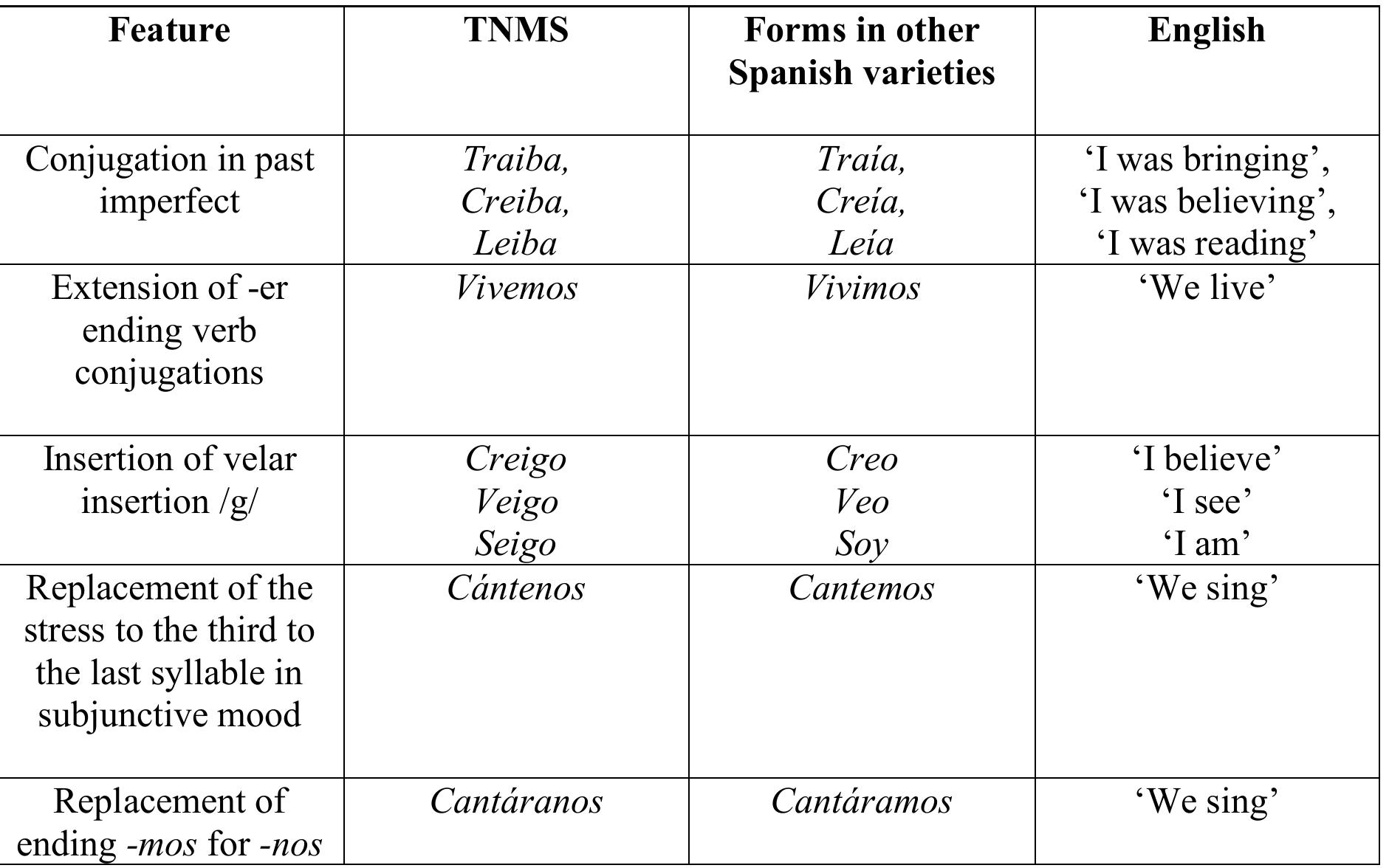
- Archaic Pronunciations: Speakers often retain 16th-century phonetic realizations, such as pronouncing initial /f/ as an aspirated sound in certain words (though this has largely receded in contemporary speech) or maintaining older forms of verb conjugations.
- Conservative Verb Forms: Strong preterites and distinct subjunctive forms inherited from Early Modern Spanish are frequently preserved, contrasting with modern standard Spanish developments.
- Morphological Innovation: The creation of unique regional verb forms and localized gender assignments for borrowed English nouns.
Lexical Composition
The vocabulary of the dialect reflects its multi-layered history. Words of Nahuatl origin, often referred to as mexicanismos, entered the dialect early through colonial interaction—terms like jacal (hut) and guajolote (turkey) remain common.
Concurrently, centuries of intense contact with English have generated a rich lexicon of loanwords and calques, often adapted to Spanish phonology and grammar. These adaptations are not random errors, as older critics sometimes claimed, but rather systematic products of bilingual creativity known as code-switching and lexical borrowing.
| Category | Traditional / Archaic Term | Modern Standard Spanish Equivalent | English Borrowing / Regional Adaptation |
|---|---|---|---|
| Agriculture & Environment | ciénega (marsh) | ciénaga | finca / rancho |
| Household & Daily Life | chiqueado (spoiled) | mimado / consentido | chequear (to check) |
| Flora & Fauna | ajuatado (prickly) | espinoso | güquete (bucket) |
Socio-Cultural Pressures and Language Shift
The viability of the New Mexican Spanish dialect in transition is challenged by rapid socio-economic shifts, urbanization, and historical educational policies. Throughout much of the 20th century, regional school systems discouraged or outright prohibited the use of Spanish in classrooms, fostering a generational stigma that associated the dialect with lower social status or educational disadvantage.
Furthermore, economic integration drew rural populations toward larger urban centers like Albuquerque and Santa Fe, where English is the undisputed medium of commerce, media, and public administration. As families integrated into English-dominant environments, intergenerational transmission disrupted. While grandparents and older parents frequently spoke fluent New Mexican Spanish, they often raised their children primarily in English to spare them the discrimination their own generation faced.
The Influence of Standard Mexican Spanish
Compounding the pressure from English, the presence of modern standard Mexican Spanish—driven by immigration, media, and academic norms—creates a complex identity dynamic for heritage speakers. Native New Mexican Spanish speakers frequently find that their traditional lexicon and grammar are viewed as "incorrect" or "non-standard" by speakers of mainland Mexican Spanish. This double marginalization—pressured by English on one side and corrected by standard Spanish speakers on the other—accelerates the abandonment of the local dialect in favor of dominant linguistic norms or complete monolingualism in English.
Documentation, Revitalization, and Academic Study
Despite the decline in spontaneous intergenerational transmission, New Mexican Spanish has attracted significant attention from linguists, folklorists, and community advocates dedicated to its documentation and cultural preservation.
Academic institutions, notably the University of New Mexico, have long histories of documenting regional speech patterns, collecting oral histories, and analyzing the structural evolution of the dialect. Researchers utilize sociolinguistic interviews, acoustic analysis, and corpus linguistics to record how younger speakers modify traditional phonology and syntax.
Concurrently, grassroots revitalization efforts are emerging. Cultural organizations, local writers, and educators are working to destigmatize the dialect, celebrating its literature, poetry, and oral traditions. Poets and musicians who utilize traditional New Mexican Spanish help maintain its cultural prestige, demonstrating that the dialect remains a vital artistic medium capable of expressing contemporary realities while honoring historical roots.
Comparative Overview of Spanish Varieties in New Mexico
To understand the current linguistic landscape, it is helpful to contrast New Mexican Spanish with other Spanish varieties spoken in the state today.
- Traditional New Mexican Spanish: Spoken primarily by multi-generational families native to the region; characterized by archaic features, local lexical items, and deep historical roots.
- Border/Transnational Spanish: Spoken by recent immigrants and cross-border commuters; closely aligned with standard northern Mexican Spanish varieties with dynamic, ongoing contact with contemporary Mexican slang and media.
- Bilingual English-Dominant Heritage Spanish: Spoken by younger generations with varying levels of fluency; features frequent code-switching, simplified verbal paradigms, and heavy lexical transfer from English.
Frequently Asked Questions
What is the primary difference between New Mexican Spanish and standard Mexican Spanish?
New Mexican Spanish diverged from mainland Spanish varieties in the late 16th century due to geographic isolation. It preserves archaic lexical and phonetic features of Early Modern Castilian and incorporates unique regional loanwords, whereas standard Mexican Spanish evolved continuously in close contact with central Mexican linguistic and administrative centers.
Is New Mexican Spanish considered a dying dialect?
Linguists classify traditional New Mexican Spanish as endangered because uninterrupted intergenerational transmission has sharply declined. While thousands of older residents and heritage speakers retain passive or active knowledge, younger generations predominantly grow up speaking English.
Why do some people call New Mexican Spanish "Colonial Spanish"?
Historians and linguists sometimes use the term "Colonial Spanish" to emphasize that the dialect's core grammatical and lexical structures originated directly from the speech patterns of the initial Spanish settlers during the colonial era, remaining isolated from subsequent linguistic reforms in Spain and Mexico.
How has English influenced New Mexican Spanish grammar?
English contact has resulted in structural borrowing, calques (literal translations of English idioms), and extensive lexical integration. Speakers frequently adapt English nouns and verbs into Spanish morphology, creating hybrid forms that reflect organic bilingual community norms.
Are there schools teaching New Mexican Spanish today?
While standard Spanish is taught in many schools, specialized instruction focusing specifically on the New Mexican dialect is rare. However, university researchers and cultural heritage programs actively document and study the dialect to ensure its historical record is preserved.
Next Actions for Research and Preservation
For linguists, educators, and community members interested in engaging with the study and preservation of New Mexican Spanish, several practical steps can be taken:
- Consult Academic Archives: Explore university libraries and digital archives, such as the University of New Mexico's Southwest Hispanic Research Institute, for primary oral histories and linguistic surveys.
- Support Local Literature: Read and support regional authors, poets, and folklorists who publish works utilizing traditional New Mexican Spanish vocabulary and phrasing.
- Participate in Documentation Projects: Contribute to community-based oral history initiatives that record the memories, stories, and linguistic expressions of elderly regional speakers.
Image Gallery