USPS Ground Advantage Time Map: 2026 Transit Zones and Delivery Standards
Navigating the United States Postal Service network requires an exact understanding of origin-destination pairing, sorting hubs, and transit matrices. The USPS Ground Advantage service delivers packages across the domestic shipping lan...
Navigating the United States Postal Service network requires an exact understanding of origin-destination pairing, sorting hubs, and transit matrices. The USPS Ground Advantage service delivers packages across the domestic shipping landscape by combining the operations of legacy First-Class Package Service, Retail Ground, and Parcel Select Ground.
Contents
Evaluating the USPS Ground Advantage transit time map requires shippers to look past generalized estimates and analyze three-digit ZIP Code processing corridors. With the ongoing deployment of Regional Processing and Distribution Centers (RPDCs) and modernized Local Processing Centers (LPCs) under the Postal Service’s modernized operational plan, Ground Advantage provides a 2- to 5-day delivery window across the contiguous United States.
Understanding how geographic distance, sorting hub cutoffs, and postal zones intersect allows e-commerce merchants and fulfillment managers to set precise customer expectations, minimize transit costs, and preserve operating margins.
The Mechanics of the USPS Ground Advantage Transit Map
The USPS Ground Advantage delivery map is not a uniform concentric radius drawn on a map. Instead, it is an algorithmic network model driven by three-digit ZIP Code prefixes, surface transportation routes, and operational highway dispatch networks.
Origin Hub -> Gateway Processing -> Highway Network Routing -> Destination Processing -> Last-Mile Carrier Delivery
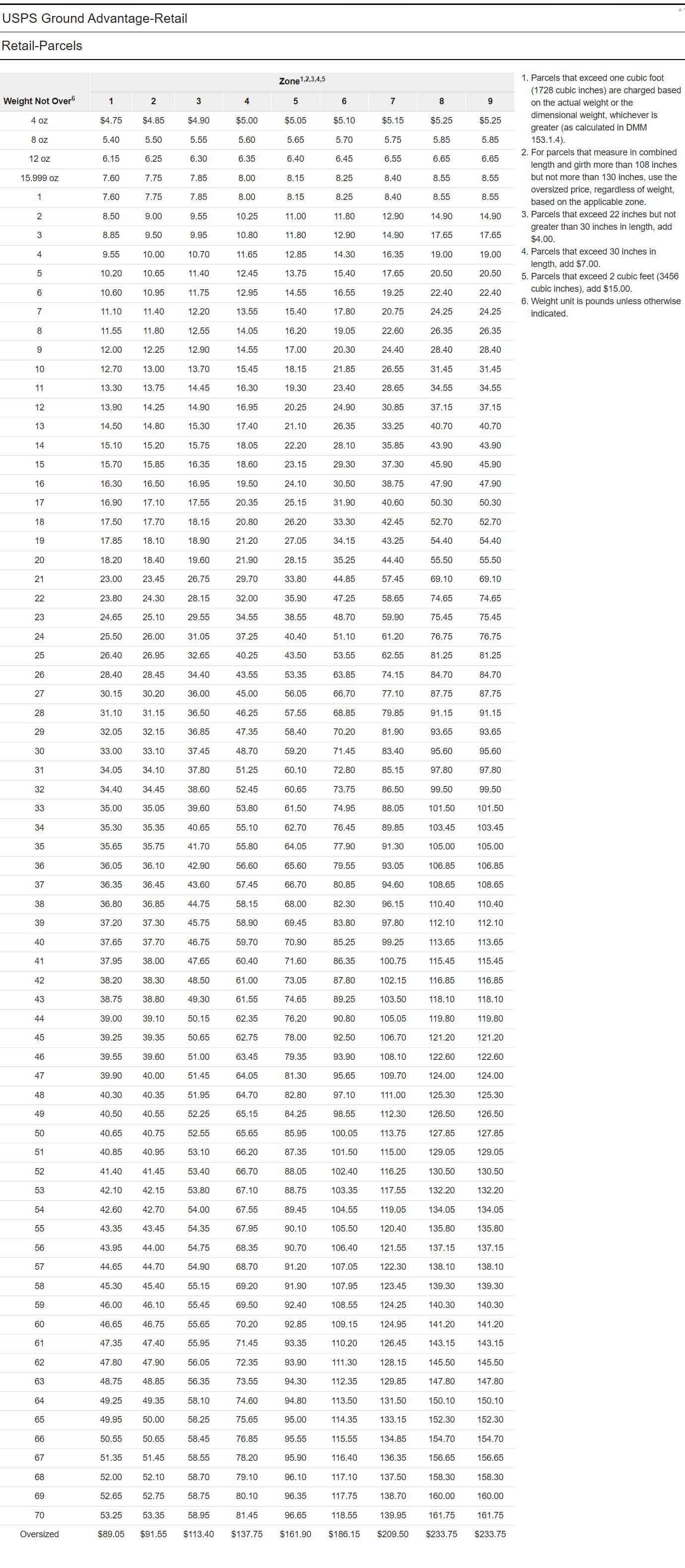
To determine transit times, the postal network measures the distance between the processing facility serving your origin ZIP Code and the facility serving the recipient. The resulting transit footprint is divided into specific service zones:
- Zone 1: Non-distance-based; designated for local regional delivery within the same processing footprint (typically 1 to 50 miles).
- Zone 2: Up to 150 miles radius.
- Zone 3: 151 to 300 miles.
- Zone 4: 301 to 600 miles.
- Zone 5: 601 to 1,000 miles.
- Zone 6: 1,001 to 1,400 miles.
- Zone 7: 1,401 to 1,800 miles.
- Zone 8: 1,801 miles and greater within the contiguous 48 states.
- Zone 9: Freely Associated States, military installations (APO/FPO/DPO), and specific offshore domestic territories.
Every single-point origin across the United States produces a unique Ground Advantage map. An origin facility based in Columbus, Ohio (ZIP prefix 432) will yield a two-day surface ground radius covering deep portions of the Midwest, Mid-Atlantic, and Upper South, whereas an origin point in Denver, Colorado (ZIP prefix 802) reflects different multi-day surface corridors due to regional topography and hub spacing.
2026 Service Standards and Expected Transit Times
USPS Ground Advantage operates on a published standard of 2 to 5 business days for domestic shipments within the contiguous United States. Unlike Priority Mail Express, Ground Advantage delivery windows are expected performance targets rather than money-back-guaranteed commitments.
The postal processing schedule directly dictates whether a parcel lands on the early or late side of that standard:
| Postal Zone | Distance Range | Contiguous US Delivery Target | Typical Transportation Mode | 2026 On-Time Performance Benchmark |
|---|---|---|---|---|
| Zones 1–2 | Local / 1–150 miles | 2 Business Days | Direct Surface Truckload / Local Relay | 96.5% – 98.2% |
| Zone 3 | 151–300 miles | 2 to 3 Business Days | Dedicated Regional Surface Linehaul | 95.0% – 97.4% |
| Zone 4 | 301–600 miles | 3 Business Days | Inter-Regional Highway Network | 93.8% – 96.1% |
| Zone 5 | 601–1,000 miles | 3 to 4 Business Days | Inter-Regional Highway Network | 92.4% – 95.3% |
| Zone 6 | 1,001–1,400 miles | 4 Business Days | Long-Haul Freight Contractors | 91.0% – 94.6% |
| Zones 7–8 | 1,401+ miles | 4 to 5 Business Days | Transcontinental Surface Rail / Truck | 89.5% – 93.8% |
| Zone 9 / Offshore | AK, HI, PR, GU, US VI | 4 to 10+ Business Days | Combined Surface and Air / Barge Cargo | Variable by Vessel Schedule |
Regional Processing and Distribution Centers (RPDCs) consolidate processing volume into specialized megahubs. While parcels traveling within a 400-mile corridor maintain predictable 2-day delivery cycles, cross-country shipments passing through multi-tier transfer nodes require shippers to factor in potential processing buffer days during peak surface load periods.
Reading and Utilizing the Interactive PostalPro Maps
To check a specific origin-to-destination transit pair, logistics teams rely on the USPS Service Standards Maps hosted via the USPS PostalPro and public retail portals. To generate an accurate view, follow these steps:
- Access the Modern Service Standards Interface: Navigate directly to the delivery standards map tool on the official USPS website or PostalPro portal.
- Select the Target Class: Choose "USPS Ground Advantage" rather than Priority Mail or First-Class Mail.
- Enter the 3-Digit Origin ZIP Code: Input the first three digits of the facility or warehouse where the package is physically accepted (e.g., enter "752" for Dallas, Texas).
- Interpret the Dynamic Color Coding: The generated national map renders regional zones in distinct shades indicating Day 2 (typically dark blue/teal), Day 3 (yellow/orange), Day 4 (light green), and Day 5 (dark green/gray).
- Cross-Check the Destination Prefix: Click directly on destination states to verify the precise 3-digit destination prefix. Major metropolitan destinations often feature faster processing windows than outlying rural ZIP codes within the exact same state.
Comparing Ground Advantage to Alternative Commercial Shipping Services
Balancing service reliability, insurance protections, and transport costs requires comparing USPS Ground Advantage with competitive parcel offerings:
| Feature / Metric | USPS Ground Advantage | USPS Priority Mail | UPS Ground | FedEx Ground |
|---|---|---|---|---|
| Contiguous Transit Window | 2 to 5 Business Days | 1 to 3 Business Days | 1 to 5 Business Days | 1 to 5 Business Days |
| Air vs. Surface Focus | Exclusively Surface (48 states) | Commercial & Cargo Air | Primary Surface | Primary Surface |
| Included Liability Insurance | Up to $100 | Up to $100 | Up to $100 | Up to $100 |
| Residential Surcharges | $0.00 (Zero Surcharge) | $0.00 (Zero Surcharge) | Added Fee ($4.50–$5.85) | Added Fee ($4.50–$5.85) |
| Delivery Area Surcharges (DAS) | $0.00 (Zero Surcharge) | $0.00 (Zero Surcharge) | Added Fee on Rural ZIPs | Added Fee on Rural ZIPs |
| Maximum Weight | 70 lbs | 70 lbs | 150 lbs | 150 lbs |
| Forward & Return Service | Included (No Return Fee) | Forward Included / Returns Apply | Return/Redelivery Fees | Return/Redelivery Fees |
USPS Ground Advantage is structurally immune to the common residential delivery surcharges and extended delivery area surcharges (DAS) imposed by private parcel carriers. This fundamental difference makes the service an economically viable choice for lightweight packages (under 15–20 pounds) going to rural, suburban, and residential destinations, even when private carriers offer similar nominal transit timelines on their ground networks.
Operational Factors that Impact the Ground Advantage Time Map
While the static transit map provides a baseline delivery projection, fulfillment managers must account for real-world logistical friction that alters delivery schedules:
Induction Windows and Critical Acceptance Times (CAT)
A package scanned at an acceptance dock at 11:00 AM does not follow the same timeline as one brought to a retail counter at 4:45 PM. Every postal facility enforces a Critical Acceptance Time. Parcels received past this window will not be inducted onto that evening’s linehaul trucks, pushing transit down by an automatic 24-hour cycle. High-volume business shippers must coordinate with their local USPS Business Mail Entry Unit (BMEU) to confirm exact outbound dispatch schedules.
Dimensional Weight (DIM) and Surcharges
Parcels exceeding one cubic foot (1,728 cubic inches) trigger dimensional weight calculations (Length x Width x Height / 166). Furthermore, packages exceeding 22 inches in length incur nonstandard length fees, and packages exceeding 30 inches or 2 cubic feet trigger substantial operational penalties. These oversized parcels are routed to manually sorted non-machinable parcel processing belts, bypassing high-speed package sorters and adding 1 to 2 business days to expected map projections.
Weather Diverts and Surface Rerouting
Because Ground Advantage operates strictly via highway transportation networks within the lower 48 states, winter weather conditions over mountain passes (such as Interstate 80 over Donner Pass or Interstate 70 through the Rockies) force fleet transports onto alternate routes or hold trailers at intermediate consolidation hubs. Unlike Priority Mail, which leverages air logistics contracts for longer jumps, Ground Advantage parcels remain in the surface linehaul queue until roadways clear.
Non-Contiguous and Offshore Transit Realities
Shipments addressed to Alaska, Hawaii, Puerto Rico, Guam, and the U.S. Virgin Islands fall into extended transit categories. While select shipments to central hubs like Anchorage or San Juan might clear within 4 to 6 business days, packages routed to outlying islands or remote boroughs rely on scheduled ocean barge and surface freight vessels. In extreme cases, transit times can extend past 10 to 14 business days. Shippers should avoid promising standard 2- to 5-day windows to offshore destinations when utilizing Ground Advantage.
Step-by-Step Logistics Playbook: Optimizing Ground Advantage Transit
To improve package velocities and ensure alignment with the USPS Ground Advantage delivery map, operations teams should implement the following steps:
- Implement Intelligent Origin Routing: If operating from a multi-node 3PL or multi-warehouse model, route orders dynamically based on the 3-digit origin map. Fulfilling an East Coast order from an Allentown or Atlanta location rather than a West Coast hub converts a 5-day Zone 8 transit timeline into a reliable 2-day Zone 2 delivery window.
- Utilize Electronic Manifesting (Scan-Based SCAN Forms): Never present loose packages to parcel clerks without an accompanying USPS Form 5630 (Shipment Confirmation Acceptance Notice). The consolidated barcode confirms the initial origin timestamp instantly, inducting packages into the tracking pipeline hours ahead of piece-by-piece sorting.
- Automate Zone-Based Shipping Thresholds at Checkout: Program e-commerce checkout logic to calculate transit days by destination prefix. For destinations located in Zones 1 through 3, default to Ground Advantage for low shipping costs with 2-day performance. For orders in Zones 7 through 8, present shoppers with an automated upgrade option to Priority Mail if delivery within 3 days is critical.
- Enforce Rigid Packaging Tolerances: Keep e-commerce boxes under the 22-inch length threshold and under the 1-cubic-foot mark whenever practical. Standardized, machinable packaging glides across automated sorters without human intervention, preventing sorting bottlenecks at regional facilities.
Frequently Asked Questions
How long does USPS Ground Advantage take to deliver within the contiguous US?
USPS Ground Advantage delivers within 2 to 5 business days for shipments moving across the lower 48 states. Shippers can determine the exact delivery timeline by evaluating the origin and destination three-digit ZIP Codes using the postal service's published service standards map.
Local deliveries within Zones 1 and 2 routinely arrive within 2 business days, while intermediate distances (Zones 3 through 5) average 3 to 4 business days. Long-distance cross-country routes stretching from Zone 6 to Zone 8 require the full 4 to 5 business days, with transit times dependent on highway dispatch schedules and package machineability.
Is the delivery transit time on the USPS Ground Advantage map guaranteed?
No, delivery timelines for USPS Ground Advantage are performance targets, not guaranteed dates backed by postage refunds. The only domestic USPS product backed by a money-back delivery guarantee is Priority Mail Express.
If a Ground Advantage parcel takes longer than the projected 2 to 5 business days, shippers cannot file a postage refund claim based on transit delay alone. However, shipments lost or physically damaged during transit remain eligible for standard claims under the included liability coverage of up to $100.
How does USPS Ground Advantage differ from the old First-Class Package Service?
USPS Ground Advantage replaced First-Class Package Service, Retail Ground, and Parcel Select Ground, establishing a consolidated service tier. While First-Class Package Service was strictly capped at 15.999 ounces, Ground Advantage accommodates packages weighing up to 70 pounds.
Additionally, Ground Advantage standardizes built-in perks across light and heavy parcels. It includes up to $100 in carrier liability protection, free forward and return delivery services for undeliverable shipments, and unified zone-based pricing across both retail counters and commercial shipping software.
Why do some destinations in the same state show different delivery days on the map?
Transit time calculations are driven by the distance and connectivity between distribution facilities, not political state borders. A package shipped across a single state may pass through distinct postal networks depending on the destination prefix.
If your package originates near a major regional processing hub, parcels sent to large metropolitan ZIP codes often land in a 2-day delivery window due to high-capacity freight volumes. Conversely, remote rural ZIP codes in that same state might require transit through a secondary Local Processing Center or Sorting & Delivery Center, adding an extra business day to the published map.
How do hazardous materials (Hazmat) affect Ground Advantage transit timelines?
Parcels marked with Hazmat indicators, lithium batteries, or Surface Transportation Only labels must move via ground linehaul networks and are barred from all domestic air transport routes.
While contiguous domestic Ground Advantage moves entirely on highway freight anyway, domestic offshore packages containing restricted items (such as electronics with lithium cells traveling to Hawaii, Puerto Rico, or Alaska) must travel exclusively via ocean surface vessel. This requirement eliminates priority air routing and can extend actual transit delivery windows past two to three weeks.
Operational Excellence in Parcel Logistics
Mastering the mechanics of the USPS Ground Advantage time map gives logistics directors, fulfillment networks, and online retailers a distinct operational advantage. By mapping out origin-destination pairings, scheduling dispatches ahead of regional Critical Acceptance Times, and optimizing carton sizes to preserve machinability, you can ship cost-effectively without sacrificing reliable delivery timelines. Review your origin 3-digit ZIP patterns regularly, adapt fulfillment rules to shifting postal network paths, and leverage regional carrier nodes to keep shipping transit reliable throughout 2026.
Image Gallery