Understanding Federal Fair Credit Reporting: Rights, Regulations, and Consumer Protection
Federal fair credit reporting is governed primarily by the Fair Credit Reporting Act (FCRA), a federal law that ensures the accuracy, fairness, and privacy of information in the files of consumer reporting agencies. It grants consumers...
Federal fair credit reporting is governed primarily by the Fair Credit Reporting Act (FCRA), a federal law that ensures the accuracy, fairness, and privacy of information in the files of consumer reporting agencies. It grants consumers the right to access their data, dispute inaccuracies, and control who can view their credit profiles.
Contents
In 2026, the landscape of credit reporting continues to be a cornerstone of the American financial system. Whether you are applying for a mortgage, seeking employment, or simply monitoring your financial health, understanding federal fair credit reporting laws is essential. These regulations do not just apply to the "Big Three" credit bureaus; they encompass a wide array of data collectors that influence your ability to participate in the modern economy.
The Foundations of the Fair Credit Reporting Act (FCRA)
Enacted in 1970 and significantly amended over the decades—most notably by the Fair and Accurate Credit Transactions Act (FACTA) of 2003—the FCRA is the primary federal statute regulating the collection and use of consumer credit information. As of 2026, the Consumer Financial Protection Bureau (CFPB) and the Federal Trade Commission (FTC) share enforcement authority, ensuring that the entities handling your data adhere to strict federal standards.
The law was designed to address the growing power of credit reporting agencies (CRAs). Before federal intervention, consumer data was often gathered through informal networks, leading to widespread inaccuracies and "blacklisting" without recourse. The FCRA transformed this by mandating that credit information must be handled with "maximum possible accuracy" and that consumers must be informed when their data is used against them.
Jurisdiction and Scope
Federal fair credit reporting laws apply to any "Consumer Reporting Agency." While many people think only of Equifax, Experian, and TransUnion, the legal definition is much broader. It includes specialty agencies that track:
- Rental history and tenant screenings.
- Check-writing history and banking records (e.g., ChexSystems).
- Employment history and professional licensing.
- Medical payment data and insurance claims history.
Core Consumer Rights Under Federal Law
The strength of federal fair credit reporting lies in the specific rights it grants individuals. These protections are designed to prevent systemic errors from ruining a consumer’s financial reputation.
The Right to Information Disclosure
Consumers have the right to know what is in their file. Under federal law, you can request a disclosure of all information in your file from any CRA. While the most famous way to access this is through AnnualCreditReport.com, which provides free reports from the major bureaus, you also have the right to a free report if:
- A person has taken "adverse action" against you because of information in your credit report.
- You are the victim of identity theft and have placed a fraud alert in your file.
- Your file contains inaccurate information due to fraud.
- You are on public assistance.
- You are unemployed but expect to apply for employment within 60 days.
The Right to Accuracy and the Dispute Process
Perhaps the most utilized section of the FCRA is the right to dispute inaccurate information. When a consumer identifies an error—such as an account that does not belong to them or an incorrect payment status—the CRA is legally obligated to investigate.
Upon receiving a dispute, the CRA typically has 30 to 45 days to conduct an investigation. They must contact the "furnisher" (the bank or lender that provided the data) to verify the information. If the information cannot be verified, it must be deleted or corrected. If an investigation results in a change, the CRA must provide you with the results and a free copy of your updated report.
The Right to Privacy and Permissible Purpose
Your credit report is not public record. Federal law strictly limits who can access your credit file. This is known as "permissible purpose." Entities that can legally access your report include:
- Lenders from whom you are seeking credit.
- Landlords for tenant screening (with your consent).
- Employers (only with your specific written authorization).
- Insurance companies for underwriting purposes.
- Government agencies in response to a court order or grand jury subpoena.
Obligations of Entities in the Credit Ecosystem
The FCRA imposes duties on three distinct groups: Consumer Reporting Agencies, Furnishers, and Users.
Consumer Reporting Agencies (CRAs)
CRAs are the "middlemen" who compile the data. Their primary obligation is to maintain procedures that ensure the information they report is as accurate as possible. They must also provide consumers with a "Summary of Your Rights under the Fair Credit Reporting Act" whenever a disclosure is made.
Information Furnishers
Furnishers are the entities that provide data to CRAs, such as credit card issuers, mortgage servicers, and debt collectors. Under federal fair credit reporting guidelines, furnishers are prohibited from reporting information they know—or have reasonable cause to believe—is inaccurate. If a consumer disputes an item with a furnisher directly, that furnisher must investigate and stop reporting the data until the investigation is complete.
Users of Credit Reports
Users are the businesses that buy credit reports to make decisions. Their most critical obligation occurs when they take an Adverse Action. If a lender denies you a loan, or an employer decides not to hire you based on your credit report, they must provide you with an "Adverse Action Notice." This notice must include the name, address, and phone number of the CRA that provided the report and explain your right to obtain a free copy of that report within 60 days.
| Entity Type | Primary Responsibility | Key Federal Requirement |
|---|---|---|
| CRA (Bureaus) | Data Maintenance | Must investigate disputes within 30-45 days. |
| Furnishers (Banks) | Data Accuracy | Prohibited from reporting known inaccurate data. |
| Users (Lenders/Employers) | Transparency | Must provide Adverse Action Notices for denials. |
| Consumers | Verification | Right to one free annual report from each major CRA. |
Identity Theft and Security Freezes
As of 2026, identity theft remains a significant concern in federal fair credit reporting. The law provides specific mechanisms to protect victims.
- Security Freezes: Federal law allows consumers to "freeze" and "unfreeze" their credit reports for free. A freeze prevents new creditors from accessing your file, effectively stopping identity thieves from opening new accounts in your name.
- Fraud Alerts: Consumers can place an initial fraud alert on their file for one year. This requires creditors to take extra steps to verify the identity of anyone seeking credit in that consumer's name. Victims of identity theft can extend this to a seven-year alert.
- Blocking Fraudulent Information: If you provide a CRA with an official identity theft report (such as a police report), the CRA must block information resulting from the identity theft from appearing on your credit report.
Recent Developments and 2026 Regulatory Landscape
The application of federal fair credit reporting has evolved to meet modern challenges. In recent years, the CFPB has increased scrutiny on the "Big Three" regarding their automated dispute systems. There is a growing legal consensus that simply "parroting" what a furnisher says is not a sufficient investigation. CRAs are now expected to review the actual documentation provided by the consumer.
Furthermore, medical debt reporting has seen significant federal shifts. In 2026, most medical debts under a specific threshold or those that have been paid are no longer permitted to appear on standard credit reports, reflecting a policy shift toward viewing medical debt as an unreliable predictor of creditworthiness.
Another emerging area involves Alternative Data. Some CRAs now include rent and utility payments in credit files. While this can help "thin-file" consumers build credit, it also means these providers are now subject to the same FCRA accuracy and dispute requirements as traditional lenders.
Step-by-Step Guide: How to Dispute an Error
If you find an inaccuracy in your credit file, the following steps are mandated by federal procedure to ensure your rights are protected:
- Identify the Error: Obtain your reports from Equifax, Experian, and TransUnion. Note that an error might appear on one but not the others.
- Gather Evidence: Collect bank statements, "paid-in-full" letters, or identity theft reports that prove the information is wrong.
- Draft the Dispute: Write a clear letter identifying each item you are disputing. Explain the facts and request that the item be deleted or corrected.
- Submit to the CRA: While online portals are available, sending disputes via Certified Mail with Return Receipt Requested provides a paper trail that is vital if legal action becomes necessary.
- Notify the Furnisher: Simultaneously, send a dispute to the company that provided the data (e.g., the bank). This forces them to conduct their own internal investigation.
- Review the Results: Within 30-45 days, the CRA must send you a written response. If they refuse to correct the item, you have the right to add a "consumer statement" of up to 100 words to your file.
Common Pitfalls in Federal Fair Credit Reporting
Many consumers inadvertently waive their rights or complicate their cases by making common mistakes:
- Using "Credit Repair" Scams: Federal law allows you to do everything a credit repair company does, often for free. Many of these companies use "frivolous" dispute tactics that CRAs are legally allowed to ignore.
- Failing to Check Specialty Reports: Only checking your "Big Three" reports while ignoring tenant screening or check-history reports can lead to surprises when applying for an apartment or opening a bank account.
- Ignoring the Paper Trail: Always keep copies of every letter sent and received. In FCRA litigation, documentation is the most powerful tool for a consumer.
Frequently Asked Questions
Can an employer check my credit report without me knowing?
No. Under federal law, an employer or prospective employer must obtain your written consent before requesting a consumer report. If they intend to take an adverse action (like not hiring you) based on the report, they must provide you with a copy of the report and a summary of your rights before they take the action.
How long does negative information stay on my credit report?
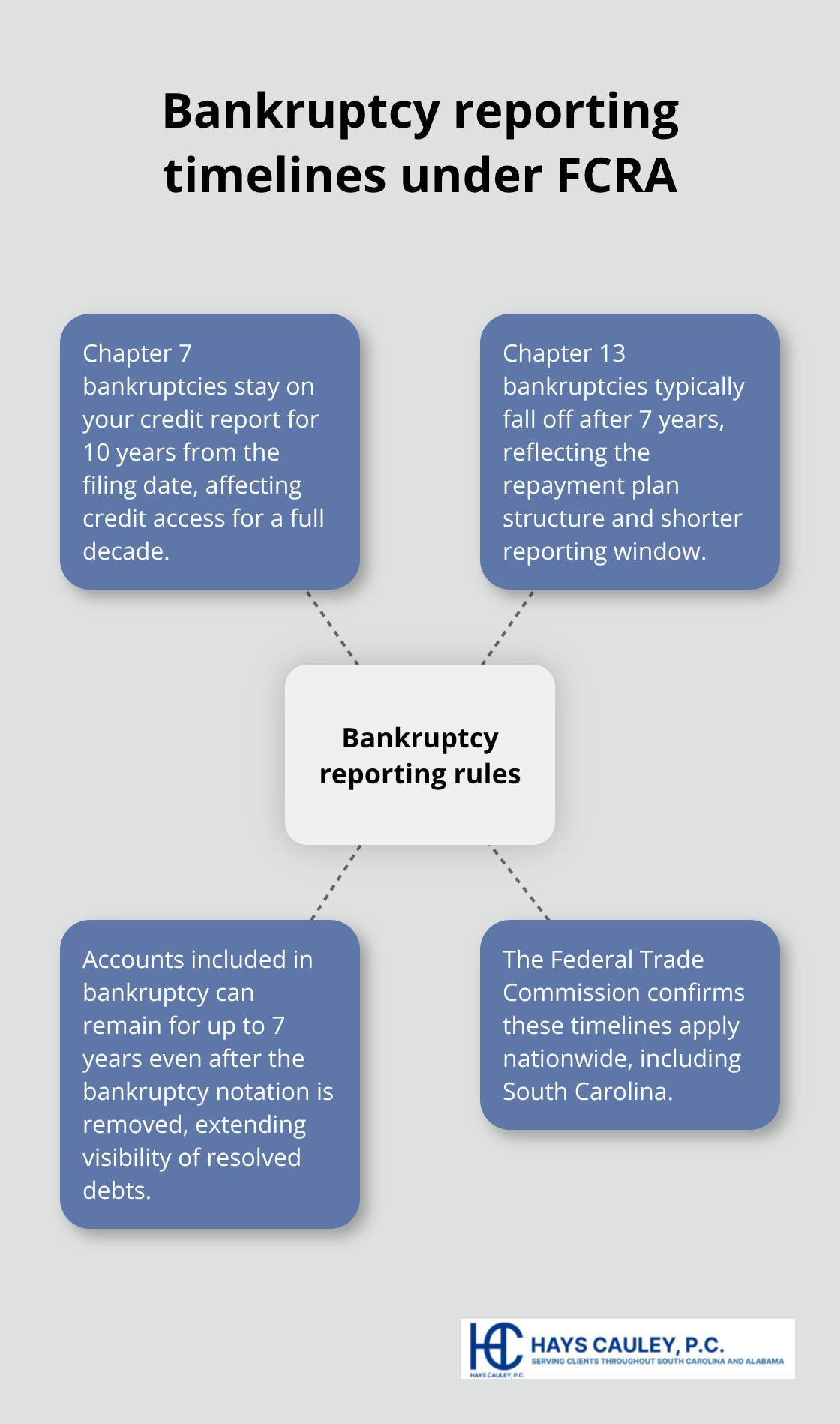
Generally, most negative information, such as late payments or accounts in collections, can stay on your report for seven years. Bankruptcies can stay for up to ten years. Information about a lawsuit or an unpaid judgment against you can stay for seven years or until the statute of limitations has run out, whichever is longer.
Is there a limit to how many times I can dispute an item?
While there is no legal limit, CRAs can label a dispute as "frivolous" if you repeatedly dispute the same item without providing new evidence. If a dispute is deemed frivolous, the CRA is not required to continue investigating that specific claim.
Does federal law cover credit scores?
The FCRA primarily covers credit reports, but the FACT Act and subsequent regulations require that lenders disclose the credit scores they used if they take an adverse action against you or offer you less favorable terms than other consumers.
What can I do if a CRA refuses to fix an obvious error?
If the dispute process fails, you may have the right to sue in state or federal court. The FCRA allows consumers to recover actual damages, and in cases of "willful noncompliance," you may be entitled to punitive damages and attorney fees. Many consumers also choose to file a formal complaint with the CFPB.
Practical Recommendation
To effectively manage your standing under federal fair credit reporting laws, adopt a proactive approach. In 2026, digital tools make it easier than ever to monitor your files. At a minimum, you should review your reports from all three major bureaus at least once a year. If you are preparing for a major financial milestone, such as buying a home, start this review process six months in advance to allow sufficient time for the 45-day dispute windows. Always use official channels for disputes and maintain a meticulous archive of your financial correspondence.
Image Gallery