Guide to Foundation Crack Repair in Hartsdale, NY
Foundation crack repair in Hartsdale requires identifying whether structural movement or simple drying shrinkage caused the damage, especially given Westchester County's expansive clay soil and intense seasonal freeze-thaw cycles. Whil...
Foundation crack repair in Hartsdale requires identifying whether structural movement or simple drying shrinkage caused the damage, especially given Westchester County's expansive clay soil and intense seasonal freeze-thaw cycles. While non-structural hairline cracks can be sealed using polyurethane or high-modulus epoxy injections, structural cracks with displacement require engineered intervention such as carbon fiber wall straps or helical piers to ensure long-term stability and compliance with Town of Greenburgh building codes.
Contents
Understanding Foundation Cracks in Hartsdale Properties
Hartsdale features a diverse housing stock ranging from early 20th-century fieldstone foundations to mid-century block construction and modern poured concrete basements. The local terrain in Westchester County often presents distinct geological challenges, including shallow bedrock outcroppings, dense glacial till, and heavy clay soils. During wet seasons, clay soils expand as they absorb water, exerting immense lateral hydrostatic pressure against subterranean basement walls. Conversely, during hot summer spells, the soil shrinks away from the foundation, causing localized settling.
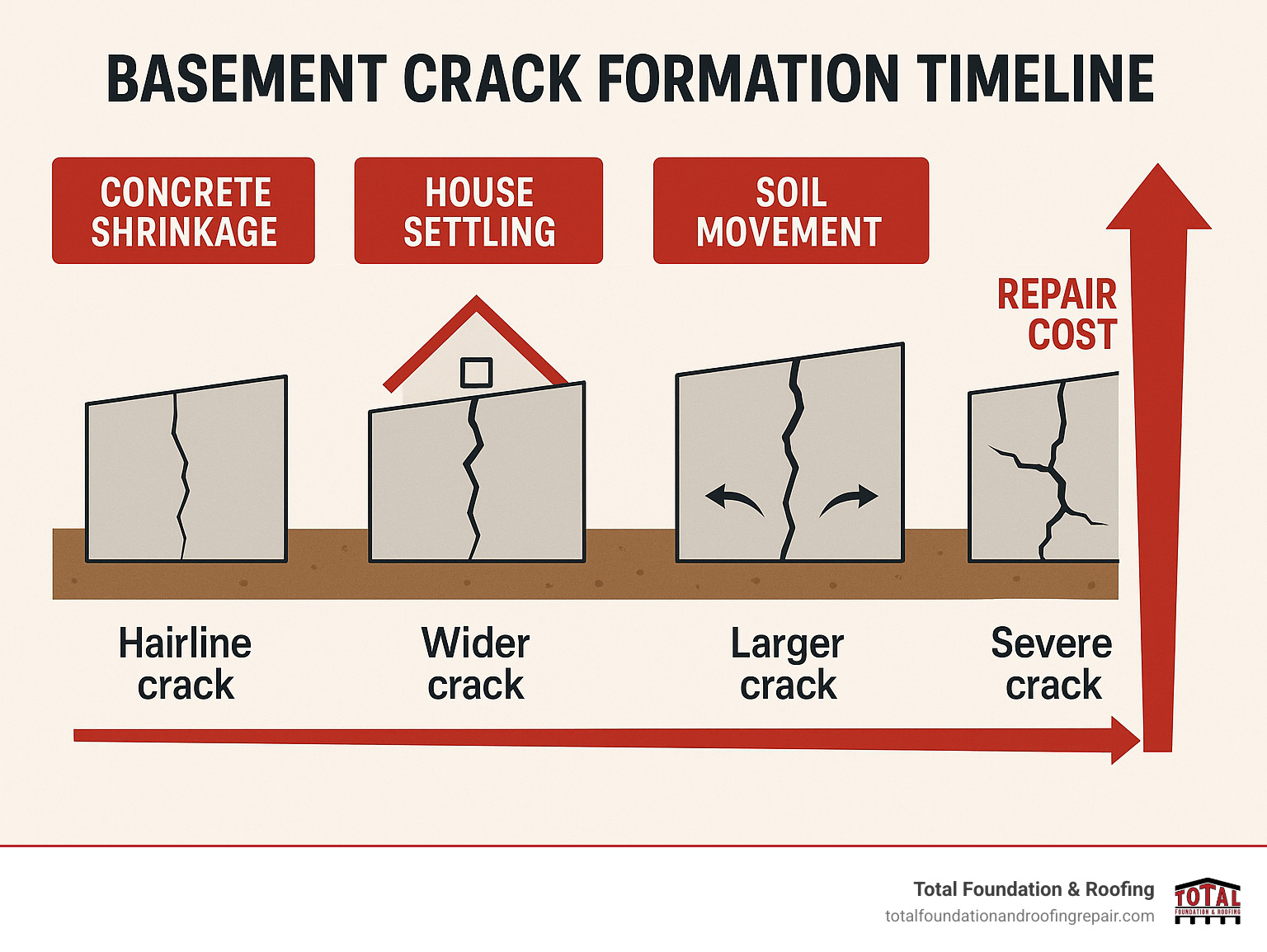
This continuous expansion and contraction cycle is compounded by winter freeze-thaw dynamics. Water trapped in unsealed cracks expands by roughly 9% upon freezing, forcing small fissures to widen over time. Discerning the age, architectural style, and specific soil conditions of your Hartsdale home is the essential first step before selecting a remediation method.
Seasonal Hydrostatic & Freeze-Thaw Stress:
- Winter / Wet Season
- Saturated Clay Soil
- Pushes Inward
- Foundation Wall (Hydrostatic Pressure)
- Summer / Dry Season
- Shrinking Clay Soil
- Pulls Away
- Foundation Wall (Settling & Cracking)
Categorizing Foundation Cracks: Structural vs. Non-Structural
Before undertaking any repair work, property owners must determine whether a crack threatens the structural integrity of the home or simply presents a basement waterproofing issue.
Non-Structural Cracks
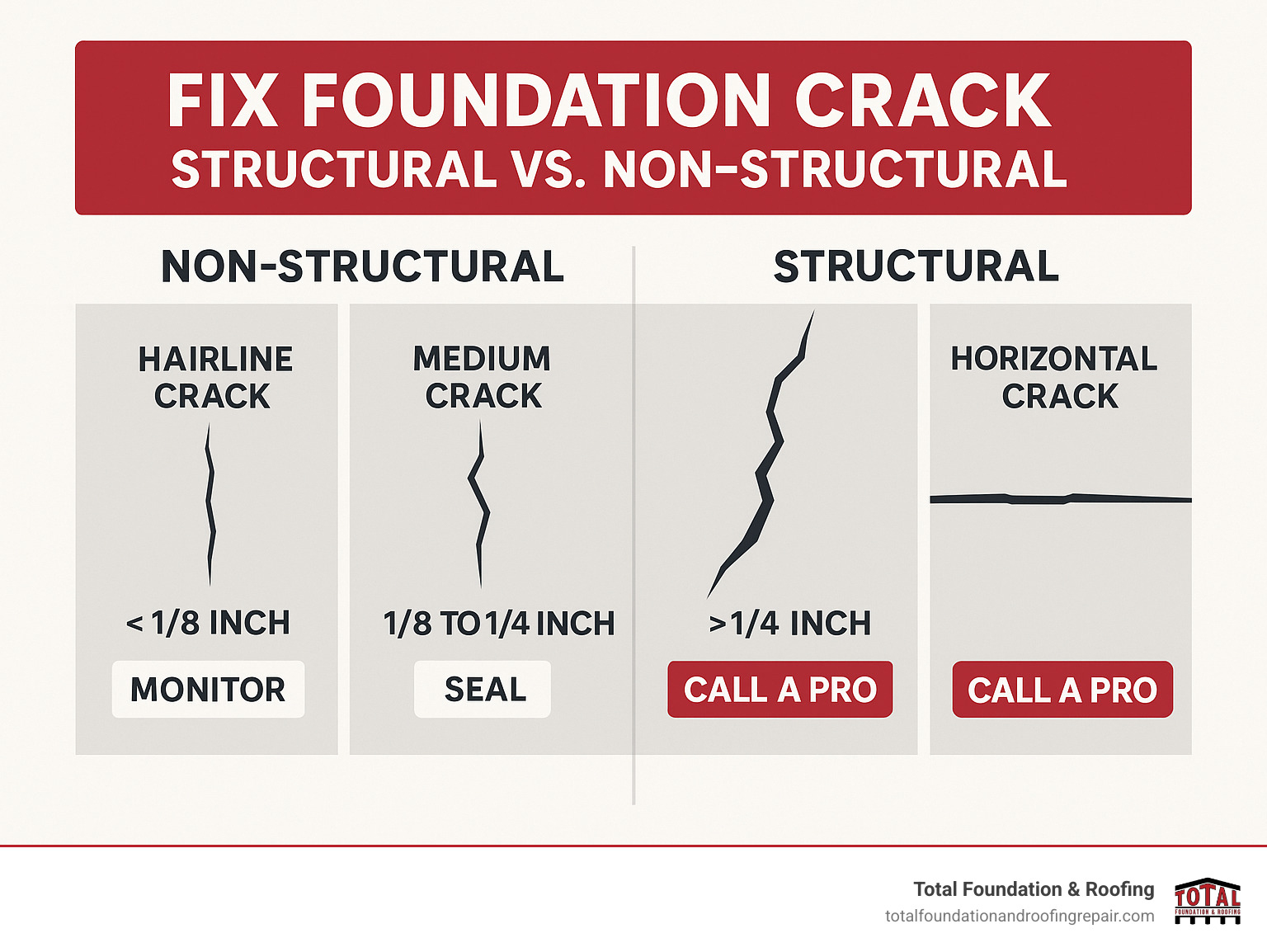
Non-structural cracks typically result from concrete curing shrinkage, minor thermal movement, or slight initial settling. These issues affect aesthetic appeal and moisture resistance rather than load-bearing capability.
- Vertical Hairline Cracks: Often less than 1/8-inch wide, vertical cracks frequently appear within the first few years after construction due to concrete hydration and drying shrinkage.
- Corner Cracks (Step Cracks above Grade): Minor hairline fissures near basement window openings or basement floor slab margins where stress concentrates.
- Surface Crazing: Fine web-like surface cracking caused by rapid surface drying during initial concrete placement.
Structural Cracks
Structural cracks signal ongoing movement, wall overload, or settlement of the footings. These require immediate structural engineering evaluation and robust mechanical reinforcement.
- Horizontal Cracks: Horizontal fractures running along mid-wall height are primary indicators of excessive lateral earth pressure or hydrostatic force pushing the wall inward.
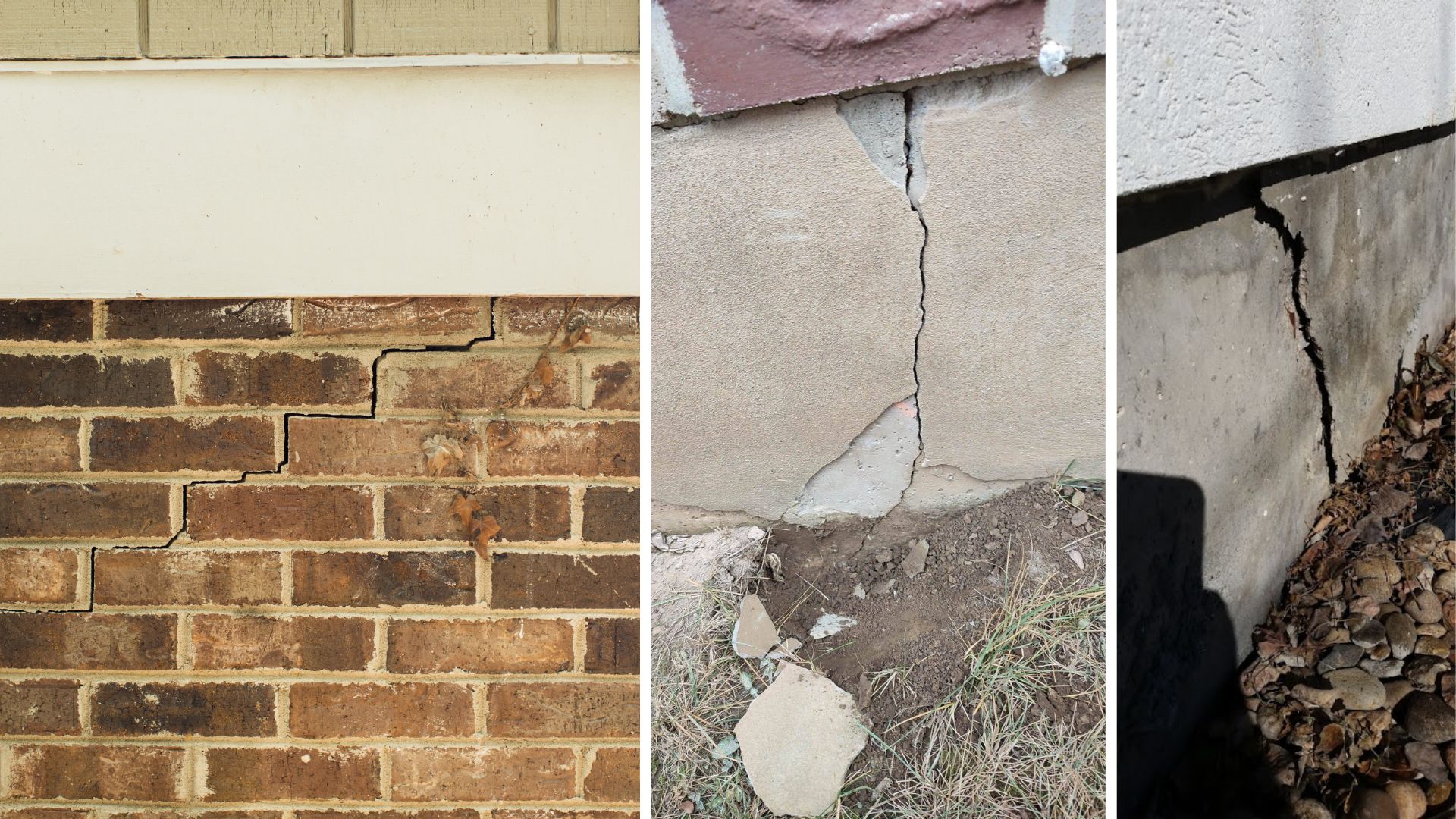
- Stair-Step Cracks in Masonry: In cinder block (CMU) foundations, cracks following the horizontal and vertical mortar joints indicate localized foundation settlement or severe soil shifting.
- Sheared or Displaced Cracks: Cracks where one side of the fracture wall projects outward past the adjacent side, or where the gap exceeds 1/4-inch, point to active structural failure.
- Diagonal Cracks Wider at Top or Bottom: Diagonal fractures extending from foundation corners toward the center suggest differential settlement, where one section of the foundation footing drops lower than adjacent sections.
Primary Foundation Repair Techniques
Selecting the correct repair method depends entirely on crack geometry, moisture conditions, and structural load requirements.
Foundation Crack Diagnosis:
- Structural Failure / Movement
- Lateral: Carbon Fiber Straps
- Settlement: Helical Piers
- Non-Structural / Seepage
- Dry Crack: Epoxy resin Injection
- Active Leaks: Polyurethane Hydrophobic Foam
1. High-Modulus Epoxy Resin Injection
Epoxy injection is used primarily for dry, structural cracks in poured concrete walls where restoration of the wall's original tensile and compressive strength is required.
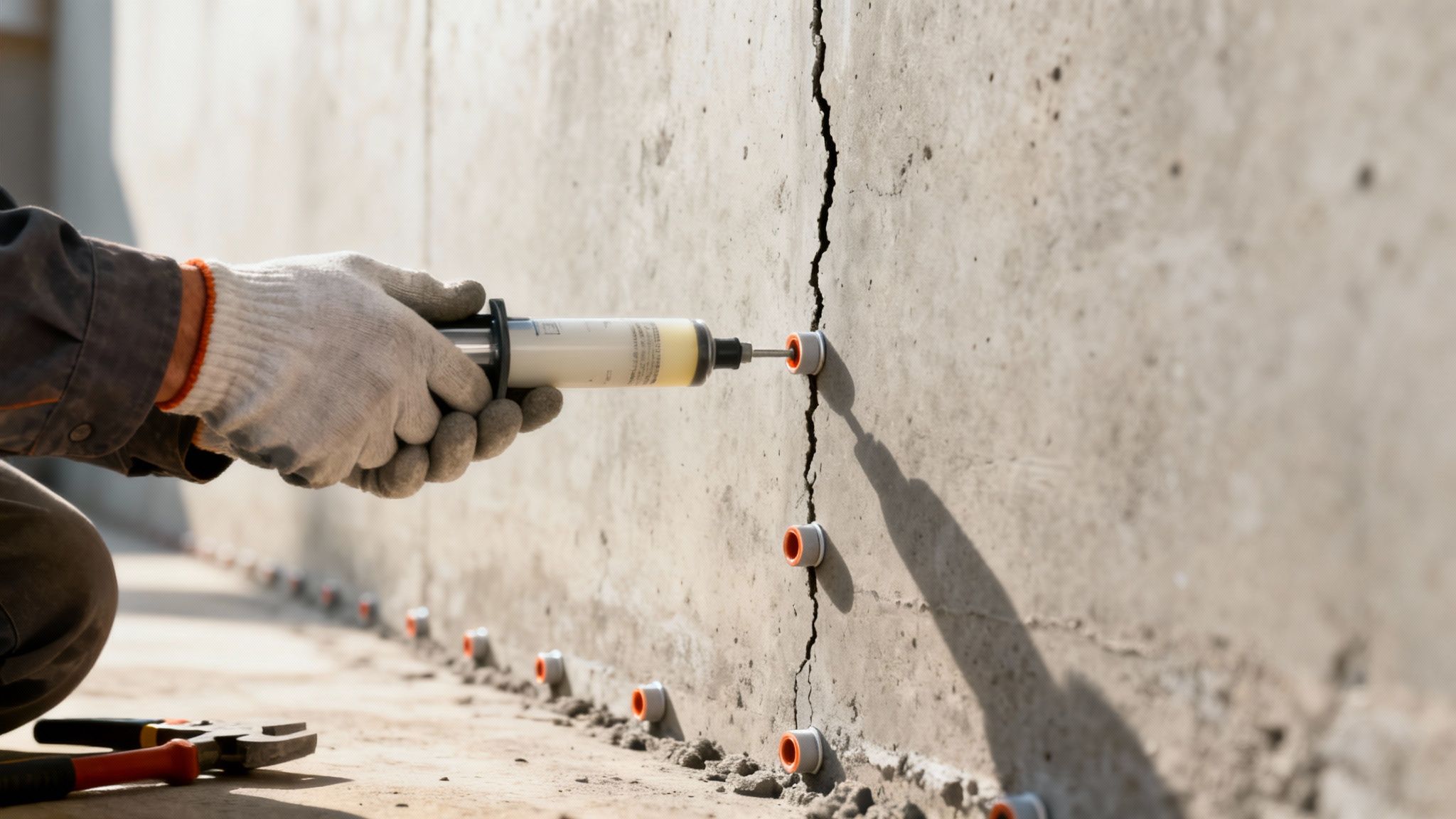
- Mechanism: Surface ports are adhered along the crack line, and the crack face is sealed with a fast-setting epoxy paste. Liquid epoxy is injected under pressure from the lowest port upward, completely filling the void.
- Best Used For: Inactive structural cracks in solid poured concrete that are completely free of active water leaks.
- Limitations: Epoxy cures rigid; if the soil continues to move or freeze-thaw cycles persist without addressing external drainage, a new crack may form immediately adjacent to the rigid epoxy repair.
2. Hydrophobic Polyurethane Foam Injection
Polyurethane resin is the preferred solution for waterproofing active basement leaks and non-structural fractures.
- Mechanism: Liquid polyurethane is injected under moderate pressure into the crack. Upon encountering moisture inside the wall, the chemical reacts rapidly, expanding up to 20 times its original volume to form a dense, flexible rubber seal.
- Best Used For: Active water leaks, dynamic hairline cracks subject to minor thermal expansion, and non-structural basement wall fissures.
- Limitations: Polyurethane provides high-performing elastomeric waterproofing, but it adds zero structural reinforcement to a compromised wall.
3. Carbon Fiber Reinforcement Straps
When lateral earth pressure causes a concrete or block wall to bow inward by less than two inches, carbon fiber reinforcement offers a non-invasive, low-profile structural repair.
- Mechanism: High-tensile carbon fiber grid straps are bonded to the interior face of the wall using structural epoxy adhesives. The straps are anchored to the top sill plate and the basement floor slab.
- Best Used For: Preventing further inward bowing or shear movement of concrete masonry unit (CMU) or poured walls.
- Limitations: Carbon fiber stabilizes walls against future movement, but it cannot pull a severely bowed wall back to plumb position.
4. Helical Piers and Underpinning
When a foundation experiences vertical settlement caused by unstable soil strata or poor footing construction, underpinning is necessary to transfer structural loads down to load-bearing soil or bedrock.
- Mechanism: Heavy-duty steel helical piers are screwed deep into the earth past problematic topsoil layers until reaching rated hydraulic torque capacity. Steel brackets are attached beneath the foundation footing, allowing hydraulic jacks to lift the foundation back toward its original elevation before locking it permanently onto the piers.
- Best Used For: Structural settlement, severe foundation dropping, and corner sinkage.
- Limitations: Requires excavation, specialized heavy hydraulic equipment, and substantial investment.
Method Comparison & Cost Estimates
The following estimates reflect regional labor and material costs across Westchester County. Project costs vary based on accessibility, site slope, depth of excavation, and engineering requirements.
| Repair Method | Primary Application | Structural vs. Non-Structural | Expected Lifespan | Typical Cost Range (per unit/project) |
|---|---|---|---|---|
| Epoxy Injection | Rigid structural bonding in dry concrete | Structural | 15–25+ Years | $600 – $1,200 per injection location |
| Polyurethane Injection | Active leak sealing & expansion joint filling | Non-Structural | 10–20 Years | $450 – $900 per crack |
| Carbon Fiber Straps | Lateral wall deflection stabilization (<2" bow) | Structural | Lifetime of Structure | $750 – $1,500 per strap (spaces vary) |
| Helical / Push Piers | Remediation of foundation settlement/dropping | Structural | Lifetime of Structure | $2,000 – $4,000 per installed pier |
| Exterior Waterproofing Membrane | Full wall exterior sealing + drainage layer | Waterproofing | 20–30+ Years | $100 – $250 per linear foot |
Local Permitting, Building Codes, and Engineering Standards
In Hartsdale, which is situated within the jurisdiction of the Town of Greenburgh, structural alterations and underpinning are governed by the New York State Uniform Fire Prevention and Building Code along with local municipal regulations.
Remediation & Permitting Flow:
- Initial Inspection & Damage Assessment
- Professional Engineer (PE) Structural Plan
- Permit Application to Town of Greenburgh Building Department
- Contractor Execution of Repairs
- Final PE & Municipal Building Inspection
When is a Permit Required?
- Cosmetic / Leak Injections: Interior polyurethane or surface epoxy injections for simple, non-structural waterproofing typically do not require formal municipal structural permits.
- Structural Underpinning & Carbon Fiber: Structural repairs—such as installing helical piers, steel I-beams, carbon fiber grid systems, or performing major footing excavations—require a building permit from the Town of Greenburgh Building Department.
Professional Engineer (PE) Sign-Off
Before submitting plans for structural modification, property owners should consult a licensed New York State Professional Engineer (PE). A PE provides an independent assessment unlinked to contractor sales goals, produces stamped structural calculation drawings, and verifies that proposed piering or strap spacing complies with local load requirements. Structural modifications executed without required municipal permits can complicate real estate title transfers during future home sales.
Preventive Water and Soil Management
Repairing a crack without resolving the root environmental cause often leads to recurring damage. Because soil hydration is the primary cause of foundation movement in Westchester County, robust water management is crucial.
- Maintain Positive Exterior Grading: Soil adjacent to the foundation must slope downward away from the home at a pitch of at least 6 inches over the first 10 feet. Soil that settles near the foundation allows rainwater to pool and saturate the clay layer directly against basement walls.
- Roof Runoff Control: Clean rain gutters regularly and verify that downspouts extend at least 6 to 10 feet away from the foundation perimeter. Alternatively, route downspouts into smooth subterranean PVC lines that discharge safely away from the home into an approved dry well or municipal storm drain system.
- Sub-Slab & Perimeter Drainage (Sump Pumps): Interior perimeter drain tile systems paired with a reliable sump pump featuring battery backup power reduce hydrostatic pressure underneath the basement floor slab before ground water can force its way upward through foundation cracks.
- Tree Root Management: Mature trees planted too close to the home extract high volumes of water from clay soil during summer months, causing uneven soil shrinkage directly beneath foundation footings. Ensure deep-rooted trees are set back appropriate distances.
Frequently Asked Questions
Can I fill a structural foundation crack with ordinary hydraulic cement?
No. Hydraulic cement is a short-term patch for non-structural water leaks. It lacks the tensile strength to bond moving concrete structurally and does not flex with soil thermal movements. Using it over active structural cracks usually results in the patch popping off or the crack widening adjacent to the material.
How do seasonal temperature swings in Westchester County affect foundation repairs?
Winter freeze-thaw cycles cause moisture within open cracks to expand, while summer dry spells cause heavy clay soils to shrink away from footings. Repairs performed with rigid materials like unreinforced mortar or low-grade patch kits during dry summer months often fail or pop out during the following winter when moisture levels rise and freeze.
How do I know if a crack in my basement wall is actively growing?
You can monitor crack movement by placing pencil alignment marks across the crack width, taking precise measurements every month with a digital caliper, or installing a two-piece acrylic tell-tale crack monitor gauge over the fissure. If the gauge registers horizontal or vertical offset over time, the crack is active and requires professional evaluation.
Will home insurance cover foundation crack repairs in Hartsdale?
Standard homeowners insurance policies typically exclude foundation damage caused by soil movement, hydrostatic pressure, earthquakes, settling, or poor drainage construction. However, if a crack stems directly from a covered peril—such as an abrupt municipal water main break or fire damage—coverage may apply. Review your specific policy declarations with your insurance agent.
Is carbon fiber repair superior to installing traditional vertical steel I-beams?
Carbon fiber repair is lower-profile, sits flush against the basement wall, leaves interior floor space uncompromised, and cannot rust. However, carbon fiber is designed to stabilize wall deflection before severe structural failure occurs (typically up to two inches of inward bowing). If a wall is severely sheared or bowed beyond two inches, structural steel I-beams (power braces) or wall anchoring systems are required to ensure stability.
Recommended Next Steps
If you spot foundation cracking on your Hartsdale property, follow a structured process to address the issue:
- Document and Measure: Take high-resolution photographs of the crack, record its length and width, and note whether water is actively seeping through it.
- Identify Active Water Vectors: Inspect nearby gutters, downspout extension outlets, and surface grading to ensure surface water is directed away from the wall.
- Engage Independent Expertise: For cracks wider than 1/8-inch, horizontal fractures, or bowed walls, schedule an evaluation with a licensed New York State Professional Engineer (PE) to determine structural safety.
- Obtain Multiple Written Contractor Bids: Seek detailed scopes of work from licensed foundation contractors in Westchester County, ensuring their proposals conform strictly to engineering specifications and local Town of Greenburgh permit guidelines.
Professional Advice Limitation: This guide is provided for educational and informational purposes only. Foundation stability depends heavily on site-specific geotechnical factors, structural loads, and local environmental conditions. Always consult a licensed New York State Professional Engineer (PE) and a qualified foundation contractor before executing structural repairs.
EDITORIAL CATEGORY METADATA:
Image Gallery