All the Kings and Queens of England in Order: A Complete Chronological Guide
The complete lineage of English and British monarchs spans over eleven centuries, beginning with the Anglo-Saxon kings who unified England in the ninth and tenth centuries and continuing through to the modern constitutional monarchy. T...
The complete lineage of English and British monarchs spans over eleven centuries, beginning with the Anglo-Saxon kings who unified England in the ninth and tenth centuries and continuing through to the modern constitutional monarchy. This chronological guide details every sovereign of England, Great Britain, and the United Kingdom in order, outlining their regnal dates, royal houses, and historical significance.
Contents
Understanding the Line of Succession and Constitutional Evolution
Tracing all the kings and queens of England requires understanding how the monarchy transformed from regional Anglo-Saxon kingdoms into a unified English crown, and eventually into the modern United Kingdom. History traditionally recognizes Egbert (827–839) as the first King of Wessex to establish broad Anglo-Saxon overlordship, though his grandson Athelstan (924–939) became the first actual King of all England in 927 after unifying the Anglo-Saxon heptarchy and driving out Viking rulers from York.
The royal line underwent fundamental legal changes over the centuries:
- The Anglo-Saxon Monarchy (827–1066): Characterized by elected succession through the Witenagemot (council of wise men) from the House of Wessex, interrupted by Danish rulers.
- The Feudal English Monarchy (1066–1707): Initiated by William the Conqueror, establishing hereditary feudal law, absolute divine right, and later parliament-monarch power sharing post-Magna Carta (1215).
- The British Monarchy (1707–1800): Formed when the Acts of Union 1707 united the Kingdom of England and the Kingdom of Scotland into a single sovereign state called the Kingdom of Great Britain under Queen Anne.
- The United Kingdom Monarchy (1801–Present): Created by the Act of Union 1800, uniting Great Britain and Ireland. Today, the constitutional sovereign serves as head of state with powers strictly defined by parliamentary law.
The Anglo-Saxon and Danish Monarchs (827–1066)
The early history of England was shaped by struggle between Anglo-Saxon rulers and Scandinavian invaders. King Alfred the Great laid the legal and military foundations of a unified English identity, which was achieved by his descendants before falling briefly to Danish conquest in the eleventh century.
- House of Wessex (827–1013)
- Egbert (827–839)
- Ethelwulf (839–858)
- Ethelbald (858–860)
- Ethelbert (860–865)
- Ethelred I (865–871)
- Alfred the Great (871–899)
- Edward the Elder (899–924)
- Athelstan (924–939) [First King of All England, 927]
- Edmund I (939–946)
- Edred (946–955)
- Edwy (955–959)
- Edgar the Peaceful (959–975)
- Edward the Martyr (975–978)
- Ethelred II the Unready (978–1013, 1014–1016)
House of Wessex (First Reign)
- Egbert (827–839): Consolidated Wessex supremacy over Mercia and southern Anglo-Saxon realms.
- Ethelwulf (839–858): Defended Wessex against intensified Viking raids and established strong administrative structures.
- Ethelbald (858–860): Eldest surviving son of Ethelwulf, ruled during a period of heavy Viking pressure.
- Ethelbert (860–865): Unified the administration of Wessex and Kent under a single crown.
- Ethelred I (865–871): Fought alongside his younger brother Alfred against the Great Heathen Army.
- Alfred the Great (871–899): Protected Wessex from Viking subjugation, promoted literacy, instituted legal reforms, and constructed fortified burhs.
- Edward the Elder (899–924): Expanded Wessex control northward into the Danelaw alongside his sister Æthelflæd of Mercia.
- Athelstan (924–939): Officially united England by seizing Viking York in 927 and securing oaths of submission at Eamont.
- Edmund I (939–946): Reclaimed territories in Mercia and Northumbria after temporary Norse uprisings.
- Edred (946–955): Defeated the last Norse King of York, Eric Bloodaxe, firmly securing English unification.
- Edwy (955–959): Short reign marked by political strife between royal factions and monastic reformers.
- Edgar the Peaceful (959–975): Preserved internal peace, reformed monastic orders, and was crowned in a unified coronation rite at Bath in 973.
- Edward the Martyr (975–978): Assassinated at Corfe Castle after a brief, turbulent reign.
- Ethelred II "the Unready" (978–1013, 1014–1016): Reign dominated by Viking attacks, Danegeld payments, and eventual flight into exile when Sweyn Forkbeard invaded.
House of Denmark and Wessex Restoration
- Sweyn Forkbeard (1013–1014): Declared King of England following Ethelred’s flight, but died five weeks after proclamation.
- Edmund Ironside (1016): Son of Ethelred II; valiantly resisted Canute the Great before agreeing to divide the realm, dying shortly after.
- Canute the Great (1016–1035): Ruled a North Sea Empire encompassing England, Denmark, and Norway; brought legal stability and regional peace.
- Harold I Harefoot (1035–1040): Illegitimate son of Canute who seized control while his half-brother Harthacanut was in Denmark.
- Harthacanut (1040–1042): Last Danish king of England, whose brief rule was characterized by heavy taxation.
- Edward the Confessor (1042–1066): Restored the Anglo-Saxon House of Wessex; built Westminster Abbey; died without a clear heir, causing the succession crisis of 1066.
- Harold II Godwinson (1066): Crowned after Edward's death; defeated Harald Hardrada at Stamford Bridge but was killed at the Battle of Hastings by William of Normandy.
The Norman Dynasty and House of Blois (1066–1154)
The Norman Conquest of 1066 fundamentally reshaped English society, language, governance, and landholding, ending centuries of Anglo-Saxon control.
Normans & Blois (1066–1154)
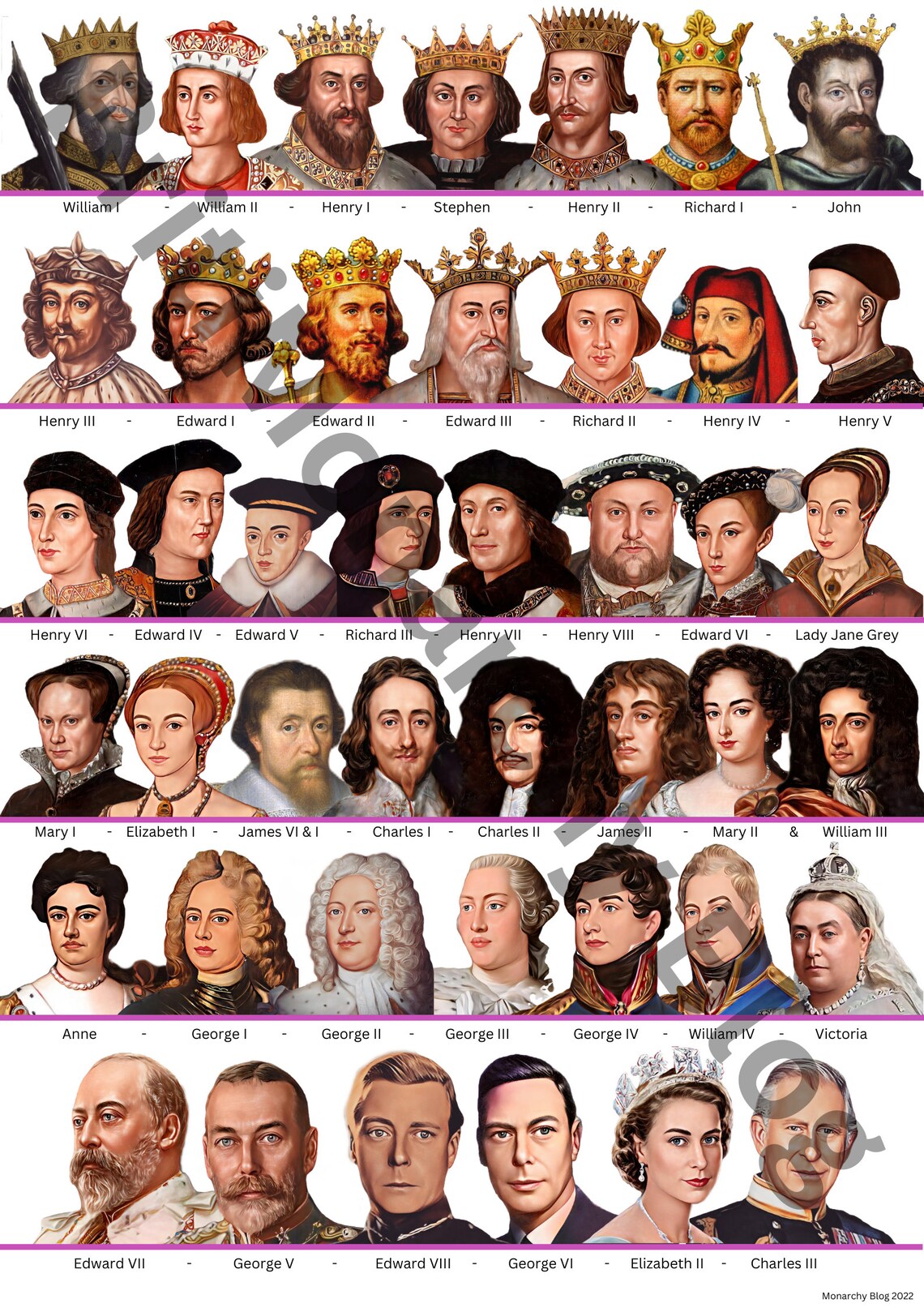
- William I (1066–1087)
- William II (1087–1100)
- Henry I (1100–1135)
- Stephen (1135–1154) [House of Blois]
William I (The Conqueror) (1066–1087): Invaded from Normandy, introduced continental feudalism, suppressed rebellion through the Harrying of the North, and commissioned the Domesday Book survey in 1086.
William II (Rufus) (1087–1100): Maintained firm rule, expanded into Wales, but was killed by an arrow while hunting in the New Forest.
Henry I (1100–1135): Younger brother of Rufus; established efficient legal and administrative practices, including the Exchequer system. His only legitimate son drowned in the White Ship disaster of 1120.
Stephen (1135–1154): Nephew of Henry I who usurped the throne from Henry's daughter, Empress Matilda. His reign led to nineteen years of civil war known as "The Anarchy," settled by the Treaty of Wallingford designating Matilda’s son Henry as heir.
The Plantagenet Dynasty (1154–1399)
The Plantagenet kings (initially known as the Angevins) ruled England for over two centuries, forging an empire across France and England, developing common law, and establishing the early English Parliament.
House of Plantagenet (1154–1399)
- Henry II (1154–1189)
- Richard I (1189–1199)
- John (1199–1216)
- Henry III (1216–1272)
- Edward I (1272–1307)
- Edward II (1307–1327)
- Edward III (1327–1377)
- Richard II (1377–1399)
Henry II (1154–1189): Rebuilt royal authority, developed English common law, and expanded the Angevin Empire; clashed with Thomas Becket over church privileges.
Richard I (The Lionheart) (1189–1199): Spent less than six months of his decade-long reign in England, focusing instead on the Third Crusade and defending continental territories.
John (1199–1216): Lost Normandy to France, engaged in dispute with the Papacy, and was forced by rebellious barons to accept Magna Carta in 1215.
Henry III (1216–1272): Crowned at age nine; rebuilt Westminster Abbey and faced baronial rebellions led by Simon de Montfort, leading to the birth of early parliamentary representation.
Edward I (Longshanks) (1272–1307): Formally annexed Wales, instituted legal statutes, summoned the "Model Parliament" in 1295, and campaigned heavily against Scotland.
Edward II (1307–1327): Suffered major military defeat against Robert the Bruce at Bannockburn (1314); deposed and likely murdered by his wife Isabella and Roger Mortimer.
Edward III (1327–1377): Initiated the Hundred Years' War with France in 1337, established the Order of the Garter, and governed during the Black Death pandemic (1348–1350).
Richard II (1377–1399): Came to power as a child during the Peasants' Revolt of 1381; his increasingly autocratic rule led to his deposition by his cousin, Henry of Bolingbroke.
The Houses of Lancaster and York (1399–1485)
The fifteenth century was defined by dynastic civil conflict between two branches of the Plantagenet house—Lancaster (red rose) and York (white rose)—known collectively as the Wars of the Roses.
- Lancaster & York (1399–1485)
- House of Lancaster
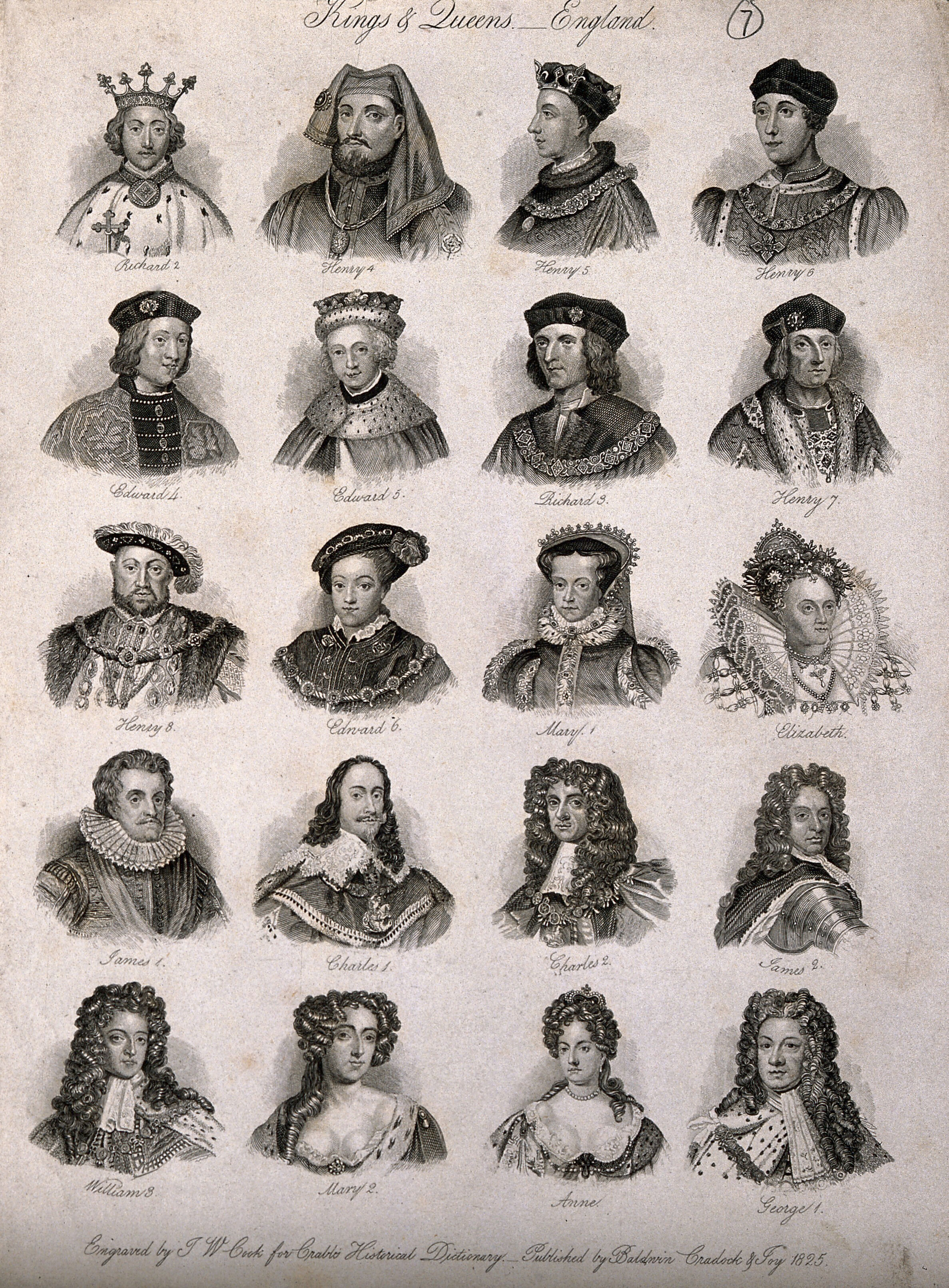
- Henry IV (1399–1413)
- Henry V (1413–1422)
- Henry VI (1422–1461, 1470–1471)
- House of York
- Edward IV (1461–1470, 1471–1483)
- Edward V (1483)
- Richard III (1483–1485)
- House of Lancaster
House of Lancaster
- Henry IV (1399–1413): Usurped Richard II, spent his reign suppressing rebellions in Wales and northern England to secure his dynasty.
- Henry V (1413–1422): Renowned military commander who defeated the French at Agincourt (1415) and was recognized as heir to the French throne via the Treaty of Troyes.
- Henry VI (1422–1461, 1470–1471): Inherited the crowns of England and France as an infant; suffered mental illness, lost French territories, and was deposed during the civil wars.
House of York
- Edward IV (1461–1470, 1471–1483): Yorkist leader who deposed Henry VI; temporarily lost his crown in 1470 before reclaiming it decisively at the Battles of Barnet and Tewkesbury.
- Edward V (1483): One of the "Princes in the Tower"; twelve-year-old ruler who was never crowned and disappeared shortly after his uncle claimed the throne.
- Richard III (1483–1485): Last Yorkist monarch; killed at the Battle of Bosworth Field by Henry Tudor, ending the Plantagenet lineage.
The Tudor Dynasty (1485–1603)
The Tudor era witnessed the English Reformation, centralisation of state authority, significant naval expansion, and a flowering of literature and cultural arts.
House of Tudor (1485–1603)
- Henry VII (1485–1509)
- Henry VIII (1509–1547)
- Edward VI (1547–1553)
- Mary I (1553–1558)
- Elizabeth I (1558–1603)
Henry VII (1485–1509): Defeated Richard III, married Elizabeth of York to unite the rival houses, and restored royal financial stability.
Henry VIII (1509–1547): Famous for his six marriages, he severed ties with the Catholic Church in Rome, passed the Acts of Supremacy, and established the Church of England.
Edward VI (1547–1553): Protestant reformer king who reigned under the regencies of Somerset and Northumberland; died of illness at age fifteen.
Mary I (Bloody Mary) (1553–1558): Catholic monarch who repealed Protestant reforms, briefly re-established papal authority, and married Philip II of Spain.
Elizabeth I (1558–1603): Established the Elizabethan Religious Settlement, defeated the Spanish Armada (1588), presided over a golden age of drama and expansion, and died unmarried without an heir.
The House of Stuart and the Interregnum (1603–1714)
The Stuarts inherited the throne following Elizabeth I's death, bringing about the Union of the Crowns with Scotland and navigating constitutional conflict that produced the English Civil War, a republican Commonwealth, and the birth of constitutional monarchy.
House of Stuart (1603–1714)
- James I (1603–1625)
- Charles I (1625–1649)
- [Commonwealth / Protectorate: 1649–1660]
- Charles II (1660–1685)
- James II (1685–1688)
- William III (1689–1702) & Mary II (1689–1694)
- Anne (1702–1714) [Act of Union 1707]
James I (1603–1625): Already James VI of Scotland, he united the Scottish and English crowns under one monarch; commissioned the King James Bible (1611).
Charles I (1625–1649): Disputes with Parliament over divine right taxation led to the English Civil War; convicted of high treason and executed in 1649.
The Commonwealth & Protectorate (1649–1660): England operated as a republic governed by Parliament and later under Oliver Cromwell (Lord Protector, 1653–1658) and Richard Cromwell (1658–1659).
Charles II (1660–1685): Monarchy was restored in 1660; his reign saw the Great Plague (1665), the Great Fire of London (1666), and political party development.
James II (1685–1688): Catholic monarch whose efforts to promote Catholicism led to his overthrow in the Glorious Revolution of 1688.
William III (1689–1702) & Mary II (1689–1694): Joint sovereigns invited by Parliament; accepted the Bill of Rights 1689, confirming parliamentary supremacy over royal prerogative.
Anne (1702–1714): Presided over the creation of the Kingdom of Great Britain through the Acts of Union 1707. Died without surviving children, ending the Stuart line.
The House of Hanover (1714–1901)
Pursuant to the Act of Settlement 1701, which barred Catholics from the throne, the Protestant Hanoverian line inherited the British crown, leading to a period of global imperial expansion and constitutional cabinet governance.
House of Hanover (1714–1901)
- George I (1714–1727)
- George II (1727–1760)
- George III (1760–1820)
- George IV (1820–1830)
- William IV (1830–1837)
- Victoria (1837–1901)
George I (1714–1727): German-born prince who left governance largely to his ministers, accelerating the role of Prime Minister under Robert Walpole.
George II (1727–1760): Last British monarch to lead troops in battle (Dettingen, 1473); oversaw major industrial and colonial expansion.
George III (1760–1820): Monarch during the American War of Independence, the French Revolution, and the Napoleonic Wars; ruled during the Act of Union 1800 creating the United Kingdom.
George IV (1820–1830): Served as Prince Regent during his father’s mental illness; known for patronage of arts and architecture.
William IV (1830–1837): Overseer of major legislative reforms, including the Reform Act of 1832 and abolition of slavery across the empire.
Victoria (1837–1901): Reigned for 63 years during an era of global industrialization, scientific breakthroughs, and massive expansion of the British Empire.
House of Saxe-Coburg and Gotha / Windsor (1901–Present)
In 1917, during World War I, King George V officially changed the royal house name from the German Saxe-Coburg and Gotha to the patriotic House of Windsor.
House of Windsor (1901–Present)
- Edward VII (1901–1910)
- George V (1910–1936)
- Edward VIII (1936)
- George VI (1936–1952)
- Elizabeth II (1952–2022)
- Charles III (2022–Present)
Edward VII (1901–1910): Son of Victoria; helped foster international relations through the Entente Cordiale with France.
George V (1910–1936): Led Great Britain through World War I and renamed the royal house to Windsor in 1917.
Edward VIII (1936): Abdicated after eleven months to marry American divorcée Wallis Simpson, sparking a constitutional crisis.
George VI (1936–1952): Took the throne unexpectedly following his brother's abdication; served as a symbol of national unity during World War II and witnessed the transition of the empire into the Commonwealth.
Elizabeth II (1952–2022): The longest-reigning monarch in British history (70 years, 214 days), presiding over post-war recovery, decolonization, technological evolution, and modern Commonwealth developments.
Charles III (2022–Present): Ascended the throne on September 8, 2022; formally crowned at Westminster Abbey on May 6, 2023, serving as reigning constitutional sovereign.
Complete Chronological Reference Table of Monarchs
This table offers a direct, chronological reference for every monarch of England, Great Britain, and the United Kingdom from Athelstan’s unification to the current reign.
| Monarch Name | Reign Dates | Royal House / Dynasty | Key Historical Milestone |
|---|---|---|---|
| Athelstan | 924–939 | House of Wessex | Unified Anglo-Saxon kingdoms into England (927) |
| Edmund I | 939–946 | House of Wessex | Reclaimed Northumbria from Norse forces |
| Edred | 946–955 | House of Wessex | Defeated Eric Bloodaxe, finalizing English unification |
| Edwy | 955–959 | House of Wessex | Short reign; political conflict with church leaders |
| Edgar the Peaceful | 959–975 | House of Wessex | Monastic reforms; solemn coronation at Bath |
| Edward the Martyr | 975–978 | House of Wessex | Assassinated at Corfe Castle |
| Ethelred II | 978–1013, 1014–1016 | House of Wessex | Faced intense Danish invasion; paid Danegeld |
| Sweyn Forkbeard | 1013–1014 | House of Denmark | First Danish king; ruled five weeks |
| Edmund Ironside | 1016 | House of Wessex | Divided kingdom briefly with Canute |
| Canute the Great | 1016–1035 | House of Denmark | Created North Sea Empire |
| Harold I | 1035–1040 | House of Denmark | Illegitimate son of Canute |
| Harthacanut | 1040–1042 | House of Denmark | Final Danish ruler of England |
| Edward the Confessor | 1042–1066 | House of Wessex | Rebuilt Westminster Abbey; canonized saint |
| Harold II Godwinson | 1066 | House of Wessex | Defeated at Battle of Hastings |
| William I (The Conqueror) | 1066–1087 | House of Normandy | Norman Conquest; commissioned Domesday Book |
| William II | 1087–1100 | House of Normandy | Expanded power in Wales; killed hunting |
| Henry I | 1100–1135 | House of Normandy | Legal reforms; lost heir in White Ship disaster |
| Stephen | 1135–1154 | House of Blois | Ruled during "The Anarchy" civil war |
| Henry II | 1154–1189 | House of Plantagenet | Created Angevin Empire; reformed common law |
| Richard I | 1189–1199 | House of Plantagenet | Military leader in Third Crusade |
| John | 1199–1216 | House of Plantagenet | Granted Magna Carta at Runnymede (1215) |
| Henry III | 1216–1272 | House of Plantagenet | Long reign; early parliamentary developments |
| Edward I | 1272–1307 | House of Plantagenet | Annexed Wales; Model Parliament (1295) |
| Edward II | 1307–1327 | House of Plantagenet | Defeated at Bannockburn; deposed |
| Edward III | 1327–1377 | House of Plantagenet | Started Hundred Years' War; Black Death |
| Richard II | 1377–1399 | House of Plantagenet | Peasants' Revolt; deposed by Bolingbroke |
| Henry IV | 1399–1413 | House of Lancaster | First Lancastrian king |
| Henry V | 1413–1422 | House of Lancaster | Victor at Battle of Agincourt (1415) |
| Henry VI | 1422–1461, 1470–1471 | House of Lancaster | Lost French possessions; Wars of the Roses |
| Edward IV | 1461–1470, 1471–1483 | House of York | First Yorkist king |
| Edward V | 1483 | House of York | Uncrowned; disappeared in Tower of London |
| Richard III | 1483–1485 | House of York | Killed at Bosworth Field |
| Henry VII | 1485–1509 | House of Tudor | Ended Wars of the Roses; founded Tudor dynasty |
| Henry VIII | 1509–1547 | House of Tudor | English Reformation; Church of England |
| Edward VI | 1547–1553 | House of Tudor | Advanced Protestant theology |
| Mary I | 1553–1558 | House of Tudor | Catholic restoration attempt |
| Elizabeth I | 1558–1603 | House of Tudor | Defeated Spanish Armada; Elizabethan age |
| James I | 1603–1625 | House of Stuart | Union of the Crowns (England & Scotland) |
| Charles I | 1625–1649 | House of Stuart | English Civil War; executed 1649 |
| Charles II | 1660–1685 | House of Stuart | Restoration of the Monarchy |
| James II | 1685–1688 | House of Stuart | Deposed in Glorious Revolution |
| William III & Mary II | 1689–1702 / 1689–1694 | House of Stuart / Orange | Joint monarchs; signed Bill of Rights 1689 |
| Anne | 1702–1714 | House of Stuart | Acts of Union 1707 (Created Great Britain) |
| George I | 1714–1727 | House of Hanover | First Hanoverian monarch |
| George II | 1727–1760 | House of Hanover | Last king to lead army in battle |
| George III | 1760–1820 | House of Hanover | American Revolution; Union of 1801 |
| George IV | 1820–1830 | House of Hanover | Regency period patron of arts |
| William IV | 1830–1837 | House of Hanover | Great Reform Act 1832 |
| Victoria | 1837–1901 | House of Hanover | Industrial Expansion; British Empire |
| Edward VII | 1901–1910 | Saxe-Coburg and Gotha | Edwardian era diplomacy |
| George V | 1910–1936 | Windsor | World War I; renamed dynasty to Windsor (1917) |
| Edward VIII | 1936 | Windsor | Abdicated throne |
| George VI | 1936–1952 | Windsor | World War II leader; Commonwealth creation |
| Elizabeth II | 1952–2022 | Windsor | Longest-reigning British sovereign |
| Charles III | 2022–Present | Windsor | Current reigning monarch |
Frequently Asked Questions
Who was the very first King of England?
Athelstan (924–939) is historically recognized as the first official King of England. While his grandfather Alfred the Great established the vision of a unified English people and Egbert claimed regional dominance, Athelstan brought the Viking Kingdom of York under Anglo-Saxon control in 927 and received submission from other regional kings, becoming ruler of the unified territory of England.
When did the Kingdom of England cease to exist legally?
The Kingdom of England formally ended on May 1, 1707, following the passage of the Acts of Union 1707. This legislation merged the Kingdom of England and the Kingdom of Scotland into a single unified state called the Kingdom of Great Britain, governed under Queen Anne.
Why did the House of Windsor change its name from Saxe-Coburg and Gotha?
King George V changed the royal house name to the House of Windsor in July 1917 during World War I. Strong anti-German sentiment during the conflict led the King to renounce all foreign German titles and adopt the patriotic, historic English name associated with Windsor Castle.
How long did Elizabeth II reign compared to other monarchs?
Queen Elizabeth II reigned for 70 years and 214 days (February 6, 1952 – September 8, 2022), making her the longest-reigning sovereign in British history. She surpassed Queen Victoria, who reigned for 63 years and 216 days, and King George III, who ruled for 59 years.
Who is the longest-reigning male monarch of Britain?
King George III holds the record as the longest-reigning male monarch in British history, ruling for 59 years and 96 days from October 1760 until his death in January 1820.
Key Takeaways for Historical Study
When researching the chronology of English monarchs, remember these key analytical principles:
- Distinguish between Wessex and Unified England: Do not mistake early Wessex rulers (like Egbert or Alfred) as kings of all England; true political unification occurred under Athelstan in 927.
- Account for Interregnums and Re-adjustments: The line of succession was suspended during the republican Commonwealth era (1649–1660) and altered during dynastic conflicts such as the Wars of the Roses and the Glorious Revolution.
- Recognize Legal Title Changes: Monarchs ruled the Kingdom of England until 1707, the Kingdom of Great Britain from 1707 to 1800, and the United Kingdom from 1801 onward. Official research using primary legal archives like The National Archives or parliamentary records offers authoritative confirmation of regnal dates and legislative statutes governing the royal line.
Image Gallery