Python MCQ 101 Multiple Choice Questions: The Ultimate Guide for 2026
A comprehensive set of Python MCQ 101 multiple choice questions serves as a vital self-assessment tool for developers aiming to master the language’s syntax, logic, and architectural patterns. These 101 targeted questions evaluate prof...
A comprehensive set of Python MCQ 101 multiple choice questions serves as a vital self-assessment tool for developers aiming to master the language’s syntax, logic, and architectural patterns. These 101 targeted questions evaluate proficiency in areas ranging from basic data types to advanced object-oriented programming and asynchronous execution within the Python 3.13+ environment.
Contents
The Evolution of Python Assessment in 2026
By 2026, the landscape of Python development has matured, with the language maintaining its dominance in artificial intelligence, data science, and backend engineering. Consequently, the standard for what constitutes a foundational "101" knowledge set has shifted. While early assessments focused heavily on simple syntax, contemporary Python MCQs now emphasize memory management, structural pattern matching, and the nuances of the Global Interpreter Lock (GIL) refinements introduced in recent versions.
Mastering a set of 101 questions is not merely an exercise in memorization. It is a strategic approach to identifying "blind spots" in technical knowledge. Many developers can write functional code but may struggle with the underlying logic of how Python handles mutable default arguments or the specifics of the Method Resolution Order (MRO). A structured MCQ set forces a confrontation with these technical intricacies.
Core Categories within the Python MCQ 101 Framework
To provide a holistic evaluation, a high-quality 101-question bank is typically divided into specific domains. This ensures that the learner is tested on the breadth of the language rather than just a few familiar features.
1. Basic Syntax and Variable Handling
This section covers the absolute essentials. Questions here might focus on naming conventions (PEP 8), the difference between deep and shallow copies, and the behavior of dynamic typing. In 2026, questions often include the use of type hinting, which has become a standard requirement for enterprise-grade Python projects. Understanding how the interpreter handles assignments and the identity vs. equality operators (is vs. ==) is a frequent point of failure for beginners.
2. Data Structures and Complexity
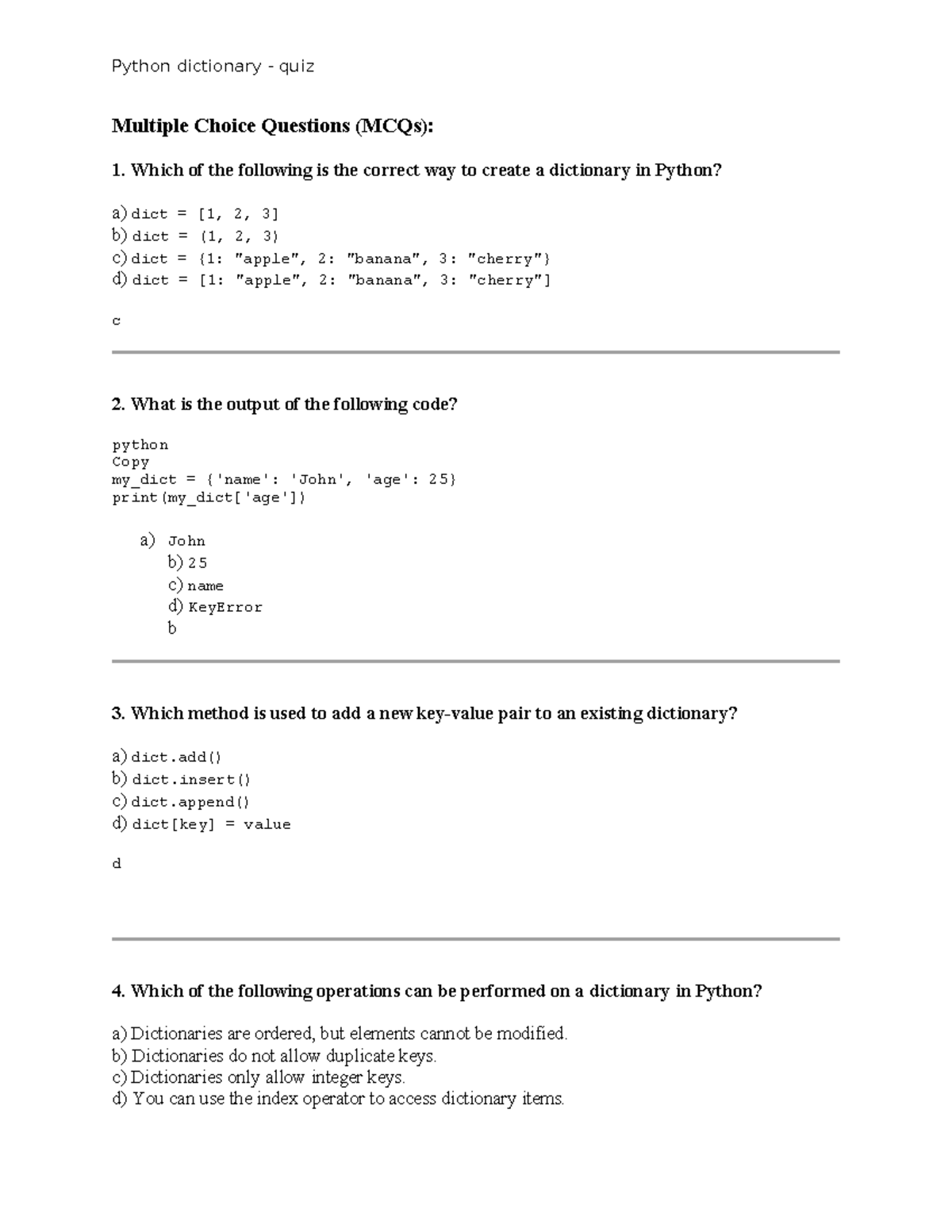
Lists, tuples, dictionaries, and sets form the backbone of Python programming. A "Python MCQ 101" set deep-dives into the time complexity of these structures. For instance, a question might ask about the performance implications of inserting an element at the beginning of a list versus a deque from the collections module. Advanced questions in this category explore dictionary comprehensions and the behavior of sets when dealing with non-hashable types.
3. Control Flow and Iterables
With the introduction of structural pattern matching in Python 3.10 and its continued refinement through 2026, control flow questions have become more sophisticated. MCQs now test the ability to use match-case statements effectively alongside traditional if-else and loop structures. Furthermore, the concept of iterators and generators is a staple of intermediate testing. Knowing how to use the yield keyword to manage memory efficiently is a key differentiator for professional developers.
4. Functional Programming and Lambdas
Python’s functional capabilities, including map, filter, and reduce, are frequently featured in 101-level assessments. Questions often challenge the developer to predict the output of nested lambda functions or to identify the most "Pythonic" way to transform a dataset without explicit for-loops.
Advanced Topics in Modern Python MCQs
As candidates progress through the 101 questions, the difficulty curve typically steepens to include architectural and performance-related topics.
Object-Oriented Programming (OOP)
OOP remains a cornerstone of Python development. Assessments focus on inheritance, encapsulation, and polymorphism. Specific attention is given to "Dunder" (double underscore) methods like init, str, and call. Understanding how these methods allow objects to emulate built-in behaviors is critical for anyone moving beyond script-writing into system design.
Exception Handling and Debugging
Effective error management is what separates robust software from fragile scripts. MCQs in this domain test the use of try-except-finally blocks and the creation of custom exception classes. In 2026, there is an increased focus on the "Exception Groups" feature, which allows multiple exceptions to be raised and handled simultaneously, particularly in asynchronous contexts.
The 2026 Standard Library and Beyond
Modern assessments now include questions on the latest standard library updates. This includes advancements in the pathlib module for file system interactions and the zoneinfo module for accurate time zone management. Proficiency in these areas demonstrates that a developer is current with the language’s evolution.
Comparing Python Proficiency Levels
The following table illustrates how a set of 101 MCQs can be structured to cater to different professional tiers.
| Assessment Tier | Primary Focus Areas | Target Audience | Expected Outcome |
|---|---|---|---|
| Foundational | Syntax, Data Types, Basic Loops | Students, Career Switchers | Ability to write and read basic scripts. |
| Intermediate | OOP, Modules, Iterators, Decorators | Junior Developers, Data Analysts | Capability to build modular applications. |
| Professional | AsyncIO, Memory Management, GIL | Senior Engineers, Architects | Optimization of high-performance systems. |
| Specialized | NumPy, Pandas, Scikit-Learn | Data Scientists, ML Engineers | Mastery of domain-specific libraries. |
Why 101 Questions?
The number 101 is significant because it represents a "complete circle" of knowledge. In academic and professional training, a 101 course is designed to be comprehensive. When applied to Python MCQs, this volume allows for:
- Sufficient Repetition: Reinforcing core concepts through varied phrasing.
- Edge Case Coverage: Ensuring that rare but critical errors (like late binding in closures) are addressed.
- Confidence Building: Providing a statistically significant sample of a developer's skills.
- Certification Readiness: Aligning with the formats used by major certification bodies such as the Python Institute (PCEP/PCAP).
Strategic Study Plan for Python MCQs
To get the most out of a 101-question set, a systematic approach is required. Simply checking the answer key is insufficient for long-term retention.
- Simulate Exam Conditions: Set a timer and attempt the questions without referring to documentation. This identifies true knowledge gaps.
- Analyze the "Why": For every incorrect answer, look up the official Python documentation. Understand why the alternative options were wrong.
- Code the Solution: If a question involves a snippet of code, type it into an IDE. Modify variables and observe how the output changes. This practical application solidifies the theoretical concept.
- Review Python Enhancements: Since we are in 2026, ensure you are reviewing the "What's New" sections for Python 3.11 through 3.14 to catch any deprecated features or new syntax optimizations.
Common Pitfalls in Python Multiple Choice Tests
Even experienced developers can be tripped up by the specific nuances of Python MCQs. One common area of confusion is the scope of variables. Python uses the LEGB rule (Local, Enclosing, Global, Built-in). Many questions are designed to trick the test-taker by shadowing a global variable with a local one.
Another frequent pitfall involves mutable default arguments. If a list is used as a default argument in a function definition, that list is created once at the time of definition, not every time the function is called. This leads to unexpected behavior that is a favorite topic for interviewers and exam creators alike.
Frequently Asked Questions
What is the most difficult topic in a Python MCQ 101 set?
Most developers find asynchronous programming (async/await) and decorators to be the most challenging. These topics require an understanding of Python’s internal execution model and the way functions are treated as first-class objects. Mastering these is essential for moving into senior-level roles in 2026.
Are Python MCQs useful for job interviews in 2026?
Yes, they remain a staple of the initial screening process. While live coding and portfolio reviews are vital, MCQs provide a quick, objective way for recruiters to filter candidates based on their core technical literacy. They ensure that a candidate has the foundational knowledge required to contribute to a codebase immediately.
How often should I refresh my knowledge with these questions?
Given the rapid pace of Python development, a bi-annual review of updated MCQ sets is recommended. This ensures that you are aware of performance improvements in the interpreter and new syntax options that can make your code more efficient and readable.
Do these questions cover third-party libraries?
A standard "Python MCQ 101" focuses primarily on the core language and standard library. However, specialized versions of these sets often include modules for Data Science (Pandas) or Web Development (Django/FastAPI). It is best to master the core 101 before branching into library-specific assessments.
Can I pass the PCAP certification using only these MCQs?
While MCQs are a major component of the Python Certified Associate in Python Programming (PCAP) exam, they should be used alongside hands-on projects. The exam tests practical application, so the ability to write code from scratch is just as important as identifying the correct answer in a list.
Next Steps for Mastery
To finalize your preparation, you should seek out a verified repository of python mcq 101 multiple choice questions that includes detailed explanations for each answer. In 2026, the most reputable sources are those aligned with the latest PEP standards and those that provide interactive environments for testing code snippets. Once you have successfully cleared the 101-question threshold with an accuracy rate of 90% or higher, you are well-positioned to pursue advanced certifications or lead complex development projects.
Image Gallery