iShares Short-Term National Muni Bond ETF (SUB): Overview, Yield, and Strategy
The iShares Short-Term National Muni Bond ETF (ticker: SUB) is an exchange-traded fund offered by BlackRock that provides targeted exposure to investment-grade, short-term U.S. municipal bonds. Designed primarily for tax-conscious inve...
The iShares Short-Term National Muni Bond ETF (ticker: SUB) is an exchange-traded fund offered by BlackRock that provides targeted exposure to investment-grade, short-term U.S. municipal bonds. Designed primarily for tax-conscious investors seeking capital preservation and income exempt from federal income taxes, SUB maintains a short duration profile to minimize interest rate sensitivity.
Contents
Overview of the iShares Short-Term National Muni Bond ETF (SUB)
The iShares Short-Term National Muni Bond ETF (SUB) seeks to track the investment results of an index composed of investment-grade U.S. municipal bonds with remaining maturities between one and five years. Managed by BlackRock under its iShares brand, SUB provides investors with a liquid, low-cost mechanism to access the short-term segment of the municipal bond market.
Municipal bonds are debt obligations issued by state and local governments, counties, cities, and public authorities to finance essential public projects such as schools, highways, bridges, water treatment plants, and public hospitals. A defining feature of municipal bond interest is its exemption from federal income tax. Furthermore, the underlying index for SUB targets bonds that are also exempt from the federal Alternative Minimum Tax (AMT), making its distributions clean of federal tax burdens for most individual taxpayers.
For investors managing high tax brackets, SUB offers a conservative fixed-income solution. Because the fund focuses exclusively on short-dated securities, its price volatility driven by benchmark interest rate changes is substantially lower than that of intermediate or broad-market municipal bond funds.
Disclaimer: This overview is provided for informational and educational purposes only and does not constitute individual tax, legal, or financial advice. Investors should consult a qualified tax advisor or financial professional to assess how municipal bond yields align with their personal tax bracket and financial plan.
Core Mechanics and Portfolio Structure
Understanding how SUB operates requires analyzing three core pillars of fixed-income construction: credit quality, maturity/duration structure, and tax treatment.
- State & Local Issuers
- General Obligation (Taxing Authority)
- Revenue Bonds (Project Revenues)
- Investment-Grade Debt (Maturities: 1–5 Years)
- iShares SUB ETF Portfolio
- Federally Tax-Exempt Cash Flow
Credit Quality and Bond Types
Municipal bonds within SUB are restricted to investment-grade quality, meaning they carry ratings of BBB-/Baa3 or higher from major national statistical rating organizations (such as S&P, Moody’s, or Fitch). The bulk of the portfolio typically resides in top-tier credit tiers (AAA and AA ratings), reflecting the historical credit stability of state and municipal issuers.
The portfolio is divided between two primary categories of municipal debt:
- General Obligation (GO) Bonds: Backed by the full faith, credit, and taxing power of the issuing state or municipality. These bonds rely on general tax revenues (income, property, or sales taxes) to service interest and principal payments.
- Revenue Bonds: Backed by specific revenue streams generated by public infrastructure projects, such as toll roads, water and sewer systems, housing authorities, or public university systems.
Duration and Interest Rate Sensitivity
Duration measures a bond fund's sensitivity to changes in prevailing interest rates. A portfolio with a lower duration experiences smaller price fluctuations when benchmark rates rise or fall.
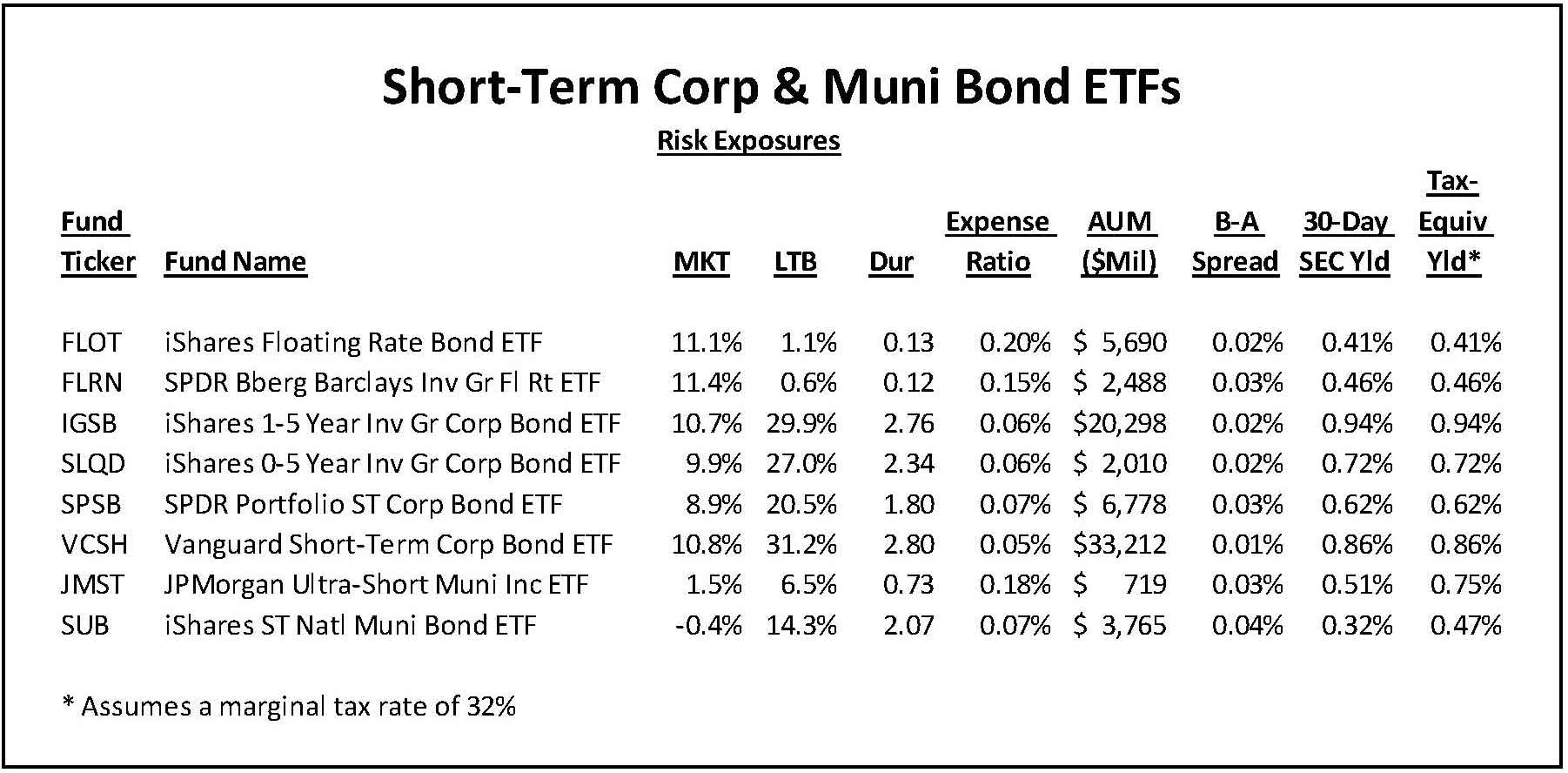
SUB maintains a short effective duration, typically ranging between 1.5 and 2.5 years. By focusing strictly on bonds maturing within a 1-to-5-year window, the fund drastically reduces interest rate risk compared to broader market municipal funds—such as the iShares National Muni Bond ETF (MUB)—which typically hold effective durations of 6 years or more.
When interest rates rise by 100 basis points (1.00%), a portfolio with a duration of 2.0 years can be expected to decline in value by approximately 2.0%, whereas a portfolio with a 6.0-year duration would experience approximately a 6.0% decline. Consequently, SUB serves as a defensive allocation within a fixed-income strategy.
AMT-Free Status and Tax Mechanics
Interest earned from municipal bonds in SUB is exempt from regular federal income taxes. In addition, the fund explicitly targets AMT-free municipal obligations. Certain municipal securities—known as private activity bonds—fund projects that benefit private entities (such as industrial development or airport terminals). Interest on private activity bonds can trigger tax liabilities for investors subject to the federal Alternative Minimum Tax. By excluding these securities, SUB ensures that its standard monthly income distributions remain clear of federal AMT implications for individual investors.
Financial Metrics and Fund Summary
The operational parameters below illustrate the fund's design, cost efficiency, and management target:
| Parameter / Metric | Profile Details |
|---|---|
| Ticker Symbol | SUB |
| Primary Listing Exchange | Cboe BZX Exchange |
| Fund Issuer | BlackRock Financial Management, Inc. |
| Benchmark Index | S&P Short Term National AMT-Free Municipal Bond Index |
| Asset Class | U.S. Municipal Bonds (Investment Grade) |
| Target Maturity Window | 1 to 5 Years |
| Weighted Average Duration | ~1.5 to 2.5 Years (Varies based on portfolio rebalancing) |
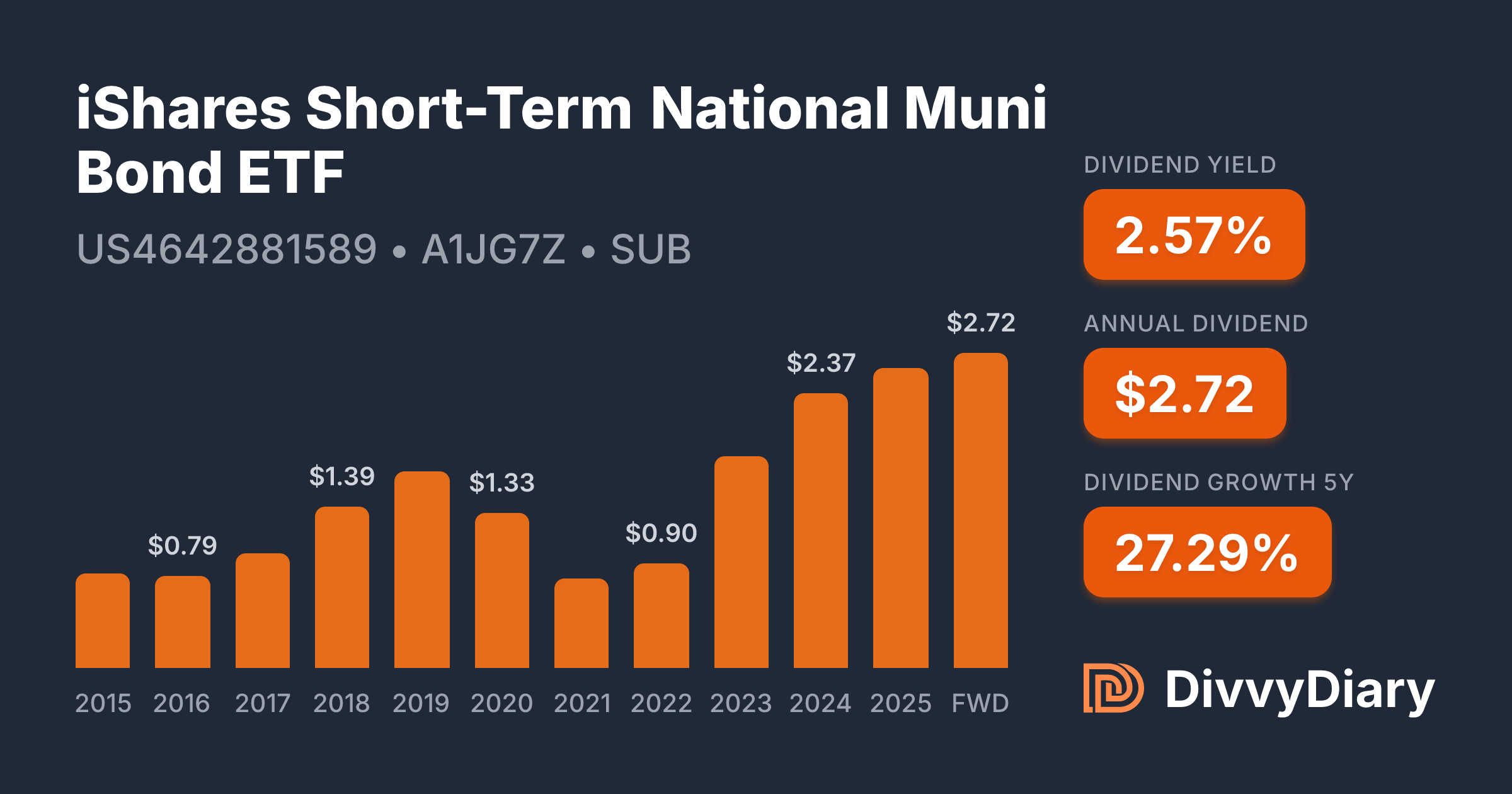
| Management Expense Ratio | 0.07% (7 basis points) |
| Distribution Frequency | Monthly |
| Federal Tax Treatment | Exempt from Federal Income Tax |
| Alternative Minimum Tax (AMT) | AMT-Free |
| State Tax Treatment | Subject to state income tax depending on investor residence and bond origin |
Taxable-Equivalent Yield (TEY) Analysis
To evaluate whether a tax-exempt fund like SUB provides a better yield than a taxable bond fund (such as a Short-Term Treasury ETF or Corporate Bond ETF), investors must calculate the Taxable-Equivalent Yield (TEY). The TEY reveals what yield a taxable investment would need to generate to match the net tax-free income of the municipal fund.
The TEY Formula
$$\text{Taxable-Equivalent Yield} = \frac{\text{Tax-Exempt Yield}}{1 - \text{Marginal Tax Rate}}$$
Where:
- Tax-Exempt Yield is the fund's SEC 30-day yield or distribution yield.
- Marginal Tax Rate is the investor's combined federal marginal tax rate, including the Net Investment Income Tax (NIIT) of 3.8% where applicable.
TEY Calculation Matrix
The table below illustrates how a hypothetical tax-exempt yield of 3.00% translates into a taxable-equivalent yield across different federal income tax brackets:
| Stated Municipal Yield | Federal Marginal Tax Rate | Net Investment Income Tax (NIIT) | Combined Federal Tax Rate | Taxable-Equivalent Yield (TEY) |
|---|---|---|---|---|
| 3.00% | 24.0% | 0.0% | 24.0% | 3.95% |
| 3.00% | 32.0% | 0.0% | 32.0% | 4.41% |
| 3.00% | 35.0% | 3.8% | 38.8% | 4.90% |
| 3.00% | 37.0% | 3.8% | 40.8% | 5.07% |
As demonstrated above, for an investor in the top federal tax bracket paying a combined federal tax rate of 40.8%, a tax-exempt yield of 3.00% delivers the same net income as a fully taxable yield of 5.07%.
The State Income Tax Limitation
Because SUB is a national municipal bond ETF, it holds bonds issued by dozens of U.S. states and territories. For individual income tax purposes:
- Interest from municipal bonds issued by an investor's home state is generally exempt from both federal and home-state income taxes.
- Interest from municipal bonds issued by other states is exempt from federal tax, but usually taxable by the investor's home state.
Because SUB holds a geographically diversified portfolio across the United States, investors residing in states with high personal income taxes (e.g., California, New York, New Jersey) will generally owe state income tax on the portion of SUB’s income generated outside their home state. Investors living in states with no personal income tax (e.g., Texas, Florida, Washington, Nevada) experience no state-level income tax penalty on out-of-state municipal interest.
Strategic Portfolio Positioning and Risk Profile
While short-term municipal bond funds offer stability, financial managers assess SUB within a broader risk and portfolio context.
Low Risk / Low Duration to Higher Yield / Higher Duration:
- Money Market / Taxable Cash (No Duration / Fully Taxable)
- SUB (Short-Term Muni) (Short Duration / Tax-Free)
- MUB (Intermediate Muni) (Moderate Duration / Tax-Free)
Key Advantages
- Capital Preservation: Short-duration portfolios exhibit low price volatility during periods of rate hikes by the Federal Reserve.
- Tax-Advantaged Cash Management: SUB serves as a high-yield alternative to traditional taxable bank deposits or taxable cash sweep accounts for individuals in top tax brackets.
- High Credit Quality: Municipal issuers demonstrate historically low default rates compared to corporate bond issuers of similar credit ratings.
- Liquidity and Low Expenses: Trading on an exchange allows intraday execution, while a 0.07% expense ratio preserves net income for shareholders.
Risk Factors and Limitations
- Reinvestment Risk: Because SUB holds short-term bonds maturing in 1 to 5 years, the fund continuously replaces maturing debt with newly issued bonds. If overall market interest rates drop, incoming cash flows must be reinvested at lower yields, reducing fund distributions over time.
- Inflation Risk: Short-term tax-exempt yields may lag behind periods of elevated inflation, resulting in negative real purchasing power gains.
- Credit Risk: Although municipal defaults are rare among investment-grade bonds, localized fiscal distress or economic downturns can affect state and municipal revenues.
- Capital Gains Tax Hazard: While monthly interest distributions from SUB are exempt from federal income tax, capital gains resulting from trading ETF shares or portfolio turnover by fund managers remain subject to standard capital gains taxation.
Comparative Assessment: SUB vs. Related Fixed-Income Vehicles
To contextualize SUB's position within a fixed-income strategy, compare its structure with alternative income instruments:
| Feature / Objective | iShares Short-Term Muni (SUB) | iShares National Muni (MUB) | Vanguard Short-Term Tax-Exempt (VTES) | Taxable Short-Term Treasury ETF |
|---|---|---|---|---|
| Duration Risk | Low (1.5 – 2.5 Years) | Moderate (5.5 – 6.5 Years) | Low (1.5 – 2.5 Years) | Low (~2.0 Years) |
| Tax Status | Federally Tax-Exempt | Federally Tax-Exempt | Federally Tax-Exempt | Exempt from State/Local, Taxable Federally |
| Primary Use Case | Capital preservation, cash management | Core fixed-income allocation | Capital preservation, low-cost muni | Risk-free cash replacement |
| AMT Exposure | AMT-Free | Excludes/Limits AMT | AMT-Free | N/A |
| State Tax Exemption | Partial (Based on home state) | Partial (Based on home state) | Partial (Based on home state) | 100% State-Exempt |
Frequently Asked Questions (FAQs)
Are distributions from SUB 100% free from all taxes?
No. Distributions from SUB are exempt from regular federal income tax and federal Alternative Minimum Tax (AMT). However, distributions are generally subject to state and local income taxes unless the underlying bond originated in the investor's state of residence. Additionally, any capital gains realized from selling shares of SUB at a profit are subject to federal and state capital gains taxes.
How does SUB differ from a municipal money market fund?
A municipal money market fund invests in ultra-short debt (such as variable rate demand notes with maturities typically under 397 days) and strives to maintain a stable $1.00 Net Asset Value (NAV). SUB invests in short-term bonds maturing between 1 and 5 years; its NAV fluctuates daily based on market conditions, and its duration is slightly longer, carrying a modest degree of price risk in exchange for generally higher yields.
How are distributions handled for annual tax filing?
At the end of each tax year, brokerages issue IRS Form 1099-DIV to shareholders. Tax-exempt dividends from SUB are reported in Box 12 ("Tax-exempt dividends"). Shareholders must report this amount on Form 1040 (Line 2a as tax-exempt interest). BlackRock also provides an annual state tax breakdown percentage report, allowing investors to determine what percentage of income originated from their home state to potentially claim a state tax exemption.
What happens to SUB when the Federal Reserve alters interest rates?
Because SUB maintains a short weighted-average duration (around 1.5 to 2.5 years), changes in Federal Reserve benchmark rates have a muted impact on the fund's share price compared to intermediate or long-term bond funds. If interest rates rise, SUB's price will decline slightly, but the fund will rebalance into higher-yielding new issues faster than longer-duration funds. Conversely, if interest rates fall, SUB's yield will decline more rapidly as short-term bonds mature.
Is SUB appropriate for tax-deferred accounts like IRAs or 401(k)s?
Generally, no. Municipal bond funds like SUB are designed for taxable brokerage accounts. Placing a tax-exempt fund inside a tax-deferred account (like a Traditional IRA) or a tax-free account (like a Roth IRA) is inefficient because those accounts already provide tax sheltered growth. Placing municipal funds in an IRA wastes the tax-free yield benefit, which typically pays lower nominal yields than equivalent taxable corporate or Treasury debt.
Strategic Allocation and Next Actions
For high-earning individuals operating in top tax brackets, the iShares Short-Term National Muni Bond ETF (SUB) presents a conservative, federally tax-exempt vehicle tailored for capital preservation and short-term liquidity management.
Recommended Implementation Steps:
- Calculate Taxable-Equivalent Yield: Evaluate your exact federal tax rate (including NIIT) to confirm that SUB’s tax-equivalent yield outperforms comparable short-term taxable alternatives such as Treasury bills or short-term corporate bonds.
- Review Account Type Placement: Ensure SUB is purchased exclusively within taxable brokerage accounts to maximize the economic benefit of federal tax exemption.
- Assess State Tax Impact: If you reside in a state with high income tax rates (e.g., California, New York), review BlackRock's year-end tax breakdown report or consider whether a state-specific municipal bond fund yields a superior net result after accounting for state taxes.
- Monitor Rate Cycles: Utilize SUB within a laddered bond strategy or as a cash-buffer allocation when interest rate uncertainty or rate-hike cycles favor low-duration instruments.
Image Gallery