Federal Workers' Compensation Wage Replacement: How Amounts and Rates Are Calculated
Under the Federal Employees' Compensation Act (FECA), federal workers' compensation wage replacement pays 66 2/3% of regular pay for injured employees without eligible dependents, or 75% of regular pay for employees with one or more qu...
Under the Federal Employees' Compensation Act (FECA), federal workers' compensation wage replacement pays 66 2/3% of regular pay for injured employees without eligible dependents, or 75% of regular pay for employees with one or more qualified dependents. These benefits are tax-exempt, capped at 75% of a GS-15, Step 10 basic pay rate, and administered by the U.S. Department of Labor.
Contents
Overview of FECA Wage Replacement Rates
The primary law governing disability benefits for civilian federal personnel is the Federal Employees' Compensation Act (FECA), codified under 5 U.S.C. Chapter 81. FECA provides compensation for civilian federal employees who sustain disability from personal injuries or occupational diseases incurred while performing their official duties.
Unlike state workers' compensation programs, which vary widely by jurisdiction, the federal system is standardized nationwide across all executive, judicial, and legislative agencies. The program is managed by the Office of Workers' Compensation Programs (OWCP), a division of the U.S. Department of Labor (DOL).
Wage replacement under FECA is designed to offset lost earning capacity when an accepted work-related injury or medical condition prevents an employee from performing their regular job duties. The standard monetary compensation is calculated as a specific percentage of the employee's pre-injury monthly pay rate:
- Basic Rate (No Dependents): An injured worker receive 66 2/3% (two-thirds) of their established regular monthly pay.
- Augmented Rate (With Dependents): An injured worker receives 75% (three-fourths) of their established regular monthly pay if they have at least one qualifying dependent.
Because FECA benefits are exempt from federal, state, and local income taxes, a 75% tax-free payment frequently equals or closely approximates an employee's pre-injury net take-home pay.
Qualifying Dependents for the Augmented Rate
To receive the 75% augmented compensation rate, the injured federal worker must establish that they have a recognized dependent under 5 U.S.C. § 8110. Qualifying dependents include:
- A Lawful Spouse: A husband or wife living with the employee or receiving regular court-ordered support.
- Unmarried Children Under Age 18: Biological children, legally adopted children, or stepchildren who reside with the employee.
- Full-Time Students Under Age 23: Unmarried children between 18 and 23 years of age enrolled in an accredited high school, college, or university full-time.
- Disabled Adult Children: Unmarried children over age 18 who are physically or mentally incapable of self-support due to a condition that originated before reaching age 18.
- Wholly Dependent Parents: A mother or father who relies entirely on the employee for financial support.
If an employee's dependent status changes during the period of disability—such as through marriage, divorce, or a child reaching the age limit—the employee must notify OWCP using Form CA-1032. Failure to report changes in dependency status can lead to overpayments that the federal government will re-collect.
Continuation of Pay (COP) vs. OWCP Wage Loss Benefits
Federal workers' compensation handles wage replacement in two distinct sequential phases: Continuation of Pay (COP) paid directly by the employing agency, followed by OWCP wage loss compensation.
- Workplace Traumatic Injury
- Continuation of Pay (COP): 100% Salary Paid by Agency (Up to 45 Days)
- OWCP Wage Loss Compensation (if Disability Exceeds 45 Days): 66 2/3% or 75% Tax-Free (Form CA-7)
Phase 1: Continuation of Pay (COP)
For traumatic injuries, FECA grants eligible employees up to 45 calendar days of Continuation of Pay. Unlike ongoing OWCP disability compensation, COP is paid directly by the employing federal agency at 100% of the worker's regular salary.
- Traumatic Injury Requirement: COP is available only for traumatic injuries—defined under 20 CFR § 10.5 as a discrete event occurring within a single work shift or day (such as a slip and fall or motor vehicle collision).
- Occupational Disease Exclusion: COP is not available for occupational diseases or illnesses that develop over a period longer than one workday (such as repetitive strain injuries or exposure to toxins over weeks or months).
- Timely Filing Rule: To qualify for COP, the employee must file Form CA-1 (Notice of Traumatic Injury and Claim for Continuation of Pay/Compensation) within 30 calendar days of the injury date.
- Tax Treatment of COP: Because COP is paid directly by the employing agency as continuation of regular salary, it is subject to regular tax withholdings (Federal, State, FICA, Medicare).
Phase 2: OWCP Disability Compensation
If total or partial disability extends beyond the 45-day COP window (or immediately from day one in occupational disease claims filed on Form CA-2), wage replacement transitions from the employer's payroll to OWCP disability payments.
To initiate OWCP compensation, the employee submits Form CA-7 (Claim for Compensation). Once approved, payments are issued directly by the U.S. Treasury at the standard 66 2/3% or 75% rate. Unlike COP, these direct OWCP payments are completely exempt from payroll taxation.
Maximum and Minimum Statutory Payment Caps
FECA imposes statutory upper limits (caps) and lower limits (floors) on monthly wage replacement amounts under 5 U.S.C. § 8112. These boundaries are indexed to the federal General Schedule (GS) pay scale.
Maximum Wage Replacement Limit
The maximum monthly compensation payable under FECA cannot exceed 75% of the basic monthly pay of a GS-15, Step 10 grade level, including applicable locality pay for the injured worker's geographic area. High-earning federal personnel or senior executives whose calculated 66 2/3% or 75% monthly rate exceeds this cap will have their monthly check limited to the GS-15, Step 10 cap.
Minimum Wage Replacement Limit
The minimum monthly compensation for total disability cannot be less than 75% of the basic monthly pay of a GS-2, Step 1 grade level, or the employee's actual monthly pay rate, whichever is lower. This statutory floor protects low-wage federal workers from severe financial hardship following a disabling injury.
How "Monthly Pay" Is Calculated
The monetary value of FECA wage replacement depends on establishing the employee's official base pay rate. Under 5 U.S.C. § 8114, OWCP determines an employee's monthly pay using one of three standard benchmarks—whichever yields the highest rate:
- Date of Injury: The regular pay rate on the exact day the injury occurred.
- Date Disability Began: The pay rate on the date work stoppage commenced (if different from the injury date).
- Date of Recurrence: The pay rate on the date a disability recurred, provided the employee had returned to regular full-time duty for a sustained period between the initial injury and the recurrence.
Included vs. Excluded Pay Components
Calculating "monthly pay" involves specific pay components earned during the 12 months preceding the injury:
| Included in Pay Calculation | Excluded from Pay Calculation |
|---|---|
| Basic salary or hourly base rate | Overtime pay (standard/casual) |
| Locality pay adjustments | Premium pay for voluntary extra shifts |
| Night differential pay | Travel allowances / Per diem |
| Sunday or holiday premium pay | Holiday pay (unworked) |
| Hazard pay / Environmental differential | Cash awards or performance bonuses |
Note: Overtime is explicitly excluded from base pay calculations under FECA, even if an employee routinely worked 20 hours of overtime per week prior to their injury. The only narrow exception involves administrative controllable overtime mandatory for specific federal positions like border patrol agents under specialized statutes.
Partial Disability and Loss of Wage-Earning Capacity (LWEC)
When an injured federal worker is not totally disabled, but their medical restrictions prevent them from returning to their pre-injury job at full capacity, OWCP calculates payments using a formula known as Loss of Wage-Earning Capacity (LWEC).
If the employee accepts light-duty work or alternative suitable employment that pays less than their original position, OWCP compensates for the difference between what they used to earn and what they are currently capable of earning.
The Albert Shadrick Formula
OWCP applies a standardized legal test (established in the landmark precedent case Albert Shadrick) to determine partial disability payments:
- Current Earning Capacity: OWCP determines the current wage rate for the employee's pre-injury position.
- Actual/Rated Earnings: OWCP determines the employee's current earning capacity in their modified duty role or target job classification.
- Percentage of Capacity Retained: The current earning capacity is divided by the current wage rate of the job held at injury.
- Adjusted Wage Base: The resulting percentage is multiplied by the employee's historical pay rate at the time of injury.
- Wage Loss Amount: The adjusted wage base is subtracted from the historical pay rate to establish net lost earning capacity.
- Compensation Applied: OWCP applies either the 66 2/3% (no dependents) or 75% (with dependents) percentage to that net loss amount.
This formula ensures that wage replacement payments automatically account for general wage increases, cost-of-living adjustments, and inflation over time.
FECA Schedule Awards for Permanent Impairment
In addition to temporary total or partial wage replacement, FECA provides Schedule Awards under 5 U.S.C. § 8107 for workers who suffer permanent loss, or loss of use, of specific anatomical structures or bodily functions.
Schedule awards are paid when a medical condition reaches Maximum Medical Improvement (MMI)—the point at which an injury has stabilized and no further functional recovery is expected. Permanent impairment ratings must be evaluated by a qualified physician using the American Medical Association (AMA) Guides to the Evaluation of Permanent Impairment (6th Edition).
Schedule Award Calculation Method
Schedule award amounts are calculated by multiplying the weekly compensation rate (66 2/3% or 75% of base salary) by the statutory number of weeks assigned to the impaired body part, scaled by the percentage of impairment.
$$\text{Total Benefit} = \text{Statutory Weeks} \times \text{Impairment %} \times \left( \text{Weekly Pay Rate} \times \text{Statutory Rate (66.67% or 75%)} \right)$$
Statutory Week Values for Specific Body Parts
The FECA statute dictates maximum week values for total loss of specific anatomical functions:
- Arm: 312 weeks
- Leg: 288 weeks
- Hand: 244 weeks
- Foot: 205 weeks
- Eye (Total Loss of Vision): 160 weeks
- Hearing (Complete Loss, Both Ears): 200 weeks
- Kidney (Loss of One): 156 weeks
- Larynx: 160 weeks
Calculation Example:
An employee with a dependent earns a weekly base pay of $1,200. The employee suffers a workplace accident resulting in a 20% permanent impairment of the arm.
- Statutory Duration: 312 weeks (full arm value) $\times 20% = \mathbf{62.4\text{ weeks}}$.
- Weekly Compensation Rate: $1,200 \times 75% = \mathbf{$900\text{ per week}}$.
- Total Schedule Award: $62.4\text{ weeks} \times $900/\text{week} = \mathbf{$56,160}$.
An employee can receive a schedule award even if they have returned to full-duty work at full pay. However, an employee cannot draw schedule award benefits and temporary total disability wage replacement for the same injury during the exact same time period.
Summary of Federal Wage Replacement Compensation Types
The following table summarizes how different FECA wage replacement benefits are paid, taxed, and limited:
| Benefit Category | Eligibility / Trigger | Wage Replacement Rate | Duration Limit | Tax Status |
|---|---|---|---|---|
| Continuation of Pay (COP) | Traumatic injury filed within 30 days | 100% of regular base pay | Max 45 calendar days | Fully Taxable (Payroll) |
| Total Disability (Basic Rate) | Complete work incapacity (no dependents) | 66 2/3% of regular monthly pay | Duration of total disability | Tax-Exempt |
| Total Disability (Augmented) | Complete work incapacity (with dependents) | 75% of regular monthly pay | Duration of total disability | Tax-Exempt |
| Partial Disability (LWEC) | Reduced earning capacity due to restrictions | 66 2/3% or 75% of wage loss difference | Duration of partial disability | Tax-Exempt |
| Schedule Award | Permanent loss of organ/limb function (at MMI) | 66 2/3% or 75% of weekly rate | Statutory schedule weeks | Tax-Exempt |
Tax Treatment and Benefit Offsets
Understanding how OWCP compensation interacts with tax codes, federal health benefits, and retirement pensions is critical for financial planning.
- Injured Federal Employee
- OWCP Disability Wage Replacement
- Tax-Exempt (IRC § 104(a)(1))
- OPM Retirement Annuity (FERS / CSRS)
- DUAL BENEFIT PROHIBITION
- Must Elect ONE Benefit
- (Cannot Draw Both Simultaneously)
- OWCP Disability Wage Replacement
Federal and State Tax Exemption
Under Section 104(a)(1) of the Internal Revenue Code, amounts received under workers' compensation acts as compensation for personal injuries or sickness are completely excluded from gross income. As detailed in IRS Publication Topic No. 405, direct OWCP disability payments are not subject to federal income tax, state income tax, or FICA (Social Security and Medicare) withholding.
This tax exemption applies to disability wage loss payments and schedule awards, but does not apply to Continuation of Pay (COP).
Interaction with FERS and CSRS Retirement Annuities
Under 5 U.S.C. § 8116, a federal worker cannot receive OWCP wage loss compensation and a Civil Service Retirement System (CSRS) or Federal Employees Retirement System (FERS) retirement annuity simultaneously for the same period. This rule prevents dual payments from federal funds for the same period of service.
- Election of Benefits: If an employee is eligible for both FERS/CSRS disability retirement and OWCP wage loss benefits, they must elect which benefit to receive. Because OWCP pays 66 2/3% or 75% tax-free, most injured workers elect OWCP compensation over OPM disability retirement, which is generally lower and taxable.
- Exception for Schedule Awards: An employee can receive a FECA Schedule Award simultaneously with a FERS or CSRS retirement annuity.
Social Security Disability Offset (FERS Employees)
For federal employees covered under FERS who receive both Social Security Disability Insurance (SSDI) and OWCP wage loss compensation, federal law dictates an offset mechanism. OWCP benefits are reduced by the portion of Social Security benefits attributable to the employee's federal service to prevent duplicate wage replacement coverage.
Health Insurance (FEHB) and Life Insurance (FEGLI) Deductions
When an employee is placed on OWCP compensation rolls for total disability, their coverage under the Federal Employees Health Benefits (FEHB) program and Federal Employees' Group Life Insurance (FEGLI) can continue. OWCP automatically deducts the employee's share of health insurance premiums and life insurance premiums directly from their monthly compensation check.
How to File and Ensure Accurate Calculations
Securing accurate wage replacement under FECA requires following precise administrative procedures governed by the Office of Workers' Compensation Programs.
Step 1: File the Initial Injury Report
- Traumatic Injury: Complete Form CA-1 within 30 days of the incident through the Employees' Compensation Operations and Management Portal (ECOMP). Request Continuation of Pay on line 15.
- Occupational Illness: Complete Form CA-2 as soon as you become aware of the relationship between your medical condition and your federal employment.
Step 2: Submit Medical Rationale
Wage loss compensation will not be paid without supporting medical evidence. You must provide comprehensive medical reports from a licensed physician (M.D. or D.O.) that clearly articulate:
- A definitive medical diagnosis.
- Objective clinical findings (imaging, testing, examination notes).
- A clear statement of medical causation explaining how the specific workplace duties caused or aggravated the condition.
- Specific physical restrictions preventing regular job performance.
Step 3: File Form CA-7 for Compensation
When COP expires (or immediately upon filing a CA-2 claim), submit Form CA-7 (Claim for Compensation) through ECOMP. If claiming wage loss for recurring periods, submit Form CA-7 biweekly or monthly alongside Form CA-20 (Attending Physician's Report).
Step 4: Audit Pay Calculations
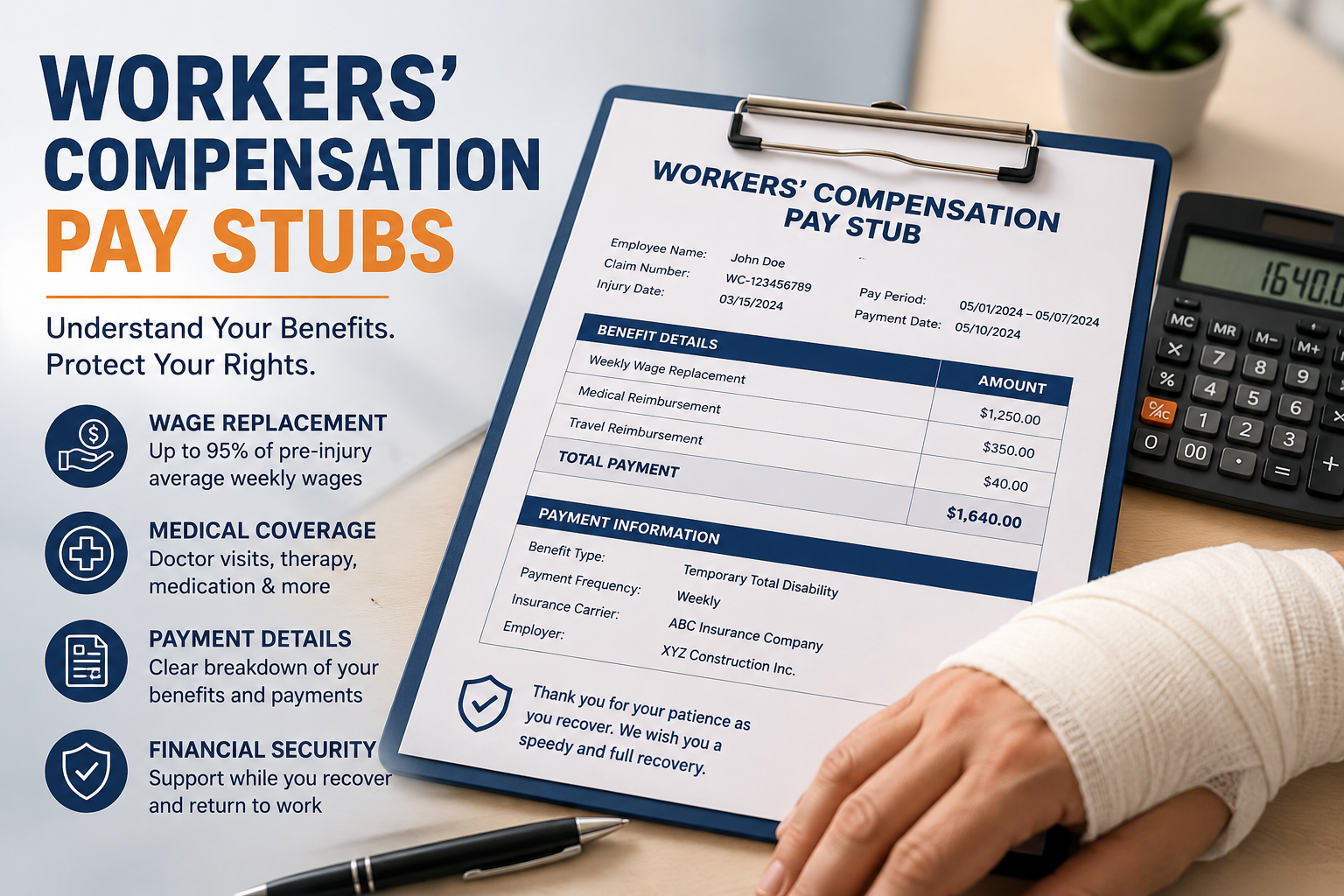
Carefully verify the pay rate reported by your agency on Form CA-7. Ensure that locality adjustments, night differentials, hazard pay, or shift premiums earned during the 12 months prior to injury are fully documented. If OWCP undercalculates your base pay rate, submit written pay stubs or Form W-2 records along with a formal request for recalculation to your claims examiner.
Frequently Asked Questions
How much does federal workers' comp pay monthly?
Federal workers' comp pays either 66 2/3% of your pre-injury gross monthly pay if you have no dependents, or 75% of your pre-injury gross monthly pay if you have one or more eligible dependents. These benefits are tax-free but cannot exceed 75% of a GS-15, Step 10 monthly salary rate.
Are federal workers' comp wage replacement payments taxed?
No. Direct OWCP wage loss compensation and Schedule Awards are completely exempt from federal, state, and local income taxes under IRS Code Section 104(a)(1). However, the initial 45 days of Continuation of Pay (COP) paid directly by your employer is regular salary and is subject to standard taxes.
What is the 75% rule for federal workers' comp?
The 75% rule allows an injured federal employee with at least one qualified dependent (spouse, minor child, full-time student under 23, or dependent parent) to receive an augmented compensation rate of 75% of their pre-injury monthly pay, rather than the basic 66 2/3% rate for single workers.
Can you receive federal retirement and OWCP disability at the same time?
No, you cannot draw OWCP wage loss compensation and a FERS or CSRS retirement annuity simultaneously. You must elect whichever benefit is more advantageous. However, you can receive a FECA Schedule Award for permanent impairment while drawing an OPM retirement annuity.
How does overtime affect federal workers' comp wage replacement?
Standard overtime pay is excluded from base pay calculations under FECA. OWCP calculates monthly pay based on your base salary, locality pay, hazard pay, and regular night or Sunday differentials, but it leaves out standard voluntary or involuntary overtime hours worked prior to injury.
Practical Action Plan for Injured Workers
If you sustain a job-related injury or medical condition as a federal civilian employee, follow these immediate steps to safeguard your wage replacement rights:
- Report the Injury Immediately: Log into ECOMP and file Form CA-1 (for traumatic events) or Form CA-2 (for occupational conditions). Meet the strict 30-day deadline to preserve 45 days of Continuation of Pay (COP).
- Establish Dependency Proof: Gather marriage certificates, birth certificates, or student enrollment documents to substantiate your eligible dependents so OWCP registers your account at the higher 75% compensation rate.
- Secure Targeted Medical Reports: Instruct your treating physician to detail your exact work restrictions and connect your physical limitations directly to your federal work duties in writing.
- Monitor Your Form CA-7 Filings: Track your wage loss compensation claims in ECOMP to avoid income gaps after your 45-day COP period ends.
EDITORIAL CATEGORY METADATA:
Image Gallery