ODOT Snow Emergency Levels Explained: Ohio’s Winter Driving Standards for 2026
Ohio utilizes a three-tier snow emergency system declared by county sheriffs to regulate road safety during severe winter storms. While Level 1 encourages caution and Level 2 limits travel to necessary trips, Level 3 closes roadways to...
Ohio utilizes a three-tier snow emergency system declared by county sheriffs to regulate road safety during severe winter storms. While Level 1 encourages caution and Level 2 limits travel to necessary trips, Level 3 closes roadways to non-emergency personnel. Understanding these levels is critical for legal compliance, insurance considerations, and personal safety.
Contents
In the winter of 2026, navigating Ohio's snowy corridors requires more than just a set of winter tires; it requires a clear understanding of the legal and operational frameworks that keep the state moving. A common misconception among motorists is that the Ohio Department of Transportation (ODOT) determines when it is "illegal" to drive. In reality, while ODOT manages the physical clearing of state routes and interstates, the authority to declare snow emergencies rests solely with the individual County Sheriffs under the Ohio Revised Code (ORC).
This guide provides a comprehensive breakdown of the three snow emergency levels, the legal implications of each, and how ODOT’s 2026 operational strategies intersect with these declarations to ensure public safety.
The Hierarchy of Ohio Snow Emergency Levels
The snow emergency classification system is designed to provide a uniform language for safety across Ohio’s 88 counties. Because weather conditions can vary drastically from the lake-effect regions of the north to the river valleys of the south, these levels are declared on a county-by-county basis.
Level 1 Snow Emergency: Roadway Caution
A Level 1 declaration is the most common and serves as a formal "heads-up" to motorists. At this level, roadways are considered hazardous due to the accumulation of snow or ice.
- Conditions: Expect patches of black ice, slushy intersections, and reduced visibility.
- Driver Responsibility: Motorists are urged to drive with extreme caution. This includes increasing following distances, reducing speed below the posted limit, and ensuring that headlights are on (a legal requirement in Ohio whenever windshield wipers are in use).
- Legal Standing: There are no travel restrictions at Level 1. However, if you are involved in an accident, the fact that a Level 1 emergency was in effect may be used by law enforcement to justify a citation for "Failure to Control" or "Speeding for Conditions."
Level 2 Snow Emergency: Necessary Travel Only
Level 2 represents a significant escalation in risk. This level is declared when blowing and drifting snow create severely limited visibility or when ice makes road surfaces unpredictable.
- Conditions: Roads are hazardous with significant snow accumulation. Wind gusts may cause "whiteout" conditions in open areas.
- Driver Responsibility: Only those who "deem it necessary" to drive should be on the roads. This phrasing is intentionally subjective but serves as a stern warning that non-essential trips—such as leisure shopping or social visits—should be postponed.
- Legal Standing: While driving is not strictly prohibited, motorists are encouraged to consult with their employers. Many private businesses in 2026 utilize Level 2 declarations as a trigger for remote work protocols or delayed openings.
Level 3 Snow Emergency: Emergency Travel Only
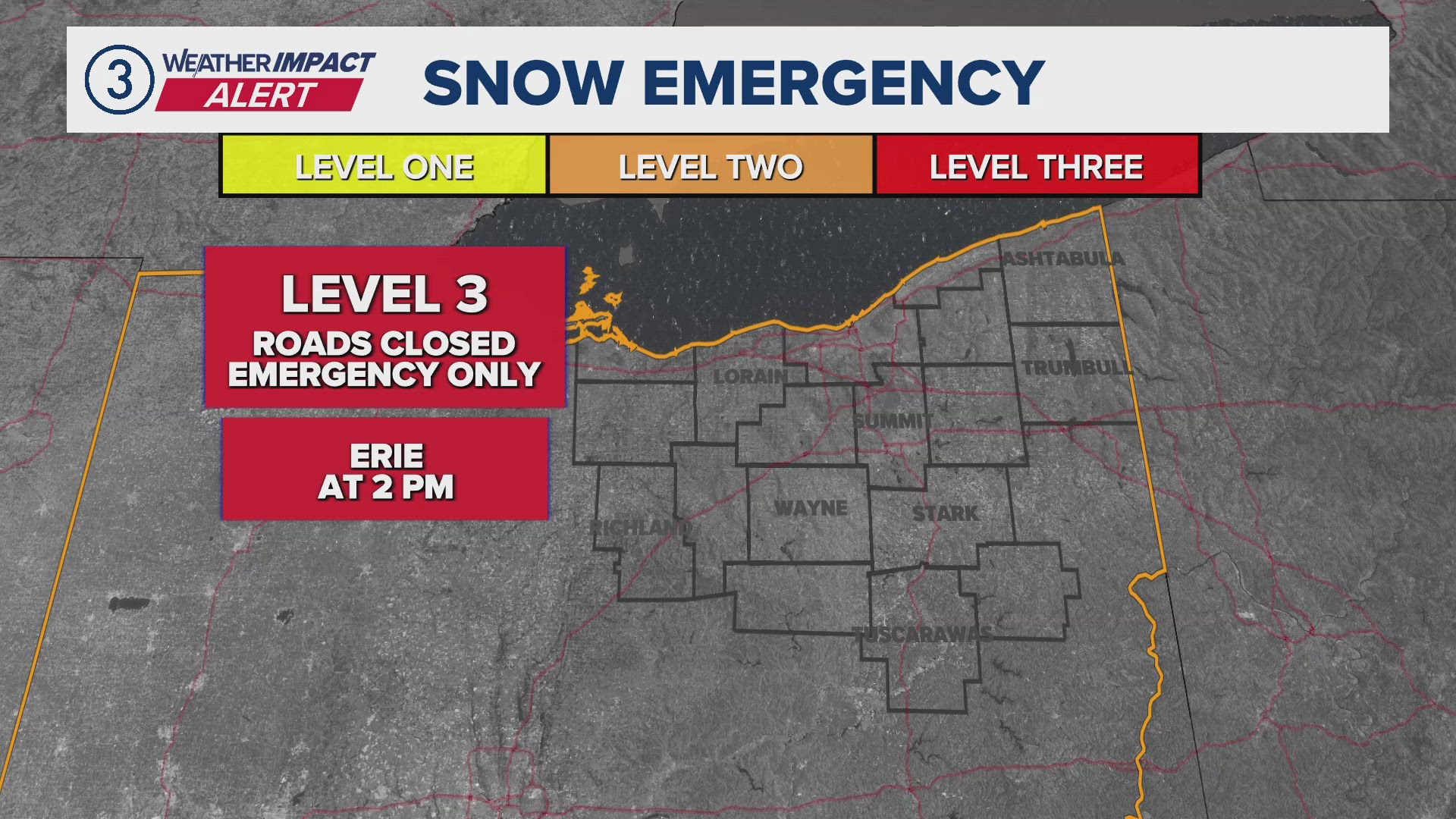
Level 3 is the most restrictive and serious declaration. When a Sheriff declares a Level 3 emergency, all roadways in that county are closed to non-emergency personnel.
- Conditions: Roads are impassable or extremely dangerous. Traveling poses a threat not only to the driver but also to emergency responders and ODOT plow operators who may need to rescue stranded motorists.
- Driver Responsibility: No one should be on the road unless it is a life-safety emergency or they are considered "essential personnel" (e.g., healthcare workers, first responders, or utility repair crews).
- Legal Standing: This is the only level where driving can result in criminal charges. Under ORC 311.07, Sheriffs have the authority to enforce these closures. Violators can be arrested and charged with a misdemeanor, which may include fines and jail time.
Comparing Snow Emergency Levels and Restrictions
The following table summarizes the operational and legal differences between the three levels as of the 2026 winter season.
| Feature | Level 1: Caution | Level 2: Necessary | Level 3: Prohibitive |
|---|---|---|---|
| Road Conditions | Slush, ice patches, light snow | Blowing snow, drifting, heavy ice | Impassable, whiteout, extreme danger |
| Travel Recommendation | Drive with caution | Only if "necessary" | Emergency Personnel Only |
| Legal Status of Driving | Permitted | Permitted | Prohibited (Restricted) |
| Potential Penalty | Standard traffic citations | Standard traffic citations | Arrest / Criminal Misdemeanor |
| Business Operations | Usually normal | Limited/Remote | Closed (unless essential) |
| ODOT Focus | Clearing main routes | Keeping main routes open | Rescuing stranded/Clearing paths |
The Role of ODOT vs. The County Sheriff
One of the most frequent points of confusion for Ohio residents is the distinction between ODOT’s maintenance role and the Sheriff’s enforcement role.
ODOT’s Operational Mandate
The Ohio Department of Transportation is responsible for the maintenance of over 43,000 lane miles of state and federal routes, including the Interstate Highway System. In 2026, ODOT utilizes advanced Road Weather Information Systems (RWIS)—a network of roadside sensors that monitor pavement temperature, salt concentration, and wind speeds in real-time.
ODOT crews work 12-hour shifts during storm events to apply salt, brine (a liquid salt solution), and specialized de-icing chemicals. Their goal is to maintain "passable" roads, which does not necessarily mean "dry" roads. Even when ODOT is successfully clearing paths, a Sheriff may still declare a Level 2 or 3 emergency if the local side roads, which are managed by townships or municipalities, remain dangerous.
The Sheriff’s Legal Authority
The County Sheriff is the highest law enforcement officer in the county and is tasked with public safety. The decision to declare a snow emergency is often made in consultation with local EMA (Emergency Management Agency) directors and ODOT district managers. The Sheriff considers visibility, the rate of snowfall, and the frequency of accidents.
It is important to note that a snow emergency is not "statewide." You may cross a county line from a Level 1 zone into a Level 3 zone. In 2026, digital signage on interstates and the OHGO mobile application are the primary methods for communicating these boundary changes to drivers in real-time.
Workplace Rights and Employer Obligations
A common question during Level 2 and Level 3 emergencies is: "Do I have to go to work?"
In Ohio, which is an "at-will" employment state, the legalities are complex. Generally, an employer can require an employee to report to work even during a Level 2 emergency. However, a Level 3 Snow Emergency changes the dynamic significantly. Because the roads are legally closed to non-emergency personnel, an employer who "orders" a non-essential employee to drive could potentially be held liable for encouraging illegal activity.
Most modern Ohio employee handbooks in 2026 include specific "Inclement Weather" clauses. It is recommended that employees:
- Verify Essential Status: Confirm with your supervisor ahead of the winter season if your role is classified as "essential."
- Document the Declaration: Keep a screenshot or official record of the Sheriff’s declaration if you are unable to travel.
- Prioritize Safety: No paycheck is worth a criminal record or a life-threatening accident on an impassable road.
Technical Enhancements in 2026 Snow Removal
By 2026, ODOT has integrated several technical improvements to assist drivers during these emergencies:
- Green Strobe Lights: All ODOT snowplows now utilize green strobe lights in addition to amber ones. Research has shown that the human eye detects green more easily in "whiteout" conditions, reducing rear-end collisions with plow trucks.
- Predictive Modeling: Using AI-driven weather modeling, ODOT can now "pre-treat" roads with brine up to 48 hours before a predicted Level 2 event, significantly reducing the bonding of ice to the pavement.
- OHGO Real-Time Camera Access: Motorists can access over 1,000 live camera feeds via the OHGO website to verify actual road conditions before deciding if a trip is "necessary" under Level 2.
Frequently Asked Questions
Who officially declares a snow emergency in Ohio?
Snow emergencies are declared by the County Sheriff of each individual county. While they consult with ODOT and the National Weather Service, the legal authority to restrict travel lies solely with the Sheriff’s office under Ohio law.
Can I be arrested for driving in a Level 3 emergency?
Yes. At Level 3, the roads are closed to all non-emergency travel. Violating this order is a misdemeanor offense. While many deputies prefer to issue warnings or assist stranded motorists, they have the full legal authority to cite or arrest anyone driving without a valid "emergency" or "essential" reason.
Does a Level 2 emergency mean I don't have to go to work?
Not necessarily. Level 2 is an advisory level suggesting that only "necessary" travel take place. Whether your job is "necessary" is typically determined by your employer. However, you should use your best judgment regarding your vehicle’s capabilities and your driving skills.
How do I find out the current snow emergency level for my county?
The most reliable sources are the official social media pages or websites of your local County Sheriff. Additionally, the ODOT OHGO app and local news broadcasts provide real-time updates for all 88 Ohio counties.
Are "Essential Personnel" the only people allowed out in Level 3?
Primarily, yes. This includes doctors, nurses, paramedics, police, fire, and utility workers (gas, electric, water). Some food supply chain drivers (delivery to grocery stores) may also be permitted depending on the specific county's guidelines, but they should carry proof of employment.
Practical Recommendations for Ohio Motorists
To navigate the 2026 winter season safely, follow these proactive steps:
- Monitor County Lines: If your commute takes you across multiple counties, check the status of each. A clear road in Franklin County does not guarantee safe passage into Licking or Delaware County.
- Prepare a Level 3 Kit: Keep a winter survival kit in your vehicle containing blankets, a portable phone charger, water, non-perishable food, and a small shovel. If you become stranded during a Level 3 emergency, help may take hours to arrive as emergency crews prioritize clearing paths for ambulances.
- Respect the Plow: Maintain a distance of at least 200 feet behind ODOT snowplows. These vehicles have significant blind spots and often discharge salt and brine that can obscure your vision if you follow too closely.
- Use Digital Tools: Download the OHGO app to receive push notifications regarding snow levels and road closures specific to your frequent routes.
By respecting the hierarchy of snow emergency levels and understanding the legal authority behind them, Ohio drivers can ensure they remain safe and compliant throughout the winter months.
Image Gallery