Securing Whole Life Insurance in Miami, FL: Policy Selection, Ratings, and Florida Legal Protections
Selecting the right whole life insurance company in Miami, Florida requires evaluating a carrier’s financial stability, dividend history, policy rider options, and alignment with state-specific legal benefits. Top choices typically inc...
Selecting the right whole life insurance company in Miami, Florida requires evaluating a carrier’s financial stability, dividend history, policy rider options, and alignment with state-specific legal benefits. Top choices typically include non-profit mutual insurance companies rated A+ or higher by A.M. Best, which offer permanent coverage, guaranteed cash accumulation, and legal safeguards under Florida law.
Contents
Understanding Whole Life Insurance Mechanisms in Florida
Whole life insurance is a form of permanent life insurance designed to provide lifetime protection, provided required premiums are paid. Unlike term life insurance—which covers a specified period such as 10, 20, or 30 years—whole life guarantees a tax-free death benefit to beneficiaries, fixed premium payments that remain constant throughout the policyholder's life, and a guaranteed cash value component that grows on a tax-deferred basis.
The cash value operates as an internal accumulation account. A portion of every premium payment is allocated toward the policy's cash value, earning interest at a minimum rate guaranteed by the insurer. Policyholders in Miami frequently utilize this cash value during their lifetimes through tax-free policy loans or withdrawals to supplement retirement income, fund private business ventures, or navigate local economic shifts.
Whole Life Policy Structure
- Fixed Annual Premiums (Locked in at issue age)
- Guaranteed Death Benefit (Tax-free payout to beneficiaries)
- Guaranteed Cash Value (Tax-deferred growth at fixed rate)
- Non-Guaranteed Dividends (Available from mutual carriers)
Participating vs. Non-Participating Policies
When shopping for whole life insurance in South Florida, policyholders must choose between participating and non-participating policies:
- Participating Policies: Offered primarily by mutual life insurance companies, participating policies allow policyholders to receive non-guaranteed annual dividends. Dividend options include taking cash payouts, applying funds toward future premium payments, accumulating interest within the contract, or purchasing Paid-Up Additions (PUA). Purchasing paid-up additions increases both the policy's total death benefit and its underlying cash value growth exponentially over time.
- Non-Participating Policies: Typically issued by stock-owned insurance companies, these contracts offer strict guarantees regarding premiums, cash values, and death benefits, but policyholders do not share in the insurance company's annual financial earnings or profits through dividends.
Disclaimer: Whole life insurance policies are binding legal contracts with long-term financial consequences. This guide is for educational purposes and does not constitute formal financial, tax, or legal advice. Consult a licensed Florida life insurance agent, financial planner, or estate attorney for personalized strategies.
Florida-Specific Legal Advantages and Asset Protections
Florida maintains some of the most robust legal protections in the United States for life insurance owners. Individuals and business executives residing in Miami leverage these statutory exemptions to shield assets from potential litigation and financial liability.
Complete Statutory Creditor Exemption
Under Florida Statute § 222.14, the cash surrender value of a life insurance policy issued upon the life of a Florida resident is completely exempt from execution, attachment, or legal process by creditors.
If a Miami resident faces a legal judgment, civil lawsuit, or commercial bankruptcy proceeding, creditors generally cannot force the surrender of a whole life insurance policy, nor can they seize accumulated cash reserves within the policy contract. This protection extends specifically to the policy cash value while the insured is living.
Regulatory Oversight and Guaranty Coverage
Life insurance operations within the state are regulated by the Florida Office of Insurance Regulation (FLOIR), which enforces solvency requirements, market conduct rules, and policy form approvals.
In the event an authorized insurer becomes insolvent, policyholders are backed by the Florida Life & Health Insurance Guaranty Association (FLHIGA). FLHIGA provides statutory safety nets for Florida policyholders up to statutory limits:
- Life Insurance Death Benefit: Up to $300,000 per individual insured life.
- Life Insurance Cash Surrender Value: Up to $100,000 in net cash surrender and withdrawal values per policy owner.
Because state guaranty limits cap cash surrender protection at $100,000 per insolvent company, consumers purchasing large policy contracts frequently split coverage across multiple high-rated carriers or restrict policy purchases to carriers carrying elite financial ratings.
Evaluating Top Whole Life Insurance Carriers Operating in Miami
Evaluating an insurer's solvency and financial endurance requires examining independent rating agency metrics. Rating organizations analyze an insurance company's balance sheet strength, investment portfolio exposure, underwriting performance, and risk management framework.
Key ratings agencies include:
- A.M. Best: Focuses exclusively on the insurance sector, rating carriers from A++ (Superior) down to D (Poor).
- Fitch Ratings: Assesses long-term financial obligations on an AAA to D scale.
- Moody's Investors Service: Evaluates insurance financial strength from Aaa to C.
- Standard & Poor's (S&P): Rates financial solvency from AAA to D.
Consumers can verify financial strength ratings directly through the A.M. Best Rating System or through official consumer guides published by the National Association of Insurance Commissioners (NAIC).
| Rating Agency | Excellent / Superior | Good / Strong | Speculative |
|---|---|---|---|
| A.M. Best | A++, A+ | A, A- | B++ down |
| S&P | AAA, AA+, AA, AA- | A+, A, A- | BBB+ down |
| Moody's | Aaa, Aa1, Aa2, Aa3 | A1, A2, A3 | Baa1 down |
| Fitch | AAA, AA+, AA, AA- | A+, A, A- | BBB+ down |
Premier Mutual Insurers Serving Miami
Mutual companies are owned by their policyholders rather than public stockholders. Because they operate with a long-term perspective rather than managing short-term quarterly earnings for public markets, mutual carriers historically pay consistent dividends to participating whole life policyholders.
Leading carriers licensed to operate in Miami, FL include:
- MassMutual (Massachusetts Mutual Life Insurance Company): Frequently holds the highest ratings (A++ from A.M. Best) and maintains a long record of annual dividend payments. Known for flexible paid-up addition riders tailored for rapid cash value accumulation.
- New York Life Insurance Company: The largest mutual life insurance company in the United States. Features financial ratings across all major rating agencies and offers specialized estate planning whole life structures.
- Northwestern Mutual: Consistently maintains low operational expense ratios, leading dividend payouts, and customized policy design options through local agencies situated in South Florida.
- Guardian Life Insurance Company of America: Outstanding for flexible policy options, including riders aimed at disability business planning and supplemental cash growth strategies.
- Penn Mutual: Highly regarded for broad policy customization, strong dividend histories, and competitive non-direct recognition policies for policy loan utilization.
Comparison of Top Whole Life Insurance Companies in Miami
The table below outlines established whole life carriers operating in South Florida, summarizing their structural designs, rating indicators, and prominent policy benefits.
| Insurance Carrier | Company Structure | A.M. Best Rating | Typical Dividend Status | Notable Features & Strengths |
|---|---|---|---|---|
| MassMutual | Mutual Insurer | A++ (Superior) | Participating (Paid historically since 1869) | Exceptional cash value growth riders; strong choice for high-net-worth estate liquidity. |
| New York Life | Mutual Insurer | A++ (Superior) | Participating (Paid continuously for 170+ yrs) | Offers customized custom-pay options (e.g., 10-Pay, Pay-to-65); dedicated local Miami agencies. |
| Northwestern Mutual | Mutual Insurer | A++ (Superior) | Participating (Consistently paid annually) | Lowest expense ratios industry-wide; flexible blended term/whole life conversion options. |
| Guardian Life | Mutual Insurer | A++ (Superior) | Participating (Paid annually for over a century) | Excellent living benefit riders; highly flexible policy loan structures for business owners. |
| Penn Mutual | Mutual Insurer | A+ (Superior) | Participating (Strong annual dividend history) | Favorable non-direct recognition policy loans; robust paid-up addition (PUA) caps. |
| Mutual of Omaha | Stock Company (Mutualized affiliate) | A+ (Superior) | Non-Participating options available | Simplified underwriting options; accessible policy face amounts for middle-market clients. |
Essential Policy Riders for Miami Policyholders
Policy riders are optional endorsements added to a base whole life contract to customize coverage, expand living benefits, or accelerate cash value accumulation.
Paid-Up Additions (PUA) Rider
For policyholders who prioritize living benefits and rapid wealth accumulation over maximum initial death benefit protection, a Paid-Up Additions Rider is essential. The PUA rider allows policyholders to deposit extra capital into the policy above the base premium.
These additional funds directly purchase small increments of fully paid-up whole life insurance. This boosts early cash surrender value while increasing the total long-term compound interest base of the contract.
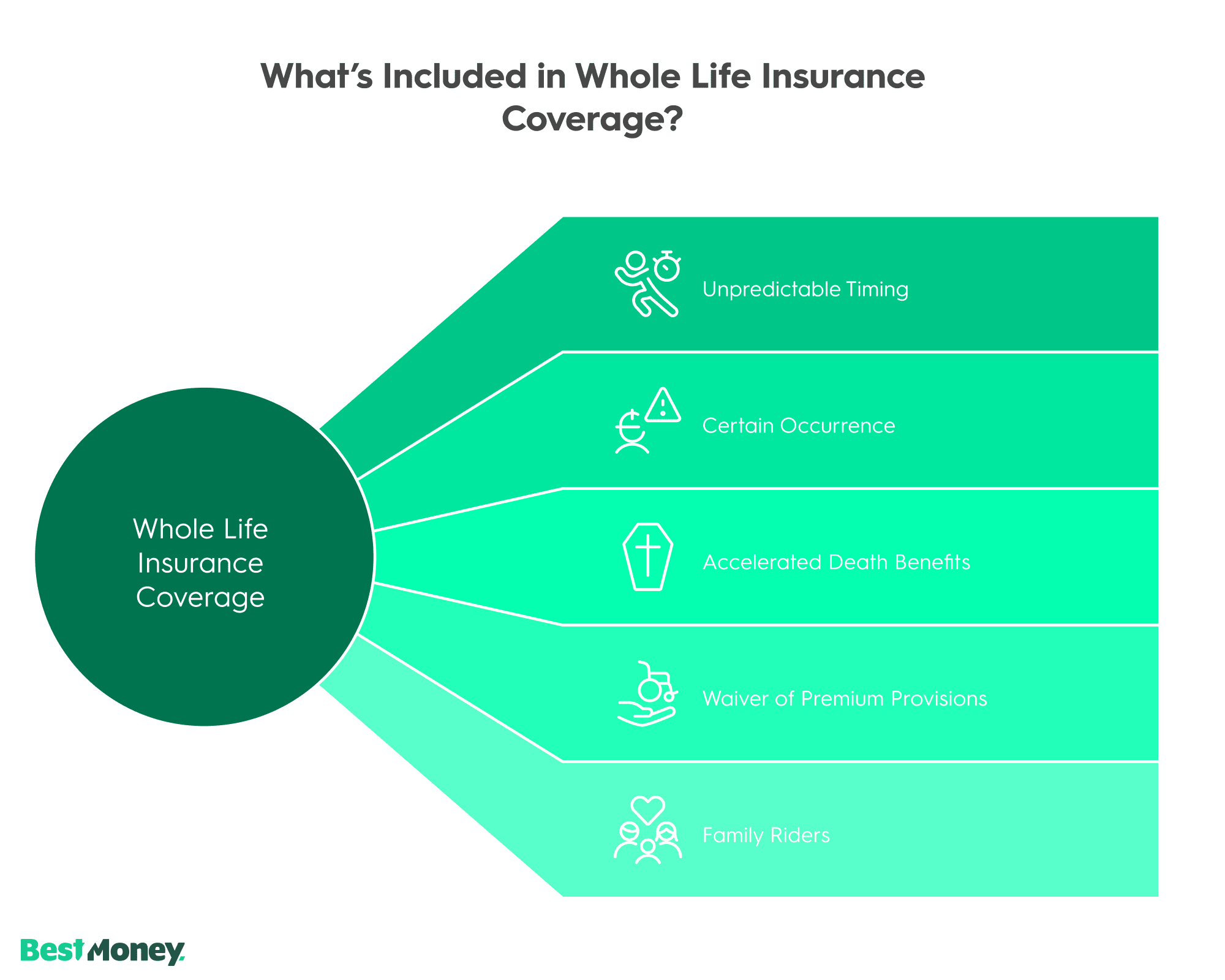
Accelerated Death Benefit and Chronic Illness Riders
Given Florida's demographic profile and the high costs associated with long-term healthcare, chronic and terminal illness riders have become fundamental elements of modern policy design.
An Accelerated Death Benefit Rider allows policyholders diagnosed with a qualifying terminal or chronic illness to access a substantial portion (often up to 75%–80%) of their policy’s death benefit penalty-free while still alive to cover medical costs, nursing care, or specialized home assistance.
Waiver of Premium Rider
The Waiver of Premium Rider protects the policyholder against total physical disability. If the insured individual becomes completely disabled due to injury or illness and cannot work, the insurance company waives all ongoing base premiums for the duration of the disability while maintaining the policy’s full death benefit, cash value schedule, and dividend eligibility.
- Essential Policy Riders
- Paid-Up Additions (PUA)
- Accelerated Cash Value Growth
- Accelerated Death Benefit
- Access Funds For Chronic Illness
- Waiver of Premium (Disability)
- Insurer Pays Premiums If Ill
- Paid-Up Additions (PUA)
Step-by-Step Guide to Purchasing Whole Life Insurance in Miami
Acquiring a whole life insurance contract involves strategic financial modeling, medical evaluation, and local legal review. Follow these sequential steps to establish a policy:
Step 1: Define Financial Goals and Premium Structure
First, determine the objective of the policy:
- Is the priority maximum liquidity and early cash accumulation for business financing?
- Is the priority lifetime wealth transfer, estate tax liquidity, or funding a buy-sell agreement for a Miami business partnership?
Select an appropriate payment duration schedule based on your timeline:
- Straight Life (Pay to Age 100/121): Spreads costs across the policyholder's life for lower annual base payments.
- Limited-Pay Policies (e.g., 10-Pay, 20-Pay, Pay up to Age 65): Premium obligations cease after a designated period, while cash growth and dividend eligibility continue perpetually.
Step 2: Compare Local Brokers vs. Captive Agents
When navigating the South Florida market, policyholders interact with two distinct insurance distribution channels:
- Captive Agents: Represent a single insurance company (e.g., a dedicated Northwestern Mutual or New York Life agent). They possess deep knowledge of their carrier's proprietary products but cannot offer policy quotes from competing insurers.
- Independent Brokers: Licensed with multiple life insurance companies. Independent brokers shop across carriers to find custom underwriting terms, ideal medical risk assessment classes, and tailored policy designs.
Step 3: Complete Medical and Financial Underwriting
Whole life underwriting evaluates both physical health and financial background:
- Medical Examination: Insurers typically deploy a paramedical examiner to the applicant’s Miami residence or workplace to perform basic measurements, record vitals, collect blood and urine samples, and review medical histories.
- Attending Physician Statement (APS): The carrier reviews medical files requested directly from South Florida healthcare providers or hospital systems.
- Financial Underwriting: For high-face-value policies (e.g., $2 million and above), carriers require verification of net worth, income tax filings, or corporate financials to justify the requested death benefit amount.
Step 4: Policy Delivery and Florida's Mandatory Free-Look Period
Once an insurance company issues the policy, the policyholder reviews the physical or digital contract documents. Under Florida Statute § 627.4555, all life insurance policies delivered in the state of Florida carry a mandatory 14-day free-look period.
During this 14-day window starting from policy receipt, the owner has the unconditional legal right to cancel the contract for any reason and receive a full 100% refund of all premiums paid.
Frequently Asked Questions
Are whole life insurance cash values completely safe from creditors under Florida law?
Yes. Under Florida Statute § 222.14, the net cash surrender value of a whole life insurance policy issued on a Florida resident is fully protected from garnishment, attachment, and legal execution by creditors. This statutory protection makes whole life insurance a primary asset protection tool for business owners, executives, and medical professionals across Miami.
How do non-guaranteed dividends impact a whole life policy’s growth?
Dividends represent a return of premium paid when a mutual insurance company's annual financial performance (investment yields, mortality claims, operational expenses) exceeds its baseline projections. While dividends are technically non-guaranteed, top mutual carriers have paid them every year for over a century. Policyholders who reinvest dividends into Paid-Up Additions (PUA) compound both their cash value growth and total death benefit payout over time.
What is the difference between direct recognition and non-direct recognition policy loans?
When you take a policy loan against your cash value, the carrier uses your cash balance as collateral. Under a direct recognition policy, the company adjusts the dividend rate paid on the portion of cash value encumbered by the loan. Under a non-direct recognition policy, the company pays the exact same dividend rate on your entire cash value, regardless of whether a policy loan is outstanding.
Can non-US citizens or foreign nationals living in Miami buy whole life insurance?
Yes. Many major insurance companies operating in Miami write policies for foreign nationals, green card holders, and visa holders (e.g., H-1B, L-1, E-2). However, underwriting requirements are more strict. Insurers usually require a verified U.S. financial connection—such as owning real estate in Florida, maintaining domestic bank accounts, or working for a U.S. company—along with standard tax documentation (ITIN or SSN).
Why are mutual insurance companies preferred over stock insurance companies for whole life insurance?
Stock insurance companies operate primarily to generate returns for external shareholders, which can create competing priorities between investor returns and policyholder performance. Mutual companies are owned exclusively by their policyholders, meaning surplus earnings are redistributed directly back to participating policyholders in the form of dividends rather than paid out to stock market investors.
Next Steps for Securing Coverage in Miami
- Conduct a Financial Needs Analysis: Calculate your required coverage amount by summing outstanding debt, mortgage balances, future income replacement needs, and long-term estate tax liabilities.
- Request Customized Policy Illustrations: Request detailed insurance illustrations showing both guaranteed and non-guaranteed values from top-tier mutual insurance carriers (rated A+ or higher by A.M. Best). Ensure the illustrations clearly break down base premiums versus Paid-Up Additions (PUA) allocations.
- Consult Qualified Professionals: Work alongside a licensed Florida independent life insurance specialist and an estate attorney to verify that ownership structures (such as Irrevocable Life Insurance Trusts, or ILITs) align with your estate planning and creditor protection goals under Florida law.
EDITORIAL CATEGORY METADATA:
Image Gallery