Understanding Near Miss HSE Reporting: A Comprehensive Guide to Workplace Safety Proactivity
Understanding near miss HSE (Health, Safety, and Environment) reporting involves recognizing, documenting, and analyzing unplanned events that did not result in injury, illness, or damage, but had the potential to do so. By capturing t...
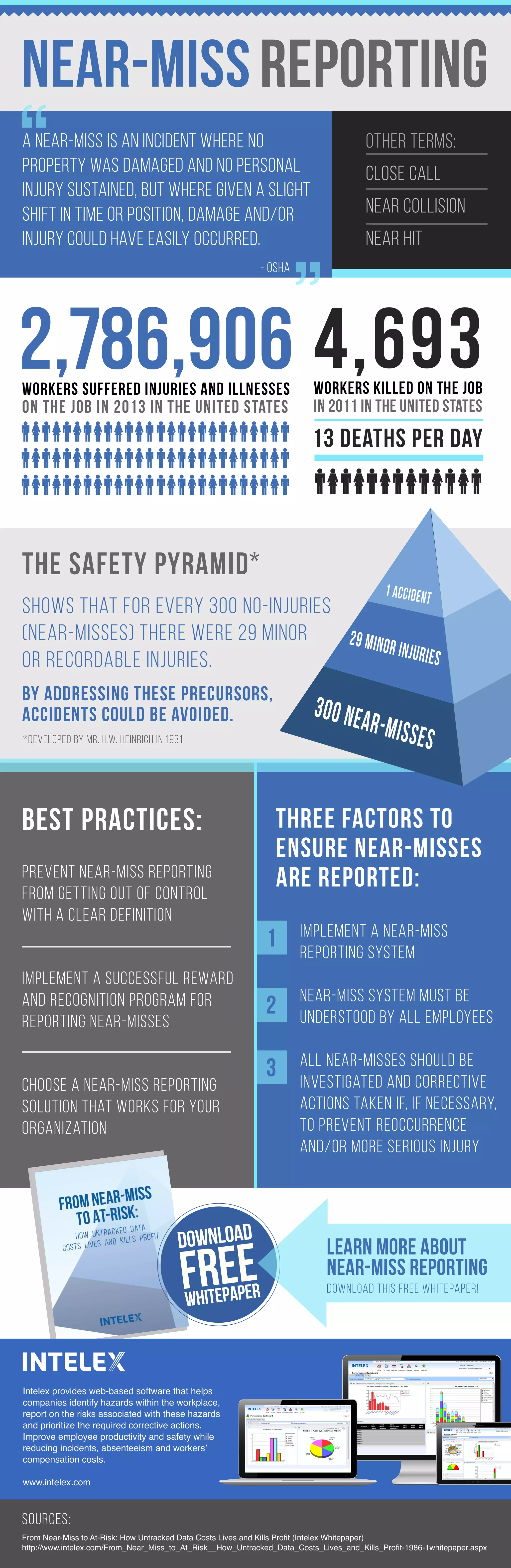
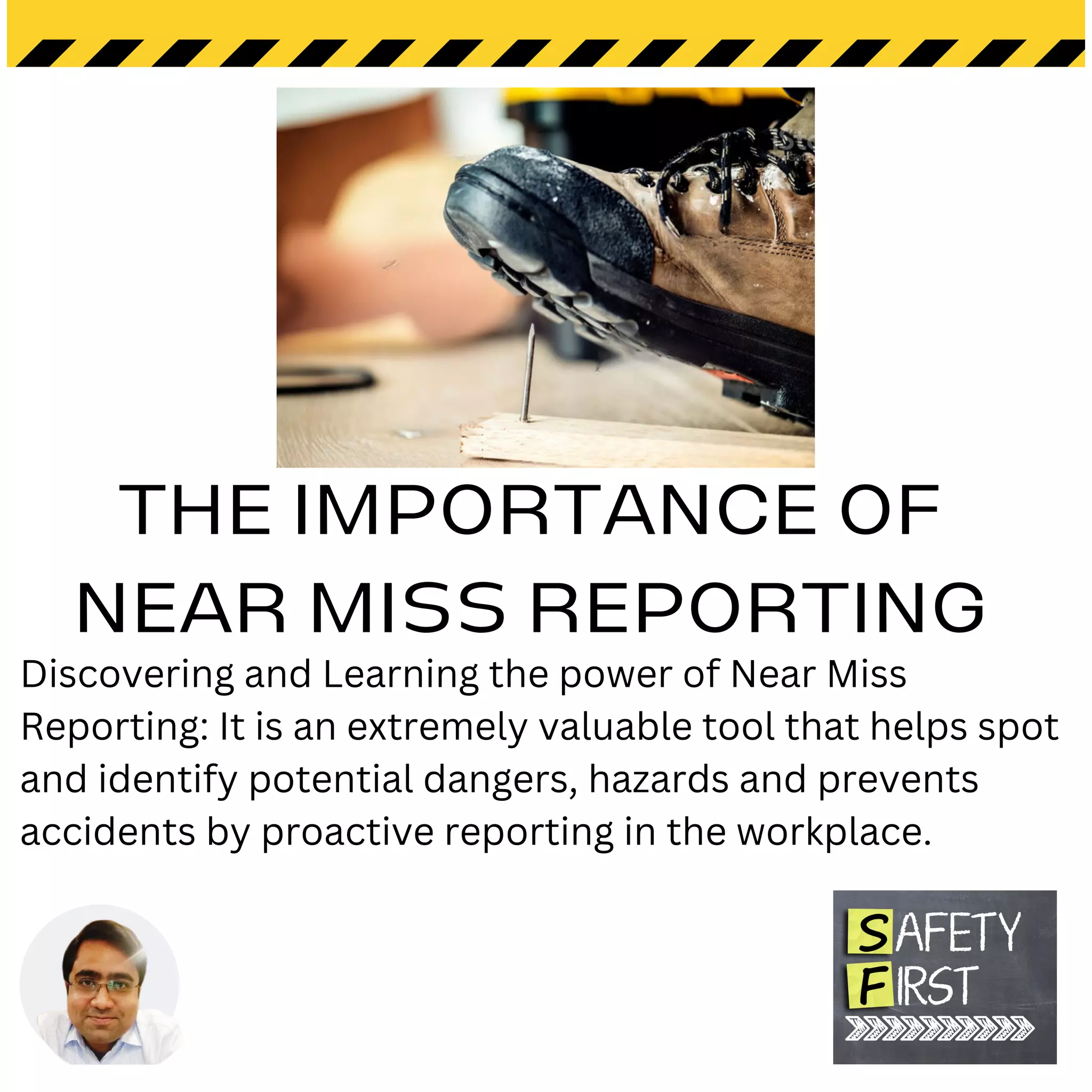
Understanding near miss HSE (Health, Safety, and Environment) reporting involves recognizing, documenting, and analyzing unplanned events that did not result in injury, illness, or damage, but had the potential to do so. By capturing these learning opportunities, organizations can proactively eliminate workplace hazards, prevent future accidents, and foster a robust safety culture before catastrophic incidents occur.
Contents
The Core Concept of Near Miss HSE Reporting
At its core, a near miss is an unplanned event that did not result in human injury, environmental harm, or equipment damage, only because a fortunate chain of events prevented it. In the context of Health, Safety, and Environment (HSE) management, near miss reporting is the systematic process where workers document these close calls. The fundamental philosophy behind this practice is rooted in the Heinrich Triangle or safety pyramid, which theorizes that for every major industrial accident, there are dozens of minor incidents and hundreds of near misses.
Organizations that master near miss reporting shift their operational posture from reactive compliance to proactive hazard elimination. When a worker notices that a scaffolding clamp is loose or that a forklift nearly struck a pedestrian due to a blind corner, recording this observation allows the safety team to intervene. Without this reporting mechanism, management remains blind to latent organizational and environmental vulnerabilities until an actual catastrophe forces an investigation. Consequently, understanding near miss reporting requires looking past the absence of damage and focusing entirely on the presence of operational risk.
Prerequisites and Cultural Foundations for Successful Reporting
Implementing an effective near miss reporting system requires more than just distributing a digital form or installing a drop-box in the breakroom. It demands a specific organizational psychology and clear baseline prerequisites. Without these elements, workers will bypass the reporting system entirely, viewing it as bureaucratic red tape or a tool for managerial surveillance.
- Unsafe Condition / Act
- Near Miss Occurs
- Worker Observes
- (Fear of Blame?) -> Silence / No Report
- (Blame-Free Culture)
- Easy Report
- HSE Analysis
- Corrective Action
- HSE Analysis
- Easy Report
- Worker Observes
- Near Miss Occurs
Establishing a Just and Blame-Free Culture
The single greatest barrier to near miss reporting is the fear of punitive consequences. If employees worry that reporting a near miss will result in reprimands, loss of privileges, or termination, they will conceal mistakes and close calls. A genuine "just culture" balances individual accountability with a recognition that human error is often systemic. When an employee steps forward to report a hazard, management must treat the disclosure as valuable data rather than a behavioral failure.
Clear Definitions and Scope
Workers often fail to report because they do not know what qualifies as a near miss. Training sessions must clearly differentiate between:
- Near Misses: Events where an adverse outcome was narrowly avoided.
- Unsafe Conditions: Physical states in the workplace that deviate from accepted safety standards (e.g., exposed wiring).
- Unsafe Acts: Behavioral departures from standard operating procedures (e.g., failing to wear eye protection).
Accessibility of Reporting Channels
The reporting mechanism must be frictionless. Whether utilizing mobile applications, intranet portals, or standardized paper logs, the process should take less than a few minutes. Complicated workflows with excessive approval gates discourage participation and cause critical safety data to wither away unrecorded.
Step-by-Step Guide to the Near Miss Reporting Process
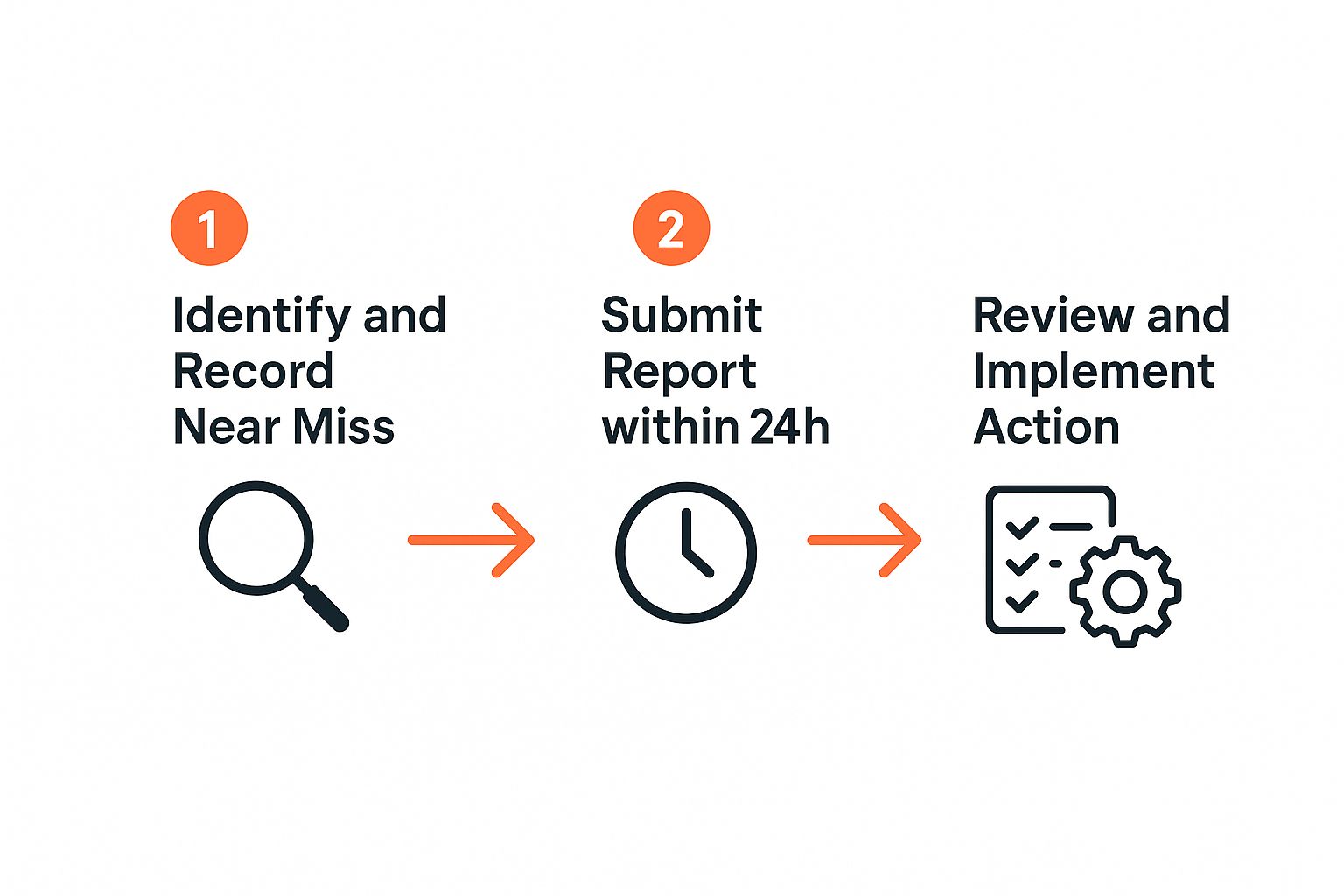
A standardized workflow ensures that every reported incident receives appropriate attention, investigation, and resolution. While organizational procedures vary across industries such as construction, manufacturing, and petrochemicals, the lifecycle of a near miss report generally follows a structured sequence.
- Immediate Hazard Mitigation: If the near miss presents an ongoing danger, the observer or nearby personnel must take immediate steps to isolate the area, stop work, or apply temporary controls (such as warning tape or manual shut-offs), provided it is safe to do so.
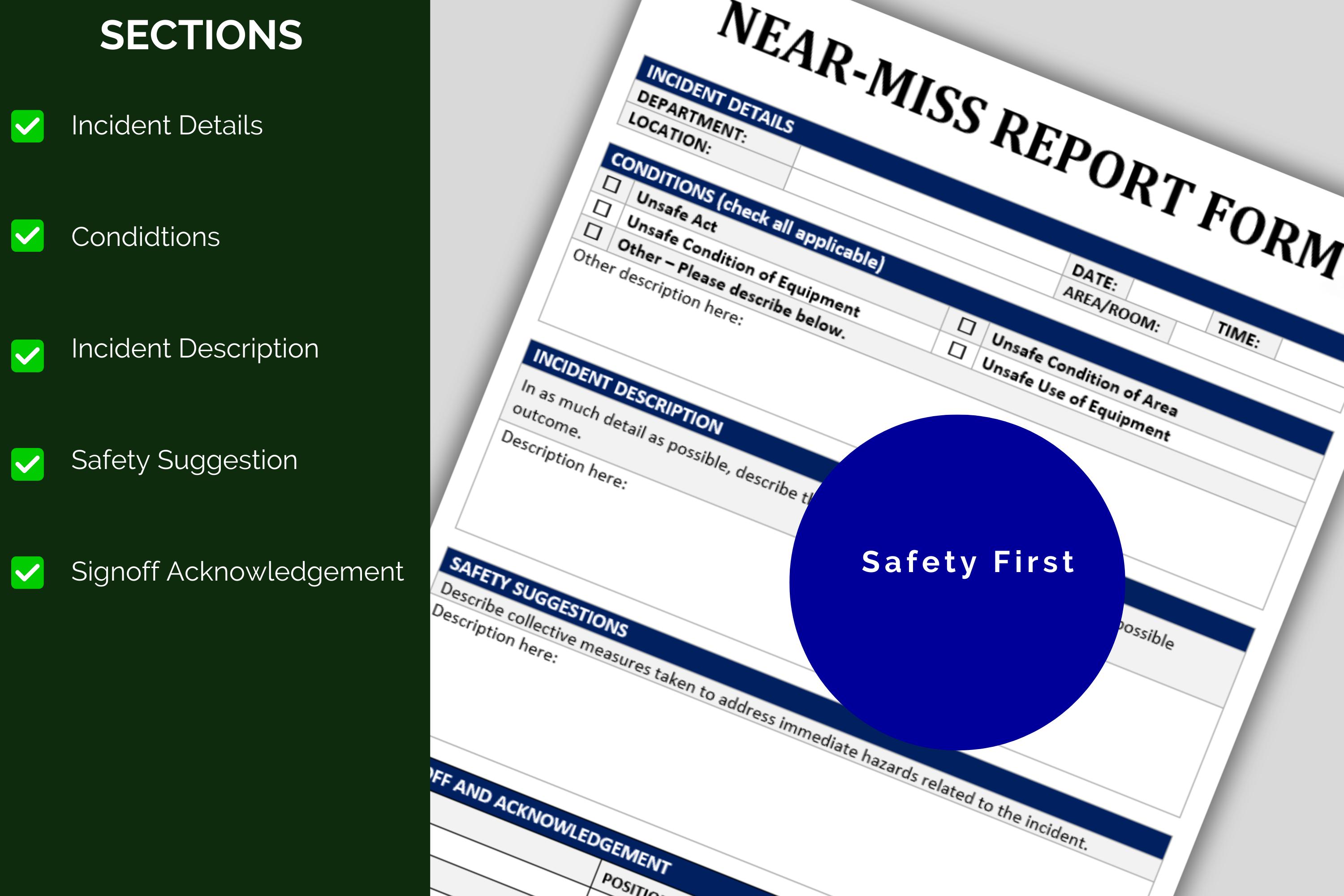
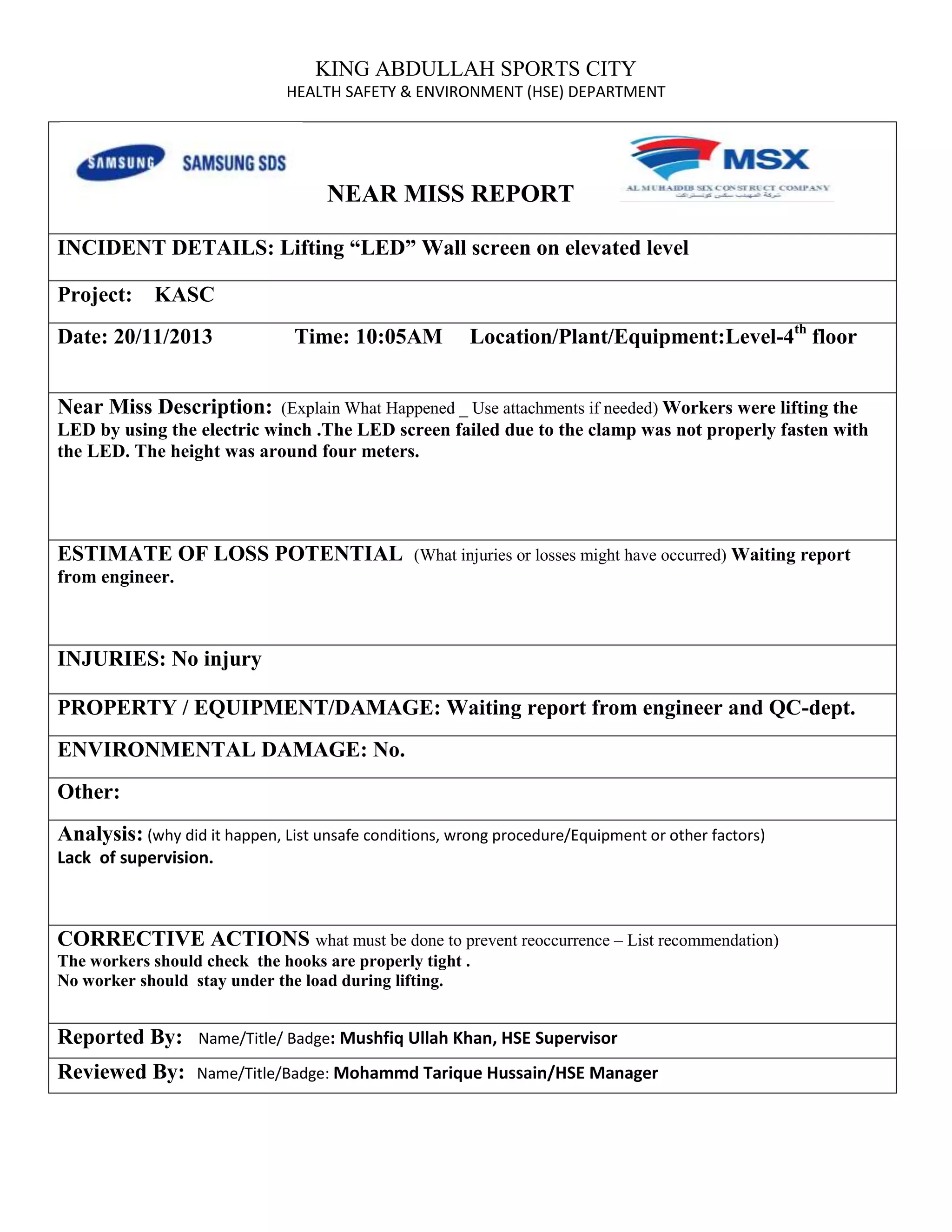
- Initial Documentation: The reporter completes the near miss form, capturing critical data points: date, time, precise location, equipment involved, and a factual description of what happened and what could have happened.
- Triage and Prioritization: The HSE team reviews incoming reports daily. They assign a risk rating based on the severity of the potential outcome and the probability of recurrence, ensuring high-risk items receive immediate investigation resources.
- Root Cause Analysis (RCA): For significant near misses, safety professionals utilize structured methodologies like the "5 Whys" or Fishbone diagrams. The goal is to uncover systemic failures—such as inadequate training, faulty procurement standards, or poor maintenance schedules—rather than blaming an individual.
- Corrective and Preventive Action (CAPA): Management implements engineering controls, administrative updates, or procedural revisions to eliminate the hazard permanently.
- Feedback Loop and Closure: The organization communicates the resolution back to the workforce. Closing the loop is vital; when workers see that their reports lead to tangible safety upgrades, their trust in the program deepens.
Comparative Analysis of Safety Reporting Metrics
To understand how near miss reporting fits into a broader HSE framework, it is helpful to compare it with other safety measurement tools. Organizations often balance lagging indicators with leading indicators to gauge performance accurately.
| Metric Type | Definition | Focus | Advantage | Limitation |
|---|---|---|---|---|
| Lagging Indicator | Measures historical safety data after incidents occur. | Past performance (e.g., Lost Time Injury Frequency Rate). | Objective, federally mandated, and easy to benchmark. | Reactive; provides no warning before a worker gets hurt. |
| Leading Indicator | Measures proactive activities designed to prevent incidents. | Future prevention (e.g., Near miss reports submitted). | Proactive; identifies vulnerabilities before harm occurs. | Difficult to quantify directly against prevented losses. |
| Near Miss Report | Documentation of narrow escapes without loss or injury. | High-risk hazard identification and mitigation. | Captures high-frequency operational insights. | Relies heavily on workforce participation and trust. |
Common Mistakes in Near Miss Programs
Many organizations invest in sophisticated safety software or policy manuals but still struggle with near miss reporting due to common operational pitfalls. Recognizing these traps allows safety leaders to adjust their strategies before participation rates decline.
Treating Reports as Metric Quotas
Some management teams mandate a specific quota of near miss reports per department per month. This practice incentivizes employees to fabricate trivial or low-risk observations just to satisfy metrics. The focus must remain entirely on the quality and significance of hazard identification rather than hitting arbitrary numerical targets.
Failing to Provide Feedback
When workers submit a near miss report and hear nothing back for months, they assume the data disappeared into a black hole. This perceived indifference destroys engagement. Transparency and rapid communication are essential to prove that reporting makes a real difference.
Overcomplicating the Form
If a near miss form requires twenty fields, including complex risk matrices and exhaustive engineering classifications, workers will abandon the task. Streamlining the intake process to capture only essential facts maximizes participation rates across all shifts and skill levels.
Operational Limitations and Professional Boundaries
While near miss HSE reporting is a cornerstone of modern industrial safety, it is not a standalone solution. Understanding its limitations prevents overreliance on a single administrative tool.
- Subjectivity in Risk Perception: What one worker considers a minor annoyance, another might view as a severe near miss. Training helps standardize perceptions, but subjective bias remains.
- Investigation Resource Constraints: In complex facilities, a high volume of near miss reports can overwhelm safety teams, leading to delayed investigations and unaddressed hazards. Prioritization protocols are essential.
- Professional Advice and Regulatory Compliance: Workplace safety standards are governed by strict national and international bodies, such as the Occupational Safety and Health Administration (OSHA) in the United States or the Health and Executive (HSE) in the United Kingdom. Organizations must ensure that internal near miss programs complement, rather than replace, mandatory statutory reporting requirements for actual injuries and environmental releases. Consulting certified safety professionals (such as CSPs or chartered practitioners) ensures that internal policies align with evolving legal frameworks.
Frequently Asked Questions
What is the difference between an incident and a near miss?
An incident results in an actual negative outcome, such as an injury, illness, property damage, or an environmental spill. A near miss shares the exact same operational origin and hazard profile, but the adverse outcome is avoided purely by chance or timely intervention.
Are employees legally required to report near misses?
Legal requirements vary by jurisdiction and industry. While general duty clauses often require workers to report unsafe conditions, many organizations establish internal company policies making near miss reporting a mandatory condition of employment to maintain compliance with safety management systems like ISO 45001.
How do you encourage reluctant workers to report near misses?
Encouragement stems from leadership commitment, visible resolution of reported hazards, and absolute immunity from disciplinary action when errors are reported honestly. Anonymous reporting options can also help bridge the gap during the early stages of cultural transformation.
Who is responsible for investigating a submitted near miss?
Responsibility typically falls on the supervisor of the affected area, working in collaboration with the site HSE officer. For complex technical failures, cross-functional teams including maintenance, engineering, and frontline operators are assembled to conduct root cause analyses.
Can near miss reporting be digitized effectively?
Yes. Digital platforms streamline the reporting process via mobile devices, enable real-time tracking, automate notifications, and provide data analytics dashboards that help safety managers identify recurring trends across different facilities.
Recommended Next Actions for Safety Leaders
To put these principles into practice, organizations should conduct an immediate audit of their current safety reporting workflows. Assess whether reporting channels are accessible to frontline workers, review existing safety cultures for elements of blame, and ensure that feedback loops are established to communicate hazard resolutions clearly. By treating every close call as a free lesson, organizations can protect their workforce and build a resilient, proactive safety ecosystem.
Image Gallery