Understanding the Dark Side of AI: Risks and Responsible Integration
The "dark side" of artificial intelligence refers to the systemic risks, ethical vulnerabilities, and unintended consequences arising from the rapid deployment of machine learning models in public and private infrastructure. While thes...
The "dark side" of artificial intelligence refers to the systemic risks, ethical vulnerabilities, and unintended consequences arising from the rapid deployment of machine learning models in public and private infrastructure. While these systems offer unprecedented efficiency, they also introduce significant challenges regarding data privacy, algorithmic bias, misinformation, and the potential for large-scale job displacement.
Contents
Defining the Scope of AI Vulnerability
Artificial intelligence is not a singular entity but a collection of technologies, including Large Language Models (LLMs), predictive analytics, and computer vision systems. Understanding the "dark side" requires shifting focus from the science fiction trope of sentient machines to the tangible, contemporary issues that affect users and organizations in 2026.
These risks are primarily categorized into technical fragility, socio-economic impact, and ethical degradation. As systems become more integrated into critical decision-making processes—such as loan approvals, medical diagnostics, and legal sentencing—the consequences of an "AI failure" become magnified. A failure is often not a mechanical breakdown, but rather a subtle misalignment between the model’s training data and the complexities of human reality.
Algorithmic Bias and Discrimination
One of the most persistent issues in AI development is the replication and amplification of human bias. Algorithms are trained on historical data, which inherently contains the prejudices and systemic inequalities of the society that produced it.
When an AI system utilizes biased training data to make high-stakes decisions, it acts as a force multiplier for discrimination. For instance, if a recruitment tool is trained on decades of hiring data from a male-dominated industry, it may develop an internal heuristic that penalizes candidates who do not match the historical profile, regardless of their actual qualifications. This creates a "black box" effect, where the reasoning behind a discriminatory decision is obscured by the complexity of the neural network, making it difficult for organizations to perform audits or provide accountability to affected individuals.
The Proliferation of Synthetic Content and Misinformation
The democratization of generative AI has lowered the barrier to creating high-fidelity synthetic media, including text, images, and audio. While this has clear creative advantages, it poses a structural threat to digital trust.
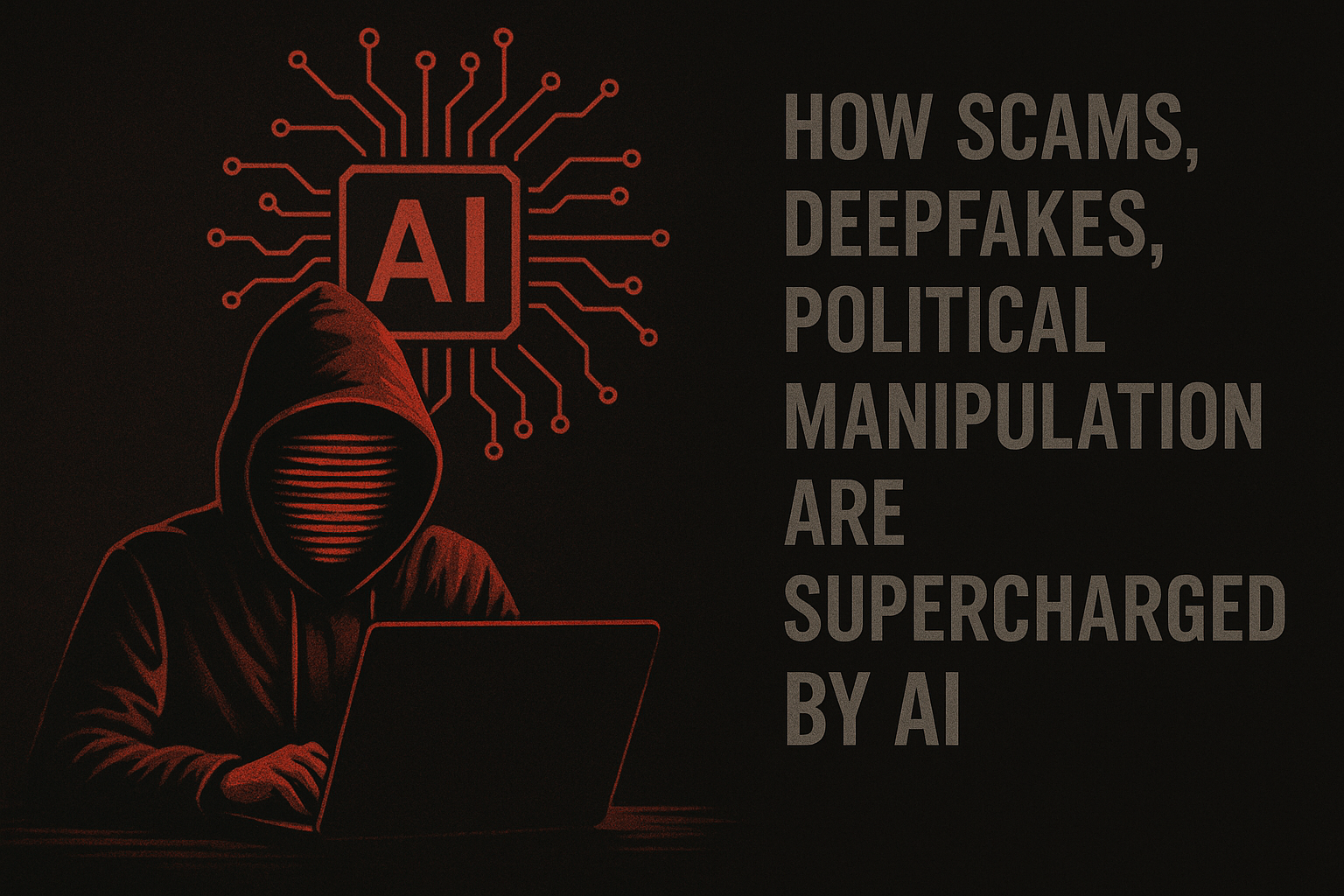
In 2026, the challenge lies in the rapid production of "hallucinated" facts—statements generated by an AI that sound authoritative but are factually incorrect. Furthermore, the rise of deepfakes and automated influence campaigns complicates the verification of information. Organizations and individuals must now implement more robust verification workflows, assuming that any digital artifact could be synthetically altered. The dark side here is the erosion of the shared reality necessary for functional social and commercial discourse.
Data Privacy and Intellectual Property
The training of foundation models often involves scraping massive datasets from the internet. This process has led to significant legal and ethical tension regarding intellectual property rights. Many content creators and businesses have found their proprietary data incorporated into models without consent or compensation.
Moreover, there is the risk of "data leakage." If an employee enters sensitive corporate information into a public-facing AI interface, that data may be ingested by the system and potentially regurgitated in response to a prompt from a different user. Maintaining data sovereignty requires organizations to shift toward private, sandboxed instances of AI models where training data and input queries remain strictly within the corporate firewall.
Comparison of AI Risk Vectors
The following table summarizes the primary categories of risk associated with contemporary AI deployment.
| Risk Category | Primary Manifestation | Impact Level | Mitigation Strategy |
|---|---|---|---|
| Algorithmic Bias | Skewed hiring/lending data | High | Regular audits & diverse datasets |
| Data Privacy | Inadvertent leakage of PII | Extreme | Private, air-gapped instances |
| Synthetic Media | Deepfakes/misinformation | Medium | Cryptographic provenance tags |
| Model Hallucination | Factually incorrect outputs | High | Human-in-the-loop (HITL) review |
| Cybersecurity | AI-automated phishing | Medium | Behavioral anomaly detection |
The Socio-Economic Cost: Displacement and Dependence
The economic dimension of the dark side of AI involves the disruption of labor markets. Unlike previous waves of automation that primarily affected manual labor, current AI advancements target cognitive tasks. This creates a risk of structural unemployment for knowledge workers.
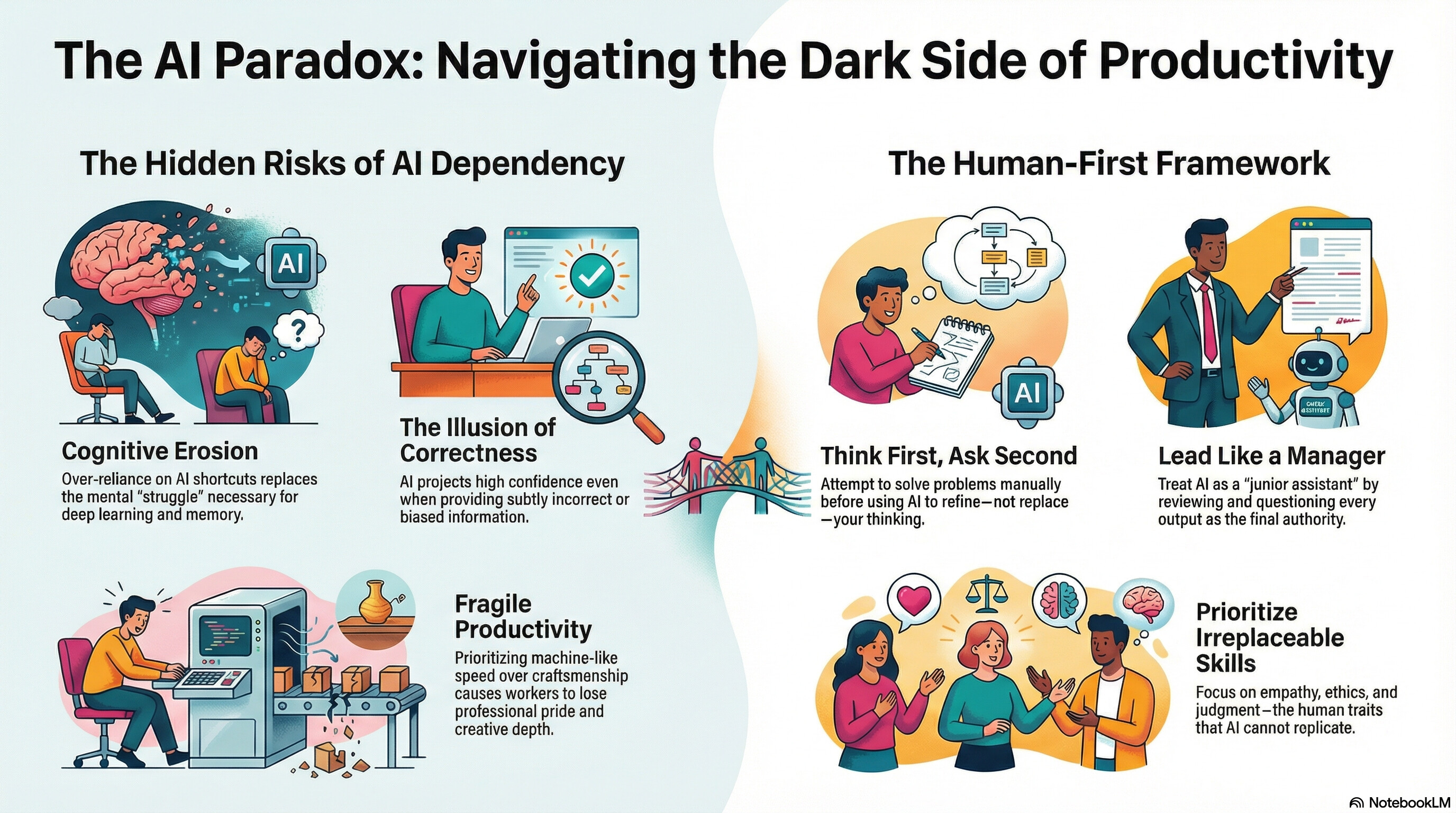
Additionally, there is the risk of "cognitive atrophy." As users increasingly rely on AI to draft communications, solve problems, and make decisions, there is a legitimate concern regarding the loss of essential human critical thinking skills. Over-dependence on AI-generated summaries may lead to a superficial understanding of complex topics, as the nuance inherent in the primary sources is often lost during the summarization process.
Strategies for Responsible AI Adoption
Navigating the dark side of AI does not require a total rejection of the technology. Instead, it necessitates a framework of "defensive implementation."
- Establish Human-in-the-loop (HITL) Systems: Never allow an AI to execute a high-stakes decision without human intervention. The human must act as the ultimate validator of the output.
- Conduct Algorithmic Audits: Use independent, third-party organizations to review models for bias and compliance with regulatory standards.
- Implement Data Governance: Classify data assets and ensure that sensitive information is never accessible to public, non-private AI training pipelines.
- Prioritize Transparency: If an AI influences a significant outcome, the user should be informed that they are interacting with an automated system and, where possible, provided with the reasoning behind the output.
Frequently Asked Questions
Can AI developers completely eliminate bias from their models?
No. Because bias is a property of the data used to train the model, it can never be entirely eradicated. However, developers can mitigate its effects by curating more diverse datasets and implementing "de-biasing" algorithms during the training phase.
How do I know if the information provided by an AI is a hallucination?
Verification is essential. Always check AI-provided facts against primary, authoritative sources. If an AI provides a citation, verify that the source exists and that it supports the claim being made.
Is it safe to use generative AI for internal corporate strategy?
Only if you are using an enterprise-grade, private instance where your input data is not used to train the global model. Standard public-facing tools are generally not secure for sensitive internal information.
What is the most significant threat posed by AI in 2026?
The most significant threat is the rapid degradation of trust in information integrity. The combination of synthetic media and authoritative-sounding misinformation makes it increasingly difficult for users to distinguish fact from fabrication.
Will AI definitely replace human jobs?
AI will likely change the nature of many jobs rather than eliminating them entirely. Roles that involve repetitive, rule-based cognitive tasks are at the highest risk, while roles requiring human empathy, complex ethical judgment, and physical dexterity remain more resilient.
Next Steps for Organizations
To safely leverage AI, organizations should conduct a "Risk Exposure Assessment." Map out where AI is currently used within your operations, identify where it handles sensitive data, and assess the potential impact of a system error. Develop a clear AI usage policy for employees that mandates the review of all AI-generated output for accuracy and bias. By treating AI as a tool that requires constant supervision rather than an autonomous oracle, you can mitigate the dark side while harvesting the benefits of the technology.
Image Gallery