How to Use the Prismatic Evolutions Checklist for Your Pokémon TCG Collection
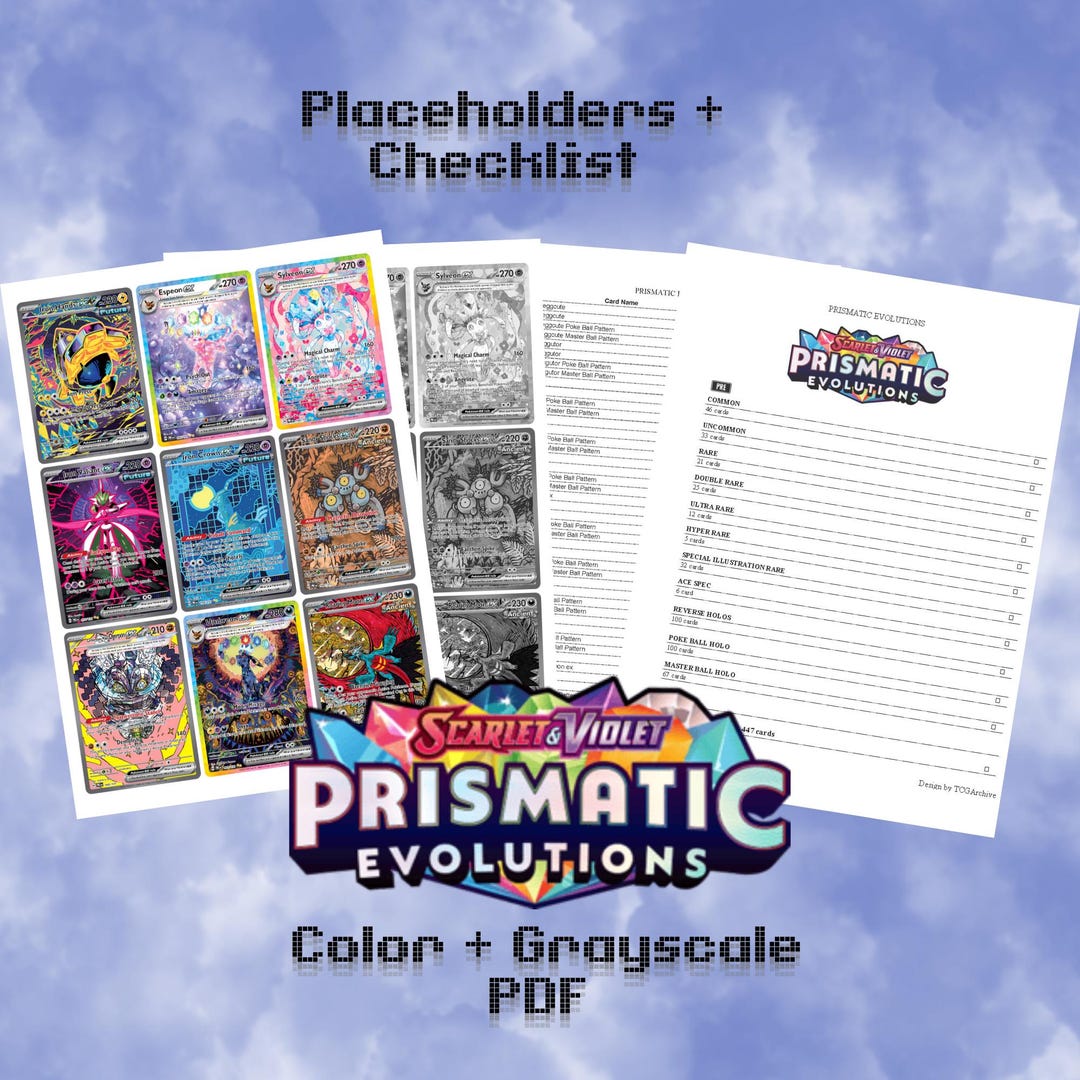
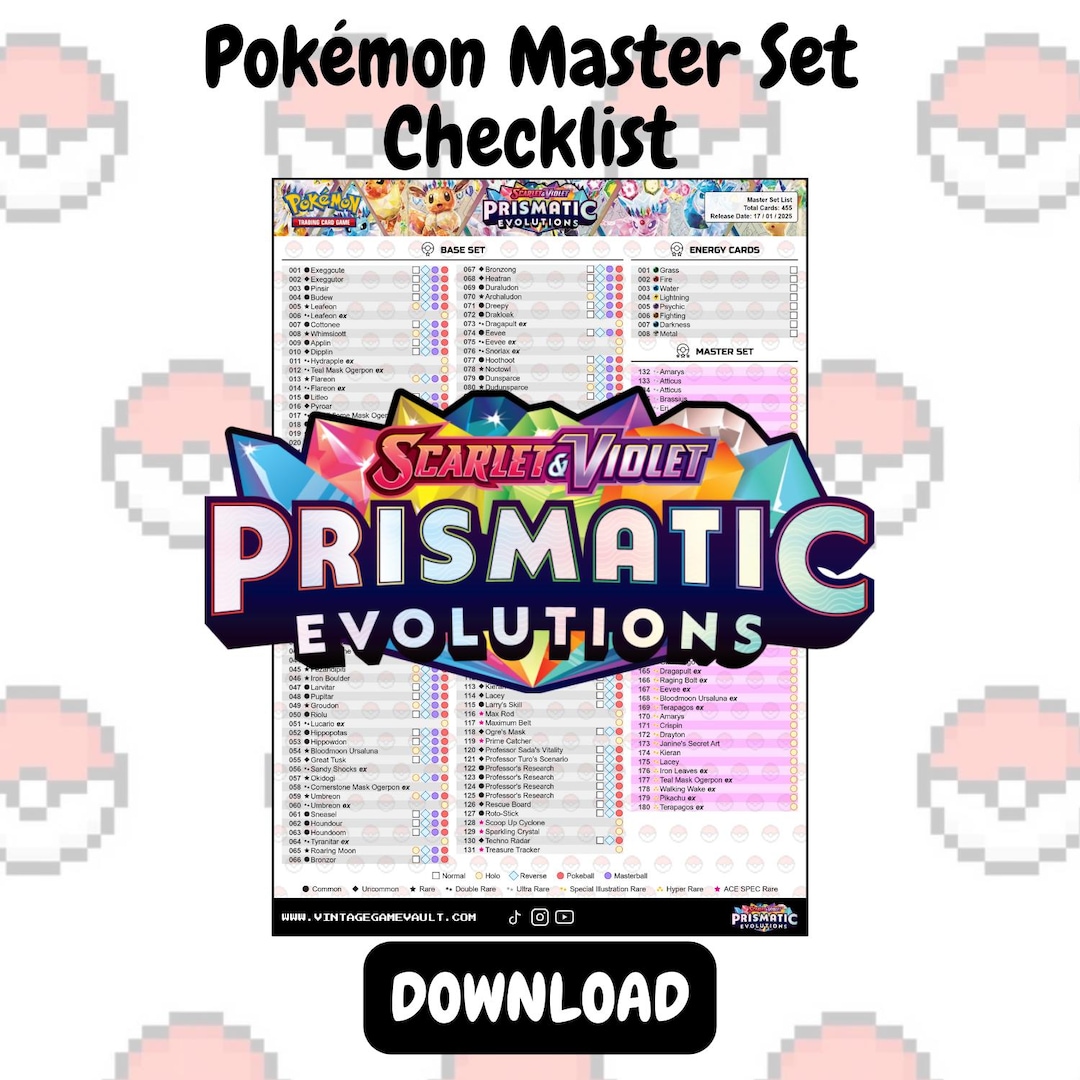
To use the Prismatic Evolutions checklist effectively, identify every card variant in the set, including standard prints, reverse holos, and secret rares. Begin by sorting your collection by set number, then mark off acquired cards on...
To use the Prismatic Evolutions checklist effectively, identify every card variant in the set, including standard prints, reverse holos, and secret rares. Begin by sorting your collection by set number, then mark off acquired cards on a digital or physical tracker to identify gaps for your Master Set or completion goals.
Contents
The release of the Prismatic Evolutions set in early 2025 marked a significant milestone for the Pokémon Trading Card Game (TCG) Scarlet & Violet era. Centered on the fan-favorite Eevee and its eight "Eeveelutions," this special expansion (often designated as SV8.5) introduced a massive array of high-rarity cards, including Special Illustration Rares (SIRs) and textured foils. As we move through 2026, the set remains a primary focus for collectors due to its long-term value and the aesthetic appeal of the "Prismatic" foil patterns.
Using a checklist is not merely about ticking boxes; it is a strategic approach to inventory management, budget allocation, and preservation. Whether you are a "Master Set" hunter or a casual fan of Umbreon and Sylveon, understanding the nuances of the Prismatic Evolutions checklist is essential for an organized hobby experience.
Understanding the Structure of the Prismatic Evolutions Set
Before diving into the checklist, you must understand how the set is organized. Prismatic Evolutions is a "special set," meaning packs are not sold in individual booster boxes but are instead found in Elite Trainer Boxes (ETBs), collection posters, and tech stickers. This distribution method often makes completing a checklist more challenging than standard expansions.
The set features a "main" list of cards, typically numbered up to approximately 175, followed by a substantial "Secret Rare" section. This section includes:
- Illustration Rares (IR): Full-art cards featuring unique artistic styles.
- Ultra Rares (Full Art): Textured cards often featuring Pokémon ex or Supporters.
- Special Illustration Rares (SIR): The "chase" cards of the set, featuring intricate backgrounds and high market value.
- Hyper Rares (Gold): Cards with a distinct gold border and etched texture.
A comprehensive checklist must account for both the numerical sequence and the "Parallel Holo" (commonly known as Reverse Holo) versions of every Common, Uncommon, and Rare card. In Prismatic Evolutions, the reverse holo pattern often features a unique prismatic sheen that distinguishes it from previous Scarlet & Violet sets.
Step-by-Step Guide to Implementing Your Checklist
1. Choose Your Checklist Format
There are three primary ways to track your Prismatic Evolutions progress. Each has distinct advantages depending on your technical preference:
- Physical Paper Checklists: Often found in the Player’s Guide included with the Prismatic Evolutions Elite Trainer Box. These are tactile and do not require a device, but they are difficult to update if you have multiple copies or want to track card condition.
- Digital Spreadsheets (Excel/Google Sheets): Ideal for power users. You can create columns for "Quantity," "Condition" (e.g., PSA 10, Near Mint), and "Acquisition Cost." This is the best method for those viewing their collection as a financial investment in 2026.
- Mobile Apps and Database Sites: Platforms like TCGCollector or PriceCharting provide pre-built Prismatic Evolutions lists. These often sync with live market data, allowing you to see the "real-time" value of your collection as you check off cards.
2. Initial Sorting and Cataloging
Empty your storage tins or binders and sort your Prismatic Evolutions cards by the number found in the bottom-left corner (e.g., 005/175). Once sorted numerically, separate the "Standard" prints from the "Reverse Holo" prints.
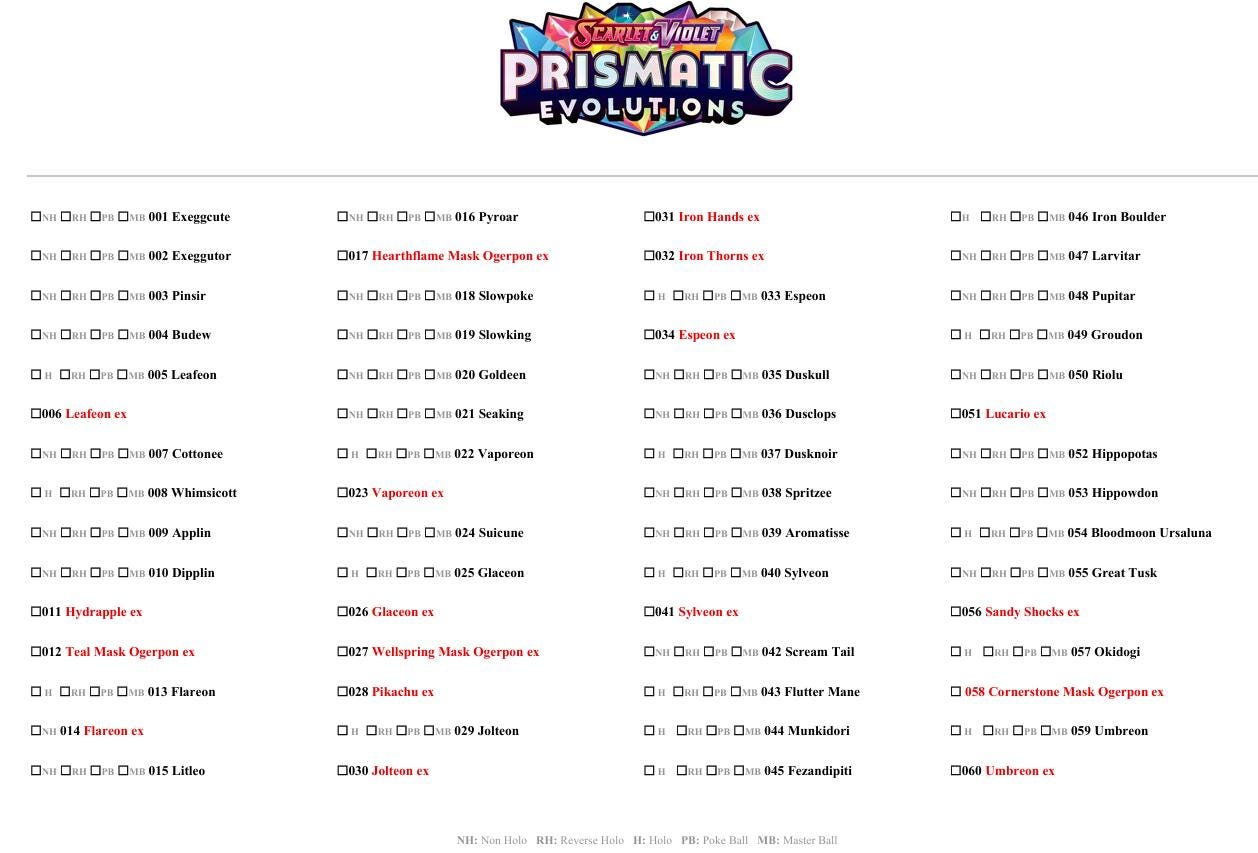
When using the checklist, ensure you have two distinct columns for the base set: one for the non-holo/standard holo version and one for the reverse holo variant. A common mistake is marking a card as "collected" when you only have the reverse holo version, leaving a gap in your "Master Set" progress.
3. Identifying Rarity Tiers
The Prismatic Evolutions set is famous for its "Special Illustration Rare" Eeveelutions. Your checklist should clearly categorize these to help you prioritize your "chase" list. Use the rarity symbols located at the bottom of the card:
| Rarity Symbol | Rarity Name | Tracking Priority |
|---|---|---|
| Single Black Circle | Common | High Volume / Low Cost |
| Single Black Diamond | Uncommon | High Volume / Low Cost |
| Single Gold Star | Rare (Holo) | Standard Completion |
| Double Silver Star | Ultra Rare (ex) | Mid-Tier Collection |
| Single Gold Sparkle | Illustration Rare | High Aesthetic Value |
| Double Gold Sparkle | Special Illustration Rare | "Chase" Cards (High Value) |
| Triple Gold Sparkle | Hyper Rare (Gold) | Completionist Final Tier |
Strategies for Master Set Completion
In the context of 2026 Pokémon TCG collecting, a "Master Set" of Prismatic Evolutions typically includes one of every card listed in the expansion, including every reverse holo variant and every secret rare.
The Reverse Holo Hurdle
The most tedious part of using a checklist is the reverse holo section. Because every common and uncommon card has a reverse holo version, the total number of unique cards to collect effectively doubles for the first 150+ cards. When using your checklist, focus on completing the "Common/Uncommon" reverse holos early. These are often inexpensive to trade for or buy as singles, but they become harder to find in mint condition as the set ages.
Tracking the "Eeveelution" Subset
Since Prismatic Evolutions focuses heavily on Eevee, Jolteon, Flareon, Vaporeon, Espeon, Umbreon, Leafeon, Glaceon, and Sylveon, many collectors use a "subset checklist." This involves tracking every card featuring these specific characters across all rarities. If you are a character-specific collector, your checklist should be reorganized by Pokémon name rather than set number to visualize the "evolution lines" in your binder.
Condition and Grading Notes
By 2026, the secondary market for Prismatic Evolutions has matured. If you intend to have cards graded by services like PSA or BGS, your checklist should include a "Grading Status" column. This allows you to track which cards are currently at the grader, which are "Raw Mint," and which have returned with a specific grade. This is vital for the SIRs (Special Illustration Rares), where the price difference between a PSA 9 and a PSA 10 can be hundreds of dollars.
Common Pitfalls When Using a Checklist
One of the most frequent errors is confusing the Prismatic Evolutions cards with other Scarlet & Violet sets. Always verify the set symbol—a specific prismatic icon—located in the bottom left or right corner of the card.
Another issue is the "Promo Card" confusion. Many Eeveelution cards are released as "Black Star Promos" inside Prismatic Evolutions products (like the cards visible in the front of an ETB or blister pack). While these are part of the Prismatic Evolutions "lineup," they are not technically part of the numbered 175+ set list. They have their own numbering (e.g., SVP 090). A professional-grade checklist will have a separate section for these "Related Promos" to ensure a truly comprehensive collection.
Managing the "Chase" with Live Data
As we look at the market in 2026, the prices for the Umbreon ex and Sylveon ex Special Illustration Rares remain volatile. When using your checklist, it is helpful to note the "Current Market Value" next to your missing cards. This helps you decide when to "strike" and buy a single card. If the checklist shows you are only missing three high-value SIRs, it is statistically more cost-effective to buy the singles rather than continuing to purchase sealed products like Elite Trainer Boxes.
Frequently Asked Questions
What constitutes a "Master Set" on a Prismatic Evolutions checklist?
A Master Set generally includes one of every standard card, one of every reverse holo variant, every Illustration Rare, Ultra Rare, Special Illustration Rare, and Hyper Rare. It also frequently includes the official promotional cards released specifically within Prismatic Evolutions branded packaging.
Does the checklist include the "Prismatic" Energy cards?
Yes. Prismatic Evolutions often includes basic Energy cards with a special foil treatment. While not numbered as part of the main 175-card set, they are considered essential by completionists and should be included in a dedicated "Energy" section of your checklist.
How do I distinguish between a Standard Holo and a Reverse Holo on the list?
In the Scarlet & Violet era, Rare cards (Single Gold Star) are always holographic in the artwork window. The "Reverse Holo" version features the holographic pattern on the entire card face except for the artwork window. Your checklist should have two separate check-boxes for every card that qualifies for a reverse holo.
Is it better to use a digital or physical checklist in 2026?
Digital checklists are superior for 2026 collectors because they allow for instant price updates and cloud syncing. However, many collectors enjoy the tradition of a physical "Checklist Book" for its archival feel and the ability to keep it inside the collection binder itself.
Where can I find the official card numbers for the Secret Rares?
The official numbers for Secret Rares (cards numbered beyond the base set, such as 180/175) are typically revealed by the community shortly after launch and are now fully documented in 2026. You can find these on official Pokémon TCG database sites or in the back of the Prismatic Evolutions Player's Guide.
Recommendation for Next Actions
To get started, download a reputable digital checklist or print a comprehensive spreadsheet that includes columns for both "Standard" and "Reverse Holo" variants. Begin by cataloging your current "Double Rare" (ex) cards and Illustration Rares, as these represent the core value of the set. Once your high-value cards are secured and sleeved, move to the systematic organization of the common and uncommon reverse holos to fill the remaining gaps in your Prismatic Evolutions binder.
Image Gallery