Navigating the Role of the Local Federal Credit Union in Context
A local federal credit union serves as a member-owned, not-for-profit financial cooperative that provides essential banking services while operating under the regulatory oversight of the National Credit Union Administration (NCUA). By...
A local federal credit union serves as a member-owned, not-for-profit financial cooperative that provides essential banking services while operating under the regulatory oversight of the National Credit Union Administration (NCUA). By prioritizing member equity over shareholder dividends, these institutions offer a distinct financial model focused on community investment, lower interest rates on loans, and higher yields on savings for individuals within a defined field of membership.
Contents
Understanding the Credit Union Structure
To understand a local federal credit union in context, one must first recognize the fundamental difference between a credit union and a commercial bank. Banks are typically for-profit entities owned by shareholders who expect a return on their investment. In contrast, a credit union is a cooperative; when you deposit money into a local federal credit union, you are not merely a customer but a member-owner. This ownership model dictates the organization's purpose: to serve the financial needs of its members rather than to maximize corporate profits.
Federal credit unions (FCUs) are chartered under the Federal Credit Union Act, which mandates they operate as non-profit cooperatives. Because they do not pay federal income taxes, they are theoretically positioned to pass those savings back to members in the form of lower fees, reduced interest rates on loans, and more competitive interest rates on deposit accounts.
Defining the Field of Membership
The most defining characteristic of a local federal credit union is its "field of membership." Unlike national retail banks that generally accept any customer, an FCU is restricted to a specific group of people. This group is defined by the credit union's charter and can be based on several factors, including:
- Geographic location: Residents living within a specific city, county, or district.
- Employment: Employees of a specific company, industry, or professional group.
- Organizational affiliation: Members of a specific church, school, labor union, or professional association.
Understanding your eligibility within this context is the first step toward access. If you reside in a community with a geographically chartered federal credit union, your primary residence often serves as your qualification for membership.
Regulatory Oversight and Deposit Security
A common point of confusion for new members involves the safety of their funds. In the context of the American financial system, federal credit unions provide security comparable to the Federal Deposit Insurance Corporation (FDIC) coverage at banks. The National Credit Union Share Insurance Fund (NCUSIF), administered by the NCUA, is backed by the full faith and credit of the United States government.
As of 2026, the standard share insurance amount is $250,000 per share owner, per insured credit union, for each account ownership category. This protection covers savings, checking, share draft, and money market accounts. Members should verify that their specific institution is "Federally Insured by NCUA," a status that should be clearly displayed at physical branch locations and on the institution’s official website.
Comparative Financial Advantages
When evaluating a local federal credit union against traditional commercial banks, members often find differences in cost and service philosophy. Because credit unions operate as cooperatives, their management is governed by a volunteer board of directors elected by the members. This structure often leads to a more member-centric approach to service and loan approvals.
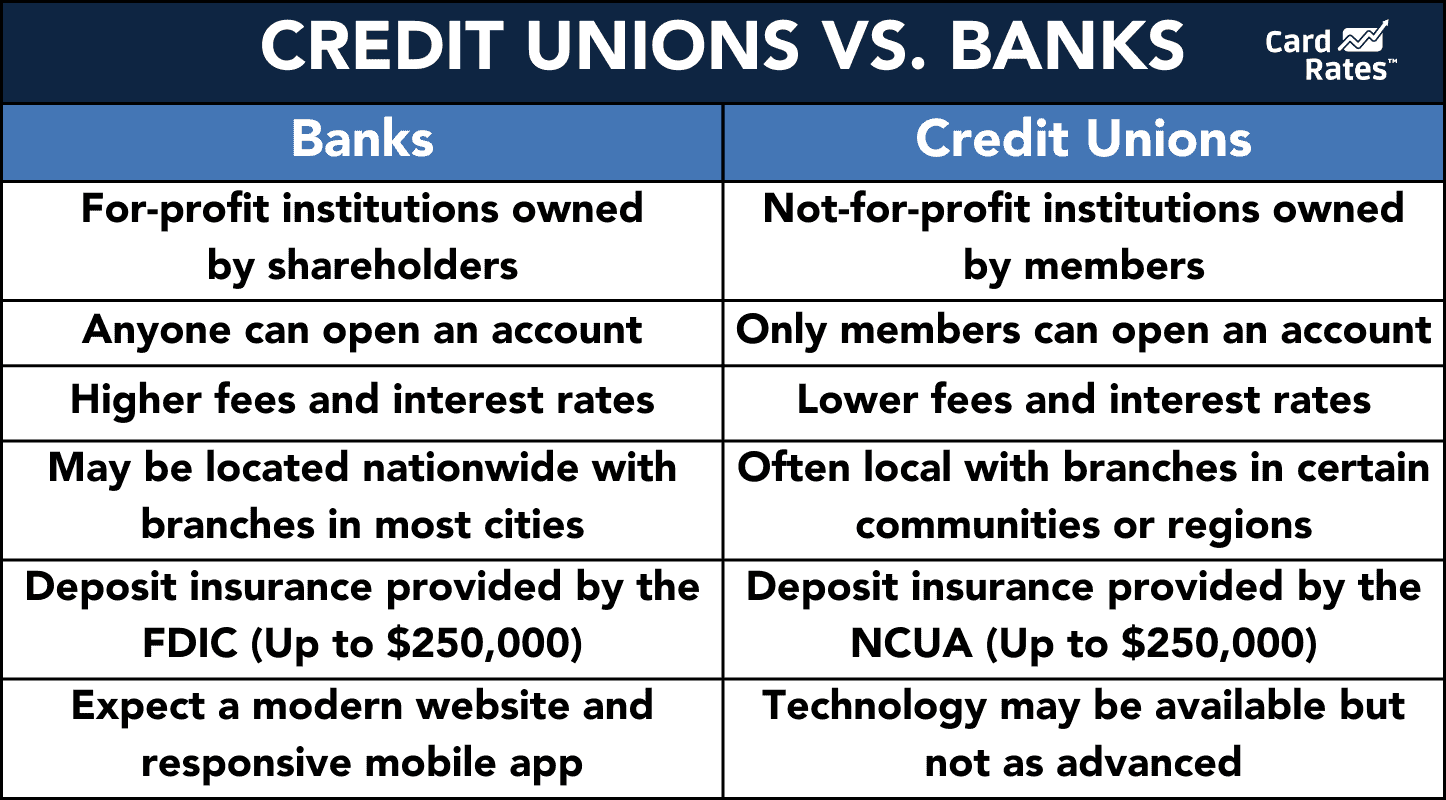
The following table summarizes key distinctions in the operational context of these institutions:
| Feature | Federal Credit Union | Traditional Commercial Bank |
|---|---|---|
| Ownership | Member-owned cooperative | Shareholder-owned corporation |
| Governance | Volunteer board elected by members | Board appointed by shareholders |
| Tax Status | Tax-exempt (non-profit) | Taxable entity (for-profit) |
| Primary Goal | Member value and community support | Profit maximization and dividends |
| Eligibility | Must meet "field of membership" criteria | Open to the general public |
| Insurance | NCUA (federal government) | FDIC (federal government) |
Service Limitations and Operational Scope
While credit unions offer distinct advantages, they operate under specific operational constraints. Historically, credit unions were smaller in scale than massive, multi-national banks. While many have expanded their reach through shared branching networks—allowing members to perform transactions at thousands of other participating credit union locations—they may not always match the massive ATM networks or cutting-edge global investment platforms provided by the largest "too-big-to-fail" banks.
Additionally, credit unions often have smaller marketing budgets and may rely on localized technology stacks. While most modern credit unions in 2026 offer robust mobile banking applications, real-time wire transfers, and digital bill pay, the breadth of advanced financial products—such as complex international derivatives or corporate high-frequency trading tools—is usually absent. For the average retail consumer, however, the essential services (mortgages, auto loans, credit cards, and savings) are fully realized and often provided at a lower cost to the borrower.
Steps to Joining a Local Federal Credit Union
The process of joining is relatively standardized, though it requires specific documentation to verify eligibility.
- Verify Eligibility: Check the credit union’s website or contact a branch representative to confirm you meet the criteria for their specific field of membership.
- Gather Documentation: You will need a government-issued photo ID (driver’s license or passport), your Social Security number, and proof of address. If your eligibility is based on employment, you may need a pay stub or a letter from your employer.
- The "Share" Deposit: Upon opening your account, you will typically be required to deposit a small amount (often $5 to $25) into a "share account." This deposit represents your "share" of the ownership in the credit union.
- Application Processing: Once the deposit is made and your identity is verified, you become a voting member of the cooperative.
Frequently Asked Questions
Are credit unions safe for large deposits? Yes. Deposits are insured up to $250,000 per member per ownership category by the NCUA. If your deposits exceed this amount, you can structure your accounts—such as opening joint accounts or designating beneficiaries—to maximize your coverage, similar to how one manages FDIC coverage at a bank.
Do I lose my membership if I move away? Generally, no. The policy of "once a member, always a member" applies to most credit unions. If you move out of the geographic area that originally qualified you for membership, you typically retain your rights and access to the credit union’s services.
Are loans at credit unions easier to get? Credit unions are often more willing to look at the individual context of a borrower rather than relying solely on automated credit scoring algorithms. While they still require sound financial practices, they may offer more flexible underwriting for auto loans or personal loans for members with established relationships.
Do credit unions have ATMs? Yes. Most credit unions participate in shared ATM networks, allowing members to use ATMs at other participating credit unions or surcharge-free networks (such as CO-OP Financial Services) without paying transaction fees.
Why does the credit union ask for a "share" deposit? The initial deposit is not just a fee; it is your capital contribution that makes you a co-owner of the institution. This small deposit ensures the cooperative remains adequately capitalized.
Next Steps for Prospective Members
If you are considering moving your banking to a local federal credit union, start by utilizing the official NCUA "Credit Union Locator" tool on the agency’s website. Identify institutions with branches in your immediate vicinity. Visit the website of a potential credit union and review their fee schedule, specifically looking for common costs like monthly maintenance, overdraft fees, and wire transfer charges. Comparing these against your current banking costs will reveal the immediate value of switching. Once a suitable candidate is identified, schedule a visit to speak with a member services representative to confirm your eligibility and discuss how their specific financial products can meet your 2026 budgetary goals.
Image Gallery