LVN Salary Hourly: Comprehensive 2026 Guide to Earnings and Trends
In 2026, the average LVN salary hourly rate in the United States typically ranges between $31.50 and $43.25, with a national median of approximately $36.80. Compensation varies significantly based on geographic location—particularly in...
In 2026, the average LVN salary hourly rate in the United States typically ranges between $31.50 and $43.25, with a national median of approximately $36.80. Compensation varies significantly based on geographic location—particularly in California and Texas—as well as clinical setting, years of experience, and specialized certifications like IV therapy or gerontology.
Contents
Licensed Vocational Nurses (LVNs) remain a cornerstone of the American healthcare infrastructure. As the "silver tsunami" of the aging population reaches its peak in 2026, the demand for nursing professionals in long-term care, home health, and outpatient clinics has driven hourly wages to historic highs. While the term "LVN" is specifically used in California and Texas, it is functionally equivalent to the Licensed Practical Nurse (LPN) designation used in the rest of the country. Understanding the nuances of hourly pay is essential for both prospective students and seasoned professionals looking to maximize their earning potential in a competitive labor market.
National Hourly Wage Landscape for LVNs in 2026
The transition into 2026 has seen a continued upward trajectory for vocational nursing wages. This is largely driven by persistent labor shortages and legislative mandates in several states regarding minimum staffing ratios. The hourly rate for an LVN is no longer just a flat fee; it is a complex calculation involving base pay, shift differentials, and "crisis rates" in specific high-demand regions.
Entry-level LVNs can expect to start near the lower end of the spectrum, often around $28.00 to $30.00 per hour, depending on the state's cost of living. However, those with five or more years of experience frequently command rates exceeding $40.00 per hour. In high-cost urban centers, particularly in the San Francisco Bay Area or the Greater Los Angeles region, senior LVNs often see hourly rates climbing toward $50.00 when working in specialized acute care or surgical settings.
The Impact of Cost of Living and Regional Demand
Regional economic health plays a massive role in determining an LVN's hourly take-home pay. While a $35 hourly wage provides a comfortable lifestyle in parts of rural Texas, that same rate may struggle to cover basic housing costs in San Diego or Austin. Consequently, employers in high-cost areas have increasingly integrated "cost-of-living adjustments" (COLA) into their base hourly scales to remain competitive against traveling nurse agencies.
Geographic Variations: California vs. Texas
Because the title "LVN" is legally specific to California and Texas, these two states represent the bulk of the data for this specific keyword. Both states have high demands for nurses but offer very different economic profiles.
California: The Highest Hourly Rates
California consistently ranks as the highest-paying state for LVNs. As of 2026, California nursing unions and private healthcare systems have negotiated aggressive pay scales to combat the exodus of healthcare workers to lower-cost states.
- Northern California: Cities like Sacramento, San Jose, and San Francisco offer the highest hourly rates, often starting at $42.00 and reaching up to $58.00 for per diem roles.
- Southern California: Los Angeles and San Diego offer competitive rates, usually ranging from $35.00 to $48.00 per hour.
- Central Valley: While lower than the coastal cities, rates here have risen to the $32.00–$38.00 range to attract talent away from the coast.
Texas: Growth and Stability
Texas offers a different value proposition. While the hourly rates are lower than California’s, the lack of state income tax and lower housing costs often result in higher discretionary income.
- Austin and Dallas-Fort Worth: These metros lead the state with hourly averages between $30.00 and $39.00.
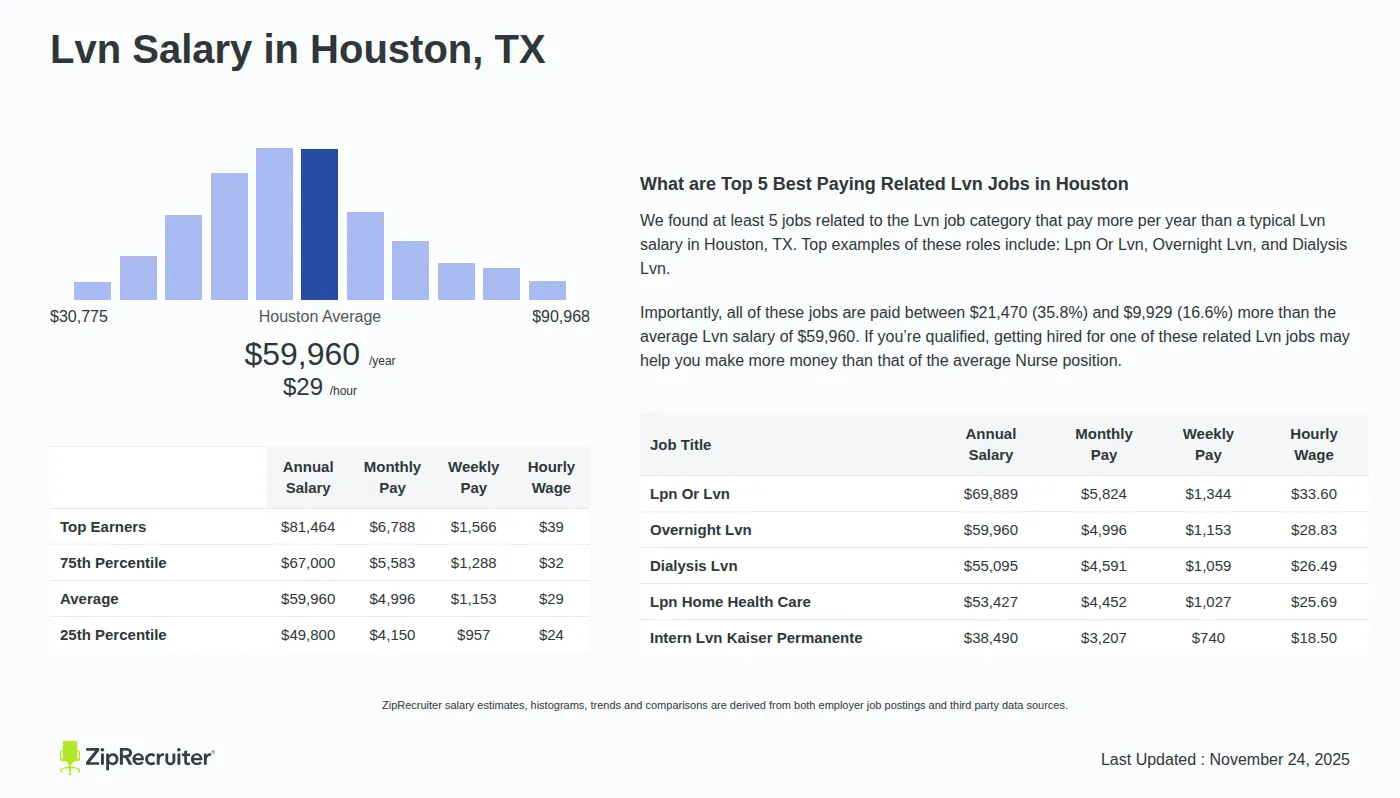
- Houston: Known for its massive medical center, Houston offers a robust market with rates averaging $31.00 to $40.00 per hour.
- Rural Texas: Rates can dip to $26.00 to $29.00, but these positions often come with lower stress levels and a significantly lower cost of living.
Factors Influencing LVN Hourly Pay
Several variables can lead to a standard LVN salary hourly rate being increased or "stacked" with additional incentives. Nurses who understand these factors can strategically position themselves for the highest possible pay.
1. Clinical Setting and Work Environment
Where you work is often more important than how much you work.
- Skilled Nursing Facilities (SNFs): Often the highest hourly base pay due to high patient acuity and heavy workloads. In 2026, many SNFs offer "hazard" or "retention" bonuses on top of the hourly rate.
- Hospitals: Provide excellent benefits but sometimes lower base hourly pay than SNFs. However, the shift differentials (night and weekend pay) are usually superior.
- Home Health: Pay is often "per visit" rather than hourly, but when calculated as an hourly rate, it can exceed $45.00, though it requires significant travel and autonomy.
- Physician Offices/Clinics: Typically the lowest paying, ranging from $27.00 to $33.00, but they offer more stable "9-to-5" schedules and no weekend requirements.
2. Experience and Tenure
In nursing, experience is synonymous with safety and efficiency. Most healthcare facilities utilize a "step system" for pay.
- Level 1 (0–2 years): Focus on foundational skills. Base pay is the priority.
- Level 2 (3–7 years): Shift into mentorship or charge nurse roles. This usually triggers a $3–$5 hourly increase.
- Level 3 (8+ years): Expert status. These nurses often max out the standard pay scale and move into per diem or agency work to secure even higher rates.
3. Certifications and Specialized Skills
Earning additional certifications is the fastest way to increase an hourly rate without returning to school for an RN degree.
- IV Therapy and Blood Withdrawal: In states like California, this is almost a requirement for high-paying hospital jobs and can add $1.00–$2.00 per hour.
- Gerontology (C-GERO): With the elderly population growing, specialized knowledge in aging can make an LVN more valuable in long-term care management.
- Wound Care Certification (WCC): Wound care is a highly specialized and in-demand skill that can command an hourly premium of $3.00–$5.00.
2026 LVN Hourly Pay Comparison Table
The following table outlines the projected 2026 hourly pay ranges for Licensed Vocational Nurses across different sectors and major regions.
| Employment Setting | California (Avg. Hourly) | Texas (Avg. Hourly) | National Average |
|---|---|---|---|
| Skilled Nursing Facility | $44.50 | $34.00 | $38.50 |
| General Hospital | $41.00 | $32.50 | $36.00 |
| Home Healthcare | $46.00 | $36.00 | $41.00 |
| Outpatient Care Center | $38.50 | $30.00 | $33.50 |
| Physician Office | $34.00 | $28.50 | $31.00 |
| Correctional Facilities | $48.00 | $37.00 | $42.50 |
Data based on 2026 market projections and regional healthcare labor reports.
Benefits and Total Compensation Package
When evaluating an LVN salary hourly offer, it is vital to look beyond the raw number. Total compensation includes the value of benefits, which can add the equivalent of $10.00 to $15.00 per hour to the total package.
Shift Differentials
Shift differentials are extra payments for working "undesirable" hours. In 2026, standard differentials include:
- Evening Shift (3 PM – 11 PM): Additional $2.00–$4.00 per hour.
- Night Shift (11 PM – 7 AM): Additional $4.00–$7.00 per hour.
- Weekend Premium: Often a flat addition of $3.00–$5.00 per hour or a percentage of the base pay.
Per Diem and Registry Work
Some LVNs choose to forgo traditional benefits (like health insurance and 401k matching) in exchange for a significantly higher hourly rate. Per diem (as needed) nurses in 2026 often earn 20% to 30% more than staff nurses to compensate for the lack of guaranteed hours and benefits. This is a popular option for nurses who are covered under a spouse's insurance plan.
The Role of Travel Nursing for LVNs
While travel nursing is traditionally associated with Registered Nurses (RNs), the LVN travel market has expanded rapidly through 2026. Travel LVNs often take short-term contracts (8–13 weeks) in areas facing severe staffing shortages. These contracts typically pay an all-inclusive hourly rate that includes a tax-free housing stipend. When the stipend is factored in, some travel LVNs effectively earn an hourly equivalent of $65.00 to $80.00.
How to Maximize Your Hourly Earnings as an LVN
To reach the top tier of the LVN salary hourly scale, nurses should be proactive in their career management.
- Negotiate During the Hiring Process: Many LVNs accept the first offer. In 2026, with the shortage of skilled labor, there is significant room to negotiate for a higher starting step based on previous experience or specialized skills.
- Pick Up "Crisis" or "Bonus" Shifts: Hospitals often offer "incentive pay" for nurses who fill in for call-outs. This can sometimes involve double-time pay or a flat bonus of $100–$200 for an 8-hour shift.
- Obtain Advanced Certifications: As mentioned previously, IV certification and wound care are the "gold standards" for increasing value.
- Monitor Local Market Trends: Use resources like the Bureau of Labor Statistics (BLS) and state-specific nursing boards to understand where the highest demand lies.
- Consider the "Float Pool": Working in a hospital's float pool—where you are sent to different units depending on need—usually comes with a higher hourly premium due to the required flexibility and broad skill set.
Common Challenges and Considerations
While hourly pay is rising, LVNs must also consider the physical and emotional demands of the role. High-paying settings like SNFs often involve high patient-to-nurse ratios, which can lead to burnout. It is important to balance the hourly rate with the work-life balance and safety protocols of the facility. Furthermore, as an LVN, your scope of practice is more limited than an RN's, which can sometimes cap your hourly potential in certain administrative or specialized clinical roles.
Frequently Asked Questions
What is the average LVN salary hourly in California for 2026?
In 2026, California LVNs earn an average of $42.50 per hour. However, this can range from $35.00 in rural areas to over $55.00 in major metropolitan hubs like San Francisco or San Jose.
Do LVNs get paid more than LPNs?
LVN and LPN are the same role; the title simply depends on the state. LVNs in California often earn more than LPNs in other states, but this is primarily due to California's higher cost of living and stronger labor unions rather than a difference in clinical responsibilities.
How much extra do LVNs make for night shifts?
Standard night shift differentials in 2026 generally range from $4.00 to $7.00 per hour. Some facilities also offer a "weekend night" differential that can be even higher.
Can an LVN earn $100,000 a year?
Yes. An LVN earning $48.00 per hour and working full-time (40 hours per week) earns roughly $99,840 annually. With modest overtime or shift differentials, many experienced LVNs in high-pay states like California comfortably exceed the $100k mark in 2026.
Is the LVN salary hourly rate expected to keep rising?
Projections indicate that nursing wages will continue to rise or at least remain stable through the end of the decade. The primary driver is the aging U.S. population, which requires more long-term care—a sector where LVNs are the primary providers of clinical care.
Next Steps for Prospective and Current LVNs
If you are looking to enter the field or increase your current earnings, your first action should be to verify the current "market rate" for your specific zip code. Use local job boards and speak with recruiters to understand what the prevailing hourly wage is for your level of experience. If you are stuck at a lower rate, consider obtaining your IV Therapy Certification or looking into Home Health opportunities, as these areas currently offer some of the fastest paths to a higher hourly wage in 2026.
Image Gallery