What Is the Most Powerful Portable Speaker? Power Metrics and Top Performers Explained
The most powerful portable speaker on the market is the SOUNDBOKS 4, capable of outputting up to 126 decibels (dB) of Sound Pressure Level (SPL) using three 72-Watt continuous Class-D amplifiers. While manufacturers frequently market p...
The most powerful portable speaker on the market is the SOUNDBOKS 4, capable of outputting up to 126 decibels (dB) of Sound Pressure Level (SPL) using three 72-Watt continuous Class-D amplifiers. While manufacturers frequently market peak wattage figures, true speaker power is defined by SPL, driver area, cabinet acoustics, and continuous Root Mean Square (RMS) power.
Contents
Decoding Audio Power: Watts vs. Decibels (SPL)
Evaluating the raw performance of a portable speaker requires separating consumer marketing terms from fundamental audio engineering metrics. Consumers often assume that a higher wattage specification automatically yields a louder speaker. However, wattage measures electrical power consumption from the amplifier, not the acoustic output generated in open space.
Sound Pressure Level (SPL) Explained
Sound Pressure Level, measured in decibels (dB), is the primary metric for audio output loudness. Because the decibel scale is logarithmic, an increase of 10 dB represents a tenfold increase in acoustic sound intensity and is perceived by the human ear as roughly twice as loud.
For context:
- 75–80 dB: Standard indoor conversational volume or background music.
- 95–100 dB: Typical maximum output of a mid-sized portable Bluetooth speaker (e.g., JBL Charge series).
- 110–115 dB: Equivalent to a live concert at close range or a commercial gym system.
- 126 dB: Peak output achieved by battery-powered concert-grade systems like the SOUNDBOKS 4, equivalent to standing near a jet engine taking off or front-row at a major music festival.
RMS Wattage vs. Peak Wattage
Amplifier performance is reported using two standard figures:
- RMS (Root Mean Square) Power: The amount of continuous power an amplifier can output to the drivers without thermal failure or unacceptable harmonic distortion. RMS is the only reliable metric for assessing sustained volume levels.
- Peak (Dynamic) Power: The maximum burst of power an amplifier can supply for a fraction of a second during sudden transient peaks, such as a sharp drum strike. Peak wattage figures are often inflated by manufacturers to twice or four times the RMS rating for marketing purposes.
Driver Efficiency and Sensitivity
A speaker driver's sensitivity rating determines how efficiently it converts electrical watts into acoustic energy. Speaker sensitivity is typically measured in decibels at a distance of 1 meter when supplied with 1 watt of power (e.g., 96 dB @ 1W/1m). A highly efficient woofer with high sensitivity requires far less wattage to achieve extreme volume than an inefficient driver. Consequently, a high-efficiency 200-Watt RMS system can easily out-perform a low-efficiency 600-Watt peak system in total volume and clarity.
Key Hardware Architecture of High-Output Portable Speakers
Engineers face distinct physical limitations when designing high-volume, battery-powered audio hardware. Generating extreme low frequencies at high decibels requires moving vast volumes of air, which demands substantial cabinet volume, powerful driver magnets, and robust power distribution.
- High-Discharge Power Pack (LiFePO4 / Li-ion with High Continuous Amperage)
- Multi-Channel Class-D DSP Amp (90%+ Efficiency, Dynamic Throttling, EQ Limiting)
- High-Sensitivity Tweeter / Compression Driver Assembly
- High-Excursion Subwoofers / Woofers (Rigid Cabinets)
Class-D Amplification
Traditional audio amplifiers (Class A or Class AB) dissipate significant energy as waste heat, often achieving operational efficiencies below 50–60%. Modern battery-powered super-speakers utilize Class-D switching amplifiers, which operate at efficiencies exceeding 90%. By rapidly switching output transistors on and off, Class-D modules minimize heat production and maximize battery life, allowing high continuous wattage inside enclosed portable cabinets.
Enclosure Volume and Porting
Acoustic power is bound by Hofmann's Iron Law, which states that a speaker cabinet's low-frequency extension, overall efficiency, and physical enclosure size are strictly interdependent. To gain deep bass output at high volume, the enclosure must expand. High-output designs utilize tuned bass-reflex ports or passive radiators:
- Bass-Reflex (Ported) Enclosures: Utilize tuned physical ducts to allow air displacement behind the woofer cone to reinforce low-frequency output, maximizing SPL at targeted bass frequencies.
- Passive Radiators: Used in medium-sized enclosures (such as the Ultimate Ears Hyperboom or JBL Boombox 3) to increase bass resonance without the internal air turbulence (port noise) created by open acoustic vents.
Battery Discharge Capabilities
Standard lithium-ion battery cells used in mobile phones cannot discharge current quickly enough to power continuous 200W+ audio amplification. Extreme portable speakers rely on specialized battery chemistry—such as Lithium Iron Phosphate ($\text{LiFePO}_4$) or high-discharge Lithium-ion packs capable of continuous high amperage (10A–20A output). These power supplies prevent voltage sag when reproducing high-energy bass transients at maximum gain.
Top Contenders for the Title of Most Powerful Portable Speaker
While dozens of manufacturers claim high performance, only a small group of specialized portable speakers deliver high Sound Pressure Levels, physical durability, and sustained battery output.
1. SOUNDBOKS 4: The Peak of Battery-Powered SPL
The SOUNDBOKS 4 represents the current benchmark for ultimate portable sound output. Engineered primarily for outdoor festivals, tailgate events, and large spaces, it operates more like a portable PA system than a traditional Bluetooth speaker.
- Acoustic Configuration: Features two 10-inch woofers combined with a 1-inch pulse-precision horn-loaded tweeter.
- Amplification: Driven by three 72-Watt RMS Class-D amplifiers optimized by custom Digital Signal Processing (DSP).
- Maximum SPL Output: Reaches 126 dB, outperforming every other battery-powered integrated speaker in its class.
- Key Strengths: Swappable battery system (Batteryboks), rugged poplar plywood cabinet with steel corner guards, pulse-reflex port design, and custom field-repairable parts.
- Primary Drawback: Heavy footprint (34 lbs / 15.5 kg), making it transportable via handle rather than easily backpackable.
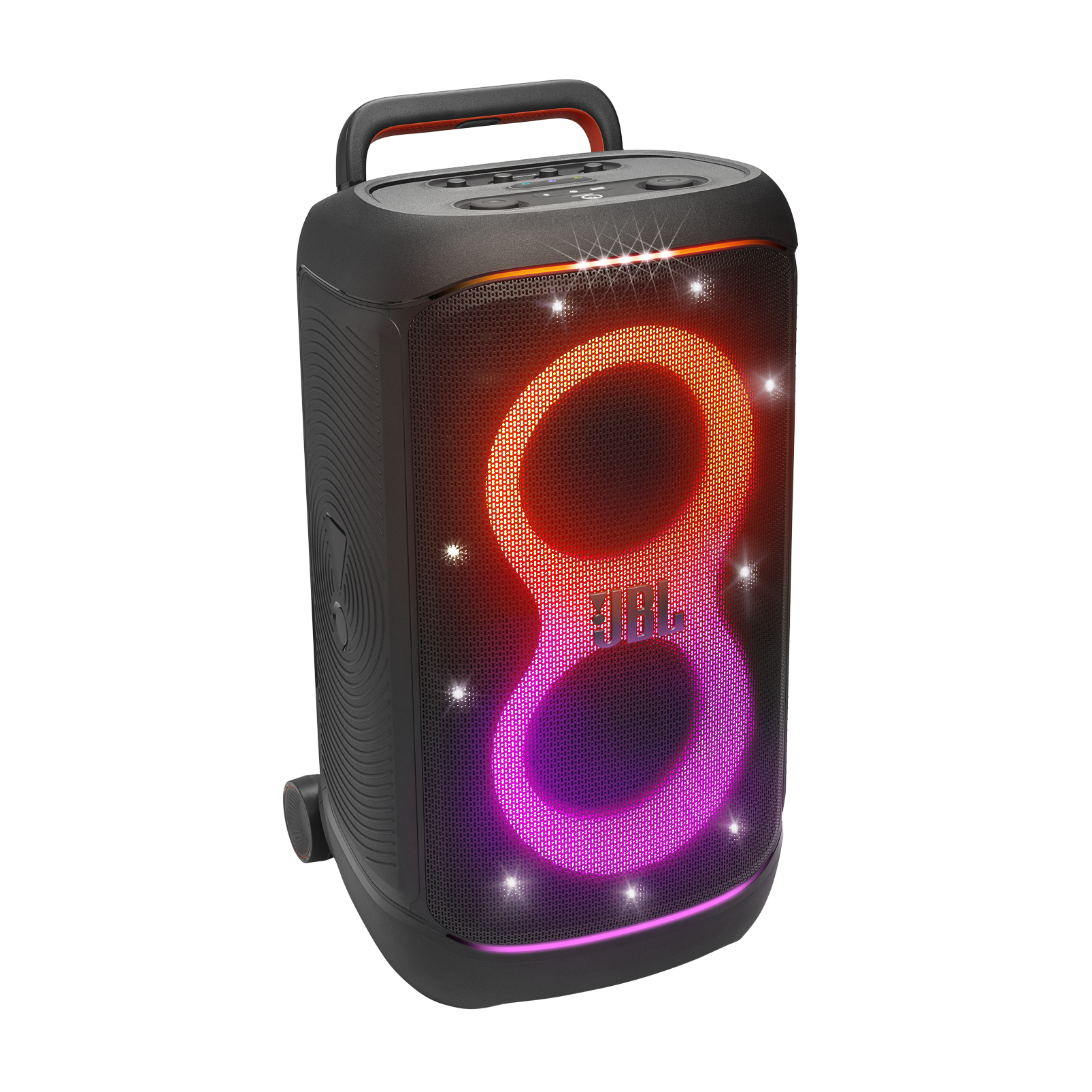
2. JBL PartyBox Stage 320: High SPL with Deep Sub-Bass Extension
For users seeking extreme volume combined with deep consumer-oriented bass tuning and integrated party lighting, the JBL PartyBox Stage 320 stands out as a leading contender.
- Acoustic Configuration: Dual 6.5-inch high-sensitivity woofers paired with dual 1-inch dome tweeters.
- Amplification: Delivers up to 240 Watts RMS when connected to AC power, with automatic dynamic scaling when operating on its swappable battery pack.
- Maximum Output: Capable of outputting up to 114–116 dB SPL.
- Key Strengths: Telescopic handle and heavy-duty wheels, extensive inputs for microphones and guitars, customizable lighting zones, and lower baseline cost than concert-grade alternatives.
- Primary Drawback: Significant physical mass (36.4 lbs / 16.5 kg) and reduced continuous RMS output when powered solely by battery.
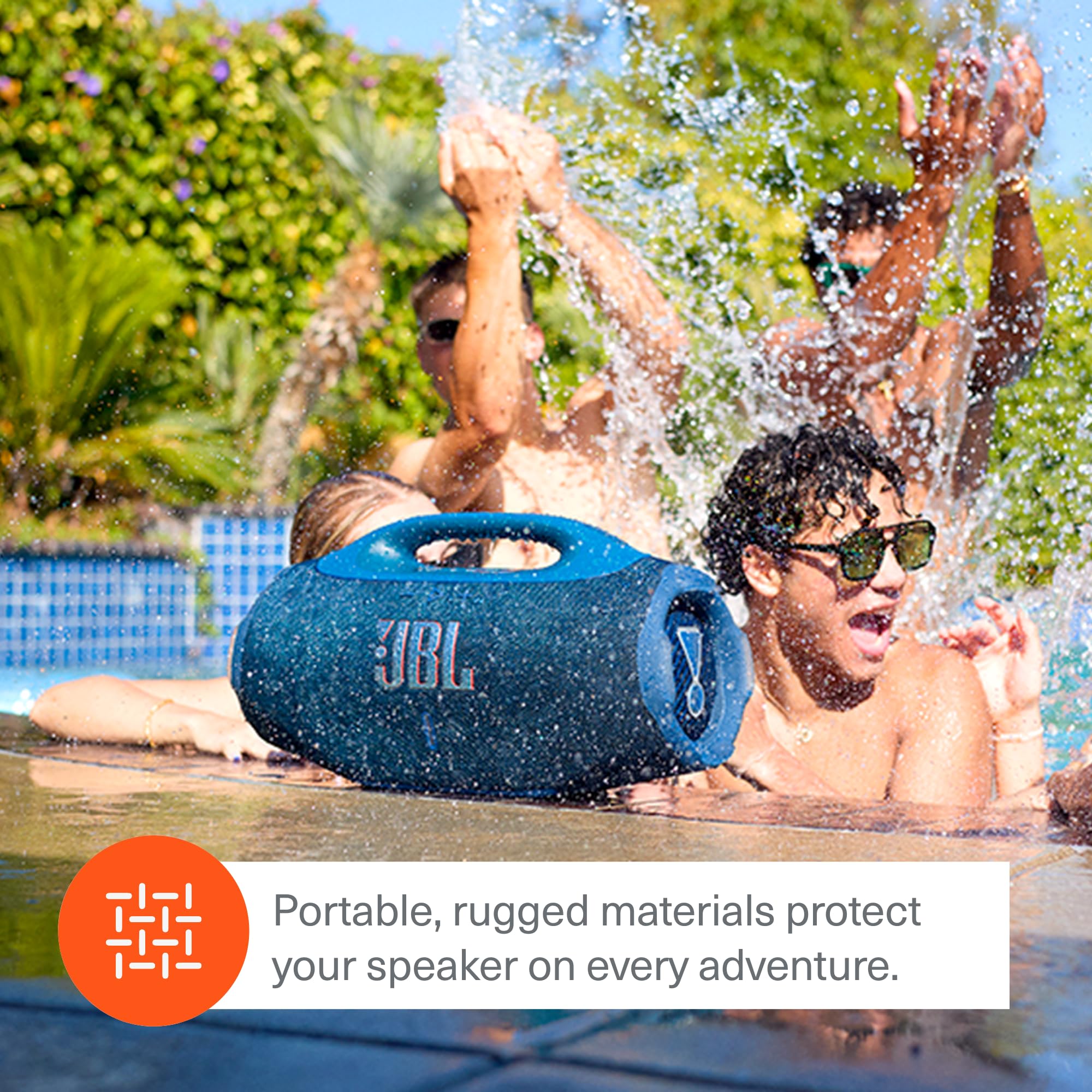
3. JBL Boombox 3 Wi-Fi: The Maximum Power for Traditional Grab-and-Go Form Factors
If portability is defined as something easily carried in one hand, the JBL Boombox 3 Wi-Fi represents the upper limit of output performance before transitioning into full-sized party cabinet hardware.
- Acoustic Configuration: A 3-way system featuring a dedicated racetrack-shaped subwoofer, two mid-range drivers, and two tweeters.
- Amplification: 1x 80W RMS (subwoofer) + 2x 40W RMS (mid-range) + 2x 10W RMS (tweeters) on AC power, delivering up to 180W RMS total.
- Maximum Output: Reaches approximately 98–101 dB SPL.
- Key Strengths: Full IP67 dustproof and waterproof casing, robust metal handle, Wi-Fi 6 high-resolution audio streaming support, and internal sub-bass tuning down to 40 Hz.
- Primary Drawback: Lacks swappable battery packs; volume output decreases slightly under low battery states.
4. Ultimate Ears (UE) Hyperboom: Compact High-Output Champion
The Ultimate Ears Hyperboom utilizes a vertical box architecture optimized for 360-degree sound projection and dense bass reproduction within a manageable footprint.
- Acoustic Configuration: Two 4.5-inch woofers, two 1-inch tweeters, and two passive radiators measuring 3.5 x 7.5 inches.
- Amplification: Custom Class-D driver array providing clean playback up to 100 dB SPL.
- Key Strengths: Dynamic adaptive EQ that recalibrates audio output using an internal microphone based on room reflections, IPX4 splash resistance, and seamless dual-Bluetooth device switching.
- Primary Drawback: Lacks replaceable battery modules; sub-bass output rolls off noticeably above 85% master volume to prevent driver over-excursion.
Detailed Specification Comparison of High-Output Portable Speakers
The following matrix compares performance metrics, driver specs, power architecture, and portability factors among top-tier battery-powered speakers.
| Feature / Metric | SOUNDBOKS 4 | JBL PartyBox Stage 320 | JBL Boombox 3 Wi-Fi | UE Hyperboom |
|---|---|---|---|---|
| Peak Sound Pressure Level (SPL) | 126 dB | ~115 dB | ~101 dB | ~100 dB |
| Continuous Power (RMS) | 3x 72W (216W Total) | 240W (AC Power) | 180W (AC Power) | ~120W Peak System Power |
| Driver Complement | 2x 10" Woofers, 1" Horn Tweeter | 2x 6.5" Woofers, 2x 1" Tweeters | 1x Sub, 2x Mid-Drivers, 2x Tweeters | 2x 4.5" Woofers, 2x 1" Tweeters, 2x Passive Radiators |
| Frequency Response (-6dB) | 40 Hz – 20,000 Hz | 40 Hz – 20,000 Hz | 40 Hz – 20,000 Hz | 45 Hz – 20,000 Hz |
| Battery Swappability | Yes (Batteryboks, LiFePO4) | Yes (Fast-Swap Li-ion Pack) | No (Integrated) | No (Integrated) |
| Playtime at Max Volume | ~6 Hours | ~3.5 Hours | ~4.5 Hours | ~3 Hours |
| Ingress Protection Rating | Water-resistant coating / IP65 components | IPX4 (Splash-proof) | IP67 (Dust & Waterproof) | IPX4 (Splash-proof) |
| Weight | 34.0 lbs (15.5 kg) | 36.4 lbs (16.5 kg) | 21.2 lbs (9.6 kg) | 13.0 lbs (5.9 kg) |
| Primary Connection Protocols | Bluetooth 5.0, SKAA wireless link, XLR/Aux | Bluetooth 5.4, Auracast, 1/4" Mic/Guitar | Wi-Fi 6, Bluetooth 5.3, AirPlay 2, Aux | Bluetooth 5.0, Optical Input, Aux |
Real-World Trade-Offs: Volume vs. Audio Clarity and Battery Throttling
Pushing portable speaker technology to extreme volumes introduces severe acoustic and electronic trade-offs. Buyers searching for raw power must understand how DSP limitations impact high-volume audio performance.
- Master Volume Level: 0% to 70% to 100%
- Bass Response: Flat / Deep Bass to Dynamic Bass Reduction
- Distortion (THD): < 0.5% THD Clean to Limiter Active / Peak Compression
1. Dynamic Equalization Limiting
To prevent hardware damage and excessive driver over-excursion, almost all high-output portable speakers employ active DSP limiting. At lower volumes (30% to 70%), the speaker boosts sub-bass frequencies to provide a warm, full sound profile.
However, as the volume dial approaches 80% to 100%, the DSP dynamically cuts sub-bass frequencies while boosting upper mid-range and treble tones. This allows the system to play louder overall without overdriving the woofers, but it leaves the audio sounding significantly brighter and less bass-heavy at max gain.
2. Total Harmonic Distortion (THD) at Maximum Output
High acoustic power is meaningless if the output sound is heavily distorted. Standard Bluetooth consumer speakers often exceed 10% Total Harmonic Distortion (THD) when pushed to their extreme limit, resulting in harsh, fatigued listening experiences. Concert-focused designs like the SOUNDBOKS 4 utilize custom DSP tuning to keep THD low even past 120 dB, maintaining sound clarity across vocals and high frequencies.
3. Thermal Throttling and Voltage Drop
Sustained high-volume playback generates substantial heat within the amplifier circuit and battery cells. Many portable units feature thermal protection algorithms that automatically scale down output wattage by 1.5 dB to 3 dB after 30–45 minutes of continuous maximum-volume playback. Furthermore, as the battery depletes below 20%, maximum volume headroom is frequently restricted to avoid triggering lower-voltage battery safety cutoffs.
How to Choose the Right High-Powered Portable Speaker for Your Needs
Selecting the correct high-output speaker depends on your venue environment, transport limitations, and access to power mains.
- Define Primary Usage Environment
- Outdoor / Large Events (Needs Max SPL & Coverage)
- SOUNDBOKS 4 (126 dB SPL, Swappable Batt)
- JBL PartyBox 320 (115 dB, Party Lights, Wheeled Transport)
- Portable / Personal (Needs Portability & Durability)
- JBL Boombox 3 (IP67, One-Handed Carrier, Wi-Fi)
- UE Hyperboom (Compact Form, Adaptive EQ)
- Outdoor / Large Events (Needs Max SPL & Coverage)
Scenario A: Outdoor Festivals, Tailgates, and Large Open Venues
- Recommendation: SOUNDBOKS 4
- Reasoning: Open outdoor areas lack room boundaries and walls to reflect acoustic energy, causing sound to dissipate rapidly over distance (following the Inverse-Square Law). To project audio across broad open spaces for dozens of listeners, 120+ dB SPL headroom is necessary. The ability to swap batteries instantly ensures uninterrupted multi-day events.
Scenario B: Backyard Parties, Live Guitars, and Karaoke Setups
- Recommendation: JBL PartyBox Stage 320
- Reasoning: When absolute SPL limits can be compromised slightly in favor of built-in features, the PartyBox series excels. Its microphone and instrument inputs, combined with transport wheels and onboard light shows, provide an all-in-one entertainment hub for medium-to-large social gatherings.
Scenario C: Camping, Beach Excursions, and Frequent Transport
- Recommendation: JBL Boombox 3 Wi-Fi or Ultimate Ears Hyperboom
- Reasoning: Speakers weighing over 30 pounds become inconvenient for casual travel. For trips to beaches, campsites, or pool decks, units under 20 pounds offering IP67 water and dust protection provide the ideal balance of high volume (~100 dB SPL) and rugged portability.
Frequently Asked Questions
Can a portable speaker really reach 126 decibels safely?
Yes, high-efficiency systems like the SOUNDBOKS 4 achieve 126 dB SPL through optimized horn-loaded tweeters, highly efficient Class-D amplifiers, and large-displacement woofers. However, exposure to sound levels above 85 dB over extended periods can cause hearing damage. At maximum output, listeners should maintain a safe distance of at least 5 to 10 meters (16 to 33 feet) or utilize appropriate hearing protection.
Why do some cheap speakers claim 1000 Watts of power?
Budget manufacturers often advertise peak PMPO (Peak Music Power Output) or theoretical driver handling capacity rather than verified RMS output. PMPO is an unstandardized measurement reflecting short electrical bursts for milliseconds before driver destruction. Always evaluate continuous RMS wattage ratings and measured dB SPL output rather than peak wattage marketing claims.
Does playing a speaker at maximum volume degrade the battery faster?
Yes. Operating a portable speaker at high output draws continuous heavy current from the internal cells. High current draw increases battery temperature and accelerates chemical degradation over time. Additionally, battery life drops exponentially at maximum volume; a speaker rated for 24 hours of playback at 50% volume may only last 3 to 6 hours at 100% output.
How does Bluetooth compression affect high-volume sound quality?
Standard Bluetooth codecs (like SBC) compress audio data, which can introduce artifacts and thin out treble detail when amplified across large, high-output drivers. High-bitrate Bluetooth codecs (such as LDAC or AAC) and native Wi-Fi streaming options (available on units like the JBL Boombox 3 Wi-Fi) deliver uncompressed digital audio streams, preventing harsh harmonic distortion at elevated playback volumes.
Final Recommendation and Next Actions
If your goal is absolute maximum sound volume, projection, and coverage for massive crowds or outdoor events, the SOUNDBOKS 4 remains the premier high-power portable speaker. For users who prioritize a balance of transportability, high volume, dynamic sub-bass, and lower cost, the JBL PartyBox Stage 320 or JBL Boombox 3 offer robust, weather-resistant alternatives.
Before making your final purchase:
- Measure Your Usage Space: Determine whether your events occur primarily in open outdoor settings (requiring >110 dB SPL) or enclosed indoor areas where 95–100 dB SPL is more than sufficient.
- Evaluate Transport Needs: Confirm whether a 34-pound cabinet-style speaker fits into your vehicle trunk or if a sub-20-pound handheld speaker is required.
- Assess Power Requirements: If hosting events lasting longer than 6 hours without access to wall power outlets, select a system featuring swappable battery modules.
Image Gallery