Why the Tempo of Pop Music Keeps Shifting: Technology, Trends, and the Streaming Era
Pop music tempo shifts due to a combination of technological advancements, changing listener habits on streaming platforms, and the cultural influence of social media trends like TikTok. These factors, alongside the blending of genres...
Pop music tempo shifts due to a combination of technological advancements, changing listener habits on streaming platforms, and the cultural influence of social media trends like TikTok. These factors, alongside the blending of genres like Trap and EDM, dictate whether artists lean toward high-energy dance tracks or atmospheric, "vibe-centric" slower compositions.
Contents
The pulse of popular music has never been static. From the frantic swing of the 1940s to the steady disco "four-on-the-floor" of the 1970s, the speed at which we consume melody is a direct reflection of our technology, our social environments, and our psychological needs. In 2026, we find ourselves in an era where tempo is more fluid than ever, moving away from the rigid 120 BPM (beats per minute) standard toward a landscape of extreme speeds and intentional slows. To understand why the tempo of pop music keeps shifting, we must look at the intersection of digital production, economic incentives, and human biology.
The Influence of Streaming Algorithms and Skip Rates
In the current landscape of 2026, the economics of music are governed by the "30-second rule." On major streaming platforms, a play only counts as a royalty-generating stream if the listener stays engaged for at least half a minute. This financial reality has a profound impact on tempo.
Higher-tempo tracks often create a sense of urgency and immediate engagement. Producers frequently use faster BPMs to prevent "passive skipping," where a listener becomes bored or distracted within the first few seconds. Conversely, a significant shift toward lower-tempo, "lo-fi," or "chill" music has been driven by the rise of mood-based playlists. Platforms like Spotify and Apple Music curate thousands of playlists designed for studying, sleeping, or working. This has created a massive market for tracks that sit comfortably between 70 and 90 BPM, providing a consistent "vibe" that doesn't demand the listener's full attention but keeps the stream running for hours.
Furthermore, the structure of pop songs has condensed. In the mid-20th century, a song might take 45 seconds to reach the chorus. Today, the tempo and the arrangement are often designed to deliver the hook within the first 15 to 20 seconds. If the tempo is too slow without a compelling melodic payoff, the risk of a "skip" increases, negatively affecting the song's performance in the algorithm.
The TikTok Effect and the Rise of "Sped Up" Versions
Perhaps the most visible reason for shifting tempos in recent years is the influence of short-form video platforms. TikTok and Instagram Reels have fundamentally changed how music is discovered. In these environments, 15 to 60 seconds of audio must compete with millions of other clips.
This led to the "Sped Up" phenomenon, where users would increase the tempo of a song by 130% to 150% to make it feel more energetic or to fit a specific dance challenge. By 2024 and 2025, record labels began officially releasing "Sped Up" and "Slowed + Reverb" versions of every major single alongside the original. This creates a strange paradox where a single song exists at three or four different tempos simultaneously, catering to different digital subcultures.
The shift toward faster tempos in these clips isn't just about energy; it’s about information density. A faster tempo allows more of the song’s lyrics and melody to be compressed into a short video window, increasing the chances that a snippet will go viral. This has caused "native" pop tempos—the speed at which a song is originally written—to fluctuate wildly as producers try to guess what will translate best to a mobile screen.
Technological Tools and Digital Audio Workstations (DAWs)
The ease with which tempo can be manipulated in modern production cannot be overstated. In the era of analog tape, changing the tempo of a recording without changing its pitch was a labor-intensive and often sonic-degrading process. Today, software like Ableton Live, Logic Pro, and FL Studio allows producers to "warp" or "time-stretch" audio with a single click.
This technological freedom has led to:
- Micro-tempo shifts: Producers can now subtly increase the tempo of a chorus by 1 or 2 BPM compared to the verse to create a subliminal sense of "lifting" or excitement.
- Grid-based perfection: Because most modern pop is recorded to a digital metronome (a click track), the tempo is perfectly consistent. However, to combat the "robotic" feel of digital perfection, some artists in 2026 are intentionally shifting back to variable tempos that mimic the natural "push and pull" of a live drummer.
- Hybrid Genres: The blending of Trap (usually 140 BPM) with Pop (traditionally 100-120 BPM) has created a "half-time" feel. A song might technically be 140 BPM, but because the snare hits on the third beat rather than the second and fourth, it feels like a slow, 70 BPM crawl. This duality allows a track to work in both a high-energy club setting and a relaxed headphone setting.
The Psychological and Biological Connection
Human biology plays a role in why certain tempos dominate specific eras. Research into musical entrainment—the process where our internal body rhythms, like heart rate and brain waves, align with external rhythms—suggests that humans have a natural affinity for tempos that mirror a resting or walking heart rate.
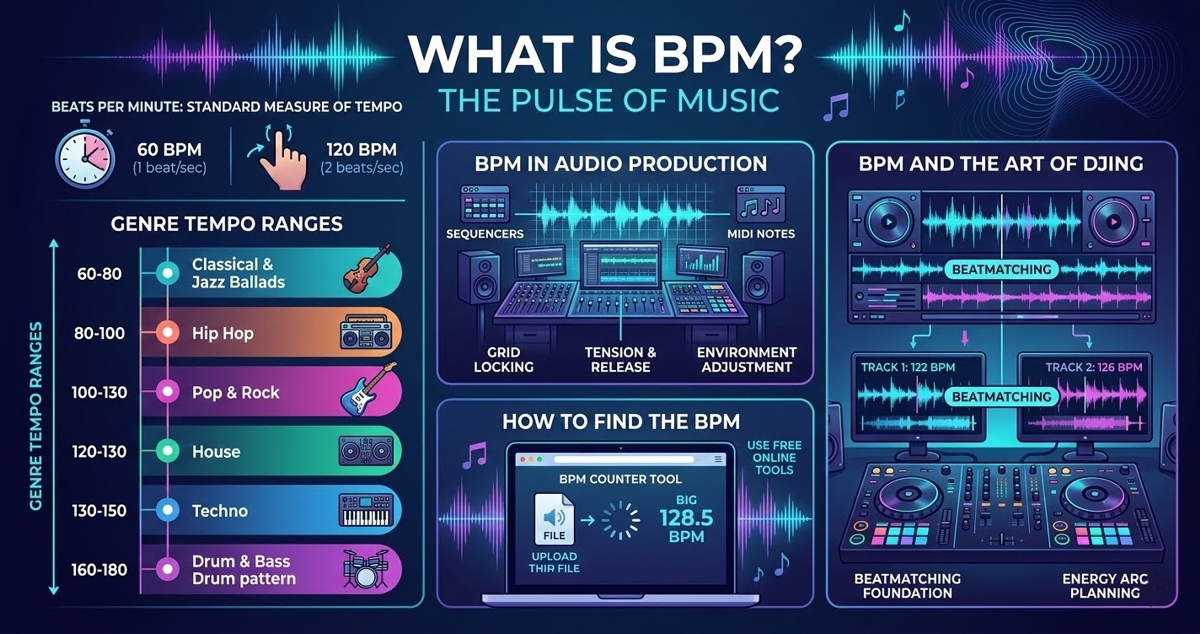
Generally, 120 BPM is considered the "golden mean" of pop music because it is roughly double the average resting heart rate and aligns with a brisk walking pace. When society is in a period of high anxiety or rapid change, we often see a split in tempo trends. Some listeners gravitate toward high-BPM music (140-160 BPM) as a form of catharsis or "escapism," while others seek out ultra-low BPMs (60-80 BPM) to regulate stress.
The post-pandemic era saw a massive surge in high-BPM "hyperpop" and Eurodance-influenced tracks, as listeners craved the energy of communal dance floors. By 2026, we are seeing a corrective shift toward "organic mid-tempo," where the focus is on singer-songwriter intimacy, often hovering around 90-105 BPM.
Historical Comparison of Pop Tempos
To visualize how these shifts occur over time, the following table compares dominant genres and their average BPM ranges across different eras of modern music.
| Era | Dominant Genre | Average BPM Range | Primary Influence |
|---|---|---|---|
| 1970s | Disco / Funk | 110 – 125 BPM | Dance floor consistency (Vinyl) |
| 1980s | Synth-Pop / New Wave | 120 – 135 BPM | Early Drum Machines (Roland TR-808) |
| 1990s | Grunge / RnB / Eurodance | 90 – 140 BPM | CD format diversity / Club culture |
| 2000s | Pop-Punk / Hip-Hop | 85 – 105 BPM | Radio-friendly "bounce" / MTV |
| 2010s | EDM / Early Trap | 128 (Standard) / 70 / 140 | Festival Mainstages / Digital DAWs |
| 2020-2024 | Hyperpop / Lo-Fi / TikTok Pop | 60 – 160+ BPM | Short-form video / Streaming mood playlists |
| 2025-2026 | Neo-Organic / Fluid Pop | 85 – 115 BPM | Return to "Human" feel / Spatial Audio |
Cultural Cycles and Genre Blending
The history of pop is a pendulum. When one sound becomes too dominant, the next generation of artists almost inevitably moves in the opposite direction.
In the early 2010s, the "EDM explosion" made 128 BPM the industry standard for almost every Top 40 hit. This was the "heartbeat" of the global festival circuit. Eventually, listeners experienced "four-on-the-floor" fatigue. This paved the way for the "Trap takeover" in the late 2010s, which introduced a much slower, more spacious rhythmic feel.
In 2026, we are seeing the results of "genre-fluidity." Artists no longer feel tethered to the constraints of a single genre’s tempo. A single album might feature a 150 BPM drum-and-bass track followed immediately by a 75 BPM soul ballad. This shifting tempo is a tool for emotional storytelling, allowing artists to navigate a wide range of feelings within a single body of work.
FAQs
Why do some songs feel fast even if the BPM is slow?
This is often due to "subdivision." Even if the main beat (the tempo) is slow, the instruments playing over it—such as the hi-hats in Trap music or the fingerpicking in folk—might be playing twice or four times as fast as the beat. This creates "perceived energy" that exceeds the actual BPM.
Is pop music getting faster or slower in 2026?
It is doing both simultaneously. We are seeing a "thinning of the middle." While the 120 BPM "standard" is less common, we see a polarization: very fast songs (140+ BPM) for social media and high-energy environments, and very slow songs (under 90 BPM) for mood-based streaming.
How does tempo affect a song's chance of becoming a hit?
Tempo affects "placement." A song at 124 BPM is highly likely to be placed in "Workout" or "Dance" playlists, while a song at 80 BPM is destined for "Chilled" or "Focus" playlists. Producers often choose a tempo based on which playlist "lane" they want to occupy to maximize their reach on streaming services.
Can a song's tempo change while it's playing?
Yes, and this is becoming more common in 2026. While traditional pop used a "locked" tempo, modern artists are experimenting with "tempo ramps" or sudden shifts (beat switches) to keep listeners engaged and prevent the song from feeling predictable.
What is the average tempo of a Top 10 hit?
Historically, the average hovers around 116-122 BPM. However, in the last three years, the variance has increased significantly, with hits ranging anywhere from 65 BPM to 170 BPM depending on the genre's current trend.
Practical Recommendation for Listeners and Creators
For listeners, understanding tempo shifts can enhance your appreciation of how music influences your mood and productivity. If you find yourself feeling fatigued by modern pop, try seeking out "variable tempo" tracks or live recordings where the human element provides a more natural rhythmic ebb and flow.
For creators and producers in 2026, the key is intentionality. Rather than defaulting to a standard BPM, analyze the target environment for your track. If you are aiming for viral social media engagement, consider how your hook sounds when sped up. If you are aiming for longevity and "deep listening," focus on a tempo that allows the lyrics and vocal nuances to breathe. The most successful artists of the current era are those who treat tempo not as a fixed setting, but as a dynamic instrument in its own right.
Image Gallery