What Is the Purpose of a CV? A Comprehensive Guide to Its Strategic Role
A CV, or Curriculum Vitae, serves as a comprehensive marketing document designed to showcase your professional history, skills, and qualifications to potential employers. Its primary objective is to demonstrate your suitability for a s...
A CV, or Curriculum Vitae, serves as a comprehensive marketing document designed to showcase your professional history, skills, and qualifications to potential employers. Its primary objective is to demonstrate your suitability for a specific role and persuade the hiring manager to invite you for an interview, rather than securing the job immediately.
Contents
While many job seekers view the CV as a mere list of past experiences, its functional utility is far more complex. In the professional landscape of 2026, a CV acts as a bridge between an applicant’s unique value proposition and the specific operational needs of an organization. Understanding the multifaceted purpose of this document is the first step toward crafting a career narrative that resonates with modern recruiters and automated screening systems alike.
The Fundamental Goal: More Than Just a Biography
The most common misconception about a CV is that it is a historical record of everything an individual has ever done. While it contains historical data, its purpose is fundamentally forward-looking and persuasive. It is a sales tool where you are the product and the employer is the customer.
Securing the Interview
The immediate, tangible purpose of a CV is to get you "in the room." Recruiters often spend less than ten seconds scanning a document before deciding whether to move a candidate to the next stage. Therefore, the CV must be structured to provide high-impact information quickly. It does not need to tell your entire life story; it needs to tell the specific story that makes the reader want to speak with you.
Establishing Professional Identity
A CV allows you to define your professional brand. Through the selection of specific keywords, the highlight of certain achievements, and the tone of the writing, you establish who you are as a professional. This branding is essential for differentiating yourself in a competitive market where many candidates may have similar educational backgrounds or years of experience.
The CV as a Bridge: Connecting Skills to Solutions
Employers do not hire people simply because they have degrees or titles; they hire people to solve specific problems. The purpose of the CV is to illustrate how your past performance is a reliable indicator of your future success within their specific context.
Demonstrating Value Through Evidence
A high-quality CV moves beyond a list of "duties" and focuses on "achievements." By quantifying your impact—using percentages, currency figures, or time-saved metrics—the CV serves as a portfolio of evidence. It proves to the employer that you understand the bottom-line goals of a business and have the competency to contribute to them.
Aligning with Organizational Needs
Modern recruitment relies heavily on "mapping." This is the process of comparing a candidate's profile against the requirements of a Job Description (JD). The CV acts as the data source for this mapping. Its purpose is to mirror the language of the industry and the specific company, showing that you are not just a "qualified candidate" but the "right candidate" for their specific culture and challenges.
Structural Elements: How Each Section Serves a Purpose
To fulfill its overarching goal, a CV is divided into specialized sections. Each part of the document has a distinct functional purpose that contributes to the overall narrative of employability.
The Professional Summary or Profile
Located at the top of the document, the summary serves as an "elevator pitch." Its purpose is to provide a high-level overview of your career and your most significant value proposition. In 2026, this section is increasingly used to highlight specialized technical proficiencies or unique leadership philosophies that set the tone for the rest of the document.
Work History and Achievements
This is the core of the CV. Its purpose is to provide a chronological or functional record of your professional progression. However, its strategic intent is to demonstrate growth. Employers look for a "upward trajectory"—increasing responsibility, more complex projects, and a broadening scope of influence.
Education and Continuous Learning
Beyond verifying that you meet the minimum academic requirements for a role, the education section demonstrates your commitment to professional development. In a rapidly evolving technological environment, listing recent certifications or specialized workshops shows that you possess a "growth mindset" and are capable of staying current with industry trends.
Skills and Competencies
The skills section serves two purposes: it provides a quick reference for technical requirements (such as software proficiency or language skills) and it acts as a repository for keywords that help the document pass through digital filters.
The Distinction: CV vs. Resume in 2026
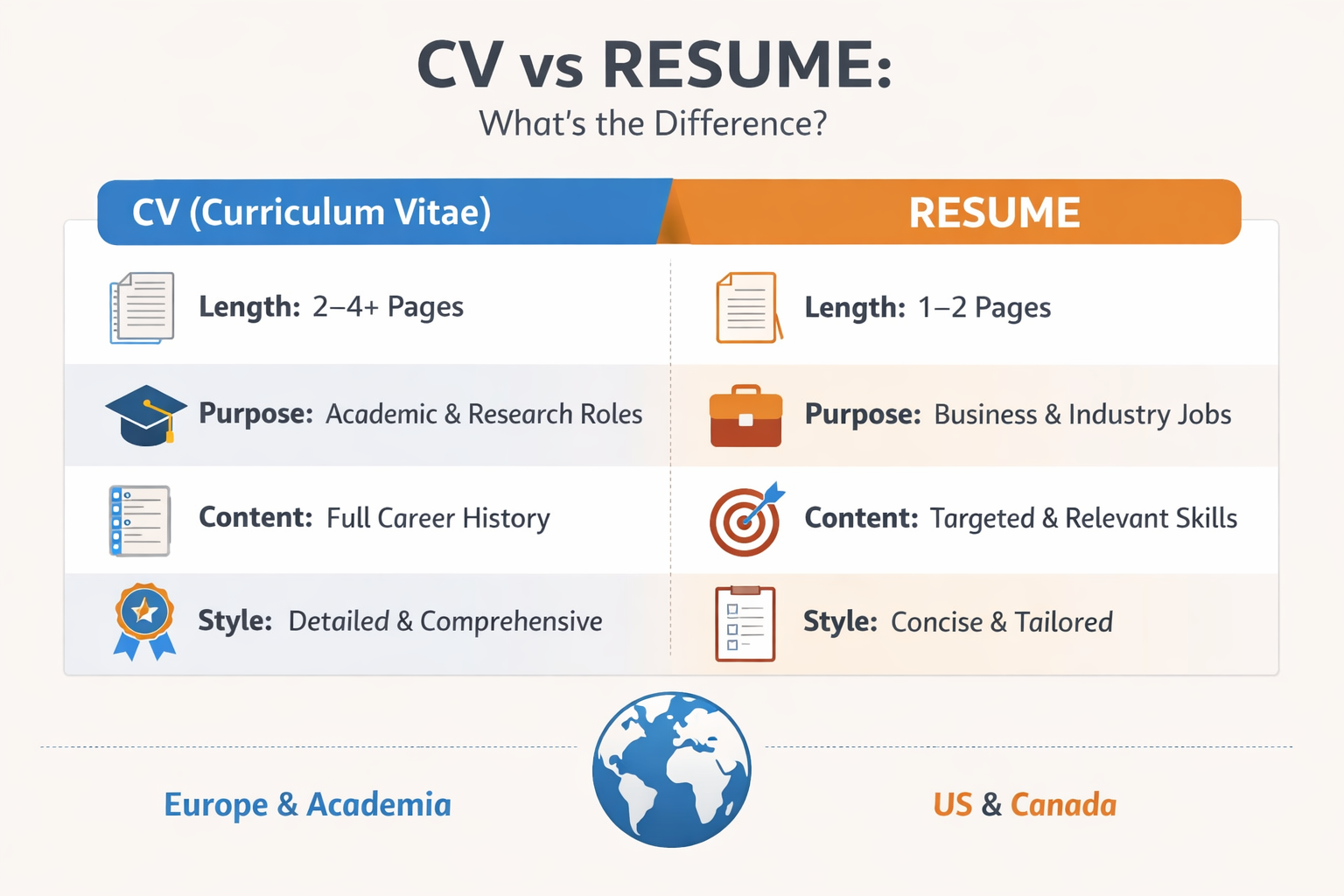
The terms "CV" and "resume" are often used interchangeably, but their purpose and usage can vary significantly depending on geography and the nature of the role.
| Feature | Curriculum Vitae (CV) | Resume |
|---|---|---|
| Primary Purpose | Comprehensive professional and academic record. | Targeted marketing for a specific job. |
| Length | Typically 2+ pages (flexible). | Strictly 1–2 pages. |
| Content Focus | Research, publications, teaching, and full history. | Relevant skills, achievements, and recent work history. |
| Common Usage | Academic, medical, or scientific roles; international markets. | Corporate, non-profit, and private sector roles in the US/Canada. |
| 2026 Trend | Increasing hybrid formats that blend both styles. | Moving toward hyper-concise, skill-based layouts. |
In the United Kingdom, Europe, and much of the Commonwealth, "CV" is the standard term for all job applications. In the United States, a CV is specifically reserved for academic or medical fields, while a "resume" is used for the general job market. However, with the rise of global remote work, many organizations now accept a "hybrid" document that focuses on professional achievements while maintaining the comprehensive nature of a CV.
The Impact of Technology: ATS and AI Screening
In 2026, the purpose of a CV is not just to be read by humans, but to be parsed by machines. Applicant Tracking Systems (ATS) use algorithms to scan documents for specific keywords and formatting cues.
If a CV is not optimized for these systems, it may never reach a human recruiter. Therefore, a secondary purpose of the CV is to serve as a "data packet" that these systems can easily categorize. This necessitates a clean layout, standard fonts, and the inclusion of industry-specific terminology. Use of AI in recruitment has made it even more vital that the CV remains factual and structured, as discrepancies between a CV and a candidate's online professional profiles (like LinkedIn) can be flagged instantly.
Strategic Tailoring: Why One Size Does Not Fit All
A common mistake is treating the CV as a static document. Its purpose is to be a dynamic tool that changes with every application. Tailoring a CV involves adjusting the emphasis of your experience to match the "pain points" mentioned in a job posting.
By tailoring the document, you fulfill the purpose of showing the employer that you have done your research. It demonstrates an understanding of the role's priorities. For example, if a job description emphasizes "stakeholder management," your CV should prioritize instances where you successfully navigated complex professional relationships, even if those weren't the primary focus of your previous job.
Common Misconceptions About CV Purpose
Clarifying what a CV is not intended to do is just as important as understanding its actual function.
- It is not a legal transcript: While it must be honest, it is a selective document. You are not required to list every part-time job you held twenty years ago if it is not relevant to the current opportunity.
- It is not a salary negotiation tool: While your experience level dictates your market value, the CV itself should generally not include salary history or expectations unless specifically requested.
- It is not a portfolio: While a CV mentions achievements, it is usually a text-based summary. For creative roles, the CV’s purpose is to lead the recruiter to a separate portfolio or website.
Frequently Asked Questions
Does a CV still need a physical address in 2026?
No, the purpose of contact information has shifted toward digital accessibility. Including your city and state/province is usually sufficient for time zone and tax residency purposes. Your LinkedIn URL and professional email address are far more important for modern recruiters.
How far back should the work history on a CV go?
Generally, a CV should focus on the last 10 to 15 years of experience. The purpose is to show your current relevance. Unless a previous role is uniquely prestigious or directly relevant to a career change, older experience can be summarized or omitted to save space.
Should I include hobbies on my CV?
Hobbies should only be included if they serve a professional purpose or demonstrate transferable skills. For example, being a marathon runner might demonstrate discipline and endurance. However, in 2026, the trend is toward keeping the CV strictly professional unless the company culture specifically encourages personal interests.
Is a cover letter still necessary if my CV is strong?
Yes. While the CV's purpose is to show what you have done, the cover letter's purpose is to explain why you want to work for that specific company. They are complementary documents that serve different strategic goals.
Can I use AI to write my CV?
AI can be a powerful tool for structuring and brainstorming, but the purpose of the CV is to represent your unique voice and experience. Recruiters are increasingly skilled at spotting generic, AI-generated text. Use AI for optimization, but ensure the final content is authentically yours.
What is the ideal length for a CV in 2026?
For most professionals, two pages remains the "goldilocks zone." It is long enough to provide depth and evidence of achievements, but short enough to respect the recruiter’s time. Academic or senior executive CVs may be longer depending on the volume of publications or board-level roles.
Practical Recommendation for Success
To maximize the purpose of your CV, you should maintain a "Master CV" and a "Targeted CV." Your Master CV is a comprehensive, internal document that lists every achievement, project, and certification you have ever earned. When applying for a job, you then extract the most relevant pieces of information from the Master CV to create a Targeted CV. This ensures that you never miss a key detail while keeping the final application document focused, concise, and perfectly aligned with the employer's needs.
Image Gallery