Minimum Auto Insurance for 18-Year-Olds: Requirements and Costs in 2026
To meet legal requirements in 2026, an 18-year-old must carry the state-mandated minimum liability insurance, which typically includes bodily injury and property damage coverage. While these "bare-bones" policies offer the lowest month...
To meet legal requirements in 2026, an 18-year-old must carry the state-mandated minimum liability insurance, which typically includes bodily injury and property damage coverage. While these "bare-bones" policies offer the lowest monthly premiums, they often leave young drivers financially exposed to costs exceeding the policy limits after a major accident.
Contents
Purchasing auto insurance at 18 marks a significant milestone in financial independence, but it is often met with the highest premiums found in the insurance market. In 2026, the landscape of young adult insurance is shaped by advanced telematics, rising vehicle repair costs, and strict state mandates. Navigating these requirements requires an understanding of how "minimum coverage" functions, how it differs across state lines, and why the "cheapest" option might be the most expensive choice in the long run.
Understanding Minimum Liability Coverage Requirements
In the United States, "minimum auto insurance" refers to the lowest level of coverage a driver can legally maintain to operate a vehicle on public roads. For an 18-year-old, this is almost always defined by three specific numbers, such as 25/50/25. This shorthand represents the thousands of dollars an insurance company will pay out in the event of a covered loss.
The Components of a Minimum Policy
- Bodily Injury Liability (Per Person): The first number (e.g., $25,000) is the maximum amount the insurer will pay for medical expenses, lost wages, or legal fees for a single person injured in an accident where the 18-year-old is at fault.
- Bodily Injury Liability (Per Accident): The second number (e.g., $50,000) is the total cap the insurer will pay for all individuals injured in a single accident. If four people are injured and the total bill is $100,000, a $50,000 limit leaves the driver responsible for the remaining $50,000.
- Property Damage Liability: The third number (e.g., $25,000) covers repairs to the other driver’s vehicle or any property damaged (fences, utility poles, buildings). Given that the average cost of a new vehicle in 2026 exceeds $50,000, a $25,000 limit is frequently insufficient.
Additional State-Mandated Coverages
Depending on the jurisdiction, "minimum coverage" may also include:
- Personal Injury Protection (PIP): Required in "no-fault" states like Florida or Michigan, PIP covers medical expenses for the driver and their passengers regardless of who caused the accident.
- Uninsured/Underinsured Motorist (UM/UIM): This protects the 18-year-old if they are hit by someone who either has no insurance or has limits too low to cover the damages.
The Financial Reality of Being 18 in the 2026 Insurance Market
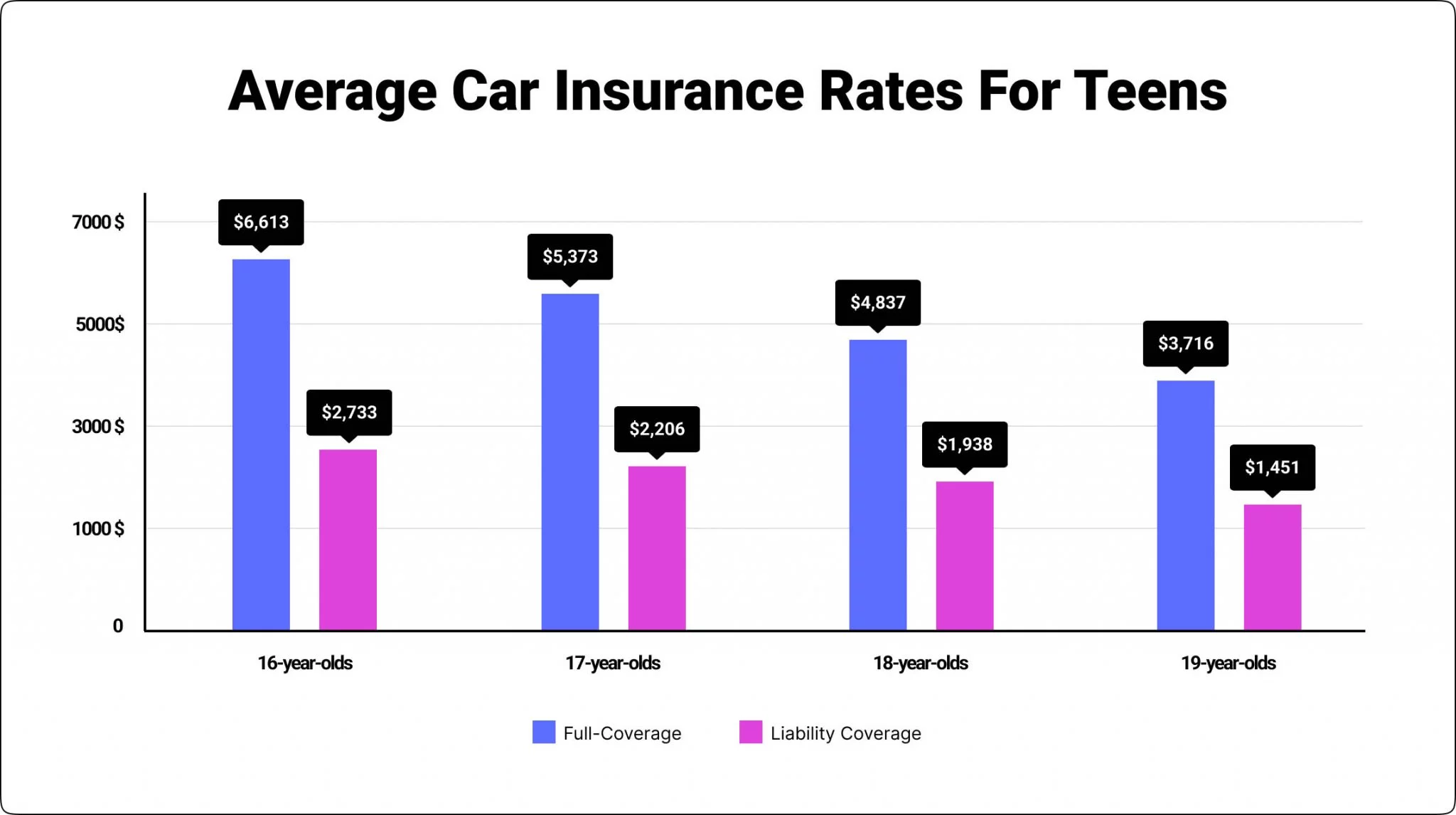
Statistically, 18-year-olds are among the highest-risk drivers on the road. Actuarial data from the Insurance Information Institute consistently shows that drivers between 16 and 19 have the highest frequency of accidents and claims. By 2026, insurers have further refined their risk models using AI and real-time data, which often results in steep premiums for new drivers who lack a multi-year "clean" driving history.
Why Rates are Higher for 18-Year-Olds
The primary driver of cost is inexperience. Insurers view 18-year-olds as high-risk due to a higher likelihood of speeding, distracted driving, and errors in judgment under pressure. In 2026, the cost of parts and labor for modern vehicles—which are increasingly equipped with expensive sensors and EV battery systems—has driven up the "severity" of claims, meaning even a minor fender-bender costs significantly more than it did a decade ago.
Comparison of State Minimum Insurance Requirements (2026 Estimates)
Each state sets its own floor for insurance. An 18-year-old moving from Ohio to California or Florida must update their policy to meet the local requirements of their new residence.
| State | Minimum Liability Limits (BI/BI Total/PD) | Additional Required Coverages | Estimated Monthly Cost (18-year-old) |
|---|---|---|---|
| California | 15/30/5 | None | $180 - $250 |
| Texas | 30/60/25 | None | $210 - $290 |
| Florida | 10/20/10 | PIP ($10,000) | $230 - $320 |
| New York | 25/50/10 | PIP ($50,000) + UM | $250 - $350 |
| Ohio | 25/50/25 | None | $140 - $190 |
| New Jersey | 25/50/25 | PIP ($15,000) | $260 - $340 |
Note: Costs are estimates for 2026 and vary wildly based on city, credit score (where legal), and driving record.
Individual Policy vs. Staying on a Parent’s Policy
One of the most critical decisions an 18-year-old faces is whether to purchase a standalone policy or remain on a family plan.
Benefits of Staying on a Parent's Policy
For most 18-year-olds, staying on a parent's policy is the most cost-effective route. Insurance companies often provide multi-car discounts and loyalty discounts that a young driver cannot access on their own. Furthermore, the parent’s higher credit score and established insurance history can "subsidize" the risk profile of the teenager, leading to a lower total household premium than if the 18-year-old sought separate coverage.
When an Individual Policy is Necessary
An 18-year-old must generally purchase their own policy if:
- They are the sole owner of the vehicle (the title is in their name only).
- They have moved out of the parental home permanently (though full-time students away at college are often exempt).
- The parents’ insurance company refuses to cover high-risk drivers or specific vehicle types.
Strategies to Lower Costs for Young Drivers
While the minimum legal requirements are fixed, the price of that coverage is not. By 2026, several programs have become standard for reducing the "youth premium."
1. Telematics and Usage-Based Insurance (UBI)
Most major insurers now offer apps or plug-in devices that track driving behavior (braking, acceleration, cornering, and time of day). For an 18-year-old willing to drive conservatively, telematics can result in discounts of 10% to 30%. This is often the most effective way for a new driver to prove they are an exception to the "high-risk" rule.
2. Good Student Discounts
Insurers continue to reward academic performance. Most companies offer a discount (averaging 10-15%) for full-time students who maintain a "B" average or a 3.0 GPA. The logic is that students who are disciplined in their studies are statistically more likely to be disciplined behind the wheel.
3. Driver Training Programs
Completing a state-certified defensive driving course or an advanced driver training program can trigger an immediate reduction in premiums. In 2026, many of these courses are available via VR (Virtual Reality) or interactive online platforms, making them more accessible than ever.
4. Vehicle Selection
The "minimum" insurance for a 2026 high-performance sports car will be vastly more expensive than the "minimum" for a used mid-sized sedan. 18-year-olds should look for vehicles with high safety ratings from the Insurance Institute for Highway Safety (IIHS), as these vehicles are cheaper to insure.
The Risks of Relying Solely on Minimum Coverage
The primary danger of "minimum auto insurance for an 18-year-old" is the gap between the policy limit and the actual cost of a modern accident.
Consider a scenario where an 18-year-old in California (which has a $5,000 property damage minimum) hits a new electric SUV. If the repair costs are $40,000, the insurance company will pay $5,000, and the 18-year-old (and potentially their parents, depending on the circumstances) is legally responsible for the remaining $35,000. This can lead to:
- Wage Garnishment: A court can order a portion of the driver's future earnings to be paid to the victim.
- Asset Seizure: Savings accounts or property can be seized to satisfy a judgment.
- Bankruptcy: Large liability judgments are a common cause of early-adult financial distress.
Frequently Asked Questions
Can an 18-year-old get insurance without a license?
Generally, no. Most insurance companies require a valid driver's license to issue a policy. However, if an 18-year-old owns a vehicle but does not drive it (e.g., they have a learner's permit and are practicing), they may be able to get a "parked car" or "non-driver" policy, but this does not satisfy state requirements for operating the vehicle on the road.
Does the gender of the 18-year-old affect the minimum insurance price?
In many states, yes. Historically, young men pay more for insurance than young women due to higher rates of reckless driving and accidents. However, several states (including California, Hawaii, Massachusetts, Michigan, Montana, North Carolina, and Pennsylvania) have banned gender-based rating for auto insurance.
Is "Full Coverage" required for 18-year-olds?
The state only requires "minimum liability." However, if the 18-year-old is financing or leasing their car, the lender will almost certainly require "full coverage," which includes Comprehensive and Collision insurance. This protects the lender's investment in the vehicle.
How long must I pay high rates before they go down?
Insurance rates typically begin to see a significant decrease once a driver turns 25, provided they have maintained a clean driving record. Small incremental decreases often occur every year after age 18 as the driver gains more "years of experience."
Can I be denied insurance at 18?
While you cannot be denied the ability to buy insurance (every state has a "high-risk pool" or assigned risk plan), private insurers can refuse to issue you a policy if you have a history of serious violations, such as a DUI or multiple at-fault accidents within your first year of driving.
Final Recommendation for 18-Year-Olds
While seeking the "minimum auto insurance" is a logical response to high premiums, the smartest move for an 18-year-old in 2026 is to seek comparative quotes for slightly higher limits. Often, increasing property damage coverage from $10,000 to $50,000 costs only a few extra dollars per month but provides five times the financial protection. Always utilize telematics programs and maintain a clean driving record to transition out of high-risk pricing brackets as quickly as possible.
Image Gallery