Master Your Mind: How to Learn to Think Critically in Everyday Life
Learning to think critically involves systematically questioning assumptions, analyzing evidence, and evaluating logical consistency before reaching a conclusion. In everyday life, this manifests as pausing to identify biases, verifyin...
Learning to think critically involves systematically questioning assumptions, analyzing evidence, and evaluating logical consistency before reaching a conclusion. In everyday life, this manifests as pausing to identify biases, verifying information sources, and considering alternative perspectives during conversations, media consumption, and decision-making processes to ensure objective and rational outcomes.
Contents
Defining Critical Thinking as a Living Skill
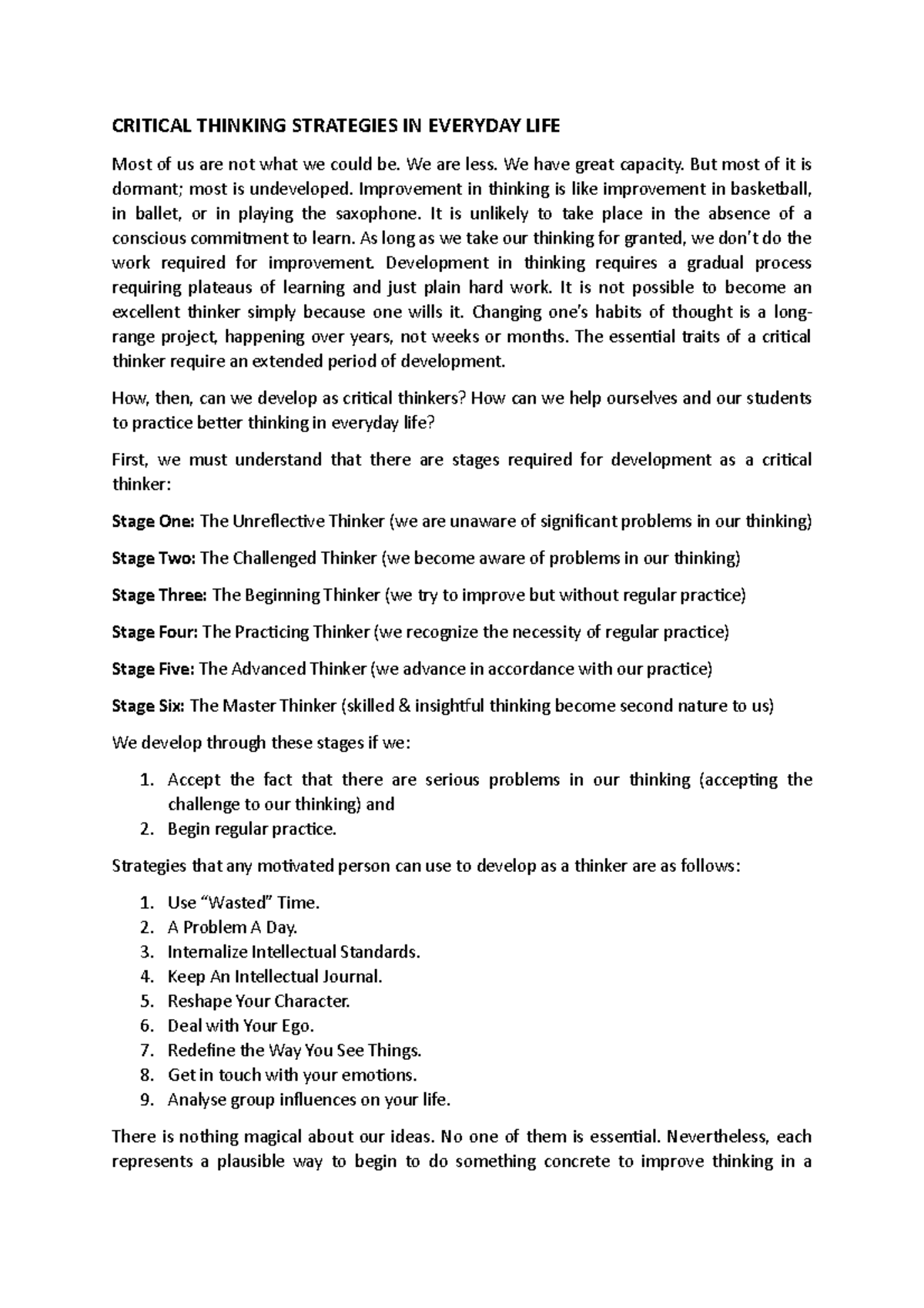
Critical thinking is frequently misunderstood as a purely academic exercise or a tendency to be "critical" in a negative sense. In reality, it is a disciplined cognitive process that allows individuals to analyze information objectively and make reasoned judgments. As of 2026, the ability to discern fact from sophisticated synthetic media and algorithmic bias has moved from being an elective skill to a fundamental necessity for navigating modern society.
At its core, critical thinking is metacognition, or "thinking about thinking." It requires an individual to step back from their immediate emotional reactions and examine the underlying structures of their thoughts. This involves identifying the purpose of a claim, the problem being solved, the data used to support it, and the implications of accepting that claim as true.
To master this skill, one must cultivate a mindset of intellectual humility. This is the recognition that one's own knowledge is limited and that personal biases can cloud judgment. By accepting that you might be wrong, you open the door to verifying information rather than simply seeking out data that confirms what you already believe.
The Core Components of the Critical Process
To learn to think critically, you must break the process down into actionable components. This allows you to apply the skill to small daily choices—such as evaluating a marketing claim—as well as major life decisions, such as a career pivot or a financial investment.
Identifying Assumptions
Every argument or statement is built upon assumptions. These are the "unspoken truths" that a person takes for granted. For example, if someone says, "We should invest in this new technology because it will increase efficiency," the underlying assumption is that efficiency is the most important goal for the organization.
To practice this, ask yourself: "What must be true for this statement to hold weight?" By uncovering these hidden premises, you can evaluate whether the foundation of an argument is actually solid. In many cases, the logic of an argument is sound, but the starting assumption is flawed.
Evaluating Evidence Quality
Not all evidence is created equal. In an era where information is abundant but often unverified, the ability to assess the source and methodology behind a claim is vital. When presented with evidence, consider the following:
- Source Authority: Is the information coming from a peer-reviewed journal, a recognized government agency, or an anonymous social media account?
- Bias and Intent: Does the source have a financial or political stake in the outcome of the argument?
- Recency and Relevance: Is the data up to date? In 2026, information regarding technology or medical science from even two years ago may be obsolete.
- Sufficiency: Is there enough evidence to support the breadth of the claim, or is it based on an isolated anecdote?
Recognizing Logical Fallacies
Logical fallacies are "glitches" in reasoning that often seem persuasive on the surface. Learning to spot these prevents you from being manipulated by rhetoric. Common fallacies include:
- The Straw Man: Misrepresenting someone's argument to make it easier to attack.
- Ad Hominem: Attacking the person making the argument rather than the argument itself.
- The Appeal to Authority: Claiming something is true solely because an "expert" said it, without examining the actual data.
- The Slippery Slope: Arguing that a small first step will inevitably lead to a chain of related (usually negative) events without providing evidence for that progression.
Practical Exercises for Daily Cognitive Discipline
Building critical thinking skills requires consistent practice, much like physical exercise. Integrating specific frameworks into your daily routine can automate these cognitive habits over time.
The "Five Whys" Technique
Originally developed for industrial problem-solving, the "Five Whys" is an excellent tool for everyday critical thinking. When faced with a problem or a strong opinion, ask "Why?" five times in succession. Each answer forms the basis of the next question. This technique strips away superficial symptoms and exposes the root cause of an issue or the core belief behind a preference.
Implementing the SIFT Method for Media
The SIFT method, developed by digital literacy experts, is particularly effective for evaluating online content. It stands for:
- Stop: Check your emotional reaction. If a headline makes you angry or elated, it is likely designed to bypass your critical faculties.
- Investigate the Source: Look beyond the name of the website. Who is behind the content?
- Find Better Coverage: Search for the same claim elsewhere to see if reputable organizations have verified or debunked it.
- Trace Claims to the Original Context: Find the original study, quote, or video to see if it has been taken out of context.
Overcoming Common Cognitive Biases
Even the most intelligent individuals are subject to cognitive biases—systematic errors in thinking that affect decisions. Recognizing these internal filters is the first step toward neutralizing them.
Confirmation Bias and the Echo Chamber
Confirmation bias is the tendency to search for, interpret, and recall information in a way that confirms one's pre-existing beliefs. In 2026, social media algorithms are highly optimized to feed this bias by creating "echo chambers." To counter this, deliberately seek out viewpoints that contradict your own. Reading a well-reasoned argument from an opposing perspective doesn't mean you have to change your mind, but it forces you to strengthen your own reasoning or identify weaknesses in your position.
The Dunning-Kruger Effect
The Dunning-Kruger effect occurs when individuals with low ability at a task overestimate their ability. Conversely, experts often underestimate their own competence, assuming that what is easy for them is easy for everyone. To mitigate this in everyday life, remain cautious when you feel "100% certain" about a complex topic outside your immediate field of expertise. True critical thinkers are often characterized by their use of probabilistic language—"based on the current evidence, it is likely that..."—rather than absolute certainty.
Critical Thinking vs. Reactive Thinking: A Comparative Analysis
To better understand how to apply these skills, it is helpful to compare the two primary modes of thought. This distinction is often referred to as "System 1" (fast, emotional) and "System 2" (slow, logical) thinking, as popularized by psychologist Daniel Kahneman.
| Feature | Reactive Thinking (System 1) | Critical Thinking (System 2) |
|---|---|---|
| Speed | Instantaneous; automatic. | Deliberate; requires time. |
| Effort | Low; requires little mental energy. | High; requires active concentration. |
| Drivers | Emotions, habits, and instincts. | Logic, evidence, and inquiry. |
| Outcome | Often biased or superficial. | Usually more objective and accurate. |
| Common Use | Driving a familiar route; social small talk. | Budgeting; evaluating news; conflict resolution. |
| Risk | High susceptibility to manipulation. | Low susceptibility to manipulation. |
Applying Critical Thinking in High-Stakes Scenarios
While critical thinking is useful for trivial matters, its true value shines in scenarios where the consequences of a poor decision are significant.
Financial and Consumer Decisions
In 2026, the consumer landscape is saturated with "personalized" AI marketing. Critical thinkers evaluate these offers by looking at the total cost of ownership rather than the monthly payment, questioning the necessity of "limited-time offers," and reading the fine print of service agreements. They ask: "Why is this company showing me this specific ad now?" and "What is the data privacy trade-off for this 'free' service?"
Navigating Interpersonal Conflict
Most arguments in daily life result from miscommunication or unexamined assumptions. Critical thinking applied to relationships involves empathetic listening. This means listening to understand the other person’s logic rather than just listening to find a gap to insert your rebuttal. By asking clarifying questions—"What did you mean when you used that word?"—you can prevent escalations caused by semantic misunderstandings.
Obstacles to Critical Thinking in 2026
The current information environment presents unique challenges. The rise of sophisticated "Deepfakes" and AI-generated text means that seeing is no longer believing. Furthermore, "information fatigue" can lead people to default to reactive thinking simply because they are exhausted by the effort required to verify everything.
To combat this, it is essential to prioritize your cognitive energy. You do not need to apply deep critical analysis to every dinner choice, but you should have a "trigger" for when to engage your analytical mind. High-stakes triggers should include health information, political engagement, financial commitments, and significant career moves.
Frequently Asked Questions
Does critical thinking mean I have to be skeptical of everything? Critical thinking is not about cynicism or constant doubt; it is about healthy skepticism. It means requiring a level of evidence proportional to the claim. You don't need a scientific study to believe a friend had coffee this morning, but you should require substantial proof before adopting a new, unproven medical treatment.
Can children learn to think critically, or is it an adult skill? Critical thinking can and should be taught early. For children, this involves asking "How do you know that is true?" or "What do you think would happen if...?" rather than just providing them with facts to memorize. It is about fostering a sense of curiosity and a methodology for inquiry.
How long does it take to become a proficient critical thinker? Critical thinking is a lifelong practice rather than a destination. While you can learn the basic frameworks, such as the RED Model (Recognize assumptions, Evaluate arguments, Draw conclusions), in a few hours, the habit of applying them consistently takes months of conscious effort to develop.
Is critical thinking the same as being "smart"? Not necessarily. Highly intelligent people are often better at "rationalizing"—using their intellect to justify a belief they already hold for emotional reasons. Critical thinking is a set of skills and habits that can be learned by anyone, regardless of their baseline IQ, to improve the quality of their decisions.
How do I handle people who get offended when I question their claims? Frame your questions as a desire for understanding rather than a challenge to their authority. Use "I" statements, such as "I'm trying to understand the logic behind that," or "Could you help me see how you reached that conclusion?" This lowers defensiveness and promotes a collaborative search for truth.
Recommended Next Actions
To begin your journey toward more analytical thinking, start with one small habit: the "Three-Second Pause." Before sharing a post on social media, making an impulsive purchase, or responding to a provocative comment, wait three seconds. During those seconds, ask yourself: "Is this true, and why am I reacting this way?" This small gap between stimulus and response is the foundation upon which all critical thinking is built. For further study, explore resources from the Foundation for Critical Thinking or the American Psychological Association (APA) regarding cognitive development and bias.
Image Gallery