Why Data Scientist Programming Languages Matter in Everyday Work
The choice of programming language in data science is not merely a matter of developer preference; it is a fundamental architectural decision that dictates how efficiently a practitioner can move from raw data to actionable insight. By...
The choice of programming language in data science is not merely a matter of developer preference; it is a fundamental architectural decision that dictates how efficiently a practitioner can move from raw data to actionable insight. By influencing computational performance, library ecosystem support, and integration capabilities, the underlying language directly determines the scalability, reproducibility, and deployment speed of analytical workflows in a production environment.
Contents
The Foundation of Data Analysis Workflows
Data science is a multidisciplinary field that relies on the ability to ingest, transform, visualize, and model data. The programming language serves as the interface between the human analyst and the computational infrastructure. When a data scientist selects a language, they are essentially choosing their primary toolkit.
If a language lacks robust, community-maintained libraries for specific tasks—such as advanced statistical modeling or real-time streaming—the scientist must spend significant time building custom solutions or cobbling together fragile workarounds. This "tooling debt" accumulates quickly. A language with a mature ecosystem, like Python or R, provides pre-optimized functions that handle the heavy lifting of linear algebra, optimization, and data manipulation. This allows the practitioner to focus on the logic of the business problem rather than the mechanics of memory management or low-level implementation.
Performance vs. Development Velocity
The tension between execution speed and development velocity is a defining characteristic of data science projects. High-level languages like Python are favored for their expressive syntax, which allows data scientists to iterate rapidly through experimental phases. However, Python’s inherent performance limitations—primarily due to its Global Interpreter Lock (GIL) and dynamic typing—can become a bottleneck when processing multi-terabyte datasets.
To mitigate these issues, modern data science environments rely on languages that utilize compiled backends. For instance, while a data scientist writes Python code, the actual computation is often offloaded to libraries like NumPy or PyTorch, which are written in C or C++. This hybrid approach is crucial. The language matters here because it determines how easily a team can interface with high-performance engines without needing to rewrite entire pipelines in lower-level languages like C++ or Rust.
Integration and Deployment Efficiency
In 2026, the transition of a model from a local environment to a production service is often the most significant point of failure in the data science lifecycle. If the language used for model training is not compatible with the production infrastructure, the organization faces substantial technical debt.
For example, if a team develops a predictive model in a niche language that does not support modern containerization tools like Docker or standard cloud-native APIs, the model must be "translated" into a deployment-friendly language. This translation process introduces human error and creates a synchronization problem. When the source data shifts or the model requires a weight update, the team must maintain two distinct codebases. Choosing a language that is widely supported across CI/CD (Continuous Integration and Continuous Deployment) pipelines ensures that the transition from a Jupyter notebook to a scalable, containerized microservice is as seamless as possible.
Comparative Analysis of Primary Languages
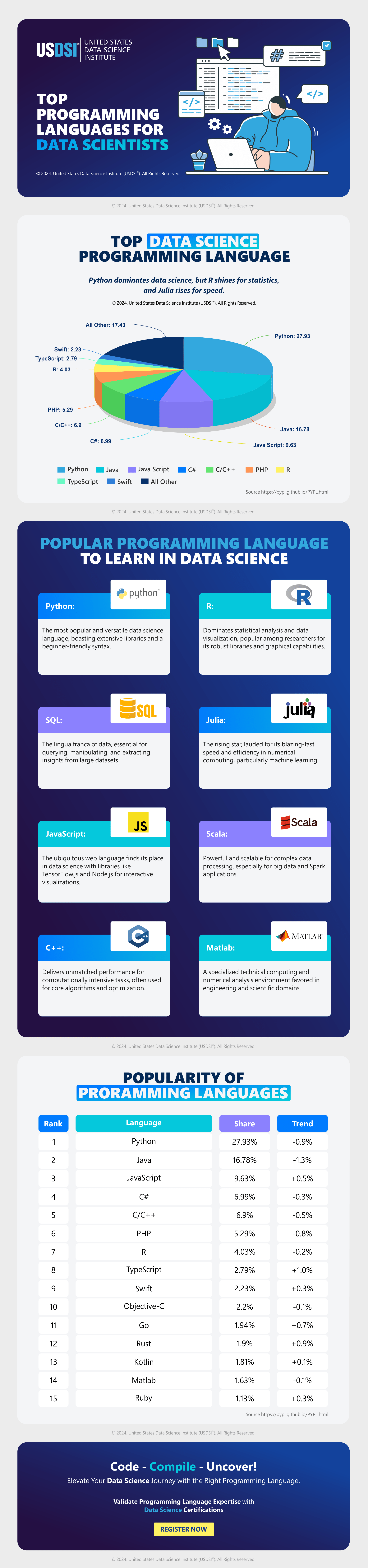
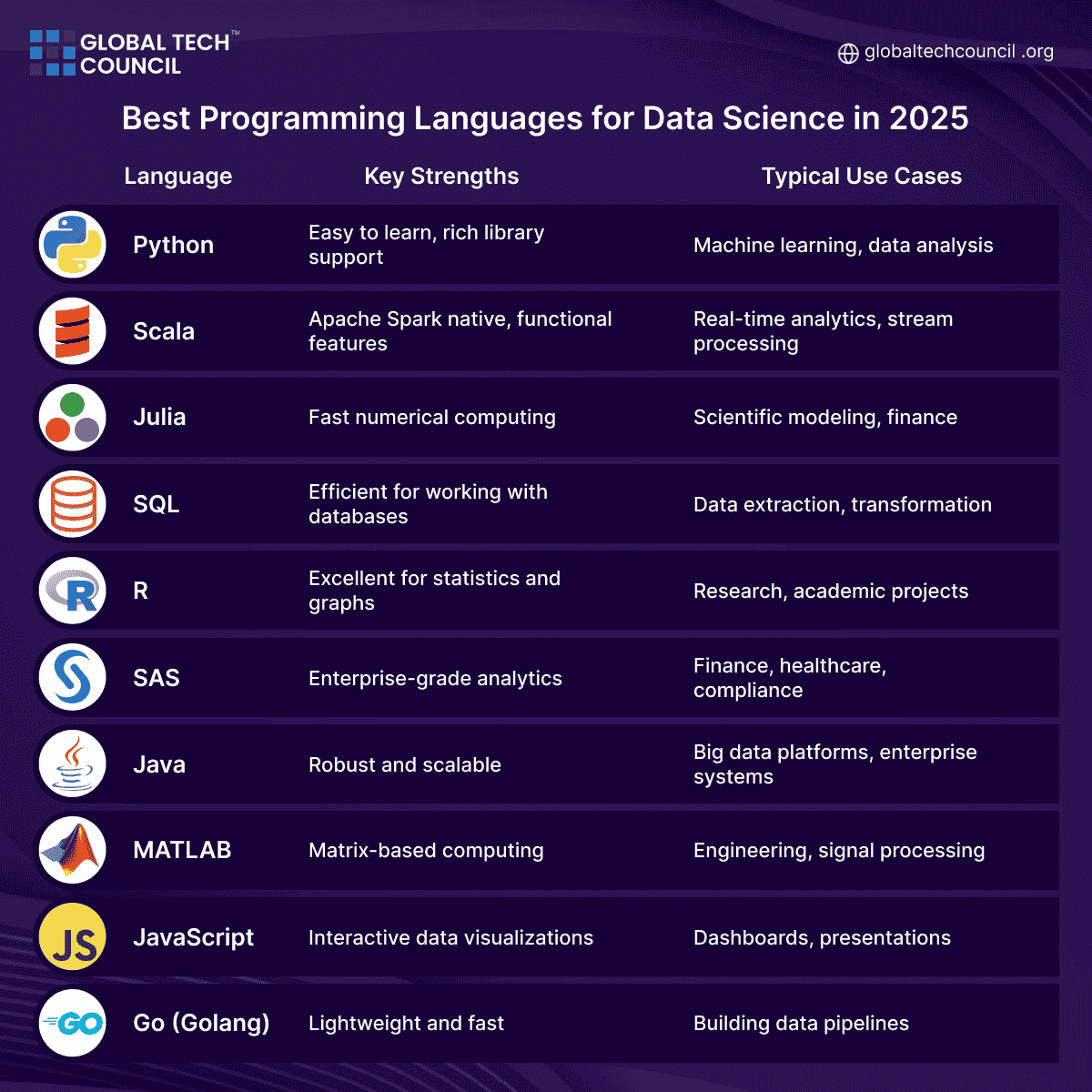
The following table outlines how different languages serve various functional requirements within a standard data science environment.
| Feature | Python | R | SQL | Julia |
|---|---|---|---|---|
| Primary Use | General-purpose, ML, DL | Statistics, Research | Data Retrieval, ETL | High-performance Computing |
| Learning Curve | Gentle | Moderate | Moderate | Steep |
| Deployment Ease | High | Low/Moderate | Very High | Low |
| Computational Speed | Low (but extensible) | Moderate | High (Database-side) | Very High |
The Role of Ecosystem and Community Support
A programming language is only as effective as the community supporting it. In data science, the availability of specialized packages—such as Pandas for data manipulation, Scikit-learn for machine learning, or Tidyverse for statistical analysis—drastically reduces the time to value.
When choosing a language, practitioners must assess the longevity of the ecosystem. A language that enjoys massive adoption among both industry practitioners and academic researchers is more likely to receive frequent security patches, updates for new hardware (like advancements in GPU acceleration), and stable documentation. In an enterprise setting, relying on a language with a shrinking community increases the risk that an organization will be left with outdated, insecure, or incompatible software as infrastructure demands evolve.
Overcoming Common Language-Related Challenges
Data scientists frequently encounter hurdles related to language limitations. Understanding these is essential for maintaining project momentum:
- Dependency Hell: Managing environments using tools like Conda or Poetry is essential. Language-specific package managers prevent version conflicts where one library requires a specific version of a dependency that breaks another.
- Memory Overhead: When working with large-scale datasets, dynamic languages can consume significant memory. Data scientists must be familiar with techniques like lazy loading, chunking, or utilizing distributed computing frameworks like Apache Spark, which provide interfaces for these languages to interact with large datasets without loading them entirely into system RAM.
- Type Safety: The transition from experimental code to production-grade software often requires introducing static analysis. Using type hinting in Python, for instance, allows teams to catch bugs earlier in the development cycle, long before the code reaches a production environment.
Frequently Asked Questions
Does the choice of language limit the type of AI model I can build? In most cases, no. Almost all modern AI frameworks provide bindings for the most popular languages. However, some languages have "first-class" support for certain libraries. For example, PyTorch and TensorFlow have deeper, more stable integrations with Python, making it the default choice for deep learning research and production.
Should I learn multiple programming languages for data science? Yes. While you should master one primary language for core tasks, learning SQL is non-negotiable for anyone handling data. Additionally, understanding the basics of a lower-level language like C++ or Rust can help you write more performant extensions when you hit the limitations of high-level scripting languages.
How does cloud infrastructure affect my language choice? Cloud providers offer managed services that prioritize certain runtimes. If your organization relies heavily on a specific cloud provider's managed ML platforms, you should prioritize the languages that have native SDK support for those platforms to simplify authentication, logging, and infrastructure scaling.
What is the "Productionization" gap? This refers to the difficulty of taking an algorithm that works on a local laptop and moving it to a high-availability server. Choosing a language with robust support for REST APIs, serialization (such as ONNX), and monitoring tools significantly reduces this gap.
Next Steps for Practitioners
To improve your workflow, audit your current data science stack. Identify which tasks take the longest to execute or cause the most friction during deployment. If your team spends more time fighting the limitations of your language than building models, consider integrating specialized tools or transitioning parts of your pipeline to languages better suited for those specific bottlenecks. Start by implementing standardized environment management practices, as this is the most immediate way to improve reliability regardless of the language used.
Image Gallery