How Much Do You Pay for PMI on a Conventional Loan?
On a conventional mortgage, private mortgage insurance (PMI) typically costs between 0.2% and 2.0% of your total loan amount per year, though most home buyers pay between 0.5% and 1.5%. For a $350,000 loan, this equates to roughly $146...
On a conventional mortgage, private mortgage insurance (PMI) typically costs between 0.2% and 2.0% of your total loan amount per year, though most home buyers pay between 0.5% and 1.5%. For a $350,000 loan, this equates to roughly $146 to $437 per month, depending primarily on your credit score, down payment percentage, and debt-to-income ratio.
Contents
Financial Advice Disclaimer
This article is provided for informational and educational purposes only and does not constitute formal financial, legal, or mortgage underwriting advice. Mortgage insurance rates, loan guidelines, and regulatory rules vary by lender, loan type, and state jurisdiction. Consult a licensed mortgage loan originator or qualified financial advisor before selecting a loan product.
What Is PMI and Why Do Conventional Lenders Require It?
Private Mortgage Insurance (PMI) is a specialized policy issued by private insurance companies that protects conventional mortgage lenders against financial losses if a borrower defaults on their loan. It is important to note that while the buyer pays the monthly premium, the policy solely protects the lender, not the homeowner.
Under standard conventional loan guidelines established by Fannie Mae and Freddie Mac, any conventional mortgage with a loan-to-value (LTV) ratio exceeding 80% requires mortgage insurance. Putting down less than 20% of the purchase price represents higher financial risk to the lending institution. PMI mitigates this risk, allowing lenders to approve mortgages for buyers who have not accumulated a full 20% down payment.
Unlike government-backed mortgages (such as FHA loans, which require upfront and ongoing Mortgage Insurance Premiums), conventional PMI is provided by private entities like Enact, Radian, Essent, and MGIC. Because these private insurers evaluate risk granularly, conventional PMI rates fluctuate heavily based on borrower credit profiles and equity levels.
Average Cost of PMI on a Conventional Loan
The annual cost of PMI depends on the size of the loan and the specific rate factor assigned by the mortgage insurer. Rate factors are expressed as a percentage of the loan balance.
To calculate your annual PMI cost, multiply the total loan amount by your assigned PMI rate factor. Dividing that annual figure by 12 yields your monthly PMI payment added to your principal, interest, taxes, and home insurance (PITI) statement.
Estimated Monthly PMI Payments by Loan Amount
The following table demonstrates standard monthly PMI payments across various loan sizes based on common annual rate factors:
| Loan Amount | Low PMI Rate (0.30%) | Average PMI Rate (0.75%) | High PMI Rate (1.50%) |
|---|---|---|---|
| $250,000 | $62.50 / month | $156.25 / month | $312.50 / month |
| $350,000 | $87.50 / month | $218.75 / month | $437.50 / month |
| $450,000 | $112.50 / month | $281.25 / month | $562.50 / month |
| $600,000 | $150.00 / month | $375.00 / month | $750.00 / month |
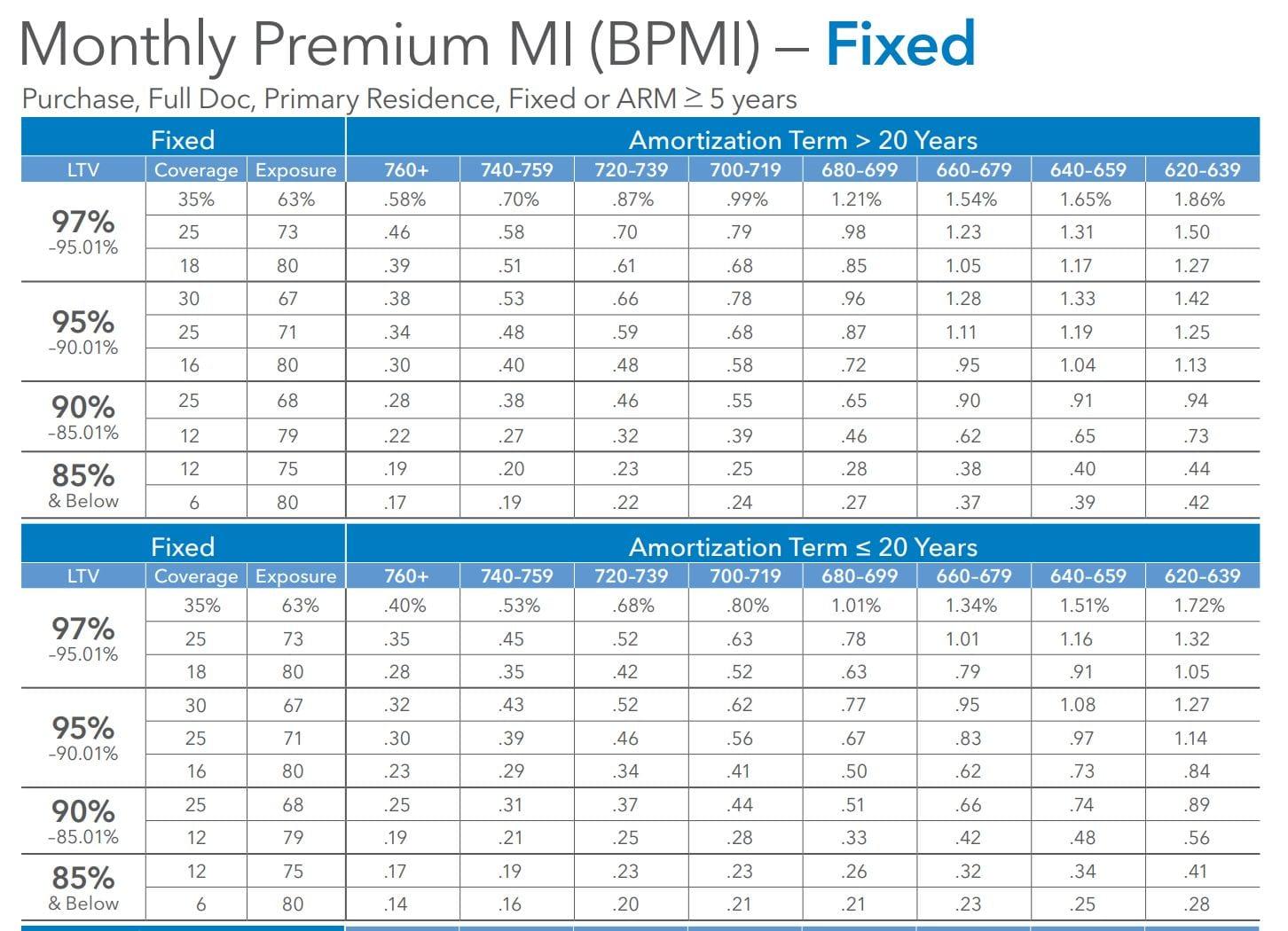
Borrowers with exceptional credit scores (760 or higher) combined with a 15% down payment often receive rates near the lower end of the spectrum (0.20% to 0.40%). Conversely, borrowers with credit scores near the minimum conventional threshold (620 to 640) and a 3% down payment face rates reaching 1.50% to 2.20% or higher.
5 Core Factors That Determine Your PMI Cost
Mortgage insurance providers use risk-based pricing matrices to calculate individual premiums. Understanding these variables helps buyers optimize their financial profile before submitting a mortgage application.
- Credit Score (Higher score = lower PMI rate)
- Down Payment / LTV (More equity = lower PMI rate)
- Premium Structure (BPMI, LPMI, Single, or Split)
- Loan Type & Term (15-yr vs. 30-yr fixed/adjustable)
- Property Occupancy (Primary vs. Second Home)
1. Credit Score
Your credit score is the single most influential variable affecting conventional PMI premiums. Private insurers penalize low credit scores significantly more than government programs like the FHA. A borrower with a 760 credit score might pay 0.35% annually, while a borrower purchasing the exact same home with a 640 credit score could be charged 1.65%.
2. Loan-to-Value (LTV) Ratio & Down Payment
The LTV ratio reflects the percentage of the home's appraisal value or purchase price that is financed. Larger down payments reduce the insurer’s exposure to loss.
- 95.01% – 97% LTV (3% to 4.9% down): Highest premium tier.
- 90.01% – 95% LTV (5% to 9.9% down): Moderate premium reduction.
- 85.01% – 90% LTV (10% to 14.9% down): Substantial premium reduction.
- 80.01% – 85% LTV (15% to 19.9% down): Lowest premium tier before PMI is eliminated completely.
3. Loan Term and Structure
Fixed-rate 30-year mortgages carry baseline PMI rates. Fixed-rate 15-year or 20-year mortgages feature lower PMI premiums because the loan principal amortizes much faster, reducing lender risk sooner. Adjustable-Rate Mortgages (ARMs) frequently carry slightly higher PMI rates due to interest rate fluctuation risks.
4. Occupancy and Property Type
Primary residences carry lower PMI rates than second homes or investment properties. Single-family detached homes receive the best pricing, while multi-unit properties (2 to 4 units) and condominiums incur rate adjustments due to higher statistical default risk.
5. Coverage Percentage Demanded by Guidelines
Fannie Mae and Freddie Mac dictate standard coverage levels based on loan terms and LTV ratios. For example, a 30-year fixed loan with 95% LTV typically requires 30% coverage, whereas a loan with 85% LTV only requires 12% coverage. Higher required coverage levels directly increase the monthly premium cost.
Types of PMI Payment Structures
Borrowers can select from four primary payment structures depending on their upfront cash reserves and long-term tax strategy.
1. Monthly Borrower-Paid PMI (BPMI)
This is the standard and most common structure. The cost is divided into 12 monthly installments added to your regular mortgage payment.
- Advantage: Requires no extra upfront cash at closing.
- Advantage: Can be canceled once you reach 20% equity in your home.
2. Single-Premium PMI
With single-premium PMI, the borrower pays the entire mortgage insurance cost upfront at closing in one lump sum, or finances the lump sum into the final loan balance.
- Advantage: Eliminates the monthly recurring PMI payment, lowering your total monthly obligation.
- Disadvantage: Upfront funds are generally non-refundable if you sell or refinance the home early.
3. Split-Premium PMI
Split-premium PMI combines aspects of monthly and single-premium models. You pay a smaller partial upfront fee at closing (typically 0.50% to 1.25% of the loan amount) and a reduced monthly payment thereafter.
- Advantage: Lowers ongoing monthly payments without requiring the heavy capital outlay of a full single premium.
- Advantage: Useful for buyers who need to lower their monthly debt-to-income (DTI) ratio to qualify for a loan amount.
4. Lender-Paid PMI (LPMI)
Under Lender-Paid PMI, the mortgage lender pays the upfront mortgage insurance premium on your behalf. In exchange, the lender increases your mortgage interest rate (typically by 0.25% to 0.75%).
- Advantage: Lower monthly cash payment compared to standard BPMI combined with a base interest rate.
- Disadvantage: The higher interest rate remains for the life of the loan. Unlike BPMI, LPMI cannot be canceled when your equity reaches 20% unless you refinance the mortgage.
Detailed Rate Comparison Matrix
The table below illustrates sample annual PMI rate percentages based on standard 30-year fixed conventional loans for primary single-family residences. Data represents standard insurer rate cards applied across various FICO score bands and down payment levels:
| Credit Score (FICO) | 3% Down (97% LTV) | 5% Down (95% LTV) | 10% Down (90% LTV) | 15% Down (85% LTV) |
|---|---|---|---|---|
| 760+ | 0.55% | 0.38% | 0.24% | 0.18% |
| 740 – 759 | 0.72% | 0.52% | 0.32% | 0.22% |
| 720 – 739 | 0.94% | 0.68% | 0.41% | 0.26% |
| 700 – 719 | 1.15% | 0.85% | 0.53% | 0.32% |
| 680 – 699 | 1.40% | 1.05% | 0.66% | 0.38% |
| 660 – 679 | 1.70% | 1.35% | 0.88% | 0.48% |
| 640 – 659 | 2.10% | 1.65% | 1.10% | 0.62% |
Note: These percentages represent sample market averages. Specific quotes vary by mortgage insurer, debt-to-income profile, and regional underwrite.
Rules for Canceling Conventional PMI
Unlike FHA mortgage insurance—which usually lasts for the lifetime of the loan—conventional PMI is designed to be temporary. The federal Homeowners Protection Act of 1998 (HPA) establishes clear legal standards for canceling borrower-paid PMI.
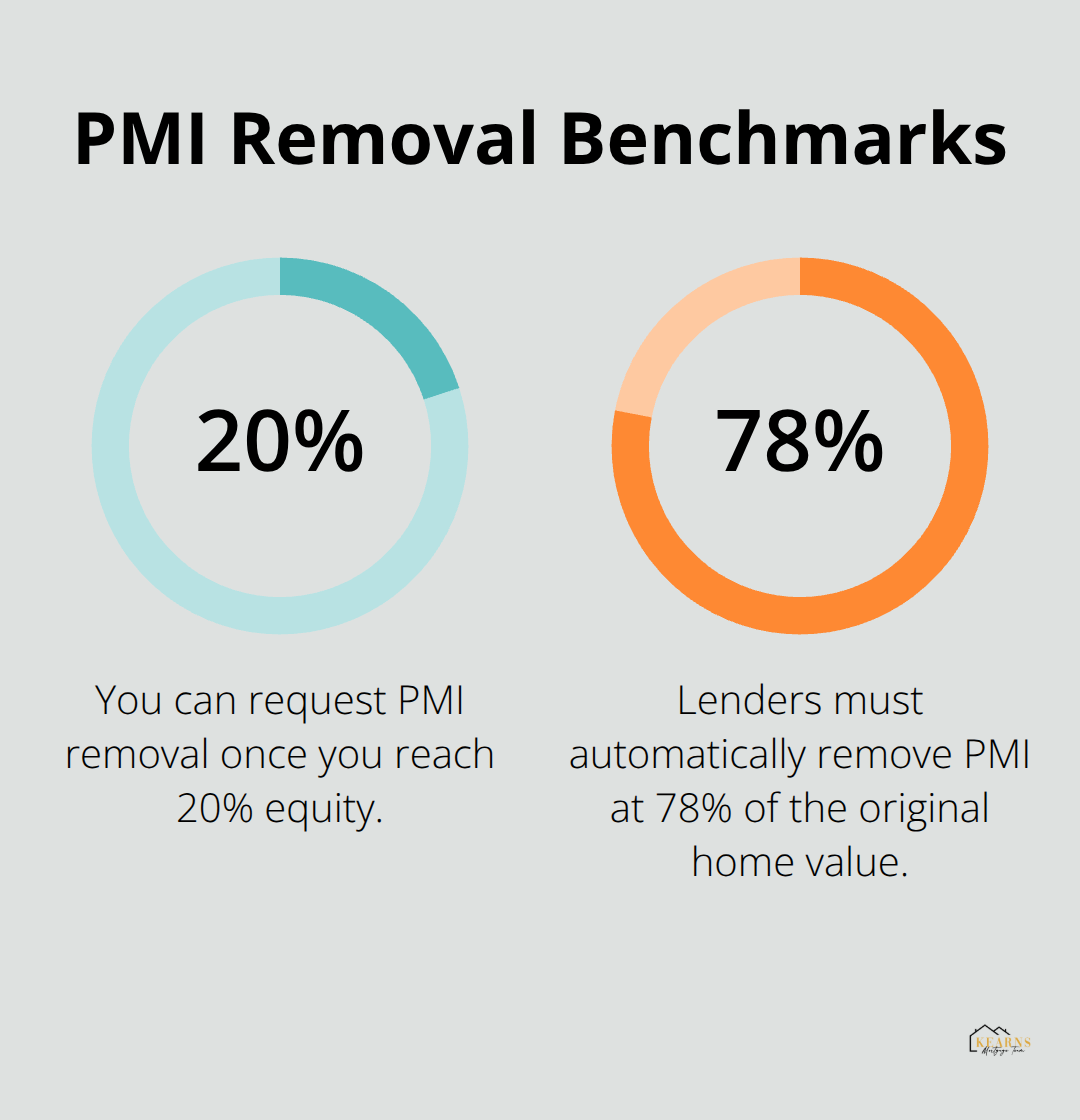
- 80% LTV: Borrower can request cancellation (Requires good payment history)
- 78% LTV: Automatic lender termination (Based on original schedule)
- 50% Point: Midpoint of amortization schedule (Mandatory final termination)
1. Requested Cancellation (80% LTV)
You have the legal right to submit a written request to your mortgage servicer to cancel PMI once your loan balance reaches 80% of the home's original value (the lesser of the original purchase price or original appraised value).
To qualify for requested cancellation:
- You must have a good payment history (no payments 30 days late within the past 12 months, and no payments 60 days late within the past 24 months).
- You must certify that there are no secondary liens (such as a home equity line of credit) on the property.
- You may be required to prove the home’s market value has not declined below its original valuation through a servicer-ordered appraisal.
2. Automatic Termination (78% LTV)
The mortgage servicer is legally required to automatically terminate your monthly PMI when your principal balance reaches 78% of the original home value, based strictly on the original amortization schedule.
- The borrower must be current on all scheduled monthly mortgage payments for automatic termination to trigger.
3. Midpoint Termination
If you reach the midpoint of your loan’s amortization schedule (e.g., year 15 of a 30-year mortgage) and are current on payments, the lender must terminate PMI, even if your principal balance has not yet reached 78% of the original value.
4. Removal via Rising Home Equity (Market Appreciation)
If property values in your neighborhood appreciate significantly, or if you complete major home renovations, you may reach 20% equity faster than your original payment schedule dictates. Fannie Mae and Freddie Mac guidelines generally permit PMI cancellation based on a new appraisal under specific conditions:
- 2-to-5-Year Loan Age: Requires a maximum LTV of 75% (25% equity) based on a new valuation.
- Over 5-Year Loan Age: Requires a maximum LTV of 80% (20% equity) based on a new valuation.
- Significant Improvements: If you performed major structural improvements that increased market value, the minimum time-on-loan requirement may be waived by the servicer.
Conventional PMI vs. FHA Mortgage Insurance (MIP)
Borrowers deciding between a conventional loan and an FHA loan should carefully evaluate how mortgage insurance structures differ between the two formats.
| Feature | Conventional PMI | FHA MIP |
|---|---|---|
| Upfront Fee | Optional | Mandatory (1.75%) |
| Credit Sensitivity | Very High | Low / Flat Rates |
| Cancellation | Drops at 80% LTV | Life of loan (>10% dp required to drop) |
FHA Mortgage Insurance Premiums (MIP)
- Upfront MIP: Requires a mandatory 1.75% upfront fee paid at closing or added to the loan balance.
- Annual MIP: Charges a flat annual rate (typically 0.55% for most 30-year loans with 3.5% down) regardless of credit score.
- Duration: For buyers putting down less than 10%, FHA MIP remains active for the entire life of the loan, requiring a future mortgage refinance to remove.
Conventional Private Mortgage Insurance (PMI)
- Upfront Fee: No mandatory upfront insurance fee for standard monthly BPMI.
- Risk-Based Premiums: Higher credit scores yield significantly lower rates than FHA MIP, while lower credit scores yield higher rates.
- Duration: Automatically drops off once specified equity thresholds are achieved without needing to refinance.
For buyers with credit scores above 720, conventional PMI is almost universally cheaper and more flexible than FHA mortgage insurance. For buyers with credit scores below 660, FHA loans often provide lower total monthly payments, though the inability to remove MIP without refinancing remains a key long-term drawback.
How to Reduce or Avoid Conventional PMI
If you want to keep your monthly payments as low as possible, consider these practical strategies to minimize or completely eliminate PMI expenses:
1. Put Down 20% or More
The most direct way to eliminate PMI is to finance 80% or less of the home's purchase price. This can be accomplished through personal savings, seller concessions, or gift funds from family members.
2. Utilize a Piggyback Loan (80-10-10 Structure)
A piggyback loan structure splits your financing into two separate mortgages:
- First Mortgage: Covers 80% of the purchase price (eliminating PMI requirements).
- Second Mortgage: Covers 10% of the purchase price (often structured as a Home Equity Line of Credit or fixed second loan).
- Down Payment: Covers the remaining 10% in cash.
Trade-off: While this structure eliminates PMI, the interest rate on the second mortgage is usually higher than standard conventional rates, and you will manage two separate monthly payments.
3. Strengthen Your Credit Score Before Applying
Because conventional PMI rates are heavily credit-dependent, raising your FICO score by 20 to 40 points prior to applying for a loan can save thousands of dollars over the life of the mortgage policy. Pay down revolving credit card balances and resolve any derogatory credit items to cross into a higher pricing tier.
4. Opt for Special Regional or Professional Loan Programs
Certain specialized loan options offer low down payments without requiring PMI:
- VA Loans: Available to eligible military service members and veterans; requires zero down payment and no monthly mortgage insurance (though a one-time VA funding fee applies).
- Physician / Professional Loans: Tailored for medical doctors, attorneys, or certified public accountants; often permit low down payments without monthly PMI.
- Community Lending Programs: Programs like Fannie Mae HomeReady or Freddie Mac Home Possible offer reduced PMI rates for low-to-moderate-income buyers.
Frequently Asked Questions
Is PMI tax-deductible?
Federal tax laws regarding PMI deductibility have changed periodically. While PMI was historically deductible as mortgage interest for qualifying income brackets under specific extensions, standard tax rules should be verified directly with a Certified Public Accountant (CPA) or tax professional for your specific filing year.
Does PMI protect me if I lose my job or cannot pay my mortgage?
No. PMI protects the mortgage lender against financial default; it does not protect the homeowner. It does not pay your mortgage if you experience job loss, disability, or death. Homeowners seeking personal financial protection should investigate disability insurance, term life insurance, or income protection policies.
How do I request PMI cancellation once I reach 20% equity?
Submit a written request directly to your mortgage servicer (the company to which you make monthly payments). Ask for their specific PMI cancellation guidelines and requirements. The servicer will evaluate your loan payment history and notify you if a certified property appraisal is necessary to verify current market value.
Can I remove PMI by refinancing my mortgage?
Yes. If your home's market value has increased or if you have paid down your principal balance significantly, you can apply for a replacement conventional loan. If the new appraisal demonstrates that your loan-to-value ratio is 80% or lower, the new mortgage will not require PMI. Remember to weigh closing costs against your ongoing PMI savings when evaluating a refinance strategy.
Recommended Next Steps for Home Buyers
- Calculate Your Target LTV: Evaluate your available liquid funds to determine whether a 5%, 10%, or 15% down payment offers the best balance between initial cash reserves and monthly PMI pricing.
- Review Your Credit Profile: Obtain official copies of your credit reports. Prioritize paying down revolving balances to maximize your score before requesting formal mortgage rate quotes.
- Compare Insurer Rate Cards: Ask your mortgage originator for a detailed line-item comparison showing monthly BPMI, single-premium PMI, and lender-paid PMI options across multiple rate quotes.
- Monitor Property Equity Post-Closing: Track local real estate appreciation and your remaining principal balance annually so you can request PMI cancellation the precise moment you reach 20% equity.
Image Gallery