How to Use Proper Spanish Grammar: A Complete Structural Guide
To use proper Spanish grammar, you must master noun-adjective gender and number agreement, memorize core verb conjugation patterns across three moods (indicative, subjunctive, and imperative), and understand essential paired distinctio...
To use proper Spanish grammar, you must master noun-adjective gender and number agreement, memorize core verb conjugation patterns across three moods (indicative, subjunctive, and imperative), and understand essential paired distinctions like ser versus Estar and por versus para. Building consistent sentence structure requires placing object pronouns correctly and applying accurate accent marks to preserve stress and meaning.
Contents
Understanding the Core Pillars of Spanish Grammar
Spanish grammar is fundamentally systematic, relying on structured rules of agreement, inflection, and syntax. Unlike English, which relies heavily on strict word order to convey grammatical relationships, Spanish relies on verb endings and concordances to indicate who is performing an action, when it occurs, and how elements within a sentence relate to one another.
Achieving fluency requires moving beyond word-for-word translation. Learners must adopt the underlying logic of the language, beginning with its foundational structural components: noun classification, article usage, and agreement.
Noun Gender and Number Agreement
Every noun in Spanish possesses an inherent grammatical gender: masculine or feminine. Grammatical gender does not strictly correlate to biological sex; rather, it is a categorization system that dictates how accompanying words, such as articles and adjectives, must adjust.
As a general guideline:
- Nouns ending in -o are typically masculine (el libro, el zapato).
- Nouns ending in -a are typically feminine (la mesa, la casa).
- Nouns ending in -ción, -sión, -dad, -tad, and -tud are almost universally feminine (la canción, la ciudad, la libertad).
- Nouns ending in -ma, -pa, or -ta derived from Greek are often masculine (el problema, el mapa, el sistema).
Notable exceptions exist that require memorization, such as el día (masculine) and la mano (feminine). Additionally, feminine singular nouns beginning with a stressed a- or ha- sound take the masculine singular article el solely to prevent cacophony (e.g., el agua fría or el hacha afilada), though the noun remains syntactically feminine and requires feminine adjectives.
Pluralization follows predictable patterns:
- Nouns ending in a vowel add -s (libro $\rightarrow$ libros).
- Nouns ending in a consonant add -es (hotel $\rightarrow$ hoteles).
- Nouns ending in -z change the z to c before adding -es (el pez $\rightarrow$ los peces).
Adjectives must agree in both gender and number with the noun they modify. In Spanish, descriptive adjectives usually follow the noun (un coche rojo, unas casas blancas), whereas limiting adjectives (such as numbers or demonstratives) precede the noun (tres libros, esta mesa).
Definite and Indefinite Articles
Articles in Spanish signal both the gender and number of the noun they introduce, while defining whether the noun is specific or general.
- Definite Articles (equivalent to "the"):
- Masculine singular: el
- Feminine singular: la
- Masculine plural: los
- Feminine plural: las
- Indefinite Articles (equivalent to "a", "an", or "some"):
- Masculine singular: un
- Feminine singular: una
- Masculine plural: unos
- Feminine plural: unas
Unlike English, Spanish frequently requires definite articles when speaking about concepts in a general sense (El baloncesto es divertido / "Basketball is fun") or when using titles of respect in the third person (El señor Gómez está aquí / "Mr. Gómez is here").
Mastering Spanish Verb Conjugations and Tenses
Verbs serve as the engine of Spanish grammar. Spanish is a pro-drop (pronoun-dropping) language, meaning explicit subject pronouns (yo, tú, él, etc.) are usually omitted because the verb inflections themselves explicitly communicate the subject.
Regular vs. Irregular Verb Patterns
Spanish infinitives end in one of three categories: -ar, -er, or -ir. Regular verbs follow consistent patterns where the stem remains constant while the termination changes according to the person, number, tense, and mood.
For present indicative tense, the regular terminations follow this pattern:
| Subject Pronoun | -AR Verbs (Hablar) | -ER Verbs (Comer) | -IR Verbs (Vivir) |
|---|---|---|---|
| Yo (I) | hablo | como | vivo |
| Tú (You informal) | hablas | comes | vives |
| Él / Ella / Usted (He/She/You formal) | habla | come | vive |
| Nosotros / Nosotras (We) | hablamos | comemos | vivimos |
| Vosotros / Vosotras (You all - Spain) | habláis | coméis | vivís |
| Ellos / Ellas / Ustedes (They/You all) | hablan | comen | viven |
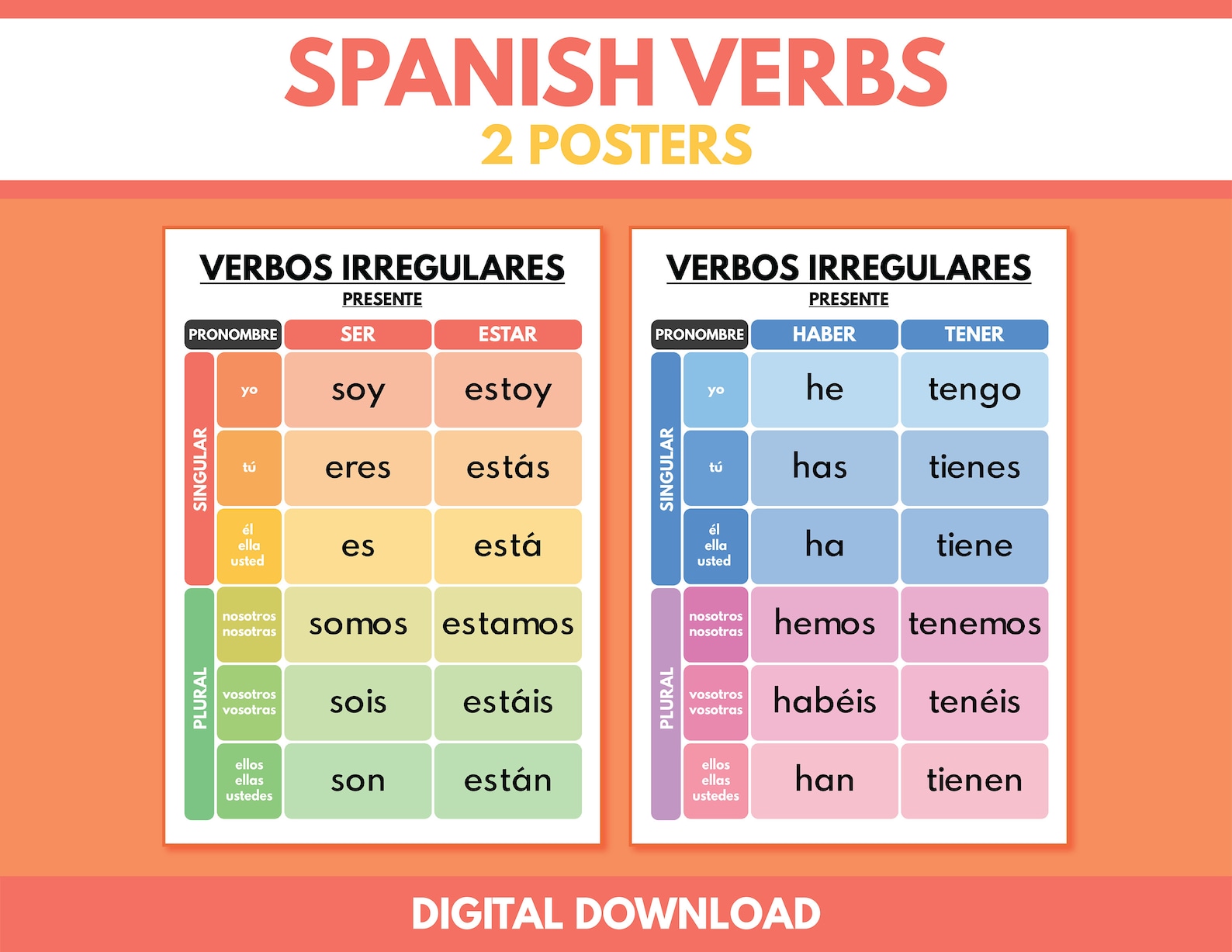
Irregular verbs deviate from these stem or ending rules. Stem-changing verbs alter their root vowel in the present tense (except for nosotros and vosotros), such as e $\rightarrow$ ie (pensar $\rightarrow$ pienso), o $\rightarrow$ ue (dormir $\rightarrow$ duermo), and e $\rightarrow$ i (pedir $\rightarrow$ pido). Fully irregular verbs, such as ir (to go), ser (to be), and haber (auxiliary to have), require memorization.
The Indicative, Subjunctive, and Imperative Moods
Understanding Spanish verb usage requires recognizing that tenses reside within three grammatical moods that reflect the speaker's perspective:
- Indicative Mood: Expresses facts, objective statements, certainty, and actual events in the past, present, or future (e.g., Sé que viene / "I know he is coming").
- Subjunctive Mood: Expresses subjectivity, doubt, wishes, hypothetical situations, emotions, or unconfirmed actions (e.g., Dudo que venga / "I doubt that he is coming"). According to the official reference guidelines of the Real Academia Española, the subjunctive mood is triggered by specific matrix verbs and subordinating conjunctions expressing desire, uncertainty, or impersonal evaluation.
- Imperative Mood: Expresses direct commands, requests, or instructions (e.g., ¡Habla más despacio! / "Speak slower!").
Navigating Past Tenses: Preterite vs. Imperfect
A common challenge for learners of Spanish grammar is selecting between the two primary past tenses in the indicative mood:
- Preterite (Pretérito Indefinido): Describes completed actions that occurred at a specific point in time or within a defined timeframe (Ayer comí una manzana / "Yesterday I ate an apple").
- Imperfect (Pretérito Imperfecto): Describes ongoing, habitual, or background actions in the past where the exact beginning or end is unspecified (Cuando era niño, comía manzanas todos los días / "When I was a child, I used to eat apples every day").
Essential Distinctions: Ser vs. Estar and Por vs. Para
Spanish maintains distinctions between concepts that merge into single terms in English. Correct grammar depends on applying these pairings based on contextual rules.
Ser versus Estar
Both verbs translate as "to be," but they are not interchangeable:
- Ser is used for inherent characteristics, identity, origin, nationality, professions, time, date, and events' locations.
- Ella es médica. (She is a doctor - Profession)
- El concierto es en el estadio. (The concert takes place at the stadium - Event location)
- Estar is used for temporary states, physical condition, emotional states, geographic location of physical objects, and continuous actions (-ing forms).
- Ella está cansada. (She is tired - Temporary state)
- El teléfono está sobre la mesa. (The phone is on the table - Physical location)
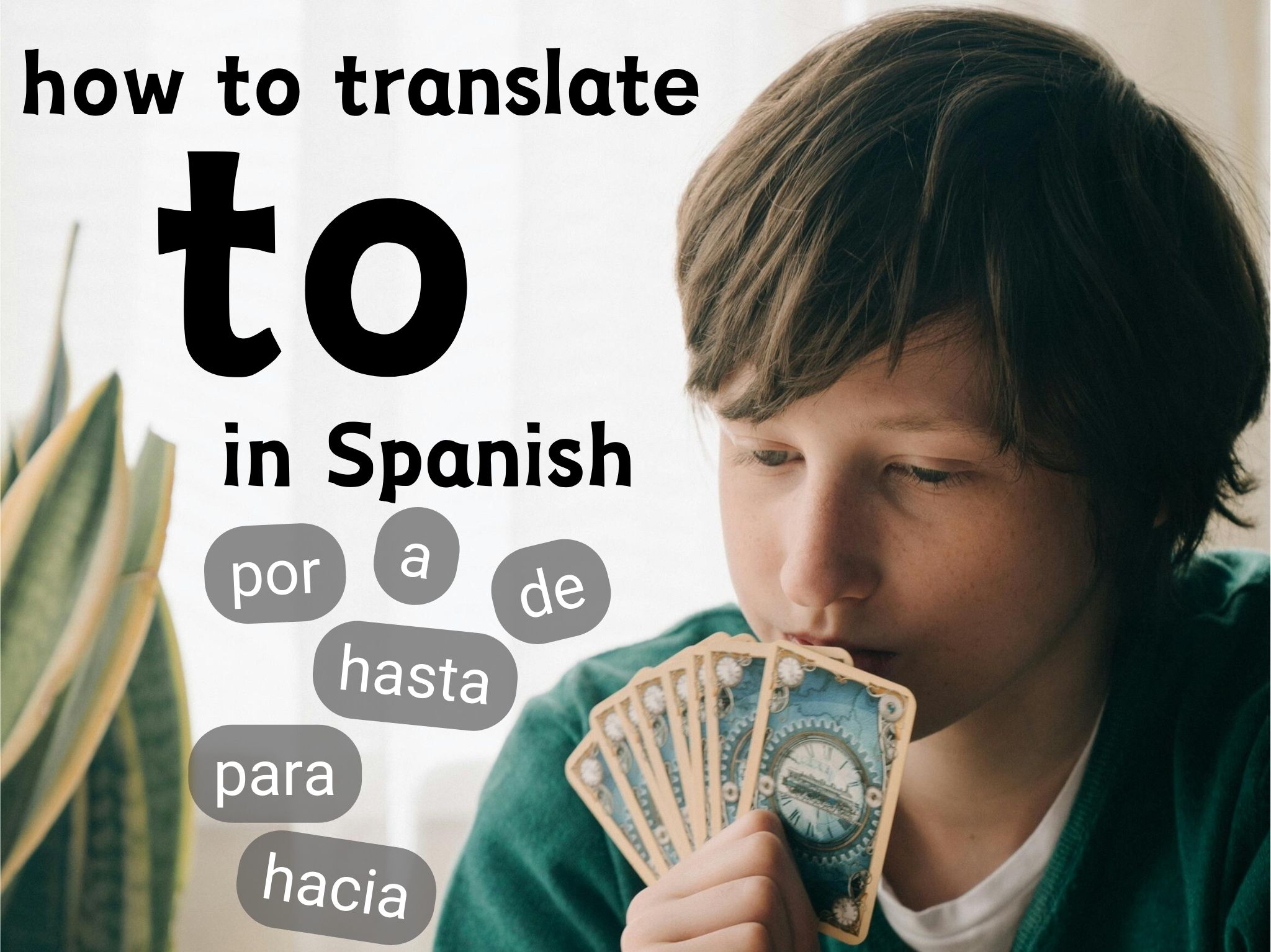
Por versus Para
Both prepositions translate as "for" or "by," but serve distinct logical functions:
- Por indicates cause, motivation, exchange, duration of time, means of transportation/communication, or passing through a place (Lo hice por ti / "I did it because of you"; Viajamos por tren / "We traveled by train").
- Para indicates destination, deadline, intended recipient, purpose/in order to, or comparison against a norm (Este regalo es para ti / "This gift is for you"; Estudio para aprender / "I study in order to learn").
Sentence Structure and Pronoun Placement
Standard word order in declarative Spanish sentences generally follows Subject-Verb-Object (SVO), similar to English. However, Spanish allows considerable flexibility to emphasize specific information. For instance, Juan escribió la carta, Escribió Juan la carta, and La carta la escribió Juan are all grammatically valid, with subtle shifts in topical focus.
Placement of Direct and Indirect Object Pronouns
Direct object pronouns (me, te, lo, la, nos, os, los, las) and indirect object pronouns (me, te, le, nos, os, les) follow precise structural rules:
- Preceding Conjugated Verbs (Proclisis): In standard tenses, object pronouns must sit directly before the conjugated verb. If both direct and indirect pronouns are present, the indirect pronoun always precedes the direct pronoun (ID rule).
- Te lo doy. (I give it to you.)
- Attached to Infinitive, Gerund, or Affirmative Command (Enclisis): Pronouns can be attached directly to the end of an infinitive, a present participle (-ando/-iendo), or an affirmative command, often requiring an added accent mark to preserve original stress.
- Quiero dártelo. (I want to give it to you.)
- Estoy escribiéndola. (I am writing it.)
- ¡Dáselo! (Give it to him/her!)
- The Le/Les to Se Transformation: When an indirect third-person pronoun (le or les) is immediately followed by a direct third-person pronoun (lo, la, los, las), the indirect pronoun changes to se to prevent repetitive l- sounds.
- Incorrect: Le lo dije.
- Correct: Se lo dije. (I told it to him/her.)
Core Spanish Grammar Quick-Reference Guide
The following comparative table synthesizes critical structural rules across core categories:
| Rule Category | Concept / Feature | Standard Form | Example Sentence | Common Error to Avoid |
|---|---|---|---|---|
| Gender Concordance | Greek-origin -ma nouns | Masculine singular (el) | El problema fue resuelto. | Avoid la problema. |
| Gender Concordance | Stressed initial a- | Masculine article, feminine adj. | El agua fría es refrescante. | Avoid la agua or el agua frío. |
| Verb Mood | Subjunctive for doubt | Subjunctive present verb | Dudo que ellos tengan razón. | Avoid using indicative tienen after doubt. |
| Past Tense | Completed action | Preterite indicative | Ayer hablé con el gerente. | Avoid using imperfect hablaba for single events. |
| Verb Choice | Condition vs. Identity | Estar for condition, Ser for trait | La comida está fría. | Avoid La comida es fría unless defining intrinsic nature. |
| Pronoun Order | Indirect before Direct | Indirect + Direct + Verb | Nos los enviaron ayer. | Avoid placing direct pronouns before indirect (Los nos enviaron). |
| Prepositions | Deadline / Target | Para for deadlines | La entrega es para el viernes. | Avoid using por el viernes for deadlines. |
Common Spanish Grammar Pitfalls and How to Avoid Them
Even advanced learners routinely encounter specific areas where English language habits interfere with proper Spanish structure.
1. Misusing Accent Marks (Tildes)
Written accent marks (tildes) in Spanish are not optional decorative marks; they dictate phonetic stress and differentiate homophones.
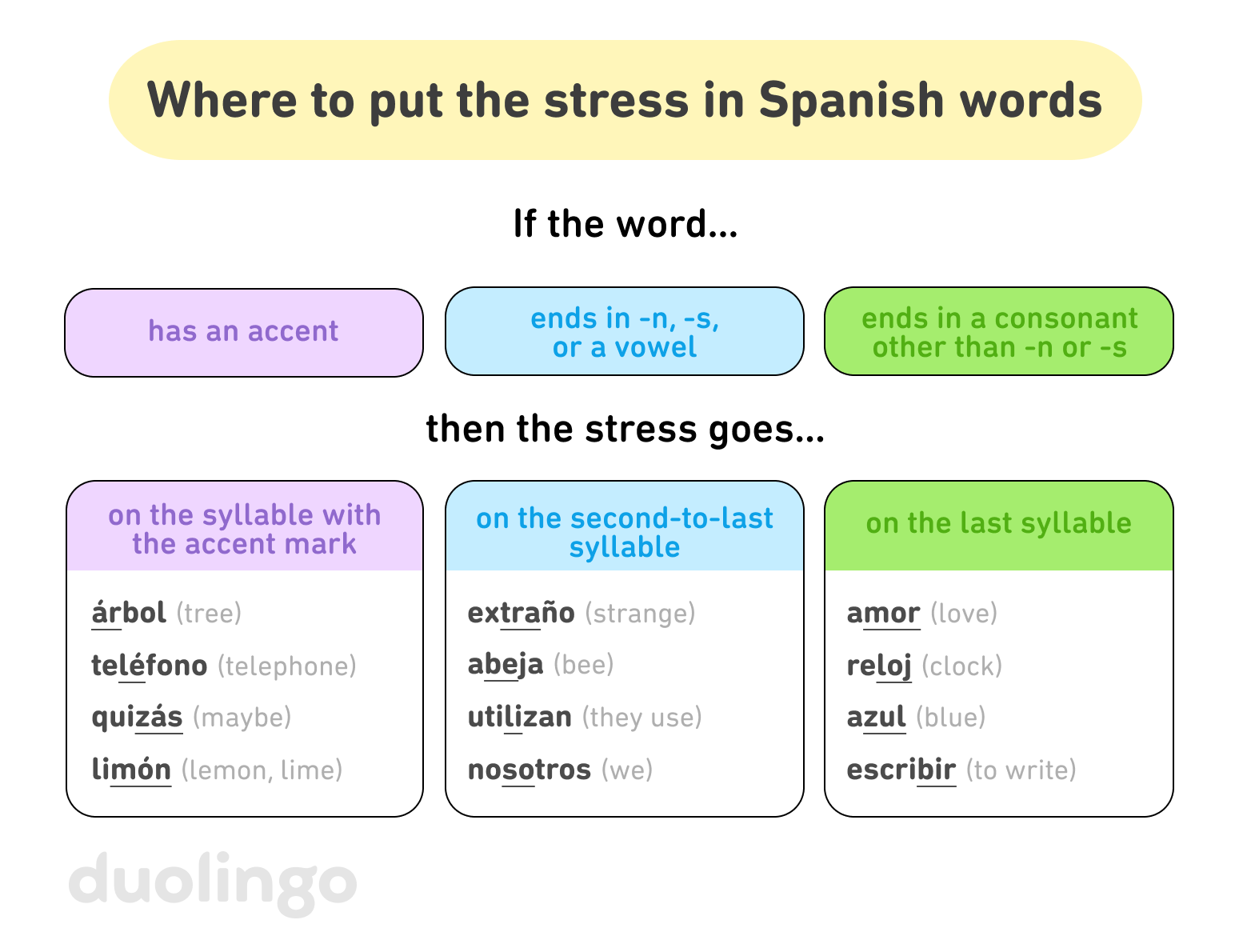
- Stress Rules: Words ending in a vowel, n, or s are naturally stressed on the second-to-last (penultimate) syllable (ca-sa, ex-a-men). Words ending in any other consonant are naturally stressed on the last syllable (ca-nort, ha-blar). Any deviation from these rules requires an explicit written accent mark (ár-bol, ex-á-me-nes).
- Diacritical Accents: Accents differentiate words spelled identically:
- tu (your - possessive) vs. tú (you - subject pronoun)
- el (the - article) vs. él (he - pronoun)
- si (if - conditional) vs. sí (yes / oneself)
- te (you - object pronoun) vs. té (tea - noun)
2. Literal Translation of Idiomatic Expressions
Many daily expressions use tener (to have) or hacer (to make/do) where English uses "to be":
- Age: Tengo 30 años (Literally: "I have 30 years," not Soy 30).
- Physical Sensations: Tengo hambre ("I am hungry"), Tengo frío ("I am cold").
- Weather: Hace frío ("It is cold"), Hace sol ("It is sunny").
3. Overusing Subject Pronouns
Because Spanish verb conjugations encode person and number within their endings, repeating yo, tú, or nosotros in every sentence sounds unnatural and repetitive. Subject pronouns should generally be reserved for emphasis, contrast, or clarifying ambiguity when a verb form could apply to multiple subjects (such as él/ella/usted in the imperfect tense).
Actionable Steps to Improve Your Spanish Grammar
- Analyze Real Native Inputs: Read high-level published material from reputable outlets such as El País or official literature. Pay specific attention to how relative clauses, prepositions, and subjunctive structures are deployed naturally.
- Practice Conjugation Patterns in Context: Instead of memorizing isolated tables, write complete sentences that require contrasting tenses (e.g., pairing the imperfect for background actions with the preterite for interrupting events).
- Perform Targeted Pronoun Drills: Practice replacing direct and indirect objects with pronouns across affirmative commands, negative commands, compound tenses, and infinitive constructions.
- Consult Official Language Resources: When uncertain about syntax or regional variation, reference authoritative databases provided by linguistic bodies such as the Diccionario panhispánico de dudas maintained by the Real Academia Española.
Frequently Asked Questions
What is the most effective way to remember noun genders in Spanish?
Learn each noun alongside its definite article (e.g., memorize el libro instead of just libro). Pay attention to specific suffix rules, such as identifying that nouns ending in -ción, -dad, and -tud are feminine, while Greek-origin nouns ending in -ma are masculine.
How do I know when to use the subjunctive mood instead of the indicative?
Use the indicative mood when stating objective facts, habits, or certainty. Switch to the subjunctive when the main clause expresses a desire, recommendation, emotional reaction, doubt, denial, or an unknown/hypothetical condition introduced by que.
Why do some words change meaning when used with ser vs. estar?
Because ser denotes essential characteristics and estar denotes states or conditions, some adjectives change meaning entirely depending on the verb used. For instance, ser aburrido means "to be boring," whereas estar aburrido means "to be bored." Similarly, ser listo means "to be smart," while estar listo means "to be ready."
What is the difference between el and él?
El (without an accent mark) is the masculine singular definite article meaning "the" (e.g., el perro / "the dog"). Él (with a written diacritical accent mark) is the third-person masculine subject pronoun meaning "he" or "him" (e.g., Él estudia español / "He studies Spanish").
Are accent marks mandatory in written Spanish?
Yes, accent marks (tildes) are mandatory in proper Spanish orthography. Omitting an accent mark can alter the tense or meaning of a word entirely. For example, hablo means "I speak" (present indicative), whereas habló means "he/she/you spoke" (preterite past tense).
Practical Recommendation
To build lasting grammatical precision, focus initial efforts on mastering high-frequency verbs in the present, preterite, and imperfect indicative tenses while drilling noun-adjective agreement. Once core sentence formation is reliable, systematically introduce object pronoun placement and the subjunctive mood. Consistently reading published, professionally edited Spanish literature and verifying complex points against official reference grammars remains the single most reliable path to full grammatical mastery.
Image Gallery