The State of Voice Technology in Japan: 2026 Industry Analysis and Implementation
As of 2026, voice technology in Japan has transitioned from a supplementary interface to a core infrastructure component, driven by the maturity of Japanese-optimized Large Language Models (LLMs). The industry currently prioritizes sol...
As of 2026, voice technology in Japan has transitioned from a supplementary interface to a core infrastructure component, driven by the maturity of Japanese-optimized Large Language Models (LLMs). The industry currently prioritizes solving the chronic labor shortage in healthcare and logistics while refining high-fidelity speech synthesis capable of navigating the complex socio-linguistic requirements of honorifics (Keigo) and regional dialects.
Contents
The Technological Foundation: Overcoming Japanese Linguistic Complexity
The implementation of voice technology in Japan faces unique hurdles compared to Western counterparts. The Japanese language relies heavily on context, pitch accent, and a complex writing system consisting of Kanji, Hiragana, and Katakana. By 2026, advancements in Automatic Speech Recognition (ASR) have largely solved the "homophone problem," where different Kanji characters share the same phonetic reading.
Natural Language Processing and Keigo Integration
The most significant technical breakthrough in the 2026 landscape is the seamless integration of Keigo (honorific speech) into conversational AI. Japanese business culture requires varying levels of politeness—Sonkeigo (respectful), Kenjougo (humble), and Teineigo (polite)—depending on the relative social standing of the speakers. Modern voicebots deployed in Japanese hospitality and banking now utilize transformer-based architectures that analyze the user's register and adjust the response's politeness level in real-time. This is not merely a vocabulary swap; it involves complex grammatical restructuring that older NLU (Natural Language Understanding) systems failed to execute naturally.
Speech Synthesis and Prosody
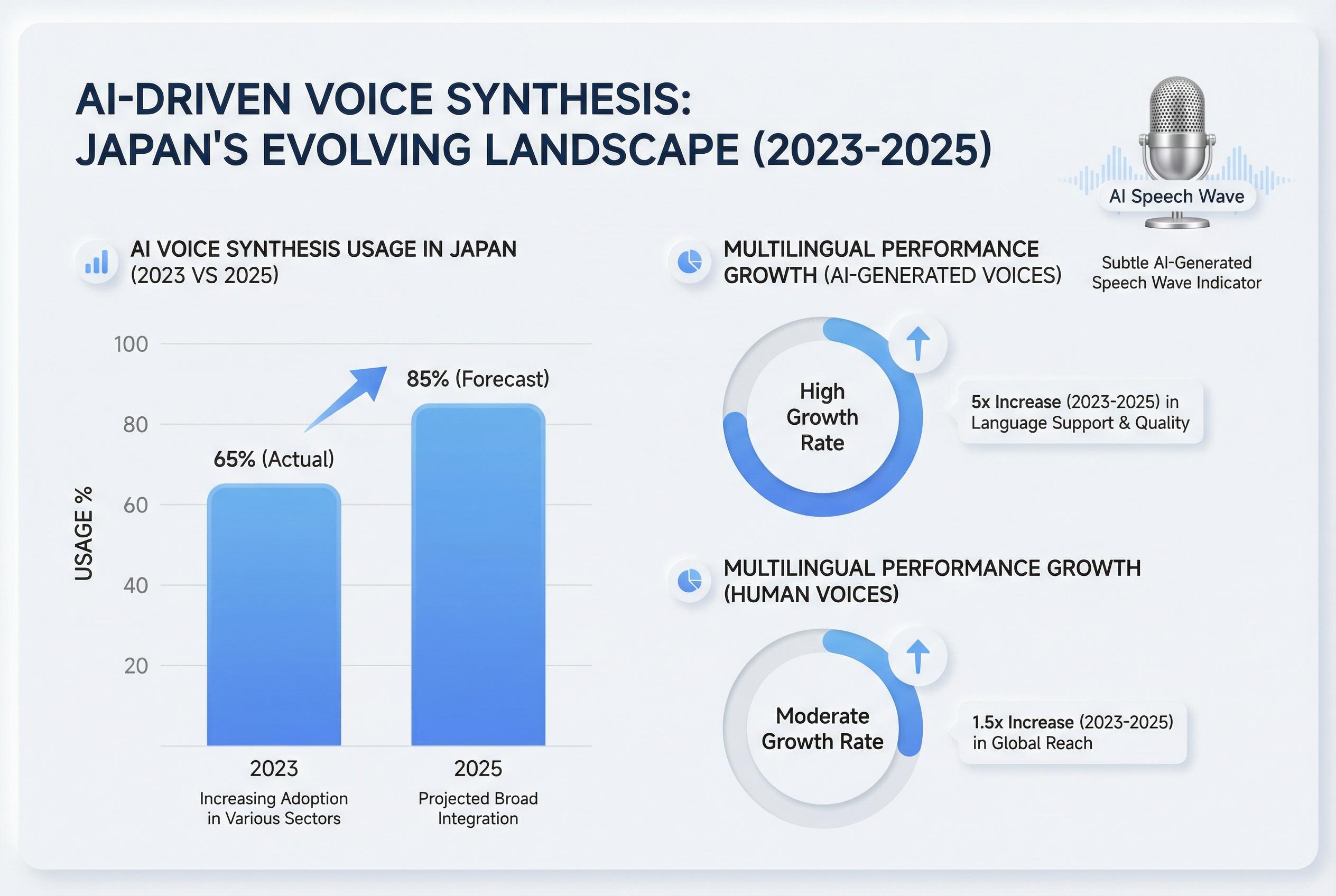
Text-to-Speech (TTS) technology in Japan has moved beyond "robotic" intonation to achieve human-like prosody. Companies like ReadSpeaker (owned by HOYA) and NTT have pioneered Deep Neural Network (DNN) models that accurately replicate Japanese pitch accents. In Japanese, the meaning of a word can change based on which syllable is accented (e.g., hashi meaning "bridge" vs. "chopsticks"). By 2026, these systems have reached a level of naturalness where they are indistinguishable from human voice actors in 95% of standard interactions, a development that has revolutionized the "Voice Economy," particularly in the VTuber and gaming sectors.
Key Market Drivers and Industry Applications
The rapid adoption of voice technology in Japan is not merely a matter of consumer preference but a strategic necessity fueled by demographic shifts and government initiatives like the Digital Garden City Nation project.
Healthcare and the "Super-Aged" Society
Japan’s demographic profile—characterized by a rapidly aging population—has made voice technology a critical tool in elderly care. Voice-activated monitoring systems are now standard in assisted living facilities. These systems go beyond simple commands; they utilize acoustic sensing to detect signs of distress, such as falls or irregular breathing patterns, and can engage in "mimamori" (watching over) conversations to combat social isolation.
Voice-enabled companion robots, such as the evolved iterations of AIBO or specialized care bots, use voice as their primary interface to assist seniors with medication reminders and cognitive stimulation exercises. These devices are increasingly integrated with the National Health Insurance data platforms to provide real-time health updates to family members and medical professionals.
Automotive and Smart Mobility
The Japanese automotive sector, led by giants like Toyota, Honda, and Nissan, has integrated sophisticated voice assistants into their 2026 vehicle lineups. These systems are designed for high-noise environments and can process commands locally (on the edge) to ensure functionality in tunnels or remote mountainous areas.
The focus has shifted from simple infotainment control to "driver-state monitoring." Using voice biometrics and sentiment analysis, the vehicle can detect signs of fatigue or irritation in the driver's voice, suggesting a rest stop or adjusting the cabin environment to improve safety. This integration is vital as Japan moves toward Level 4 autonomous driving in specific "green zones."
The "Voice-first" Retail and Hospitality Experience
In major urban centers like Tokyo and Osaka, "voice-first" kiosks have replaced traditional touchscreens in many high-traffic retail locations. This transition was accelerated by post-pandemic hygiene preferences and the need for multilingual support. A 2026 voice kiosk at a Japan Railways (JR) station can seamlessly switch between standard Japanese, various Japanese dialects, and five foreign languages, providing complex routing information that would be cumbersome to navigate on a physical map.
Leading Platforms and Local Innovation
While global players like Amazon (Alexa) and Google Assistant maintain a presence, the Japanese market is increasingly dominated by localized solutions that offer better data residency and linguistic nuance.
| Provider | Core Technology | Primary Use Case | Key Strength |
|---|---|---|---|
| NTT (corevo) | Multimodal AI | Telecommunications & Government | Deep integration with Japanese legacy infrastructure. |
| LINE (Clova) | Hyperclova LLM | Messaging & Smart Home | High social integration and consumer familiarity. |
| Sony (Audio Intelligence) | Edge ASR/TTS | Consumer Electronics & Automotive | Superior noise cancellation and high-fidelity audio. |
| Toshiba (RECAIUS) | Intent Recognition | Manufacturing & Industrial | Specialized vocabulary for technical and industrial fields. |
| SoftBank | Conversational AI | Customer Service & Logistics | Large-scale deployment in robotic concierge services (e.g., Pepper). |
Regulatory Landscape and Privacy Standards
In 2026, voice data is treated with the same level of scrutiny as biometric fingerprints under the Act on the Protection of Personal Information (APPI). The Japanese government has issued specific guidelines regarding "Voice ID" and the storage of acoustic patterns.
Companies operating in Japan must ensure that voice recordings are either processed on-device or encrypted with sovereign cloud solutions that prevent data from leaving Japanese jurisdiction. This regulatory environment has led to the rise of "Private Voice AI," where corporations host their own voice models to protect trade secrets and customer privacy, avoiding the data-harvesting pitfalls associated with global public clouds.
Challenges and Future Outlook
Despite the progress, two significant challenges remain for voice technology in Japan in 2026.
- Dialect Equity: While Tokyo-standard Japanese (Hyojungo) is flawlessly supported, regional dialects such as Kansai-ben, Tohoku-ben, and the distinct languages of Okinawa still experience lower accuracy rates. Efforts by the National Institute of Information and Communications Technology (NICT) are currently focused on gathering "low-resource" linguistic data to bridge this gap.
- Contextual "Kuuki wo Yomu": The Japanese cultural concept of "reading the air" (non-verbal context) remains difficult for AI. A voice assistant may understand the literal words spoken but fail to grasp the underlying hesitation or social nuance. Research in 2026 is pivoting toward "affective computing," which uses prosodic analysis to detect the emotional state behind the words.
The trajectory for the next few years suggests a move toward "Invisible UI," where voice technology becomes so integrated into the environment (ambient intelligence) that users no longer feel they are "interacting with a computer."
Frequently Asked Questions
How does Japanese voice recognition handle different levels of politeness?
Modern Japanese ASR systems use context-aware LLMs to identify the relationship between speakers. By 2026, these systems don't just transcribe words; they tag the "politeness level" (Keigo). If a user speaks in a casual register, the AI can respond in kind or maintain a professional distance based on its programmed persona, ensuring cultural appropriateness in business settings.
Is voice technology in Japan compatible with regional dialects like Kansai-ben?
Support for dialects has improved significantly by 2026. Major providers now offer "dialect packs" that allow for higher accuracy in regions like Osaka or Kyoto. However, very localized or "deep" dialects from rural areas still pose a challenge, often requiring the user to switch to more standardized Japanese for complex tasks.
What are the privacy protections for voice data in Japan?
Privacy is governed by the Personal Information Protection Commission (PPC). In 2026, explicit "opt-in" consent is required for the collection of voiceprints. Most Japanese voice applications now utilize "differential privacy" techniques, which allow the AI to learn from the data without ever storing the actual identifiable audio of the user on a central server.
Can Japanese voice assistants work without an internet connection?
Yes, "Edge AI" has become a standard feature for Japanese automotive and industrial voice tech by 2026. This allows for immediate response times and functionality in areas with poor connectivity, which is vital for safety features in cars and equipment operation in factories.
Are there specific voice technologies for the Japanese elderly population?
Yes, there is a dedicated sector called "Silver Tech." These products feature slower speech synthesis, higher frequency clarity (to account for age-related hearing loss), and specialized NLU that can interpret the slightly slower or repetitive speech patterns sometimes found in seniors with mild cognitive impairment.
Practical Recommendation
For businesses looking to implement voice technology in Japan, the priority must be localization over translation. Utilizing a global engine like Alexa for basic tasks is acceptable, but for customer-facing or high-stakes industrial applications, partnering with local providers like NTT or Sony is recommended. These entities offer the linguistic depth and regulatory compliance necessary to navigate the Japanese market effectively. Ensure your implementation accounts for the "pitch accent" requirements of the Japanese language to avoid user frustration and brand misalignment.
Image Gallery