How to Identify Motorcycle Bad Spark Plug Symptoms: A Complete Diagnostic Guide
Identifying bad spark plug symptoms in a motorcycle involves monitoring for engine misfires, difficulty starting, decreased fuel economy, and erratic idling. Physical signs include carbon deposits, oil fouling, or a worn electrode. A m...
Identifying bad spark plug symptoms in a motorcycle involves monitoring for engine misfires, difficulty starting, decreased fuel economy, and erratic idling. Physical signs include carbon deposits, oil fouling, or a worn electrode. A multimeter test can confirm internal failure by measuring resistance against the manufacturer’s specified range (typically 5k ohms).
Contents
The spark plug is the unsung hero of the internal combustion engine. In the context of 2026 motorcycle technology, while electronic fuel injection (EFI) and advanced engine management systems have become standard, the fundamental reliance on a high-voltage arc to ignite the air-fuel mixture remains unchanged. When a spark plug fails, it creates a "weak link" in the combustion cycle, leading to performance degradation that ranges from subtle power loss to a complete engine stall. Understanding how to identify these symptoms early can prevent more expensive damage to the ignition coils, catalytic converter, and piston crowns.
Understanding the Role of the Spark Plug in 2026
Before diving into symptoms, it is essential to understand what the spark plug does. Its primary job is to provide a gap for electricity to jump across, creating a spark that ignites the compressed gas in the cylinder. However, it also serves as a heat exchanger, pulling unwanted thermal energy away from the combustion chamber and transferring it to the engine's cooling system.
By 2026, many high-performance motorcycles utilize Iridium or Ruthenium-tipped plugs. These materials are chosen for their high melting points and excellent conductivity, allowing for a thinner center electrode. A thinner electrode requires less voltage to jump the gap, which is crucial for modern high-compression engines. Despite these advancements, no plug is invincible. Heat, vibration, and chemical byproducts of combustion eventually take their toll.
Operational Symptoms of a Failing Spark Plug
The first signs of a failing spark plug are usually felt rather than seen. Because the engine is a balanced system, even a slight irregularity in the spark will manifest as a physical sensation during the ride.
1. Difficulty Starting (Hard Cranking)
If your motorcycle struggles to come to life, especially during cold starts, the spark plugs are a primary suspect. A worn or fouled plug requires higher voltage to create a spark. When an engine is cold, the air-fuel mixture is denser and harder to ignite. If the plug cannot deliver a strong, consistent arc, the starter motor must turn the engine over for a longer duration, putting unnecessary strain on the battery. In some cases, the engine may "catch" but immediately die as the weak spark fails to sustain the initial idle.
2. Misfiring and Hesitation
A misfire occurs when the spark fails to ignite the air-fuel mixture in the cylinder. You will feel this as a sudden "jerk" or a momentary loss of power while riding. This often happens under load—such as when you open the throttle quickly to overtake another vehicle. Hesitation is the precursor to a misfire, where the engine feels like it is "stumbling" before it finds its rhythm. Repeated misfires allow unburned fuel to enter the exhaust system, which can lead to backfiring and damage to the oxygen sensors.
3. Rough Idling and Vibration
When a motorcycle is at a standstill, the engine should maintain a steady, rhythmic RPM. If you notice the needle on your tachometer bouncing or feel an unusual vibration through the handlebars and footpegs, the spark plugs may be "stuttering." A healthy plug provides a consistent cadence; a bad plug causes the engine to skip beats, forcing the idle air control valve to constantly adjust, which creates a "searching" or surging sound.
4. Reduced Fuel Economy
If you find yourself visiting the gas station more frequently than usual, your spark plugs might be inefficient. When a plug is fouled or the gap has widened due to erosion, combustion becomes incomplete. This means the engine is not extracting the maximum energy from the fuel it consumes. Modern ECU (Engine Control Unit) systems may attempt to compensate by adjusting fuel trim, but they cannot overcome a physically weak spark, leading to a noticeable drop in Miles Per Gallon (MPG).
Visual Diagnosis: Reading the Spark Plug
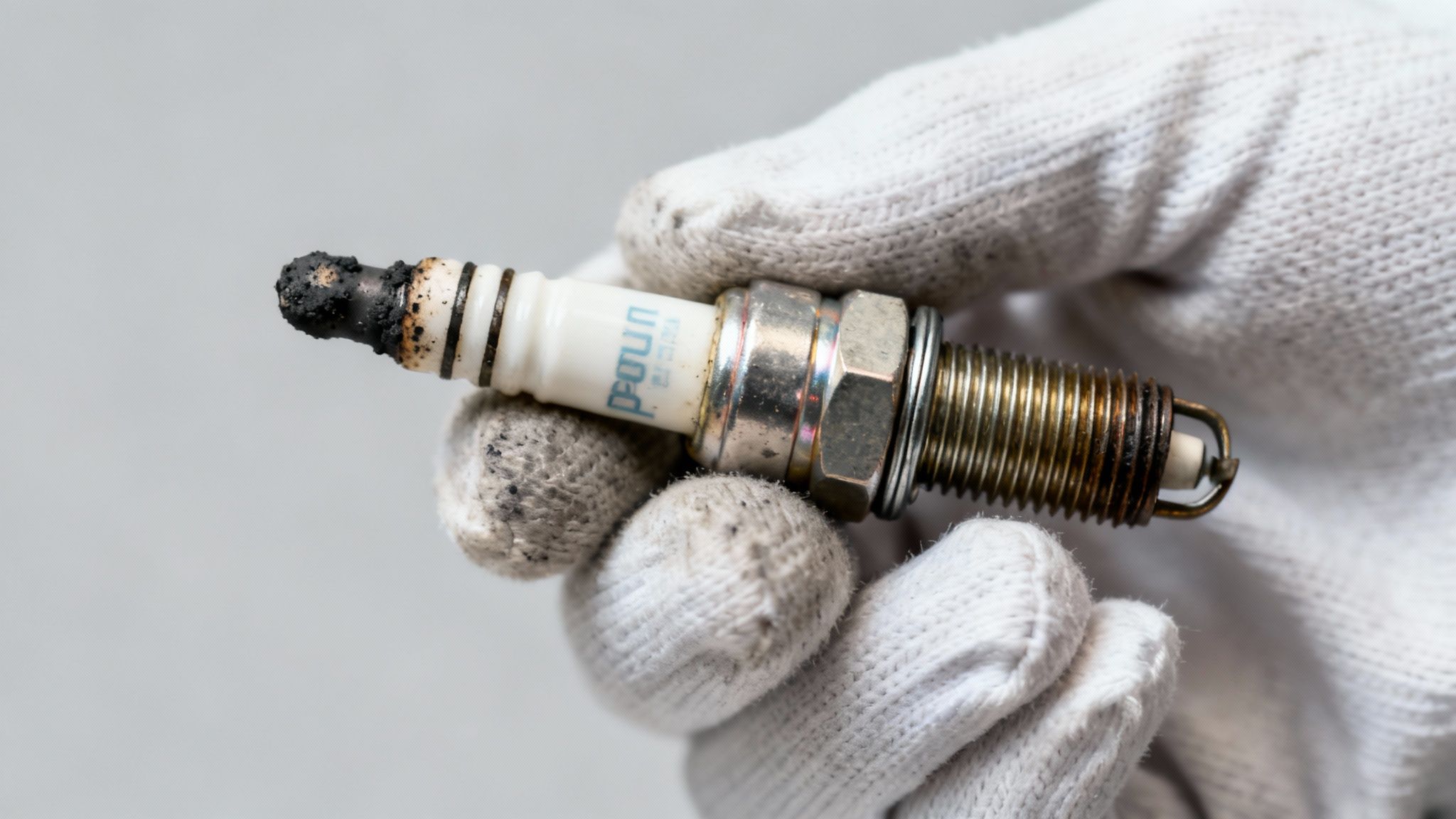
Removing the spark plug for a visual inspection—often called "reading the plug"—is the most definitive way to identify issues. The appearance of the insulator tip and the electrode provides a historical record of what has been happening inside the combustion chamber.
Carbon Fouling
Carbon fouling appears as a dry, black, sooty coating over the insulator and electrodes. This indicates an overly "rich" air-fuel mixture (too much fuel, not enough air). In older carbureted bikes, this was often due to a stuck choke; in 2026 EFI bikes, it may point to a dirty air filter, a faulty MAP (Manifold Absolute Pressure) sensor, or frequent short trips where the engine never reaches its optimal operating temperature.
Oil Fouling
Unlike carbon fouling, oil fouling is wet, shiny, and black. This is a more serious symptom. It suggests that engine oil is leaking into the combustion chamber. Common culprits include worn piston rings, degraded valve stem seals, or an overfilled oil crankcase. Oil is a significant insulator; once the plug is coated, the spark will likely be smothered entirely, leading to a dead cylinder.
Overheating and Blistering
If the ceramic insulator appears stark white, blistered, or has "pockmarks," the spark plug is running too hot. This can be caused by using a plug with the wrong heat range, an overly lean air-fuel mixture, or advanced ignition timing. Overheating is dangerous because it can lead to pre-ignition (knocking), which can melt a hole through the top of a piston in a matter of seconds.
Mechanical Damage and Gap Erosion
Physical damage, such as a cracked ceramic insulator or a bent ground electrode, usually stems from improper installation or "detonation" within the cylinder. Furthermore, check the gap. As spark plugs age, the spark literally wears away the metal of the electrodes, making the gap wider. If the gap exceeds the manufacturer’s specification (usually found in the owner's manual), the ignition coil may not be able to bridge the distance.
Comparison of Spark Plug Conditions
The following table summarizes common visual cues and their likely causes to help you differentiate between various failure modes.
| Visual Indicator | Condition Name | Likely Cause | Operational Impact |
|---|---|---|---|
| Light Tan or Gray | Normal | Healthy combustion | Optimal performance |
| Dry, Black Soot | Carbon Fouled | Rich fuel mixture; dirty air filter | Hard starting; misfiring |
| Wet, Shiny Black | Oil Fouled | Worn rings or valve seals | Complete misfire; blue smoke |
| White, Blistered | Overheating | Lean mixture; wrong heat range | Engine knocking; power loss |
| Melted Electrode | Pre-ignition | Severe overheating | Catastrophic engine failure |
| Wide/Rounded Gap | Worn Out | Natural age and mileage | High-speed hesitation |
Technical Testing with a Multimeter
If a visual inspection is inconclusive, you can use a digital multimeter to test the internal integrity of the spark plug, specifically if it is a resistor-type plug (common on almost all motorcycles produced in the last 20 years).
- Set the Multimeter: Turn the dial to the Ohms (Ω) setting, specifically the 20k range.
- Contact Points: Place one probe on the top terminal (where the plug wire connects) and the other probe on the center electrode (the tiny metal tip inside the ceramic).
- Analyze the Reading: Most modern plugs have an internal resistor designed to suppress RFI (Radio Frequency Interference). A typical reading should be between 3,000 and 7,500 ohms (3k–7.5k Ω).
- Identifying Failure: If the multimeter reads "1" or "OL" (Open Loop), the internal resistor has failed, and the plug will not fire reliably under pressure. If the reading is 0, the plug is shorted.
Preventive Maintenance and Best Practices
To avoid the symptoms of a bad spark plug, adherence to a strict maintenance schedule is paramount. By 2026, many manufacturers recommend spark plug inspections every 7,500 miles, with total replacement of Iridium plugs occurring between 15,000 and 30,000 miles, depending on the engine's rev range.
When replacing plugs, always use a torque wrench. Over-tightening can crack the ceramic or strip the threads in the aluminum cylinder head, while under-tightening prevents the plug from dissipating heat correctly, leading to overheating. Additionally, ensure the "heat range" of the replacement plug matches the OEM (Original Equipment Manufacturer) specifications exactly. A "hotter" or "colder" plug than required can cause fouling or engine damage respectively.
Common Mistakes in Diagnosis
A common error is replacing the spark plugs only to have the symptoms return a week later. This happens because the bad spark plug was a symptom of a deeper issue, not the root cause. For instance, if a plug is carbon-fouled, simply putting in a new one won't fix a clogged air intake. Always investigate why the plug failed.
Another mistake is neglecting the spark plug caps and wires. Over time, the rubber boots can crack, allowing the high-voltage current to "leak" to the engine block before it ever reaches the plug. If your plugs look healthy but you still experience misfires, inspect the ignition leads in a dark garage while the engine is running; you may see blue "arcs" indicating a leak.
FAQ
Can a bad spark plug cause a motorcycle to backfire?
Yes. If a spark plug fails to ignite the fuel in the cylinder, that unburned fuel is pushed into the hot exhaust manifold during the exhaust stroke. Once it touches the hot metal or meets residual flames from other cylinders, it ignites spontaneously, causing a loud "bang" or backfire.
Should I always replace all spark plugs at once?
Generally, yes. If one plug has reached the end of its life, the others are likely in a similar state of wear. Replacing them as a set ensures balanced combustion across all cylinders, which is vital for engine longevity and smooth power delivery.
Will bad spark plugs trigger a Check Engine Light (CEL)?
On most motorcycles built after 2015, including all 2026 models, the ECU monitors the crankshaft speed. If it detects a sudden deceleration consistent with a misfire, it will log a fault code (such as P0300) and illuminate the Check Engine Light or a warning icon on the TFT display.
Can I clean a fouled spark plug and reuse it?
While you can clean carbon fouling with a wire brush or specialized spray, it is often a temporary fix. The cleaning process can leave microscopic scratches on the insulator that encourage future fouling. Given the relatively low cost of spark plugs compared to other engine components, replacement is the safer and more effective option.
Does the gap size really matter on modern plugs?
Absolutely. Even a deviation of 0.1mm can affect the efficiency of the spark. While many modern Iridium plugs come "pre-gapped," they can be bumped during shipping. Always check the gap with a feeler gauge or wire gap tool before installation, being careful not to apply pressure to the delicate center electrode.
Final Recommendation
If you identify any of the symptoms mentioned above, start with the easiest and cheapest solution: a physical inspection. For most riders, replacing spark plugs every two years or according to the mileage interval in the owner's manual is the best insurance against performance issues. If a new set of plugs does not resolve the symptoms, proceed to check the ignition coils, fuel delivery system, and air filtration. For 2026 models with complex electronics, using an OBD-II scanner compatible with your motorcycle can help pinpoint exactly which cylinder is misfiring, saving significant diagnostic time.
Image Gallery